


















UNISSULA SUSTAINABILITY REPORTING
SDG 8 – Decent Work and Economic Growth
Progress Report 2025
2025 Report Overview
In 2025, Universitas Islam Sultan Agung (UNISSULA) documented its progress towards SDG 8 – Decent Work and Economic Growth through fair remuneration, employee welfare, labour rights protection, workplace equality, and responsible employment practices. The university maintained a minimum remuneration equivalent of at least IDR 21,000 per hour, exceeding the 2025 Semarang City minimum-wage benchmark, while strengthening institutional policies on non-discrimination, freedom of association, collective bargaining, protection against forced labour, and equivalent rights for outsourced workers. This report presents UNISSULA’s institutional commitments, documented employment measures, and continuing priorities for promoting decent work, equitable remuneration, and sustainable economic well-being during the 2025 reporting period.
Full SDG 8 Progress Report 2025
8.2.1
Employment Practice Living Wage
8.2.1 Living Wage for All Staff and Faculty at UNISSULA
Fair Pay and Decent Remuneration
Universitas Islam Sultan Agung (UNISSULA) is committed to ensuring fair and decent remuneration for all staff and faculty. The university applies a formal salary and allowance system governed by the employment regulations of Yayasan Badan Wakaf Sultan Agung (YBW-SA) and by the applicable government wage regulations in Semarang City.
In 2025, UNISSULA maintained employee remuneration above the applicable local government wage benchmark. The university applies a minimum remuneration equivalent of at least IDR 21,000 per hour, which is above the equivalent hourly value of the official 2025 minimum wage for Semarang City.
This minimum remuneration is complemented by a broader package of fixed allowances, welfare benefits, and academic incentives for lecturers and other employees.
Government-Defined Local Wage Benchmark
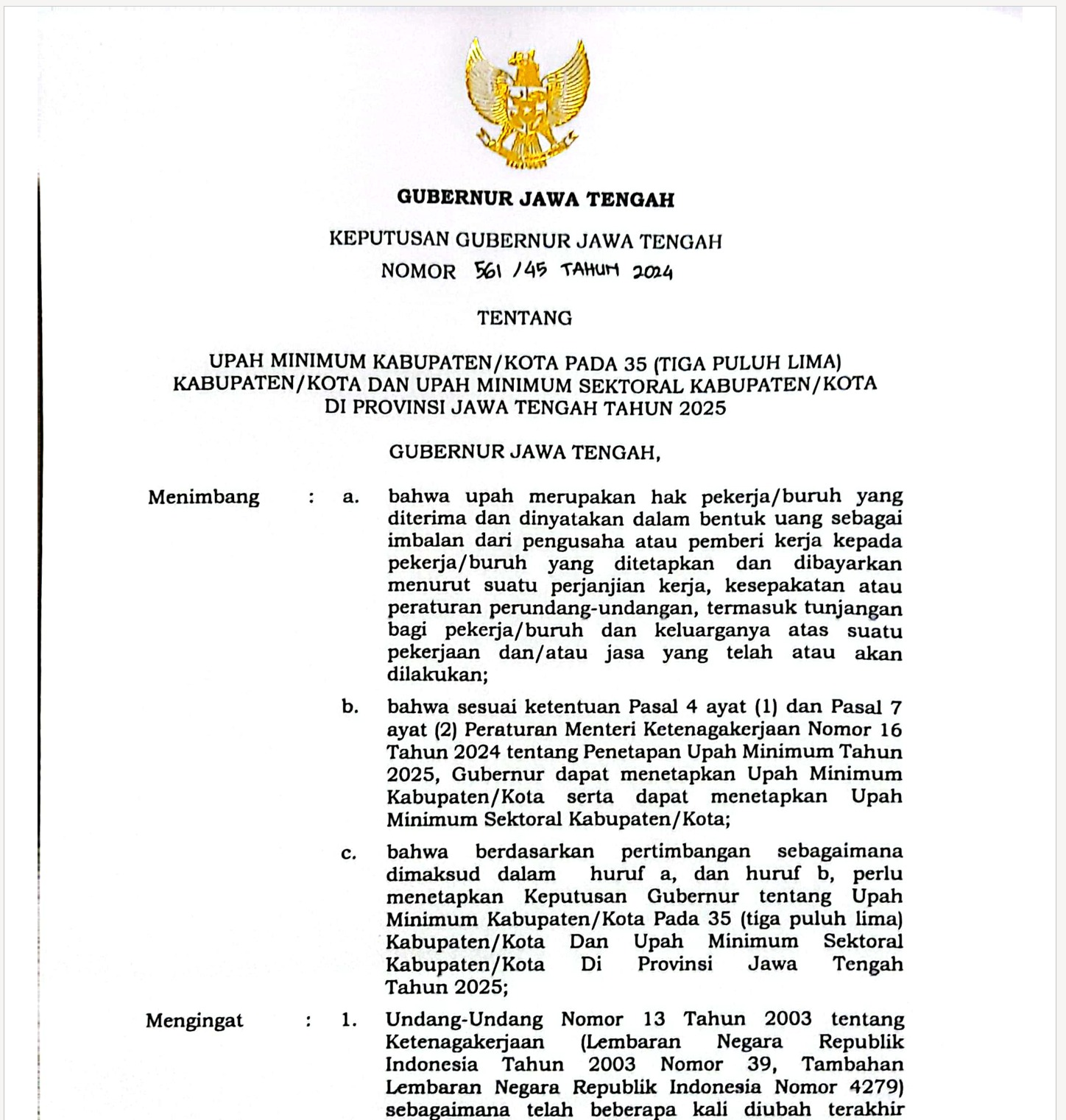
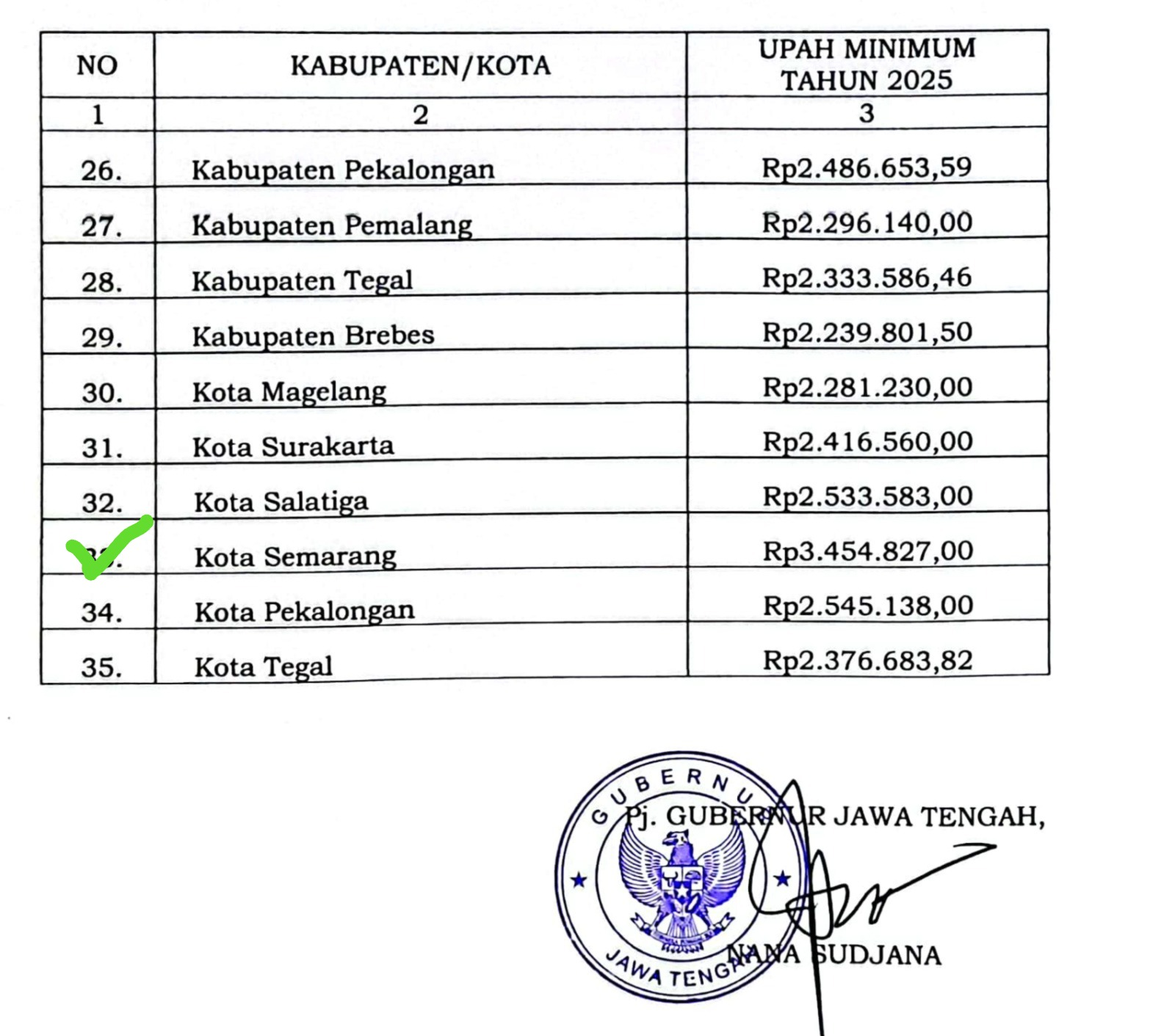
The Government of Central Java established the official minimum wage for Semarang City for 2025 through the Governor of Central Java Decree No. 561/45 of 2024 on District/City Minimum Wages and Sectoral Minimum Wages in Central Java Province for 2025.
Under this regulation, the 2025 minimum wage for Semarang City is IDR 3,454,827 per month.
The regulation also states that employers are prohibited from paying wages below the applicable minimum wage and that the 2025 wage provisions became effective on 1 January 2025.
This government-defined wage serves as the local benchmark for UNISSULA because the university is located in Semarang City.
Equivalent Hourly Wage
UNISSULA’s employment framework defines normal working time as up to 40 hours per week.
Using the official Semarang City minimum wage:
IDR 3,454,827 × 12 months ÷ 52 weeks ÷ 40 hours
results in an equivalent local wage benchmark of approximately:
IDR 19,932 per hour
For institutional reporting purposes, UNISSULA applies a conservative minimum remuneration equivalent of:
IDR 21,000 per hour
This is above the calculated local benchmark.
The comparison can be summarized as follows:
| Wage Measure | 2025 Value |
|---|---|
| Semarang City minimum wage | IDR 3,454,827/month |
| Equivalent local hourly benchmark | ≈ IDR 19,932/hour |
| UNISSULA minimum remuneration equivalent | ≥ IDR 21,000/hour |
| Equivalent weekly remuneration | IDR 840,000/week |
| Equivalent annual remuneration | IDR 43,680,000/year |
| Equivalent monthly value | IDR 3,640,000/month |
UNISSULA’s minimum remuneration equivalent is therefore above the applicable local government wage benchmark.
Formal Employment Regulation
UNISSULA’s remuneration system is governed by the 2025 YBW-SA Employment Regulations.
In July 2025, UNISSULA formally distributed YBW-SA Decree No. 188/SK/YBW-SA/VI/2025 concerning the Compilation of YBW-SA Employment Regulations to university leaders, faculties, bureaus, units, institutions, and other organisational units for implementation.
These regulations establish the institutional framework for salaries, allowances, employment conditions, working hours, employee welfare, and other employment rights.
Protection Against Payment Below the Minimum Wage
The 2025 employment regulations contain an explicit protection against remuneration falling below the applicable minimum wage.
For employees serving a probationary period, the regulations state that a prospective employee may receive 80% of the applicable basic salary together with relevant allowances, but with the explicit condition that remuneration must:
not fall below the applicable minimum wage.
This provision is particularly important because it ensures that even employees at an early stage of employment remain protected by the minimum wage floor.
It demonstrates that the institutional remuneration framework does not permit payment below the applicable government benchmark.
Basic Salary and Fixed Allowances
UNISSULA’s remuneration system is not limited to basic salary alone.
Under the 2025 employment regulations, employee remuneration consists of basic salary and allowances, with salary payments made regularly at the end of each month.
The remuneration structure includes fixed and welfare-related components such as:
- Basic salary;
- Spouse allowance;
- Child allowance;
- Position allowance;
- Functional allowance;
- Health and employment social-security benefits; and
- Other employee welfare allowances.
Additional YBW-SA regulations further clarify that wage-related calculations include basic salary and fixed allowances provided to employees and their families.
For UNISSULA personnel, documented fixed allowance categories include food-related, spouse, child, and functional allowances.
Additional Employee Welfare Allowances
In addition to basic salary, UNISSULA provides further allowances and welfare components that strengthen the overall remuneration received by employees.
These include:
- Transportation allowance;
- Spouse allowance;
- Child allowance;
- Rice allowance;
- Meal allowance;
- Lecturer functional allowance; and
- Other employee welfare benefits.
These forms of remuneration complement the basic salary structure and support the economic welfare of both academic and non-academic employees.
The YBW-SA remuneration framework distinguishes between fixed allowances and other forms of employee welfare support, demonstrating that employee compensation is structured as a broader package rather than as basic salary alone.
Academic Incentives for Lecturers
UNISSULA also provides additional academic incentives for lecturers in recognition of their teaching, research, community engagement, and academic responsibilities.
These include incentives for:
- Research activities;
- Community service activities;
- Examining students;
- Supervising students; and
- Other academic responsibilities.
These academic incentives are additional to the university’s basic remuneration framework and are intended to recognise the wider professional responsibilities carried out by academic staff.
This approach is comparable in structure to the remuneration model used by other Indonesian universities, where basic salary is supplemented by performance-based and academic incentives for lecturers and staff. The UGM example similarly distinguishes between basic living wage provisions and additional performance or academic incentives for lecturers and staff.
Transportation and Daily Welfare Support
UNISSULA also provides transportation and food-related support as part of the broader employee welfare system.
Transportation allowances help support the daily mobility costs associated with work, while rice and meal allowances contribute to employees’ day-to-day welfare.
These benefits are provided in addition to the basic remuneration framework and further strengthen the overall compensation received by employees.
Family-Related Allowances
The university’s remuneration framework also recognises family responsibilities.
Employees may receive:
- Spouse allowance;
- Child allowance; and
- Other family-related benefits.
The YBW-SA employment regulations explicitly recognise spouse and child allowances as part of the remuneration structure.
This helps support employees not only as individuals but also in relation to their household responsibilities.
Regular Monthly Salary Payment
UNISSULA maintains a regular salary-payment mechanism.
The 2025 employment regulations specify that salaries are paid at the end of each month and that employee remuneration comprises basic salary and allowances.
Regular salary payment provides predictability and financial stability for employees.
Remuneration Structure at UNISSULA
The overall remuneration framework can be represented as:
- Basic Salary
- Fixed Allowances
- Family Allowances
- Transportation Support
- Rice and Meal Allowances
- Functional Allowances
- Research Incentives
- Community Service Incentives
- Examination Incentives
- Supervision Incentives
This demonstrates that the wage received by staff and faculty is not limited to basic salary, but consists of a broader package of remuneration and welfare support.
Living-Wage Comparison for 2025
The 2025 position can be summarized as follows:
| Indicator | UNISSULA 2025 |
|---|---|
| Government-defined local wage benchmark | IDR 3,454,827/month |
| Equivalent hourly benchmark | ≈ IDR 19,932/hour |
| UNISSULA minimum remuneration equivalent | ≥ IDR 21,000/hour |
| Equivalent UNISSULA monthly value | ≥ IDR 3,640,000/month |
| Normal working time | 40 hours/week |
| Payment below applicable minimum wage permitted | No |
| Fixed allowances provided | Yes |
| Family allowances provided | Yes |
| Academic incentives for lecturers | Yes |
| Regular monthly salary payment | Yes |
| Applies to staff and faculty | Yes |
Employee Welfare Beyond the Minimum Wage
The important feature of UNISSULA’s remuneration system is that the minimum wage serves as a minimum floor rather than the entire remuneration package.
Employees receive basic remuneration that is maintained above the applicable local wage benchmark, while additional fixed allowances, family allowances, transportation support, food-related allowances, and academic incentives further increase their total compensation.
For lecturers, additional academic remuneration may arise from research, community service, examination, and supervision activities.
This provides a more comprehensive approach to employee welfare than compliance with a minimum wage alone.
Supporting Decent Work and Economic Growth
Through its remuneration and employment framework, UNISSULA contributes to SDG 8: Decent Work and Economic Growth.
The university supports decent employment through:
- Remuneration above the applicable local wage benchmark;
- Formal employment regulations;
- Explicit minimum-wage protection;
- Regular monthly salary payment;
- Family-related allowances;
- Transportation and food-related support;
- Social-security-related benefits;
- Functional allowances for academic staff; and
- Academic incentives for research, community service, examination, and supervision activities.
These measures strengthen economic security and employee welfare across the university.
8.2.2
Employment Practice Unions
8.2.2 Recognition of Unions for All Staff at UNISSULA
Recognition of Employee Union Rights
Universitas Islam Sultan Agung (UNISSULA) recognizes the right of all employees to form, join, and participate in lawful trade unions or employee organizations.
This recognition applies to all categories of employees, including academic and non-academic staff, permanent and non-permanent employees, women employees, and international staff.
The university’s recognition of union rights is established through formal employment regulations and reinforced through a university circular issued in 2025.
Formal Recognition in the 2025 Employment Regulations
The 2025 YBW-SA Employment Regulations formally recognize the role of employee unions in employment relations.
The regulations define a collective labour agreement as an agreement resulting from negotiations between one or more registered trade unions or employee unions and YBW-SA, containing the terms of employment as well as the rights and obligations of both parties.
This provision demonstrates that trade unions or employee unions are formally recognized within the institutional employment framework governing UNISSULA.
The regulation therefore acknowledges that employee unions can participate in formal negotiations concerning employment conditions, rights, and responsibilities.
University-Wide Recognition of Union Rights
This recognition was further strengthened in 2025 through UNISSULA Circular No. 8394/J/SA/IX/2025, dated 4 September 2025.
The circular explicitly states that:
UNISSULA recognizes the right of all employees to form, join, and participate in lawful trade unions or employee organizations in accordance with applicable laws and regulations.
This recognition applies to all employees, including:
- Lecturers;
- Educational and administrative staff;
- Permanent employees;
- Non-permanent employees;
- Women employees; and
- International staff.
The circular therefore makes clear that union recognition is not limited to one employment category or one demographic group.
Equal Recognition for Women Employees
UNISSULA explicitly includes women employees within its recognition of union rights.
The 2025 circular states that the right to organize applies to women employees together with other staff categories.
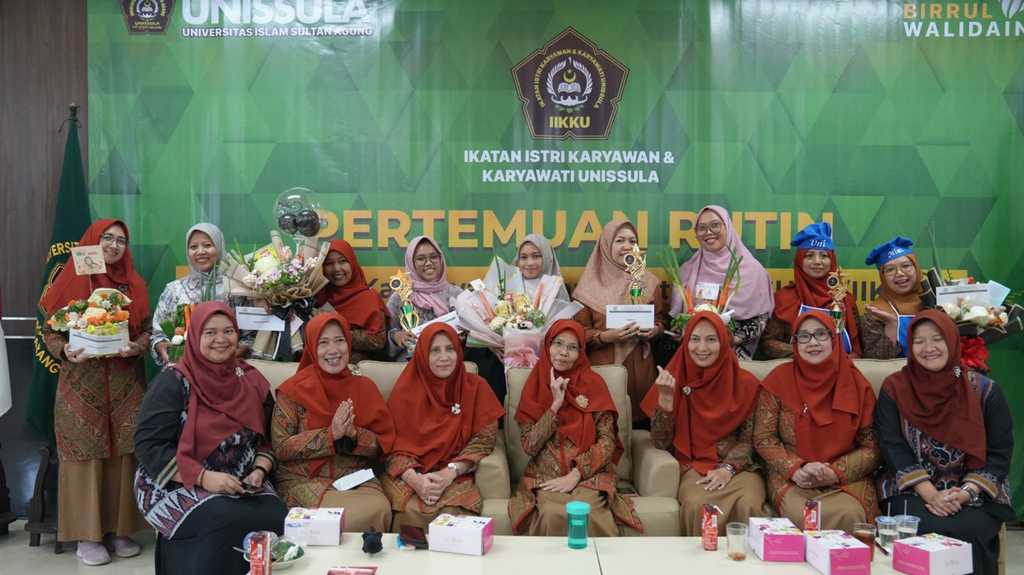
The university also has active employee-related organizations involving women. One visible example is IIKKU (Ikatan Istri Karyawan & Karyawati UNISSULA), which holds regular activities involving women within the university community.
The existence of IIKKU provides additional evidence that women are actively represented in employee-related organizational life at UNISSULA.
However, IIKKU is used here as supporting evidence of women’s organizational participation, while the primary evidence for union recognition remains the formal 2025 employment regulations and university circular.
Recognition for International Staff
UNISSULA’s 2025 circular also explicitly extends union recognition to international staff.
The document states that recognition of the right to organize applies to international staff together with lecturers, educational staff, permanent employees, non-permanent employees, and women employees.
This explicit inclusion is important because the university’s recognition is therefore not restricted by nationality.
International staff working at UNISSULA are included within the same institutional framework of lawful employee organization and participation.
Protection from Discrimination and Intimidation
The 2025 circular not only recognizes union participation but also protects employees from adverse treatment arising from union membership or participation.
UNISSULA states that participation or membership in a trade union or employee organization must not become a basis for:
- Discrimination;
- Intimidation;
- Restriction of rights; or
- Other disadvantageous treatment in employment relations.
This strengthens the practical meaning of union recognition because employees are not merely allowed to organize; they are also protected from negative treatment because of lawful participation.
Institutional Responsibility to Respect Union Rights
The circular further requires university leadership across faculties, bureaus, institutions, units, and work units to respect and implement these provisions.
This makes the recognition institution-wide rather than limited to one office or unit.
The circular is formally addressed to:
- Faculty leaders;
- The Director of RSIGM;
- Bureau heads;
- Institution heads;
- UPT heads;
- Unit heads; and
- Heads of administration within UNISSULA.
Formal Status of the 2025 Circular
The circular was issued on 4 September 2025 and signed on behalf of the Rector by the Vice Rector II of UNISSULA.
This provides formal institutional evidence that the recognition of union rights was in place by 2025.
Supporting Employment Framework
The broader 2025 YBW-SA employment framework also recognizes multiple employee categories and formal employment relationships.
The 2025 employment regulations were formally circulated by UNISSULA to university leaders, faculties, bureaus, units, institutions, and other organizational bodies for implementation.
This strengthens the institutional basis of the union-recognition provisions because they are embedded within the wider employment governance framework applicable to UNISSULA employees.
Coverage of Employees
The recognition framework covers the main staff categories at UNISSULA:
| Employee Category | Recognition of Union Rights |
|---|---|
| Lecturers | Yes |
| Educational / administrative staff | Yes |
| Permanent employees | Yes |
| Non-permanent employees | Yes |
| Women employees | Yes |
| International staff | Yes |
The university therefore recognizes union rights across different employment statuses and demographic groups.
Institutional Approach
UNISSULA’s recognition of employee unions can be summarized as follows:
Formal employment regulation
→ recognizes trade unions / employee unions as parties in collective labour agreements
University circular
→ explicitly recognizes the right of all employees to form, join, and participate in lawful unions
Inclusive coverage
→ includes women and international staff
Protection
→ prohibits discrimination, intimidation, restriction of rights, or disadvantage because of union participation
Institution-wide implementation
→ applies across faculties, bureaus, institutions, units, and work units
Contribution to Decent Work and Employment Rights
Through these policies, UNISSULA supports decent work and fair employment relations by recognizing employee representation and collective participation.
The university’s approach supports:
- Freedom of lawful employee organization;
- Collective representation;
- Inclusive participation;
- Equal treatment;
- Protection from retaliation; and
- Constructive employment relations.
These provisions strengthen employee voice and provide a formal basis for workers to participate collectively in matters relating to employment conditions and rights.
8.2.3
Employment Policy On Discrimination
8.2.3 Policy on Ending Discrimination in the Workplace at UNISSULA
Commitment to a Fair and Inclusive Workplace
Universitas Islam Sultan Agung (UNISSULA) is committed to maintaining a fair, safe, inclusive, and dignified workplace for all employees.
In 2025, UNISSULA formalized this commitment through Circular No. 8395/J/SA/IX/2025, dated 4 September 2025, which establishes a university-wide policy prohibiting discrimination in the workplace.
The policy applies across employment practices and is intended to ensure that employees are treated fairly and without discrimination.
Prohibition of Workplace Discrimination
The 2025 circular explicitly prohibits all forms of discrimination in the workplace based on:
- Race;
- Skin color;
- Sex;
- Gender;
- Age;
- Religion or belief;
- National origin;
- Refugee status;
- Disability;
- Marital status; and
- Other personal characteristics protected under applicable laws and regulations.
This establishes a clear institutional policy against discriminatory treatment in employment.
Coverage of All Employees
The policy applies to all employees at UNISSULA, including:
- Lecturers;
- Educational and administrative staff;
- Permanent employees;
- Non-permanent employees;
- Women employees; and
- International staff.
The policy therefore covers both academic and non-academic employees and is not limited by employment status or nationality.
Scope Across Employment Practices
The anti-discrimination policy applies throughout key areas of employment, including:
- Recruitment;
- Placement;
- Career development;
- Employee rights and remuneration;
- Performance assessment;
- Promotion; and
- Other employment relationships.
This means that the policy is intended to apply throughout the employee lifecycle, from recruitment and appointment to career progression and remuneration.
Protection from Harassment and Retaliation
UNISSULA also prohibits conduct that may result in unfair or harmful treatment of employees.
The circular states that the university does not permit:
- Harassment;
- Intimidation;
- Restriction of rights;
- Retaliation; or
- Other disadvantageous treatment
arising from the protected characteristics covered by the policy.
This extends the policy beyond direct discrimination and provides protection against other forms of adverse workplace treatment.
Reporting and Handling of Discrimination
The circular further states that reports concerning discrimination are handled in accordance with the applicable university rules and mechanisms.
This provides an institutional route for concerns related to discriminatory treatment to be addressed.
Institutional Responsibility
Implementation of the policy is not limited to one university office.
The circular requires all leaders and work units within UNISSULA to implement and maintain the policy.
The document is addressed to university leadership across faculties, RSIGM, bureaus, institutions, UPTs, units, and administrative offices.
This establishes institution-wide responsibility for maintaining a non-discriminatory workplace.
Supporting Mechanism for the Prevention of Sexual Violence
UNISSULA also maintains a formal mechanism for the prevention and handling of sexual violence.
Through Rector Decree No. 13243/E.1/SA/XI/2023, UNISSULA established the Task Force for the Prevention and Handling of Sexual Violence.
The decree formally appoints the task force and assigns it responsibility for implementing duties related to the prevention, monitoring, and handling of sexual violence within the university.
This task force serves as supporting institutional evidence for UNISSULA’s broader commitment to a safe and respectful working and learning environment.
Formal Policy Period
The university-wide anti-discrimination circular was issued on 4 September 2025.
The supporting sexual-violence prevention mechanism was formally established in 2023.
Both documents therefore reflect policies and institutional mechanisms that were created or active within the recent review period.
Workplace Equality Framework
UNISSULA’s approach can be summarized as follows:
Anti-discrimination policy
→ prohibits discrimination based on religion or belief, race, color, sex, gender, age, national origin, refugee status, disability, marital status, and other legally protected characteristics.
Inclusive employee coverage
→ applies to lecturers, educational staff, permanent and non-permanent employees, women employees, and international staff.
Employment-wide scope
→ covers recruitment, placement, career development, remuneration, performance evaluation, promotion, and other employment relations.
Protection from adverse treatment
→ prohibits harassment, intimidation, restriction of rights, retaliation, and disadvantageous treatment.
Institutional implementation
→ applies across university leadership and all work units.
Supporting protection mechanism
→ includes a formal task force for the prevention and handling of sexual violence.
Contribution to Decent Work
Through these measures, UNISSULA supports decent work by promoting:
- Equal treatment in employment;
- Fair access to recruitment and career opportunities;
- Non-discriminatory remuneration and promotion;
- Protection from harassment and retaliation;
- Inclusion of women and international staff; and
- Institutional mechanisms for handling workplace concerns.
These measures contribute to a safer and more equitable employment environment across the university.
8.2.4
Employment Policy Modern Slavery
8.2.4 Policy Commitment Against Forced Labour, Modern Slavery, Human Trafficking, and Child Labour at UNISSULA
Commitment to Ethical and Lawful Employment
Universitas Islam Sultan Agung (UNISSULA) is committed to maintaining employment practices that are humane, fair, safe, and consistent with applicable laws and regulations.
In 2025, UNISSULA formalized this commitment through Circular No. 8396/J/SA/IX/2025, dated 4 September 2025. The circular establishes a university-wide policy prohibiting forced labour, modern slavery, human trafficking, and child labour in university employment and operational activities.
Prohibition of Forced Labour, Modern Slavery, Human Trafficking, and Child Labour
UNISSULA explicitly prohibits all forms of:
- Forced labour;
- Modern slavery;
- Human trafficking; and
- Child labour.
The prohibition applies throughout university employment and operational activities.
This policy establishes a clear institutional commitment that exploitative labour practices are not permitted within UNISSULA.
Employment Based on Free and Lawful Consent
UNISSULA requires all employment relationships to be based on lawful and voluntary consent.
The 2025 circular states that employment relationships must be free from:
- Coercion;
- Threats;
- Exploitation;
- Retention of personal documents; and
- Other practices that restrict workers’ freedom.
This provision reinforces the university’s commitment to ensuring that work is undertaken voluntarily and that employees retain their personal freedom throughout the employment relationship.
Prevention of Forced Labour
The policy directly addresses the risk of forced labour by requiring employment to be based on valid consent and by prohibiting coercive practices.
Workers must not be compelled to work through threats, exploitation, restrictions on personal freedom, or retention of personal documents.
This supports a working environment in which employment is based on agreement rather than compulsion.
Commitment Against Modern Slavery
UNISSULA explicitly identifies modern slavery as a prohibited practice.
By prohibiting modern slavery together with coercion, exploitation, document retention, and other restrictions on worker freedom, the university establishes a clear institutional position against exploitative employment practices.
Commitment Against Human Trafficking
The university also explicitly prohibits human trafficking within its employment and operational activities.
This prohibition forms part of UNISSULA’s broader commitment to protecting human dignity and ensuring that labour relationships are lawful, voluntary, and free from exploitation.
Prevention of Child Labour
UNISSULA explicitly commits not to employ children below the minimum working age established by applicable laws and regulations.
The policy therefore establishes a direct institutional safeguard against child labour.
Rather than setting a separate institutional age threshold, UNISSULA requires compliance with the legally applicable minimum working age.
Application to Third Parties
The 2025 policy extends beyond direct employment by UNISSULA.
The circular requires both:
- University work units; and
- Third parties working for or on behalf of the university
to comply with the same requirements.
This provision strengthens the policy because the prohibition is not limited only to employees directly appointed by UNISSULA.
Institution-Wide Responsibility
The circular requires all leaders and work units within UNISSULA to implement and maintain the policy.
The document is formally addressed to leaders across faculties, RSIGM, bureaus, institutions, UPTs, units, and administrative offices.
This gives the policy university-wide institutional coverage.
Supporting Employment Regulations
The university’s policy is reinforced by the broader 2025 YBW-SA Employment Regulations.
Those regulations formally define UNISSULA as a higher education unit under YBW-SA and establish employee categories covering educational, administrative, medical, and health-related staff.
They also establish formal employment relationships through permanent and fixed-term employment agreements.
Formal Employment Agreements
Under the 2025 YBW-SA Employment Regulations, prospective employees who pass the recruitment process are required to sign an employment agreement and an integrity pact before being accepted as employees.
The regulations also govern fixed-term employment arrangements and provide compensation rights in accordance with applicable legislation.
These provisions support transparent and documented employment relationships.
Protection Against Abusive Employment Practices
The YBW-SA Employment Regulations also provide safeguards where employees experience abusive or unlawful treatment.
The regulations recognize circumstances in which employees may seek termination of employment where the employer:
- Abuses, insults, or threatens an employee;
- Persuades or orders an employee to commit an unlawful act;
- Orders work outside what was agreed in the employment arrangement; or
- Assigns dangerous work that was not included in the employment agreement.
These provisions support the principle that employment must remain lawful, agreed, and free from abusive practices.
Employee Rights
The 2025 employment regulations provide employees with formal rights, including:
- Salary;
- Allowances;
- Overtime pay;
- Meal facilities;
- Uniforms according to employment status;
- Promotion;
- Leave;
- Social security; and
- Other rights provided under applicable laws and regulations.
This broader employment framework supports fair and lawful working conditions.
Compliance with Employment Law
The YBW-SA Employment Regulations refer to Indonesian employment legislation, including national employment law, the Job Creation framework, and regulations concerning fixed-term employment, outsourcing, working time, rest periods, and termination of employment.
The 2025 employment regulation itself came into effect in June 2025.
This provides an additional legal and institutional foundation for UNISSULA’s employment practices.
Institutional Framework
UNISSULA’s approach can be summarized as follows:
Formal prohibition
→ forced labour, modern slavery, human trafficking, and child labour are prohibited.
Voluntary employment
→ employment must be based on lawful consent and be free from coercion, threats, exploitation, retention of personal documents, or restrictions on worker freedom.
Child protection
→ children below the legally established minimum working age are not employed.
Third-party responsibility
→ university units and third parties working for or on behalf of UNISSULA must comply with the same policy.
Formal employment arrangements
→ employees are appointed through documented employment agreements.
Employee protection
→ employment regulations protect workers from abusive and unlawful employment practices.
Institution-wide implementation
→ all university leaders and work units are responsible for applying the policy.
Contribution to Decent Work
Through these measures, UNISSULA promotes decent and ethical employment by supporting:
- Voluntary employment relationships;
- Freedom from coercion;
- Freedom from exploitation;
- Prohibition of forced labour;
- Prohibition of modern slavery;
- Prohibition of human trafficking;
- Prevention of child labour;
- Formal employment agreements;
- Protection of employee rights; and
- Responsible employment practices involving third parties.
8.2.5
Employment Practice Equivalent Rights Outsourcing
8.2.5 Policy on Guaranteeing Equivalent Rights for Outsourced Workers at UNISSULA
Commitment to Fair Treatment of Outsourced Workers
Universitas Islam Sultan Agung (UNISSULA) is committed to ensuring that workers engaged through outsourcing arrangements or third parties receive fair treatment and equivalent employment rights in accordance with applicable laws and regulations.
In 2025, UNISSULA formalized this commitment through Circular No. 8397/J/SA/IX/2025, dated 4 September 2025, which establishes institutional requirements for the protection of workers employed through outsourcing companies or other third parties.
Guarantee of Equivalent Employment Rights
The 2025 circular explicitly states that workers who perform work through outsourcing companies or third parties must receive equivalent employment rights in accordance with applicable laws and regulations.
This provision establishes a clear institutional commitment that outsourced workers must not be excluded from fundamental employment protections simply because their employment relationship is managed through a third-party provider.
Rights Covered by the Policy
The policy specifies that the rights protected for outsourced workers include:
- Wages;
- Working time;
- Rest periods;
- Occupational safety and health;
- Social security;
- Fair treatment;
- Non-discrimination;
- Protection from forced labour; and
- Protection from improper employment practices.
By listing these areas directly, UNISSULA provides a substantive framework for protecting outsourced workers across major dimensions of employment.
Fair Wages and Working Conditions
The policy requires outsourced workers to receive protection in relation to wages, working hours, and rest periods.
This helps ensure that outsourced work is carried out within lawful and fair employment conditions rather than under inferior or unregulated arrangements.
Occupational Safety and Health
UNISSULA also requires outsourced workers to receive protection concerning occupational safety and health.
This extends the university’s responsibility for decent working conditions beyond direct employees and into outsourced activities conducted on behalf of the institution.
Social Security Protection
The policy explicitly includes social security as part of the rights that must be protected for outsourced workers.
This supports the principle that outsourced workers should not lose access to basic employment protections simply because they are employed through a third-party company.
Fair and Non-Discriminatory Treatment
The circular requires outsourced workers to receive fair and non-discriminatory treatment.
This reinforces UNISSULA’s broader commitment to fair employment practices and helps ensure that outsourced workers are treated with dignity and without unjustified disadvantage.
Protection from Forced Labour and Improper Employment Practices
The policy also protects outsourced workers from forced labour and other improper employment practices.
This provision aligns with UNISSULA’s broader employment framework, which prohibits exploitative labour practices and requires employment relationships to be lawful and fair.
Responsibility of Outsourcing Companies and Third Parties
The circular places direct responsibility on every outsourcing company or third party working for or on behalf of UNISSULA.
These external parties are required to:
- Comply with applicable employment regulations; and
- Guarantee the fulfilment of their workers’ rights.
This is important because the policy does not treat outsourcing as a way to transfer responsibility entirely away from the university.
Instead, UNISSULA requires its external partners to maintain employment standards consistent with applicable labour protections.
Institution-Wide Oversight
The policy also assigns responsibility to university leadership.
All leaders and work units within UNISSULA are required to ensure implementation of the policy in every outsourcing activity.
The circular is formally addressed to leaders across faculties, RSIGM, bureaus, institutions, UPTs, units, and administrative offices.
This makes the commitment institution-wide rather than limited to a single administrative unit.
Supporting Employment Regulation
The policy is supported by the broader 2025 YBW-SA Employment Regulations, which formally recognize outsourcing arrangements.
Those regulations define an outsourcing company as a legally incorporated business entity that performs certain work based on an agreement with the employing foundation.
The same regulations also provide that YBW-SA may cooperate with outsourcing companies in accordance with applicable laws and regulations.
This provides the institutional and legal context within which UNISSULA’s specific equivalent-rights policy operates.
Relationship Between the Circular and Employment Regulations
The two policy layers work together:
2025 YBW-SA Employment Regulations
→ formally recognize outsourcing as an employment arrangement governed by law.
UNISSULA Circular No. 8397/J/SA/IX/2025
→ specifically guarantees equivalent employment rights for workers engaged through outsourcing companies or third parties.
This combination provides both the structural basis for outsourcing and the specific protections expected for outsourced workers.
Application Across Outsourced Activities
The circular applies to every outsourcing activity carried out for or on behalf of the university.
The framework can therefore be summarized as:
Outsourcing arrangement
→ must comply with applicable employment law.
Third-party worker
→ must receive equivalent employment rights.
Rights protected
→ wages, working hours, rest, safety, health, social security, fair treatment, non-discrimination, and protection from forced labour.
Third-party obligation
→ must guarantee worker rights.
University responsibility
→ leadership and work units must ensure implementation.
Contribution to Decent Work
Through this policy, UNISSULA supports decent work by extending employment protections beyond directly employed staff to workers whose activities are outsourced to third parties.
The policy contributes to:
- Fair labour standards;
- Responsible outsourcing;
- Protection of worker rights;
- Occupational safety and health;
- Social protection;
- Non-discrimination;
- Prevention of forced labour; and
- Institutional accountability for outsourced activities.
8.2.6
Employment Policy Pay Scale Equity
8.2.6 Pay Scale Equity and Elimination of Gender Pay Gaps at UNISSULA
Commitment to Pay Scale Equity
Universitas Islam Sultan Agung (UNISSULA) is committed to maintaining a fair remuneration system and ensuring equitable pay treatment for male and female employees.
In 2025, this commitment was formalized through UNISSULA Circular No. 8398/J/SA/IX/2025, which establishes the university’s principles for pay scale equity, regular monitoring of salary structures, and corrective action to reduce and eliminate unjustified gender pay gaps.
The policy applies across UNISSULA and forms part of the university’s commitment to fair employment and equitable remuneration.
Equal Pay Scale for Male and Female Employees
UNISSULA applies the principle of equitable pay scales for male and female employees.
Under the 2025 policy, remuneration is determined using objective employment-related factors, including:
- Position;
- Employment grade;
- Length of service;
- Competence;
- Level of responsibility; and
- Performance.
These criteria provide a structured basis for remuneration and ensure that pay determination is linked to employment-related factors rather than gender.
Objective Basis for Salary Determination
UNISSULA recognizes that differences in employee remuneration may legitimately arise from differences in position, grade, length of service, competence, responsibility, or performance.
Accordingly, the university distinguishes between pay differences that can be explained by objective employment factors and pay differences that cannot be objectively justified.
This framework enables UNISSULA to assess pay equity between male and female employees while taking appropriate employment-related variables into account.
Regular Evaluation and Monitoring
UNISSULA’s commitment extends beyond establishing an equal-pay principle.
The university conducts periodic evaluation and monitoring of salary scales and remuneration structures to identify possible pay gaps between male and female employees.
This monitoring provides an institutional mechanism for identifying whether gender-related differences exist within the university’s remuneration structure.
The approach can be summarized as:
Salary structure review
→ Comparison of male and female remuneration
→ Identification of possible gaps
→ Assessment against objective employment factors
→ Corrective action where necessary
Measurement of Gender Pay Gaps
Through the periodic evaluation process, UNISSULA reviews its pay scale and salary structure to identify potential differences between the remuneration of male and female employees.
The review considers whether identified differences can be explained by objective factors such as:
- Position;
- Grade;
- Length of service;
- Competence;
- Responsibility; or
- Performance.
This enables the university to distinguish legitimate variations in remuneration from potentially unjustified gender-based pay differences.
Corrective Action
UNISSULA’s policy includes an explicit commitment to corrective action.
Where a pay gap is identified that cannot be justified by position, grade, length of service, competence, responsibility, or performance, the university undertakes adjustments and corrective measures.
This makes the university’s approach both preventive and corrective.
Commitment to Reducing and Eliminating Gender Pay Gaps
The policy specifically commits UNISSULA to reducing and eliminating unjustified pay gaps between male and female employees.
If a difference in remuneration is not supported by legitimate employment-related factors, the university is required to take corrective action to address the disparity.
The institutional process therefore consists of:
Equal pay principle
→ male and female employees are subject to the same objective remuneration criteria.
Periodic monitoring
→ salary scales and remuneration structures are reviewed.
Identification of differences
→ potential gender pay gaps are identified.
Assessment
→ differences are evaluated against objective employment factors.
Correction
→ unjustified gaps are addressed through adjustment and corrective measures.
Elimination
→ the university seeks to reduce and eliminate unjustified gender pay gaps.
Institution-Wide Responsibility
The responsibility for maintaining pay equity is shared across the university.
The 2025 circular requires all leaders and work units within UNISSULA to uphold the implementation of the principle of equitable remuneration.
The policy was formally circulated to leaders of faculties, RSIGM, bureaus, institutions, UPTs, units, and administrative offices within the university.
This gives the policy institution-wide coverage rather than limiting responsibility to a single administrative office.
Policy Implementation in 2025
Circular No. 8398/J/SA/IX/2025 was formally issued on 4 September 2025 and signed on behalf of the Rector by the Vice Rector II of UNISSULA.
The policy therefore provides a formal institutional basis for pay scale equity and gender pay-gap monitoring within the university in 2025.
UNISSULA Pay Equity Framework
UNISSULA’s remuneration equity framework is based on four main principles:
| Area | UNISSULA Approach |
|---|---|
| Equal pay scale | Male and female employees are covered by the same objective salary criteria |
| Objective criteria | Position, grade, service period, competence, responsibility, and performance |
| Measurement | Periodic evaluation and monitoring of salary scales and structures |
| Corrective action | Adjustments are made where unjustified gender pay gaps are identified |
| Long-term objective | Reduction and elimination of unjustified gender pay gaps |
Supporting Fair Employment
The policy supports fair employment practices by promoting:
- Equitable pay scales;
- Objective remuneration criteria;
- Equal treatment of male and female employees;
- Periodic monitoring of pay structures;
- Identification of possible gender pay gaps;
- Evidence-based review of salary differences;
- Corrective adjustments; and
- Institution-wide responsibility for pay equity.
Through these measures, UNISSULA aims to maintain a remuneration system in which differences in pay are based on legitimate employment-related factors rather than gender.
Contribution to Decent Work
Pay equity is an important component of decent employment.
By establishing equal salary principles, monitoring remuneration structures, and committing to corrective action, UNISSULA supports a working environment in which employees are treated fairly and remunerated according to objective professional criteria.
The university’s approach also strengthens institutional accountability by requiring pay equity to be maintained across all work units.
8.2.7
Tracking Pay Scale For Gender Equity
8.2.7 Tracking Pay Scale for Gender Equity at UNISSULA
Monitoring Pay Scale Gender Equity
Universitas Islam Sultan Agung (UNISSULA) maintains a structured approach to monitoring pay scale equity between male and female employees.
The university applies remuneration based on objective employment-related criteria and periodically evaluates its salary scales and pay structures to identify possible differences in remuneration between male and female employees.
This approach supports UNISSULA’s commitment to fair remuneration and gender equity in employment.
Periodic Monitoring of Salary Scales
UNISSULA formalized its pay-equity monitoring mechanism through Circular No. 8398/J/SA/IX/2025, issued on 4 September 2025.
The circular states that the university conducts periodic evaluation and monitoring of salary scales and remuneration structures to identify possible pay gaps between male and female employees.
This establishes an institutional mechanism for tracking gender equity within the university’s remuneration system.
Objective Criteria Used in Pay-Scale Monitoring
UNISSULA applies the principle of equitable pay scales for male and female employees based on objective employment factors, including:
- Position;
- Grade;
- Length of service;
- Competence;
- Responsibility; and
- Performance.
These criteria provide the basis for comparing remuneration between employees.
The university’s approach is therefore not simply to compare salary amounts between men and women, but to assess differences while considering legitimate employment-related factors.
Gender Pay Equity Tracking Process
UNISSULA’s monitoring process can be represented as follows:
Employee remuneration data
→ classification by position, grade and length of service
→ comparison of male and female remuneration
→ identification of possible differences
→ assessment against objective employment factors
→ corrective action where an unexplained gap is identified
This process enables the university to distinguish between legitimate salary differences arising from employment characteristics and differences that may indicate an unjustified gender pay gap.
Identification of Possible Gender Pay Gaps
The university specifically monitors its salary scale and remuneration structure to identify possible differences between male and female employees.
Where a difference is identified, it is reviewed against objective factors such as:
- Position;
- Grade;
- Length of service;
- Competence;
- Responsibility; and
- Employee performance.
This provides an institutional basis for assessing gender equity within the salary structure.
Corrective Action
Monitoring is linked to corrective action.
The 2025 policy states that where a salary difference cannot be explained by position, grade, length of service, competence, responsibility, or performance, UNISSULA undertakes adjustment and corrective measures to reduce and eliminate the identified gap.
Tracking therefore functions not only as an administrative exercise, but also as a mechanism for maintaining equitable remuneration.
Structured Salary Administration
The monitoring process is supported by UNISSULA’s existing salary framework, which applies structured salary administration and the principle of equality between male and female employees.
UNISSULA’s salary regulation states that employee salaries are provided according to the principle of equality between male and female employees and provides structured arrangements for salary payment, periodic salary increases, promotion, and salary scales.
This provides an additional institutional foundation for gender pay-scale monitoring.
Alignment with Indonesian Wage Regulation
UNISSULA’s approach also operates within Indonesia’s broader employment and wage-regulation framework.
For the 2025 wage period, the Government of Indonesia issued Minister of Manpower Regulation No. 16 of 2024 on the Determination of Minimum Wages for 2025. The regulation establishes the national framework for determining provincial and district/city minimum wages for 2025.
The broader national wage framework also emphasizes the use of structured and objective wage scales. Under Government Regulation No. 49 of 2025, employers are required to prepare and apply wage structures and scales by considering factors including grade, position, length of service, education, and competence.
These principles are consistent with UNISSULA’s use of objective factors in its remuneration and monitoring framework.
Government Salary-Scale Reference
Indonesia’s public-sector salary framework also demonstrates the use of objective salary structures.
Under BKN Regulation No. 1 of 2024, basic salaries for civil servants are adjusted according to grade and length of service.
For example, the regulation provides salary tables based on grade and years of service rather than employee gender.
While this regulation specifically governs civil servants and is not the direct salary regulation for all UNISSULA employees, it provides a relevant national reference for objective, grade-based salary administration.
Institution-Wide Responsibility
UNISSULA’s pay-equity policy applies across the institution.
All university leaders and work units are required to maintain the implementation of the university’s pay-equity principles.
This ensures that gender pay-scale monitoring is incorporated into the broader university employment framework rather than being limited to a single unit.
UNISSULA Gender Pay Equity Monitoring Framework
| Monitoring Area | Approach |
|---|---|
| Salary scale | Structured according to objective employment criteria |
| Gender comparison | Male and female remuneration reviewed |
| Position | Considered |
| Grade | Considered |
| Length of service | Considered |
| Competence | Considered |
| Responsibility | Considered |
| Performance | Considered |
| Periodic evaluation | Conducted |
| Potential pay gaps | Identified through monitoring |
| Unexplained gaps | Subject to corrective action |
Contribution to Fair Employment
Through its salary-scale monitoring framework, UNISSULA supports:
- Equal remuneration principles;
- Objective salary determination;
- Periodic evaluation of salary structures;
- Monitoring of male and female remuneration;
- Identification of potential gender pay differences;
- Review of differences against objective employment criteria; and
- Corrective action where unjustified differences are identified.
This approach contributes to fair and transparent employment practices across the university.
8.2.8
Employment Practice Appeal Process
8.2.8 Employee Appeal Process on Rights and Pay at UNISSULA
Formal Process for Employee Appeals
Universitas Islam Sultan Agung (UNISSULA) provides a formal process through which employees can raise and pursue disputes concerning employment rights, pay, and other employment obligations.
This process is established within the 2025 YBW-SA Employment Regulations, which recognize industrial-relations disputes and provide mechanisms for employees to submit claims or applications when their employment rights are not fulfilled.
Recognition of Employment Rights Disputes
The 2025 YBW-SA Employment Regulations define an industrial-relations dispute as a difference of opinion between YBW-SA and an employee arising from disputes over:
- Employee rights;
- Interests; and
- Termination of employment.
This definition establishes a formal basis for employees to challenge or appeal matters affecting their employment rights.
Appeals Concerning Pay
The regulations specifically recognize situations in which employees may raise a claim where salary or other employment obligations are not fulfilled.
An employee may submit an application where YBW-SA:
- Fails to pay wages at the agreed time for three consecutive months or more;
- Fails to fulfil obligations promised to the employee;
- Orders the employee to perform work outside what was agreed; or
- Assigns work that endangers life, safety, health, or morality where such work was not included in the employment agreement.
The explicit reference to unpaid or delayed wages means that the process covers pay-related disputes, not only other employment rights.
Employee Right to Submit an Application
The employment regulations recognize the employee’s right to submit a formal application when the employer is alleged to have committed one of the specified actions.
This provides a clear process through which employees can challenge employment conditions or the failure to fulfil employment obligations.
The process therefore includes issues concerning:
- Wages;
- Contractual employment rights;
- Employer obligations;
- Work assignments;
- Occupational safety; and
- Other employment-related protections.
Industrial Relations Dispute Resolution
The regulations also recognize the role of an industrial relations dispute settlement institution.
Where an employee submits an application concerning alleged violations of employment rights, the matter may be considered through the formal industrial-relations dispute-resolution mechanism.
The regulations explicitly refer to decisions of the industrial relations dispute settlement institution in relation to employee applications.
This provides an escalation route beyond the initial employee claim.
Disputes Concerning Employee Rights
The process is not limited to salary issues.
Because the regulations define industrial-relations disputes as including rights disputes, employees can raise concerns relating to rights established through employment agreements, YBW-SA regulations, collective agreements, or applicable employment law.
This gives the appeal process broad coverage across employment rights.
Pay and Employment Entitlements
Where a dispute relates to termination of employment, the regulations also establish employee entitlements such as:
- Severance pay;
- Long-service compensation; and
- Compensation for employment rights.
The regulations further state that, in the event of termination of employment, YBW-SA must provide severance pay and/or long-service compensation and compensation for rights that should be received by the employee.
These provisions show that the appeal and dispute-resolution framework is connected to enforceable financial and employment rights.
Wage-Related Protection
The regulations specifically identify failure to pay wages on time for three consecutive months or more as a basis for an employee application.
This is significant because it provides an explicit route for employees to contest pay-related problems.
The regulations therefore cover both:
Employee rights
→ contractual and employment protections.
Employee pay
→ salary and other employment-related financial entitlements.
Formal Escalation Mechanism
UNISSULA’s employee appeal process can be summarized as:
Employee identifies a rights or pay issue
→ Employee submits an application or claim
→ The matter is treated as an industrial-relations dispute
→ The dispute may be considered through the industrial-relations dispute settlement mechanism
→ Employee rights and financial entitlements are determined in accordance with the applicable rules
This creates a structured process rather than an informal complaint arrangement.
Protection of Employee Claims
The employment regulations also recognize consequences where an employee submits a request for termination because the employer is alleged to have committed specified violations.
In such circumstances, the employee may retain entitlement to severance pay, long-service compensation, and compensation for employment rights.
This strengthens the practical value of the appeal process because employee claims can have formal employment and financial outcomes.
Institution-Wide Employment Framework
The appeal and dispute-resolution process forms part of the broader YBW-SA employment framework that governs UNISSULA employees.
The framework provides employees with formal employment rights and establishes procedures for addressing disputes between employees and the employer.
The existence of a formal industrial-relations dispute process means that employees are not limited to informal discussions when challenging rights or pay issues.
Contribution to Fair Employment
Through this process, UNISSULA supports fair employment by providing employees with a mechanism to:
- Raise disputes concerning employment rights;
- Challenge unpaid or delayed wages;
- Raise concerns where employer obligations are not fulfilled;
- Contest work outside agreed employment conditions;
- Seek protection in cases involving unsafe work; and
- Pursue formal dispute resolution where necessary.
This process supports transparency, accountability, and protection of employee rights.
8.2.9
Employment Practice Labour Rights
8.2.9 Recognition of Labour Rights: Freedom of Association and Collective Bargaining at UNISSULA
Commitment to Labour Rights
Universitas Islam Sultan Agung (UNISSULA) recognizes the labour rights of all employees, including the rights to freedom of association and collective bargaining.
This recognition applies across the university and includes academic and non-academic staff, permanent and non-permanent employees, women employees, and international staff.
The university’s approach is supported by two formal institutional instruments:
- UNISSULA Circular No. 8394/J/SA/IX/2025, which recognizes the right of employees to form, join, and participate in lawful trade unions or employee organizations; and
- The 2025 YBW-SA Employment Regulations, which recognize collective labour agreements negotiated between trade unions or employee unions and YBW-SA.

Freedom of Association
Through Circular No. 8394/J/SA/IX/2025, UNISSULA explicitly recognizes the right of all employees to:
- Form trade unions or employee organizations;
- Join trade unions or employee organizations; and
- Participate in lawful union or employee-organization activities.
This provides a clear institutional basis for freedom of association within the university.
Coverage of All Employees
The recognition of freedom of association applies to all major categories of employees at UNISSULA.
The circular explicitly includes:
- Lecturers;
- Educational and administrative staff;
- Permanent employees;
- Non-permanent employees;
- Women employees; and
- International staff.
This means that the right to organize is not limited by employment status, gender, or nationality.
Recognition of Women Employees
Women employees are explicitly included within UNISSULA’s recognition of labour rights.
The 2025 circular specifically states that the right to form, join, and participate in lawful trade unions or employee organizations applies to women employees.
This ensures that women are included within the university’s institutional framework for employee representation and participation.
Recognition of International Staff
The same circular explicitly extends freedom of association to international staff working at UNISSULA.
International staff therefore fall within the same recognition framework as other employees and are included in the university’s commitment to lawful employee organization.
Protection from Discrimination and Retaliation
UNISSULA also provides protection for employees who participate in trade unions or employee organizations.
The circular states that union membership or participation must not become a basis for:
- Discrimination;
- Intimidation;
- Restriction of rights; or
- Other disadvantageous treatment in employment relations.
This strengthens the practical meaning of freedom of association by protecting employees from adverse treatment arising from lawful union involvement.
Recognition of Collective Bargaining
UNISSULA’s labour-rights framework also recognizes collective bargaining.
The 2025 YBW-SA Employment Regulations define a collective labour agreement as an agreement resulting from negotiations between:
- One or more registered trade unions or employee unions; and
- YBW-SA or relevant employer organizations.
The agreement contains employment conditions as well as the rights and obligations of the parties.
This formal recognition of negotiated collective labour agreements demonstrates that employee unions are recognized as legitimate parties in employment negotiations.
Collective Negotiation on Employment Conditions
The collective bargaining framework allows trade unions or employee unions to negotiate matters related to:
- Terms and conditions of employment;
- Employee rights;
- Employer obligations; and
- Other matters arising from the employment relationship.
This establishes a formal basis for employees to participate collectively in negotiations concerning employment conditions.
Relationship Between Freedom of Association and Collective Bargaining
UNISSULA’s labour-rights framework combines two complementary elements:
Freedom of association
→ employees have the right to establish, join, and participate in lawful trade unions or employee organizations.
Collective bargaining
→ trade unions or employee unions are recognized as parties that can negotiate collective labour agreements with YBW-SA.
Together, these provisions support both employee organization and collective representation.
Institution-Wide Recognition
The 2025 circular is addressed to leadership across:
- Faculties;
- RSIGM;
- Bureaus;
- Institutions;
- UPTs;
- Units; and
- Administrative offices within UNISSULA.
This establishes university-wide responsibility for respecting the labour rights recognized in the policy.
Labour Rights Framework at UNISSULA
UNISSULA’s approach can be summarized as follows:
| Labour-Rights Element | UNISSULA Position |
|---|---|
| Freedom to form employee unions | Recognized |
| Freedom to join employee unions | Recognized |
| Freedom to participate in union activities | Recognized |
| Collective bargaining | Recognized |
| Collective labour agreements | Recognized |
| Lecturers included | Yes |
| Educational and administrative staff included | Yes |
| Permanent staff included | Yes |
| Non-permanent staff included | Yes |
| Women employees included | Yes |
| International staff included | Yes |
| Protection against discrimination or intimidation because of union participation | Yes |
Supporting Fair Employment Relations
By recognizing freedom of association and collective bargaining, UNISSULA supports constructive employment relations based on employee participation and representation.
This framework contributes to:
- Employee voice;
- Collective representation;
- Dialogue between employees and the employer;
- Protection of employment rights;
- Non-discrimination in union participation; and
- Formal mechanisms for negotiating employment conditions.
Institutional Basis
UNISSULA’s recognition of labour rights is supported by two complementary evidence sources.
Circular No. 8394/J/SA/IX/2025 provides direct recognition of the right of all employees to organize and participate in lawful trade unions or employee organizations, explicitly including women employees and international staff.
The 2025 YBW-SA Employment Regulations provide the institutional basis for collective bargaining through their recognition of collective labour agreements negotiated between trade unions or employee unions and YBW-SA.