

















UNISSULA SUSTAINABILITY REPORTING
SDG 11 – Sustainable Cities and Communities
Progress Report 2025
2025 Report Overview
In 2025, Universitas Islam Sultan Agung (UNISSULA) documented its progress towards SDG 11 – Sustainable Cities and Communities through public access to cultural heritage, libraries, exhibition spaces, and green areas; preservation of traditional arts and intangible cultural heritage; and initiatives promoting sustainable campus development. The university supported cultural activities, maintained approximately 117,799.50 m² of planted vegetation, promoted low-emission transportation and pedestrian-friendly infrastructure, and implemented policies on remote working and sustainable building standards. This report presents UNISSULA’s institutional initiatives, documented achievements, and continuing priorities for creating inclusive, resilient, and environmentally sustainable communities during the 2025 reporting period.
Full SDG 11 Progress Report 2025
11.2.1
Public Access To Buildings
11.2.1 Public Access to Buildings of Cultural Significance
Public Access to Masjid Abu Bakar Assegaf
Universitas Islam Sultan Agung (UNISSULA) provides public access to Masjid Abu Bakar Assegaf, one of the university’s historically and culturally significant buildings.
The mosque is located within the UNISSULA campus and has long served as a centre for worship, Islamic learning, religious gatherings, character development, and community engagement. Its role extends beyond the university community, as the mosque also serves members of the general public and surrounding community.
UNISSULA publicly describes Masjid Abu Bakar Assegaf as a religious centre that provides a spacious prayer area for students, lecturers, and the general public, while also hosting religious teaching, Islamic outreach, and other community religious activities.
Historical and Cultural Significance
Masjid Abu Bakar Assegaf forms an important part of the historical development and Islamic identity of Universitas Islam Sultan Agung.
The university documented the mosque’s quarter-century commemoration in 2016, demonstrating that it had already served the university community for approximately 25 years by that time.
Over the years, the mosque has developed into more than a place of daily worship. It has become an important institutional space for Islamic education, religious traditions, community gatherings, and the development of UNISSULA’s Islamic academic culture.
Its continued use for worship, Qur’anic education, religious lectures, and communal activities gives the building significant historical, cultural, and spiritual value within the university.
Centre of UNISSULA’s Islamic Academic Culture
Masjid Abu Bakar Assegaf plays a central role in UNISSULA’s Budaya Akademik Islami (Islamic Academic Culture).
The university’s Lembaga Kajian dan Penerapan Nilai-Nilai Islam (LKPI) identifies the mosque as a centre for:
- congregational prayer;
- Qur’anic learning;
- religious lectures and study;
- student character development;
- mosque-based activities; and
- Islamic community engagement.
The mosque therefore contributes to maintaining and transmitting the university’s Islamic cultural traditions.
Free Public Access
Masjid Abu Bakar Assegaf is accessible to members of the public as a place of worship and religious activity.
Access to the mosque does not require an admission fee for ordinary worship, religious gatherings, or public religious activities.
Members of the surrounding community may participate alongside students, lecturers, staff, and visitors.
This open-access approach supports the role of the mosque as both:
University religious heritage → Community religious space
The public character of the mosque is also reflected in UNISSULA’s own facilities information, which explicitly states that the prayer space is available to the general public.
Public Religious Gatherings
Public access is demonstrated through religious activities held at Masjid Abu Bakar Assegaf.
UNISSULA has documented public religious events at the mosque, including pengajian umum or public Islamic lectures.
For example, UNISSULA reported an Isra’ Mi’raj commemoration held at Masjid Abu Bakar Assegaf as a public religious lecture, demonstrating that the mosque is used for community-facing activities rather than being restricted solely to internal university functions.
These activities provide opportunities for the wider community to participate in religious and cultural life on the UNISSULA campus.
Worship and Community Participation
The mosque functions daily as a place of worship and community gathering.
It accommodates:
- daily congregational prayers;
- Friday prayers;
- Ramadan activities;
- Qur’anic recitation;
- religious lectures;
- Islamic commemorations;
- student religious education; and
- community religious activities.
This continuous use reinforces the mosque’s cultural significance and ensures that the building remains an active heritage space rather than merely a symbolic structure.
Qur’anic Education
Masjid Abu Bakar Assegaf also functions as a centre for Qur’anic education.
UNISSULA’s Islamic development programmes use the mosque for Qur’anic learning, including tahsin and other religious-development activities.
The university’s LKPI identifies Qur’anic learning as one of the mosque’s principal services.
This educational role contributes to the transmission of Islamic cultural and religious traditions to successive generations of students.
Religious Education as Living Cultural Heritage
The cultural significance of Masjid Abu Bakar Assegaf lies not only in its architecture or age but also in the traditions maintained within it.
Activities such as:
- collective prayer;
- Qur’anic recitation;
- Islamic lectures;
- religious commemorations;
- character education; and
- community engagement
represent forms of living cultural heritage that continue to be practised within the building.
The mosque therefore represents both a significant physical building and an active cultural space.
Large-Scale Religious and Educational Activities
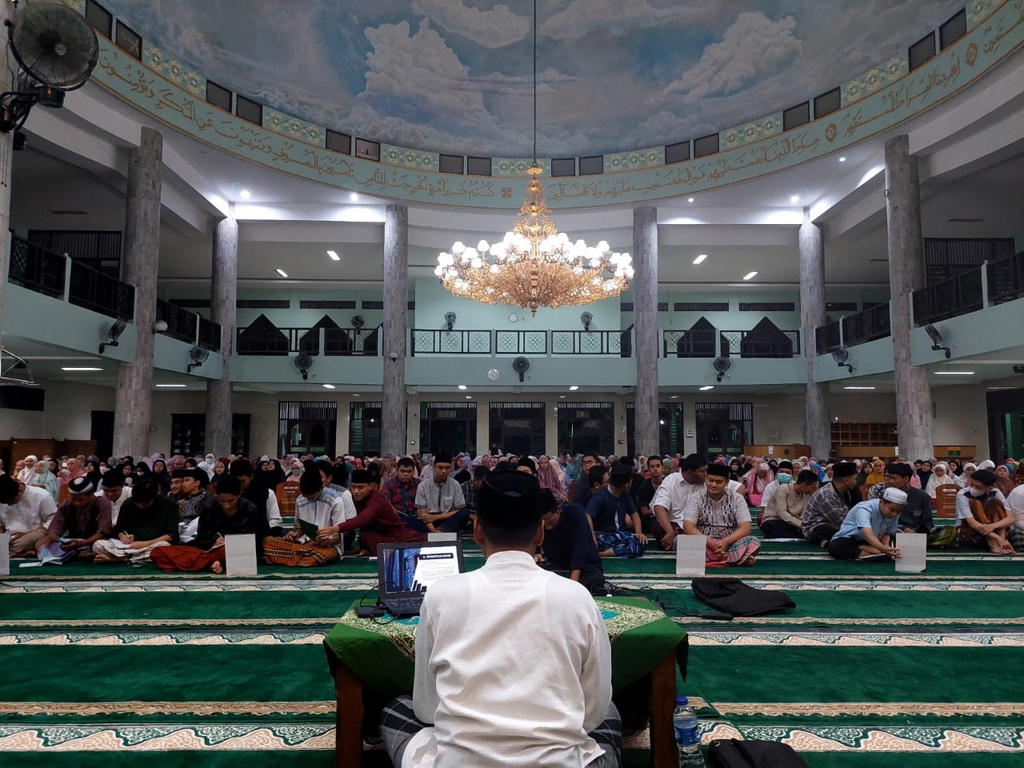
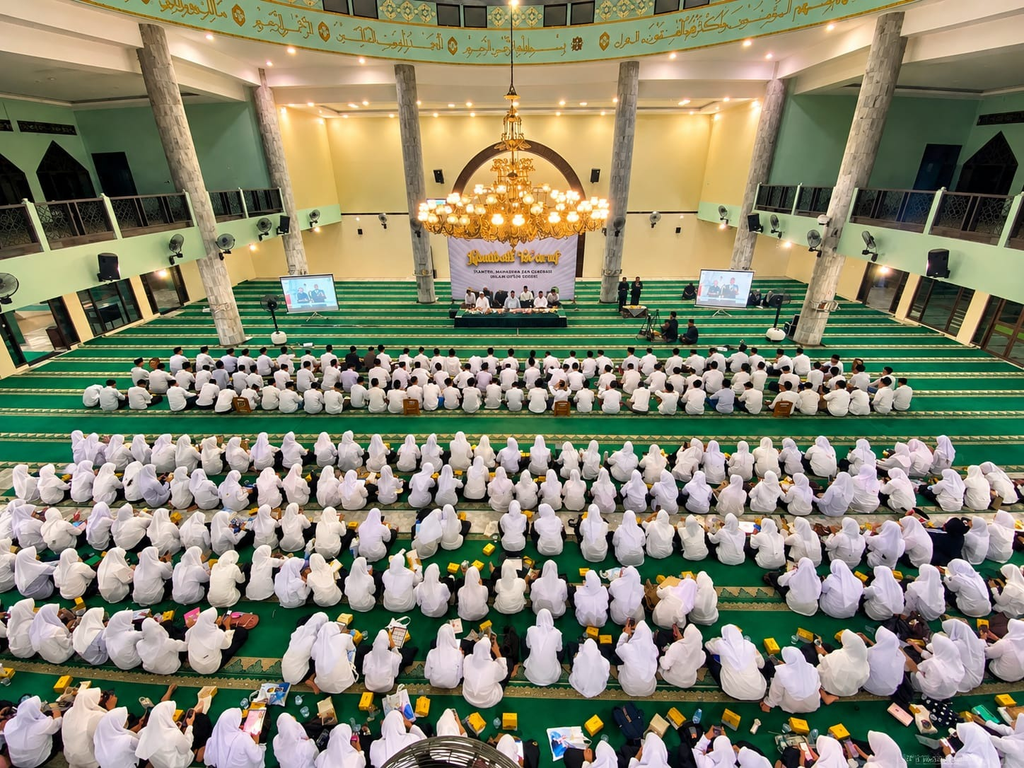
The mosque has sufficient capacity to accommodate large-scale activities involving members of the university community.
The photographic evidence shows large gatherings taking place inside Masjid Abu Bakar Assegaf, demonstrating its active role as a venue for collective religious and educational activities.
Public Religious and Cultural Engagement
Masjid Abu Bakar Assegaf connects university life with the surrounding community.
Public access enables community members to participate in religious activities alongside the university community.
This interaction supports:
- community engagement;
- preservation of religious traditions;
- public religious education;
- social interaction;
- transmission of Islamic values; and
- continuity of local religious culture.
The mosque therefore contributes to UNISSULA’s wider social and cultural role in Semarang.
Institutional Management and Mosque Services
Masjid Abu Bakar Assegaf is supported institutionally through UNISSULA’s Islamic development structure.
LKPI provides mosque-related services including:
- prayer schedules;
- religious-study information;
- Qur’anic learning;
- management of mosque activities; and
- Islamic character-development programmes.
This institutional management helps ensure that the culturally significant building remains active, maintained, and available for religious and educational use.
Continuing Religious Activities
The mosque continues to be actively used for university religious programmes.
UNISSULA documentation shows that Qur’anic teaching and student religious-development programmes continue to take place at Masjid Abu Bakar Assegaf.
This continuity demonstrates that the building remains an active part of the university’s contemporary cultural life while maintaining its historical role.
Cultural and Architectural Identity
The mosque’s physical design also contributes to its significance within the university campus.
Its large prayer hall, Arabic calligraphic decoration, central chandelier, multi-level interior, and Islamic architectural elements contribute to the cultural and religious character of the building.
The mosque functions as a visible representation of UNISSULA’s identity as an Islamic university.
A Living Historical Building
Masjid Abu Bakar Assegaf is not preserved merely as a historical object.
It remains a living building, continuously used for worship, education, religious traditions, and community engagement.
This is particularly relevant to sustainable heritage because the cultural value of the building is maintained through continuous public use.
Public Access and Cultural Preservation
Providing free public access contributes directly to the preservation of the mosque’s cultural role.
Rather than restricting access, UNISSULA enables the wider community to experience and participate in the religious and cultural activities associated with the building.
The approach can be summarised as:
Historic and culturally significant building → Free public access → Worship and cultural activities → Community participation → Continuing cultural preservation
Relationship with SDG 11
UNISSULA’s public access to Masjid Abu Bakar Assegaf contributes to SDG 11: Sustainable Cities and Communities, particularly the protection and accessibility of cultural heritage.
Masjid Abu Bakar Assegaf provides a clear example of this contribution through its combination of historical significance, cultural function, continued use, and access for the wider community.
Evidence of Public Access and Cultural Significance
UNISSULA’s provision of public access to Masjid Abu Bakar Assegaf is demonstrated through the following evidence:
- Masjid Abu Bakar Assegaf is a historically significant university building, with UNISSULA documenting its quarter-century commemoration in 2016.
- The mosque forms an important part of UNISSULA’s Islamic institutional and cultural identity.
- UNISSULA publicly states that the mosque provides prayer space for students, lecturers, and the general public.
- Public access is free of charge for ordinary worship and public religious activities.
- The mosque functions as a centre for congregational prayer, Qur’anic learning, religious lectures, and Islamic character development.
- UNISSULA has held public religious lectures and religious commemorations at the mosque.
- The mosque continues to host Qur’anic education and religious-development programmes.
- Large religious and educational gatherings demonstrate continuing active use of the building.
- Its architecture and religious functions make the mosque a significant cultural and spiritual landmark within the university.
- Publicly available university webpages provide evidence of the mosque’s history, functions, activities, and public accessibility.
11.2.2
Public Access To Libraries
11.2.2 Public Access to Libraries
Public Access to UNISSULA Library
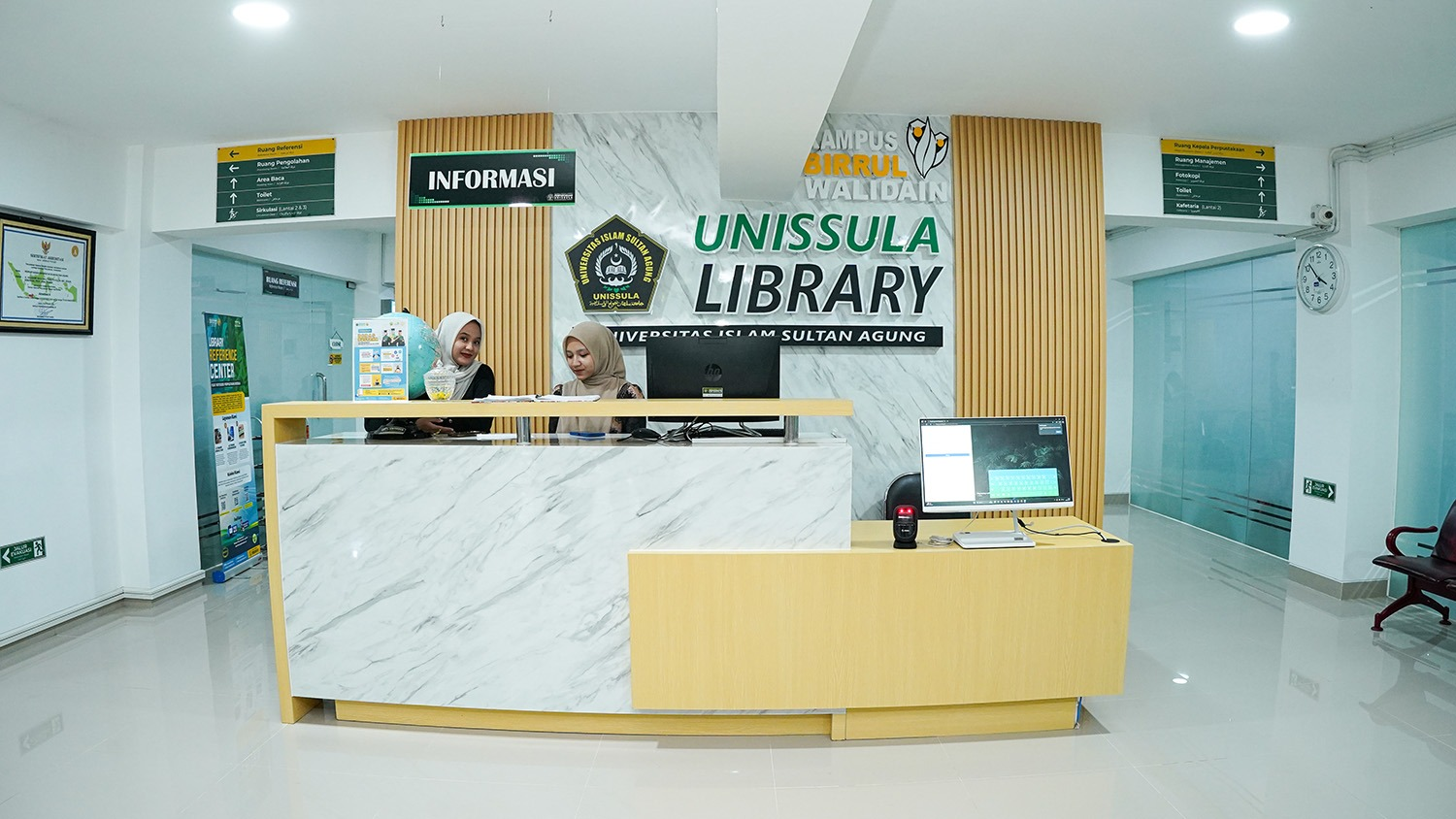
Universitas Islam Sultan Agung (UNISSULA) provides public access to its library and academic information resources for members of the wider community.
Members of the public who are not part of the university community may access the UNISSULA Library through the applicable registration process. This provides external users with opportunities to use library facilities and consult books, reference materials, and other academic resources.
Access for External Visitors
Public users may access the library after completing the required registration procedures.
This mechanism enables members of the wider community to benefit from the university’s academic resources while allowing the library to maintain appropriate visitor and service management.
The public-access arrangement supports:
- access to books and reference materials;
- use of reading and study spaces;
- access to library information services;
- consultation of academic publications; and
- engagement with university knowledge resources.
Library Facilities
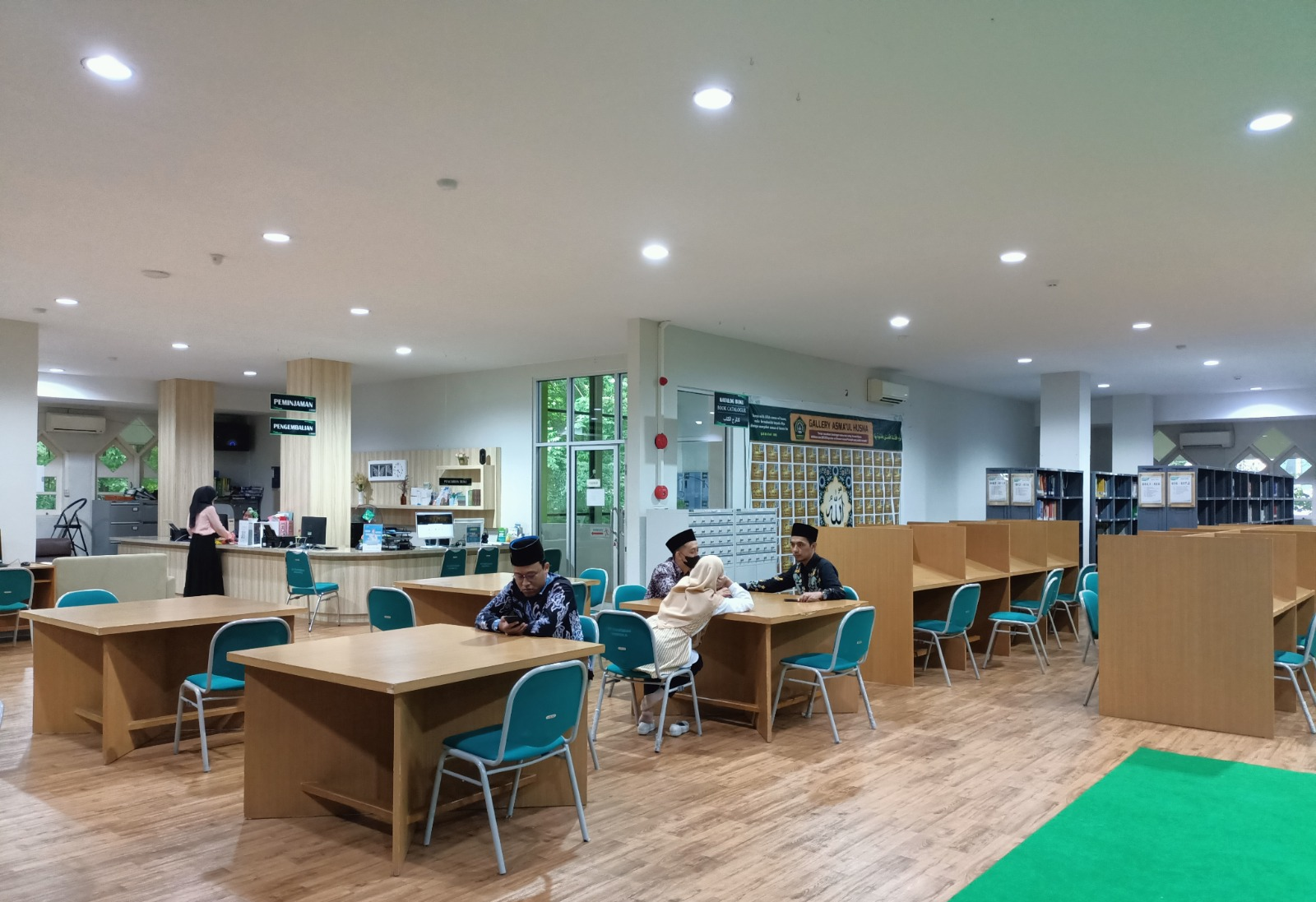
The UNISSULA Library provides spaces and services that support learning, research, and public access to academic information.
The library includes:
- reading and study areas;
- reference collections;
- book collections;
- information services;
- digital resources; and
- academic publication access.
The library environment is designed to support both individual study and access to scholarly information.
Public Access to Academic Publications
In addition to physical library access, UNISSULA provides public digital access to academic publications through its institutional repository and journal portal.
The UNISSULA Institutional Repository provides online access to academic works produced by the university community.
These resources include various forms of scholarly output that can be accessed by members of the public without needing to be physically present on campus.
Institutional Repository
UNISSULA maintains an institutional repository as a public academic information resource.
The repository provides access to scholarly works and institutional academic outputs, supporting:
- research dissemination;
- academic transparency;
- public access to knowledge;
- preservation of institutional scholarly output; and
- wider use of university research.
The repository therefore extends public access beyond the physical library.
Open Access Journal Publications
UNISSULA also maintains an online journal portal through which academic journals and scholarly articles are made available to the wider public.
The journal portal supports dissemination of research across multiple academic disciplines and allows researchers, students, practitioners, and members of the public to access academic publications online.
This strengthens UNISSULA’s contribution to open knowledge and public access to university research.
Physical and Digital Access
UNISSULA’s approach combines physical and digital access:
Public registration → Physical library access → Books and reference materials
and
Online public access → Institutional repository → Academic journals and publications
This combined model expands the availability of university knowledge resources beyond students and staff.
Supporting Community Learning
Providing public access to library resources supports learning and research beyond the university community.
External users may benefit from:
- scholarly books;
- reference materials;
- university research;
- institutional publications;
- journal articles; and
- academic information services.
This contributes to wider community access to education and knowledge.
Knowledge Dissemination
The institutional repository and journal portal also support broader dissemination of UNISSULA research.
Through online access, university knowledge can reach:
- researchers;
- students from other institutions;
- educators;
- professionals;
- government and community organisations; and
- members of the general public.
This helps extend the impact of university research beyond the campus.
Public Academic Resources
UNISSULA’s public library access can therefore be understood as a combination of:
Physical library services + Institutional repository + Open academic journals
Together, these mechanisms provide multiple ways for the public to access books, publications, research outputs, and scholarly information.
Evidence of Implementation
UNISSULA’s public access to libraries and academic publications is demonstrated through:
- Public access to the UNISSULA Library through an external-user registration mechanism.
- Access to physical books and reference collections.
- Reading and study facilities available within the library.
- Academic and information services for library users.
- A publicly accessible UNISSULA Institutional Repository.
- Online access to institutional academic outputs.
- A publicly accessible UNISSULA Journal Portal.
- Open availability of scholarly articles and academic publications.
- Integration of physical and digital resources to expand public access to university knowledge.
- Public dissemination of UNISSULA research and academic publications.
11.2.3
Public Access To Museums
11.2.3 Public Access to Museums, Exhibition Spaces, Galleries, Works of Art and Artefacts
Public Access to Sultan Agung Corner
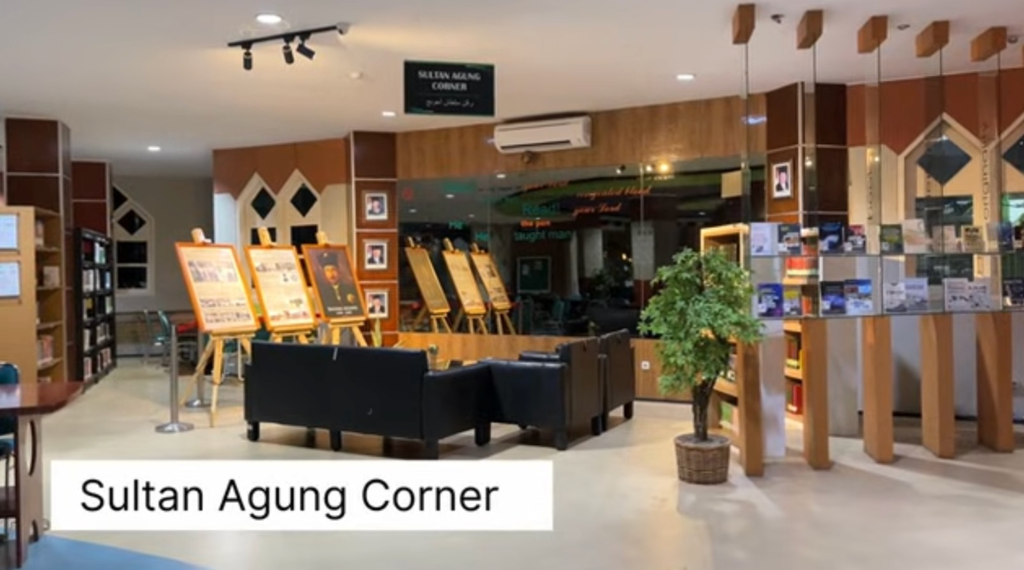
Universitas Islam Sultan Agung (UNISSULA) provides public access to Sultan Agung Corner, a permanent historical and cultural exhibition space located within the UNISSULA Library.
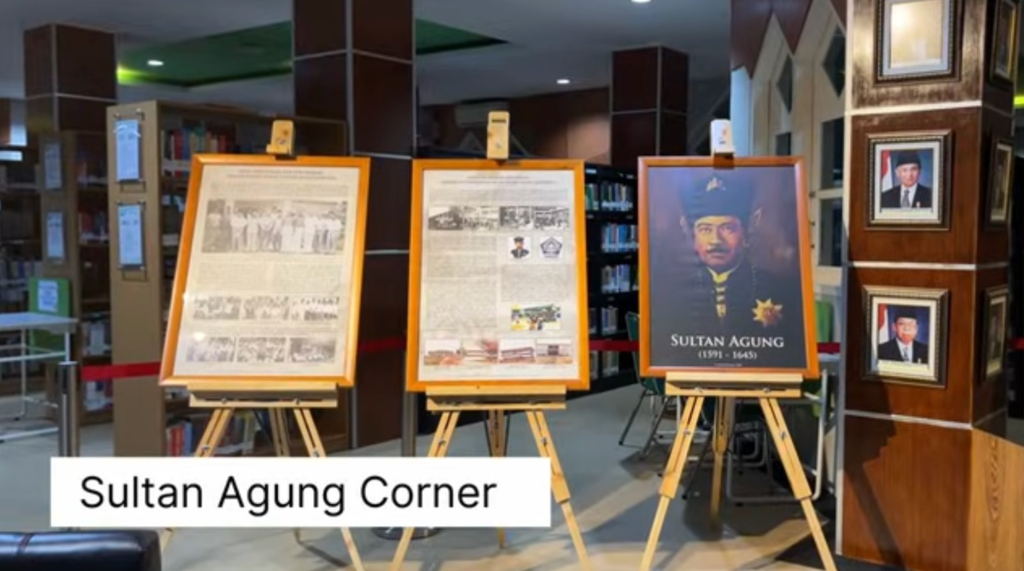
The exhibition presents visual and historical materials related to Sultan Agung, including portraits, historical photographs, information panels, and other interpretive displays. Through this exhibition space, UNISSULA preserves and communicates cultural and historical knowledge to students, researchers, visitors, and members of the wider public.
Sultan Agung Corner functions as an educational and cultural space rather than merely as a decorative area within the library.
Permanent Historical and Cultural Exhibition
Sultan Agung Corner is designed as a permanent exhibition area that presents historical and cultural materials in an accessible visual format.
The exhibition includes:
- portraits of Sultan Agung;
- historical photographs;
- interpretive information panels;
- documentary images;
- cultural and historical narratives; and
- visual displays related to Sultan Agung and the historical identity associated with UNISSULA.
The arrangement of framed displays and information panels creates a gallery-like environment within the university library.
Historical Significance of Sultan Agung
Sultan Agung is an important historical figure whose name forms part of the identity of Universitas Islam Sultan Agung.
The exhibition therefore has particular cultural significance to the university because it connects the institution’s contemporary academic identity with historical and cultural memory.
By presenting information about Sultan Agung in a dedicated exhibition space, UNISSULA provides opportunities for visitors to learn about the historical figure associated with the university’s name and identity.
Visual Historical Documentation
The exhibition uses visual documentation to communicate historical information.
The materials displayed include:
- framed historical photographs;
- archival-style images;
- explanatory panels;
- portraits; and
- historical narratives.
This visual approach allows visitors to engage with historical information in a form that is accessible beyond formal classroom teaching.
Portrait of Sultan Agung
One of the central visual elements of the exhibition is a portrait of Sultan Agung (1591–1645).
The portrait is displayed alongside historical panels and documentary material, making it part of a broader interpretive exhibition rather than an isolated decorative object.
Educational Function
Sultan Agung Corner supports education by providing historical and cultural information in a public learning environment.
Visitors can use the exhibition to:
- learn about Sultan Agung;
- understand the historical context associated with the university’s identity;
- view historical photographs and documentary materials;
- engage with visual historical narratives; and
- strengthen awareness of cultural heritage.
The exhibition therefore complements the academic and educational functions of the university library.
Cultural Heritage and Institutional Identity
The exhibition also contributes to the preservation and communication of UNISSULA’s cultural identity.
The name and historical significance of Sultan Agung form an important part of the institution’s identity.
By maintaining a dedicated exhibition area, UNISSULA helps preserve this historical connection and makes it visible to present and future generations of students and visitors.
Location within the UNISSULA Library
Sultan Agung Corner is located within the UNISSULA Library, placing the exhibition in an academic environment where historical and cultural learning can be integrated with access to books, publications, and other educational resources.
The location also makes the exhibition accessible to library visitors.
This arrangement creates a link between:
Library resources → Historical exhibition → Cultural learning
Public Access through Library Visitor Registration
Members of the wider public can access the UNISSULA Library through the applicable visitor registration mechanism.
Because Sultan Agung Corner is located within the library, public visitors who access the library are also able to view the exhibition.
This means the exhibition is not restricted exclusively to UNISSULA students or staff.
Public access can therefore be represented as:
Visitor registration → Library access → Access to Sultan Agung Corner
Exhibition Space for the Wider Community
The exhibition provides a cultural-learning opportunity for:
- students;
- lecturers;
- researchers;
- visiting academics;
- school visitors;
- community members; and
- other external visitors.
This extends the cultural and educational value of the exhibition beyond the university’s internal community.
Public Engagement with Cultural History
Providing access to Sultan Agung Corner enables members of the public to engage directly with historical and cultural information.
Visitors are able to view historical materials in person and gain a better understanding of the cultural background associated with the university.
This supports the wider role of universities as institutions that preserve and disseminate knowledge, including cultural and historical knowledge.
Exhibition as a Learning Space
Sultan Agung Corner functions as a learning space by combining historical information with visual presentation.
The exhibition format allows historical knowledge to be communicated through:
- images;
- portraits;
- photographs;
- documentary displays; and
- interpretive text.
This makes cultural heritage more visible and approachable to a broad audience.
Preserving Historical Memory
Maintaining Sultan Agung Corner also helps preserve historical memory within the university environment.
Historical photographs and information panels provide documentation that can remain accessible to successive generations of university students and visitors.
This contributes to the preservation of institutional and cultural heritage.
Connection between Knowledge and Heritage
The placement of Sultan Agung Corner within the library reflects an integrated approach to knowledge and heritage.
The library provides access to scholarly information, while the exhibition provides access to historical and cultural information.
Together, they create an environment where visitors can engage with both:
Academic knowledge + Cultural heritage
Works of Art and Historical Displays
Sultan Agung Corner also includes visual works that can be understood as cultural and historical display materials.
These include:
- framed portraits;
- photographic displays;
- historical images;
- artistic presentation of historical figures; and
- interpretive exhibition panels.
These works contribute to the educational and cultural character of the space.
Continuous Public Availability
Unlike a temporary event, Sultan Agung Corner is maintained as a dedicated exhibition area within the library.
This allows the historical and cultural materials to remain available to visitors on an ongoing basis during library access periods.
Continuous availability strengthens its value as a public cultural resource.
Relationship with the UNISSULA Library
Sultan Agung Corner complements the broader public-access role of the UNISSULA Library.
While the library provides access to:
- books;
- reference materials;
- research publications;
- institutional repository resources; and
- journal publications,
Sultan Agung Corner provides access to:
- historical information;
- cultural displays;
- portraits;
- photographs; and
- visual heritage materials.
Together, these resources broaden the university’s contribution to public knowledge.
Contribution to SDG 11
Sultan Agung Corner supports SDG 11: Sustainable Cities and Communities, particularly the role of universities in preserving and making cultural heritage accessible.
THE Sustainability Impact Ratings 2027 recognises public access to museums, exhibition spaces, galleries, works of art, and artefacts under Indicator 11.2.3. The indicator evaluates the existence of public access, supporting evidence, and whether that evidence is publicly available.
Sultan Agung Corner provides a relevant example because it functions as a permanent historical and cultural exhibition space that can be accessed by library visitors, including members of the wider public.
Evidence of Implementation
UNISSULA’s public access to exhibition spaces, cultural displays, and historical works is demonstrated through the following institutional evidence:
- Sultan Agung Corner as a permanent historical and cultural exhibition space within the UNISSULA Library.
- Display of a prominent portrait of Sultan Agung (1591–1645).
- Display of historical photographs and documentary images.
- Interpretive panels presenting historical and cultural information.
- Visual materials explaining the historical figure associated with the university’s identity.
- Gallery-style arrangement of cultural and historical materials.
- Location within the university library, enabling access to library visitors.
- Public access through the library’s external visitor registration mechanism.
- Educational use of the exhibition to communicate cultural and historical knowledge.
- Ongoing availability of the exhibition as a permanent cultural-learning space.
11.2.4
Public Access To Green Spaces
11.2.4 Free Public Access to Open and Green Spaces
University-Wide Public Access to Green Spaces
Universitas Islam Sultan Agung (UNISSULA) provides free public access to open spaces and green spaces across its campus.
These areas are available to students, lecturers, staff, visitors, and members of the wider community without an admission fee. They form part of the university’s effort to maintain an inclusive, healthy, and environmentally sustainable campus environment.
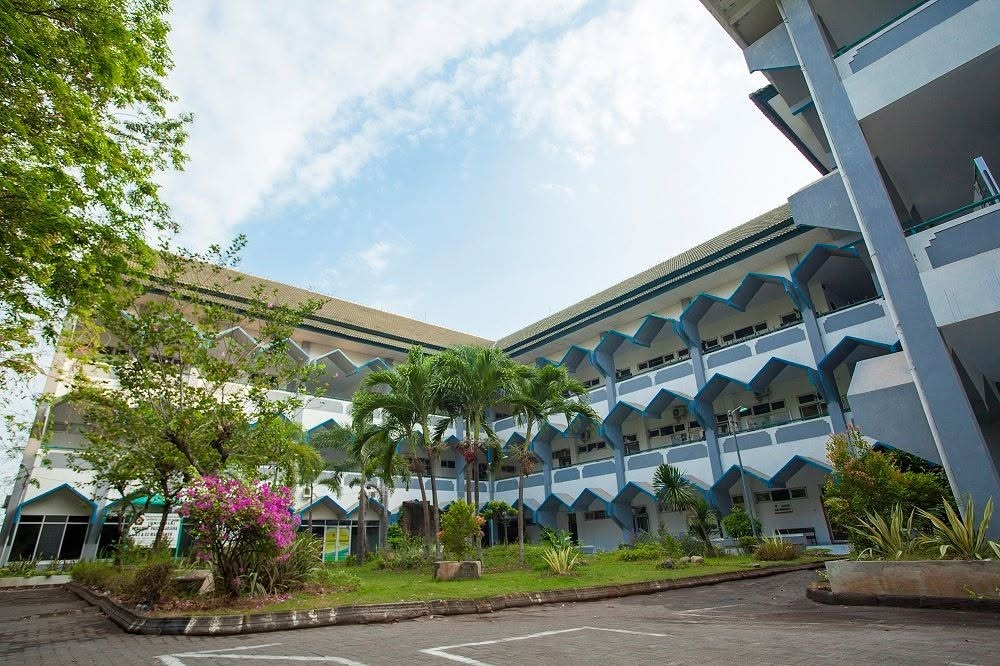
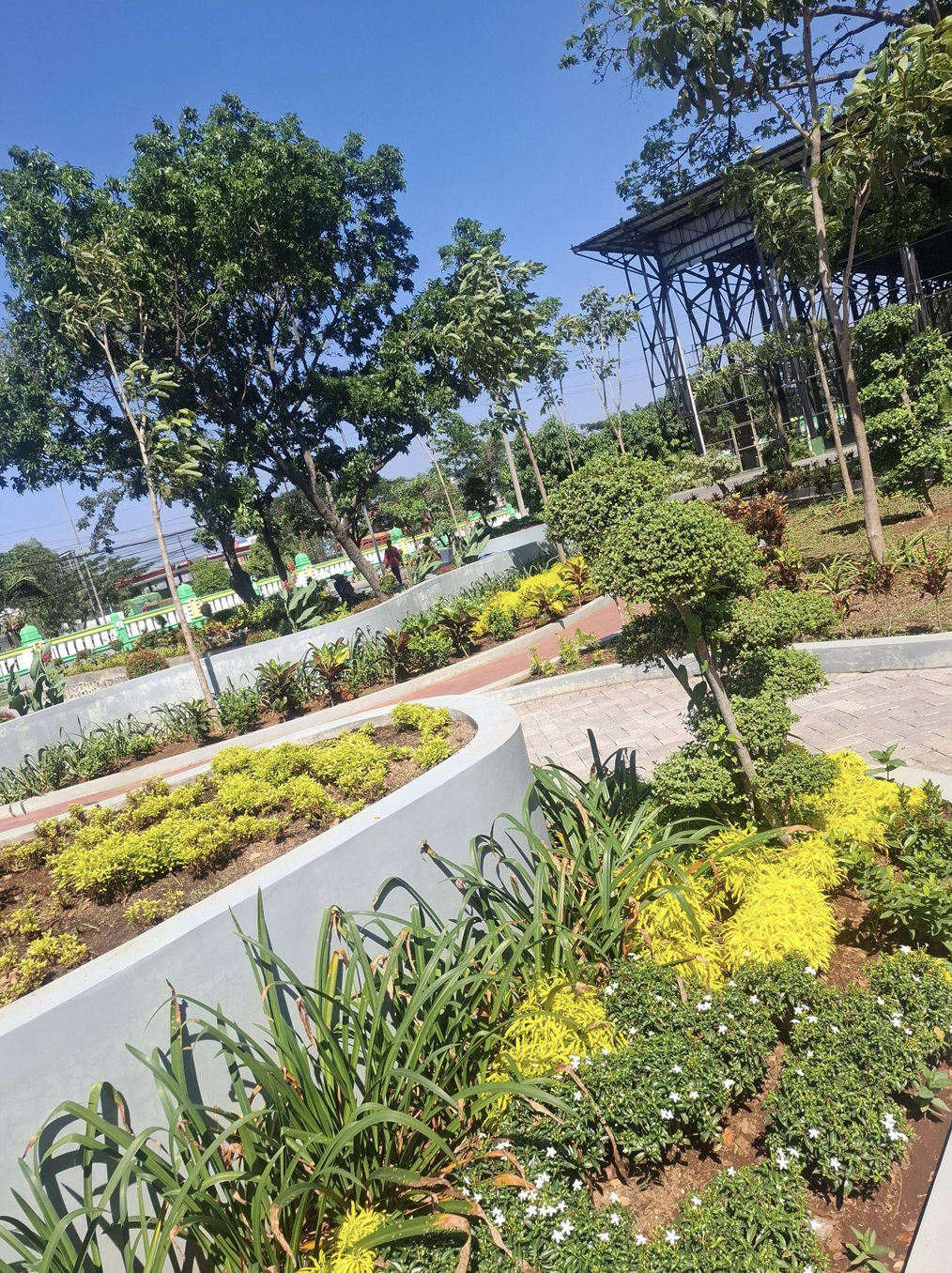
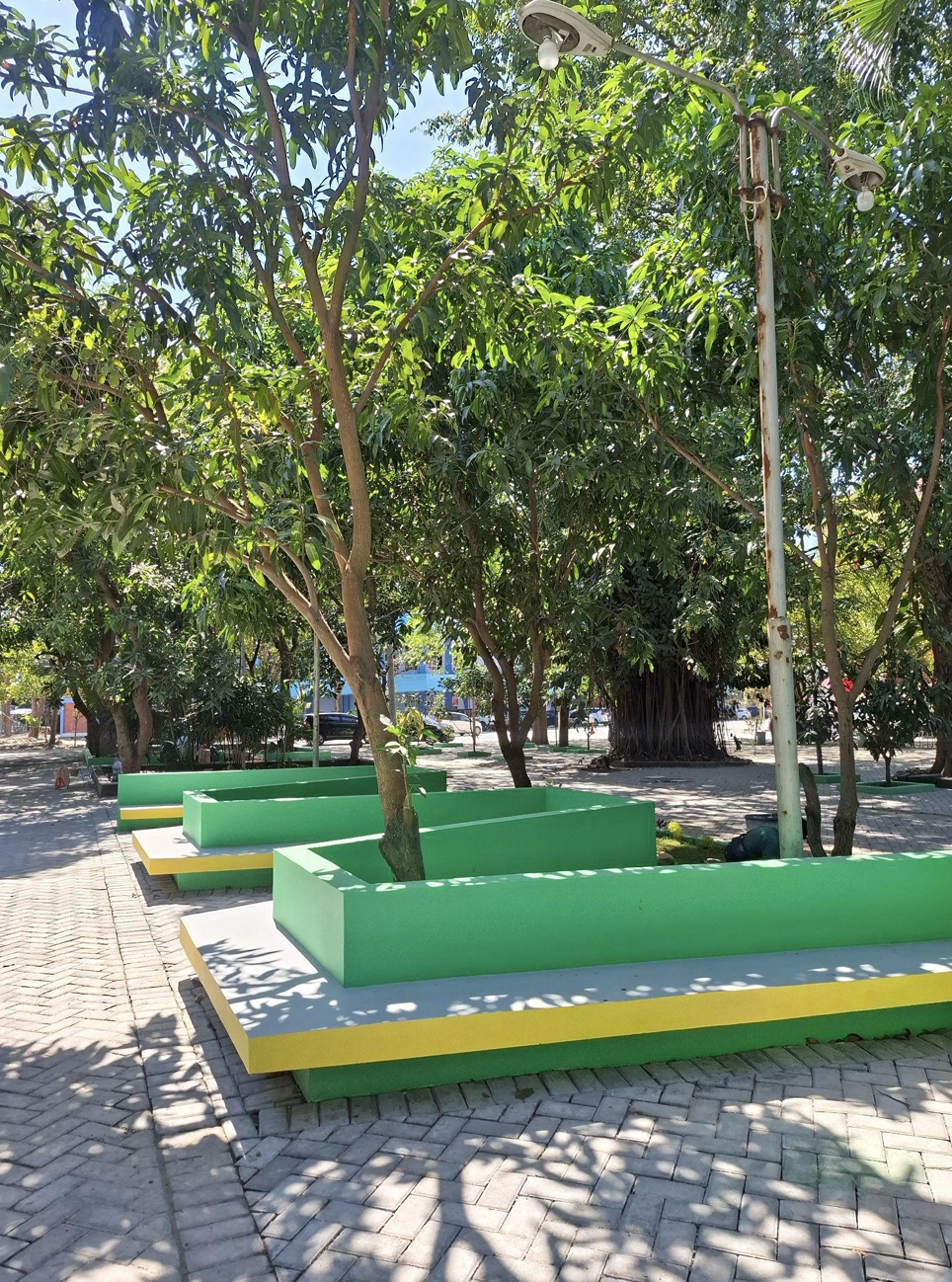
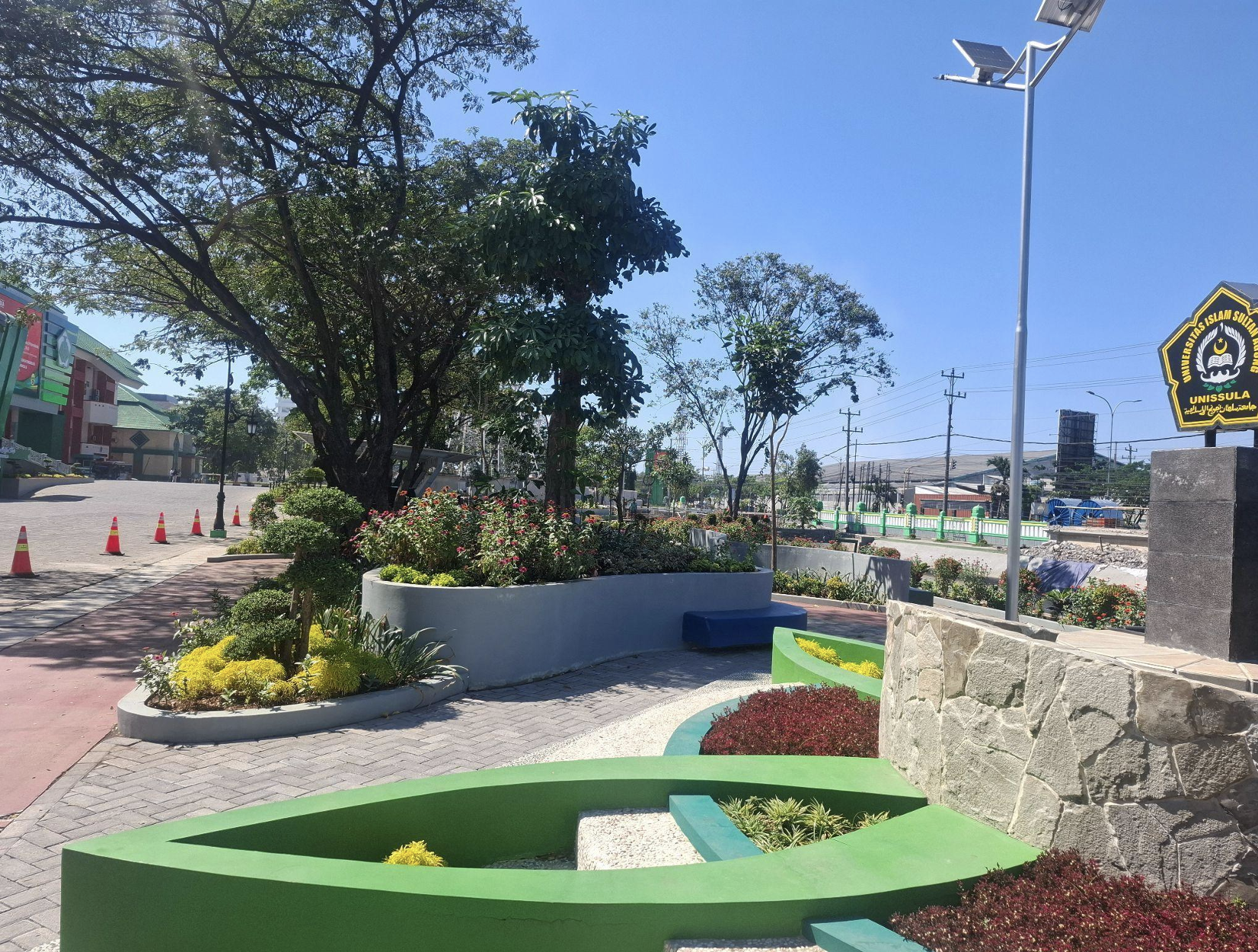
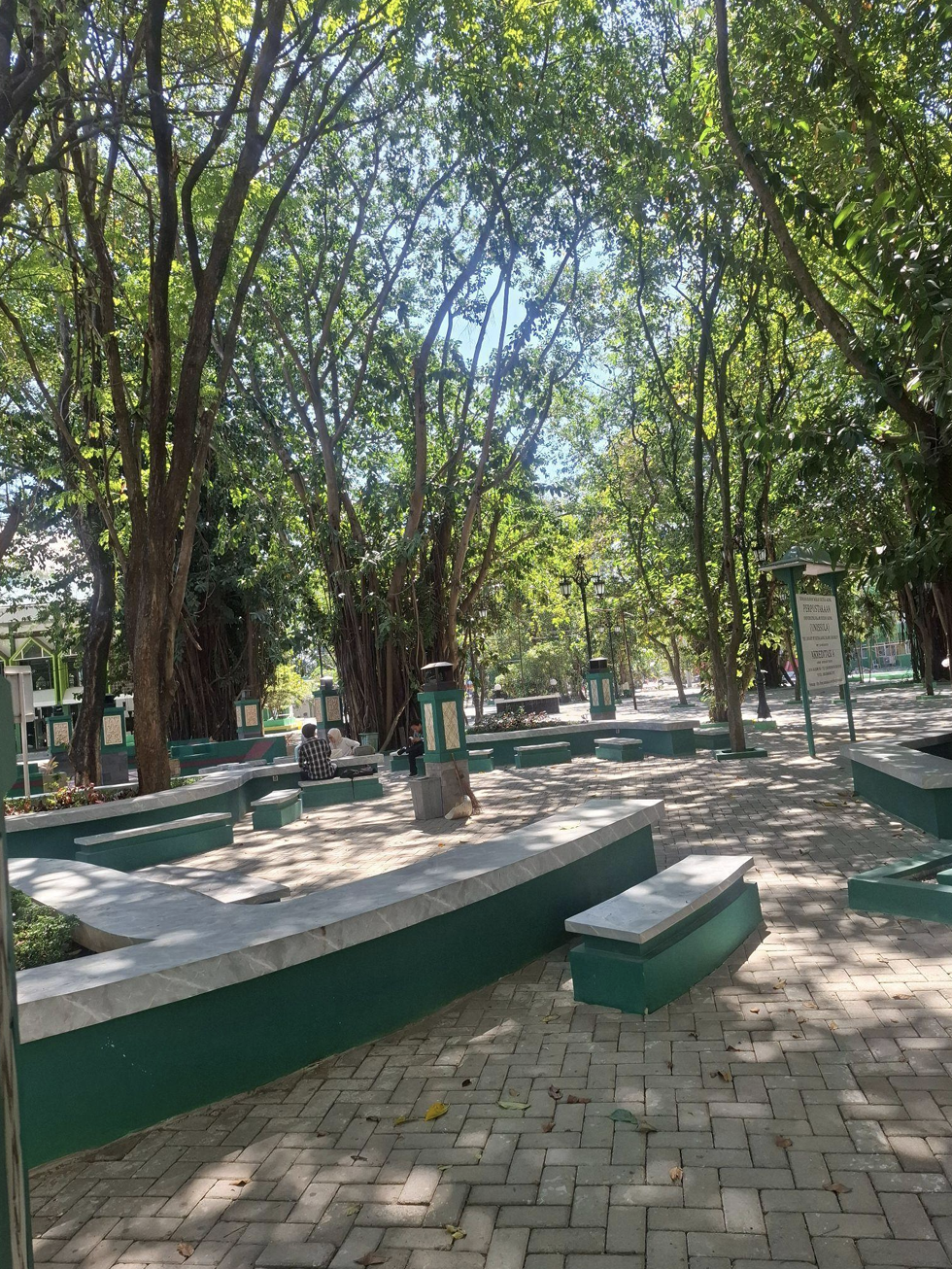
UNISSULA’s green spaces include landscaped gardens, planted courtyards, tree-lined walkways, vegetated zones around academic buildings, public open spaces, and garden areas distributed throughout the campus.
Permanent Free Access
The university’s open and green spaces are integrated into the everyday campus environment and are not limited to temporary events.
Members of the public can enter and use these areas during normal campus access without paying an admission fee.
This includes public green spaces around major university facilities such as:
- the Rectorate;
- the library;
- the mosque;
- the Sports Center;
- academic buildings; and
- other landscaped areas across the campus.
The photographic evidence shows publicly accessible gardens in front of the Rectorate, beside the Sports Center, in front of the mosque, and in front of the library.
Scale of Green Space at UNISSULA
UNISSULA maintains a substantial amount of planted vegetation across the campus.
Based on spatial analysis and field observations, the university has approximately 117,799.50 m² of planted vegetation, representing around 35% of the total campus area of 336,570 m².
These green areas are distributed throughout the campus and contribute to the environmental quality, usability, and comfort of the university environment.
Major Green Areas
The university’s documented planted vegetation includes several major areas.
These include:
- Library Garden – 43,673.30 m²
- Faculty of Engineering Garden – 4,968.81 m²
- Faculty of Economics Garden – 1,853.22 m²
- SMP Lake Garden – 1,878.60 m²
- additional green zones distributed throughout the campus.
These areas form part of a wider network of open and vegetated spaces across UNISSULA.
Library Garden
The Library Garden is one of the largest documented green areas on campus.
Located around the university library environment, the garden contributes to a more comfortable academic and public setting.
The area supports:
- walking;
- informal discussion;
- relaxation;
- study breaks;
- social interaction; and
- general public enjoyment of the campus environment.
Its location close to an academic facility makes it easily accessible to both university users and visitors.
Green Space around the Rectorate
UNISSULA also maintains landscaped public space in front of the Rectorate.
This area combines planted vegetation with pedestrian access and seating elements, creating a welcoming environment around one of the university’s central buildings.
Because the area is part of the campus public space, it can be used by students, staff, visitors, and members of the public without a separate entrance charge.
Green Space around the Mosque
Green and open areas are also maintained around Masjid Abu Bakar Assegaf.
These spaces complement the mosque’s role as a religious and community facility by providing a more comfortable outdoor environment for worshippers, visitors, and other campus users.
The mosque area therefore integrates religious, social, and environmental functions.
Green Space beside the Sports Center
The area beside the university Sports Center also contains landscaped vegetation and open space.
This supports the broader function of the Sports Center as a place for physical activity, recreation, and community interaction.
The green surroundings help create a more pleasant environment for both university users and external visitors.
Tree-Lined Walkways
UNISSULA’s green-space system includes tree-lined pedestrian routes.
These routes connect different parts of the campus while also providing shade and improving the quality of the walking environment.
Tree-lined walkways support:
- pedestrian mobility;
- thermal comfort;
- everyday recreation;
- social interaction; and
- a more attractive campus landscape.
Open Courtyards and Public Spaces
In addition to formal gardens, UNISSULA maintains open courtyards and planted public areas around academic and administrative buildings.
These spaces are part of the normal campus environment and can be used for:
- informal meetings;
- student activities;
- rest;
- discussion;
- walking; and
- community interaction.
Their integration into everyday campus life strengthens the public-access function of the university’s green spaces.
Green Islamic Campus Policy
UNISSULA’s green spaces form part of its broader Green Islamic Campus approach.
The university’s documentation states that planted zones support ecological balance, biodiversity, and sustainability through intentional landscaping and the integration of green infrastructure.
This approach links environmental sustainability with campus design and public accessibility.
Environmental Benefits
The university’s green areas provide several environmental benefits, including:
- supporting biodiversity;
- reducing heat exposure;
- improving microclimate conditions;
- providing shade;
- enhancing campus aesthetics;
- supporting pedestrian movement; and
- strengthening green infrastructure.
These environmental functions are complemented by the social benefits of keeping green spaces accessible to the university community and wider public.
Social and Community Benefits
Free public access to open and green spaces also creates social value.
Visitors can use campus green spaces for:
- walking;
- relaxation;
- social interaction;
- informal learning;
- attending campus activities;
- visiting the mosque;
- accessing public university facilities; and
- enjoying landscaped surroundings.
This helps integrate the campus with the wider community rather than treating university open spaces as closed private areas.
Supporting Health and Well-Being
Open and green spaces also support physical and psychological well-being.
The availability of gardens, shaded areas, pedestrian routes, and open spaces provides opportunities for:
- light physical activity;
- walking;
- rest;
- social interaction;
- relaxation; and
- contact with vegetation.
These functions contribute to a healthier and more comfortable university environment.
Integration with Campus Facilities
UNISSULA’s green spaces are distributed around a variety of facilities.
They are located near:
- the library;
- academic buildings;
- the Rectorate;
- the mosque;
- the Sports Center;
- student facilities; and
- other public areas.
This means users do not need to visit a separate designated park to benefit from green space; instead, planted areas are integrated into daily campus movement and activity.
Public Accessibility
The public-access value of these spaces lies in their integration into the university’s open campus environment.
Visitors are able to access green spaces while visiting university facilities, attending activities, using public services, participating in religious activities, or simply moving through the campus.
There is no separate admission charge for accessing these open and green areas.
Permanent Rather than Occasional Access
UNISSULA’s green spaces are not opened only during special events.
They form part of the permanent campus landscape and remain available as part of ordinary campus access.
This distinguishes them from occasional temporary access and supports the classification of these spaces as permanently accessible green areas.
Campus-Wide Distribution
Green spaces are not concentrated in only one location.
The documentation shows multiple green areas distributed across the campus, including around the library, Engineering Faculty, Economics Faculty, lake area, Rectorate, mosque, Sports Center, and other campus zones.
This distribution improves access to green space for users in different parts of the university.
Relationship with Sustainable Campus Development
UNISSULA’s provision of accessible green space supports a broader sustainable-campus approach.
Green areas contribute to:
- environmental sustainability;
- campus liveability;
- community access;
- biodiversity;
- recreational opportunities; and
- quality of public space.
This connects physical campus management with the objectives of SDG 11: Sustainable Cities and Communities.
Contribution to SDG 11
THE Sustainability Impact Ratings 2027 recognises free public access to open spaces and green spaces under Indicator 11.2.4.
The methodology awards the highest access component where universities provide permanent free public access, with additional points for supporting evidence and publicly available evidence.
UNISSULA’s campus green spaces are integrated into the permanent campus environment and are accessible without an admission fee.
Evidence of Implementation
UNISSULA’s provision of free public access to open and green spaces is demonstrated through the following evidence:
- 117,799.50 m² of planted vegetation across the UNISSULA campus.
- Green space representing approximately 35% of the total campus area.
- Library Garden – 43,673.30 m².
- Faculty of Engineering Garden – 4,968.81 m².
- Faculty of Economics Garden – 1,853.22 m².
- SMP Lake Garden – 1,878.60 m².
- Public green space in front of the Rectorate.
- Landscaped area beside the Sports Center.
- Green space around the mosque.
- Green areas around the library.
- Tree-lined walkways and vegetated courtyards.
- Green zones distributed around academic buildings and other campus facilities.
- Permanent public accessibility without a separate admission fee.
- Integration with UNISSULA’s Green Islamic Campus policy.
11.2.5
Arts And Heritage Contribution
11.2.5 Arts and Heritage Contribution
Supporting Local Arts and Cultural Heritage
Universitas Islam Sultan Agung (UNISSULA) actively contributes to local arts and cultural heritage through public performances organised by university student groups and cultural communities.
Throughout 2025, UNISSULA supported a range of artistic performances presented during university ceremonies, cultural events, public activities, student programmes, and external community events.
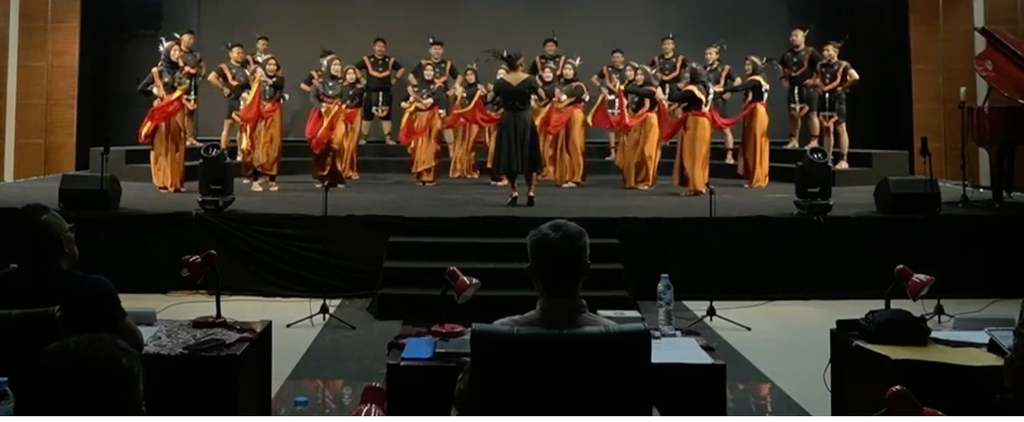
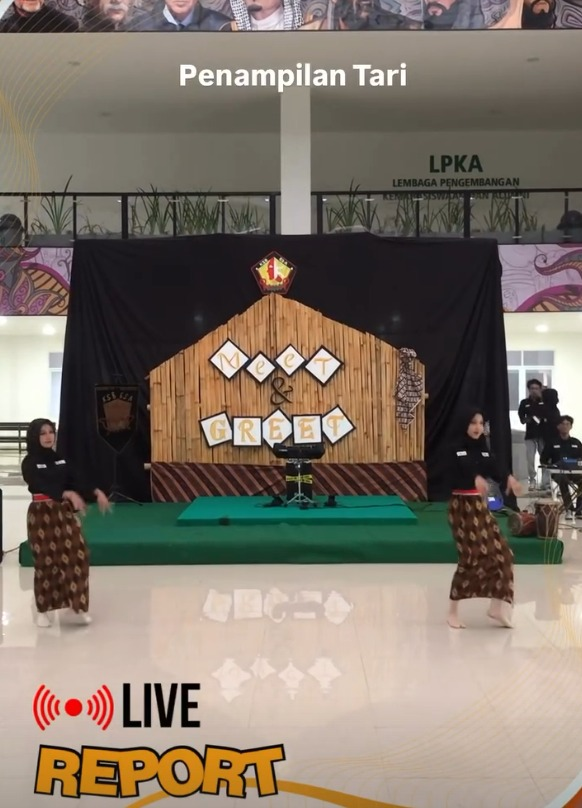
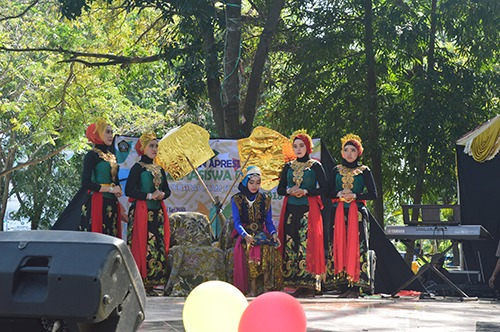
These performances include choir, traditional dance, wayang, rebana, Islamic performing arts, and other student cultural performances.



University Choir
The UNISSULA choir contributes to major university events, including graduation ceremonies and other formal academic occasions.
Through these performances, students develop musical skills while enriching important university ceremonies with artistic and cultural expression.
Choir performances also provide opportunities for university arts groups to present their work before large audiences consisting of graduates, families, invited guests, academics, and members of the wider community.
Traditional Dance Performances
Traditional dance forms an important part of UNISSULA’s cultural activities.
Student performers present Indonesian traditional dances during university events, guest receptions, institutional ceremonies, cultural programmes, and other public-facing activities.
These performances help introduce and preserve Indonesian cultural traditions while providing students with opportunities to develop and showcase their artistic abilities.
Wayang and Traditional Performing Arts
UNISSULA also supports traditional performing arts such as wayang.
Wayang represents an important element of Indonesian cultural heritage and combines storytelling, performance, traditional values, and artistic expression.
By presenting wayang in university activities, UNISSULA contributes to the continued visibility and appreciation of traditional Indonesian performing arts.
Rebana and Islamic Performing Arts
Islamic artistic traditions are also represented through rebana performances and related cultural activities.
Rebana combines music, rhythm, religious expression, and community participation, making it an important form of Islamic cultural performance.
These performances reflect UNISSULA’s identity as an Islamic university while also preserving and promoting forms of local religious and cultural expression.
Public and External Performances
UNISSULA student arts groups also participate in performances beyond internal university activities.
Participation in public and external events enables student performers to engage with wider audiences and strengthens the university’s contribution to local arts and cultural life.
These activities help connect university-based artistic development with the broader community.
Student-Led Arts and Cultural Activities
Student organisations and cultural groups play an important role in sustaining arts and heritage activities at UNISSULA.
These groups provide opportunities for students to:
- develop artistic skills;
- participate in rehearsals and performances;
- preserve traditional arts;
- collaborate with other performers;
- participate in cultural events; and
- represent the university in public activities.
Student-led activities therefore contribute both to individual development and to the preservation and promotion of cultural heritage.
Arts within University Ceremonies
Performing arts are integrated into major university occasions.
Graduations, institutional celebrations, student activities, cultural programmes, and formal university events provide regular opportunities for artistic performances.
These events allow traditional and contemporary artistic expression to become part of university life rather than being limited to isolated arts programmes.
Contribution to Local Cultural Life
UNISSULA’s artistic activities contribute to local cultural life by maintaining opportunities for public performance and by supporting student groups involved in music, dance, traditional arts, and Islamic cultural expression.
The university provides a platform where students can develop artistic skills while sharing cultural traditions with wider audiences.
Preservation of Cultural Heritage
Traditional dance, wayang, rebana, and other cultural performances help maintain forms of intangible cultural heritage.
Through continued practice and public presentation, these art forms remain visible to younger generations and wider communities.
UNISSULA therefore contributes not only to artistic performance but also to the continued transmission of Indonesian cultural traditions.
Continuous Arts Activities
UNISSULA supports arts and cultural performances throughout the academic year.
The university’s approach combines:
Student arts groups → Regular university events → Public performances → Cultural preservation → Community engagement
This creates an environment in which arts and cultural heritage remain active components of university and community life.
Evidence of Implementation
UNISSULA’s contribution to local arts and cultural heritage is demonstrated through:
- University choir performances at major academic and public-facing events.
- Traditional dance performances during university and cultural programmes.
- Wayang performances supporting Indonesian traditional arts.
- Rebana and Islamic cultural performances.
- Student arts groups participating in public and external activities.
- Cultural performances integrated into graduation ceremonies and institutional events.
- Public-facing performances involving university students and cultural groups.
- Continued support for student participation in arts and heritage activities.
- Promotion of traditional Indonesian and Islamic cultural expression.
- Regular artistic activities throughout the academic year.
11.2.6
Record And Preserve Cultural Heritages
11.2.6 Recording and Preserving Intangible Cultural Heritage
Recording and Preserving Cultural Heritage at UNISSULA
Universitas Islam Sultan Agung (UNISSULA) contributes to the recording and preservation of intangible cultural heritage through cultural performances, documentation, student participation, public cultural activities, and publicly accessible audiovisual records.
The university supports the continuation of Indonesian and local cultural traditions through activities involving wayang, traditional dance, Islamic musical traditions, sholawat, rebana, and related cultural practices.
These activities enable cultural knowledge and traditions to be practised, transmitted to younger generations, documented, and made accessible to wider audiences.


Intangible Cultural Heritage as Living Tradition
UNISSULA approaches cultural heritage not only as historical material to be preserved in archives, but also as a living tradition.
Cultural heritage is maintained through:
- public performances;
- student participation;
- cultural education;
- intergenerational transmission;
- photographic documentation;
- audiovisual recording; and
- public dissemination through digital media.
This approach helps ensure that cultural traditions remain active and visible rather than existing only as historical records.
Preservation of Traditional Dance
Traditional dance forms an important part of UNISSULA’s cultural activities.
Students participate in traditional dance performances during university ceremonies, cultural events, public activities, and other institutional programmes.
Traditional dance preserves cultural knowledge through:
- movement;
- traditional costume;
- music;
- choreography;
- symbolic expression; and
- cultural narratives.
By continuing to perform and document these dances, UNISSULA contributes to the transmission of traditional artistic knowledge to younger generations.
The photographic documentation of traditional dance performances also creates a lasting record of these cultural practices.
Local and Regional Cultural Heritage
Traditional dance activities provide an important mechanism for preserving local and regional cultural heritage.
Through participation in performances and cultural programmes, students become directly involved in maintaining traditions that are associated with Indonesian regional identities.
This contributes to cultural continuity by combining:
Practice → Performance → Documentation → Transmission
Rather than treating cultural heritage as static, UNISSULA encourages students to experience and reproduce cultural traditions through active participation.
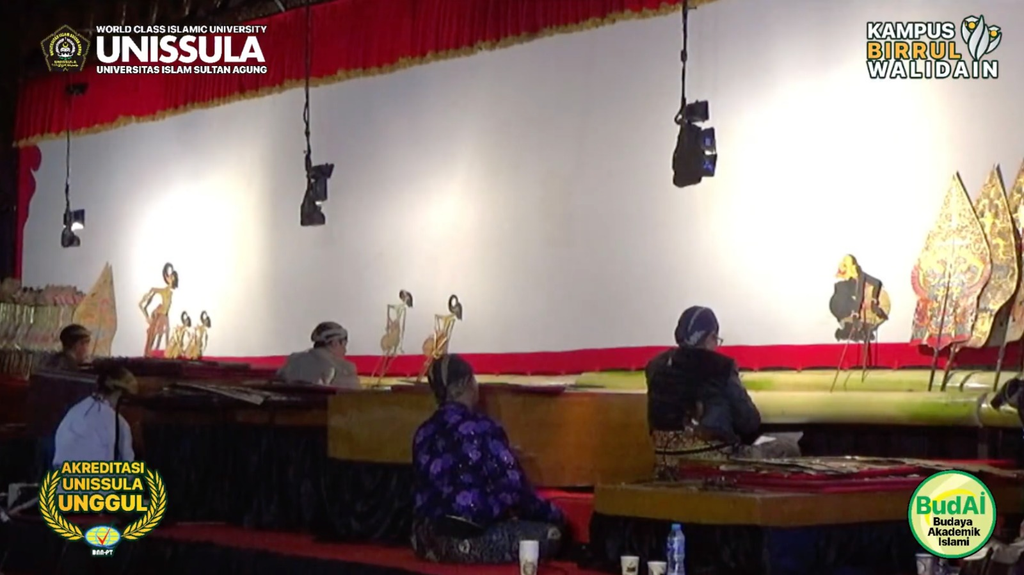
Preservation of Wayang
UNISSULA also supports the preservation of wayang, one of Indonesia’s most important traditional performing arts.
Wayang combines multiple forms of intangible cultural heritage, including:
- storytelling;
- oral tradition;
- traditional music;
- visual symbolism;
- performance techniques;
- language;
- philosophy;
- historical narratives; and
- traditional knowledge.
Through wayang performances and their documentation, UNISSULA contributes to maintaining this cultural tradition and making it visible to contemporary audiences.
Wayang as National Cultural Heritage
Wayang has significance extending beyond a single region and represents an important part of Indonesian cultural heritage.
UNISSULA’s involvement in wayang activities supports the continued transmission of traditional knowledge associated with:
- characters and stories;
- performance practices;
- moral narratives;
- local wisdom;
- traditional musical accompaniment; and
- cultural interpretation.
The documentation of wayang performances also creates audiovisual records that can be accessed after the live performance has ended.
Recording Cultural Performances
An important component of UNISSULA’s heritage-preservation approach is the recording of cultural activities.
Photographs and video recordings enable performances to be preserved beyond the original event.
This creates documentation that can support:
- cultural education;
- historical records;
- public awareness;
- future research;
- institutional memory; and
- continued appreciation of traditional arts.
Recording therefore strengthens the preservation function of cultural performances.
Islamic Cultural Traditions
UNISSULA also preserves forms of Islamic cultural heritage through activities such as sholawat, rebana, collective religious gatherings, and Islamic musical traditions.
These traditions combine religious practice with forms of cultural expression that have developed within Indonesian Muslim communities.
Their continuation involves:
- oral transmission;
- collective recitation;
- musical rhythm;
- community participation;
- religious knowledge; and
- cultural practice.
UNISSULA supports these traditions through university and community activities involving students, lecturers, staff, religious figures, and members of the wider community.
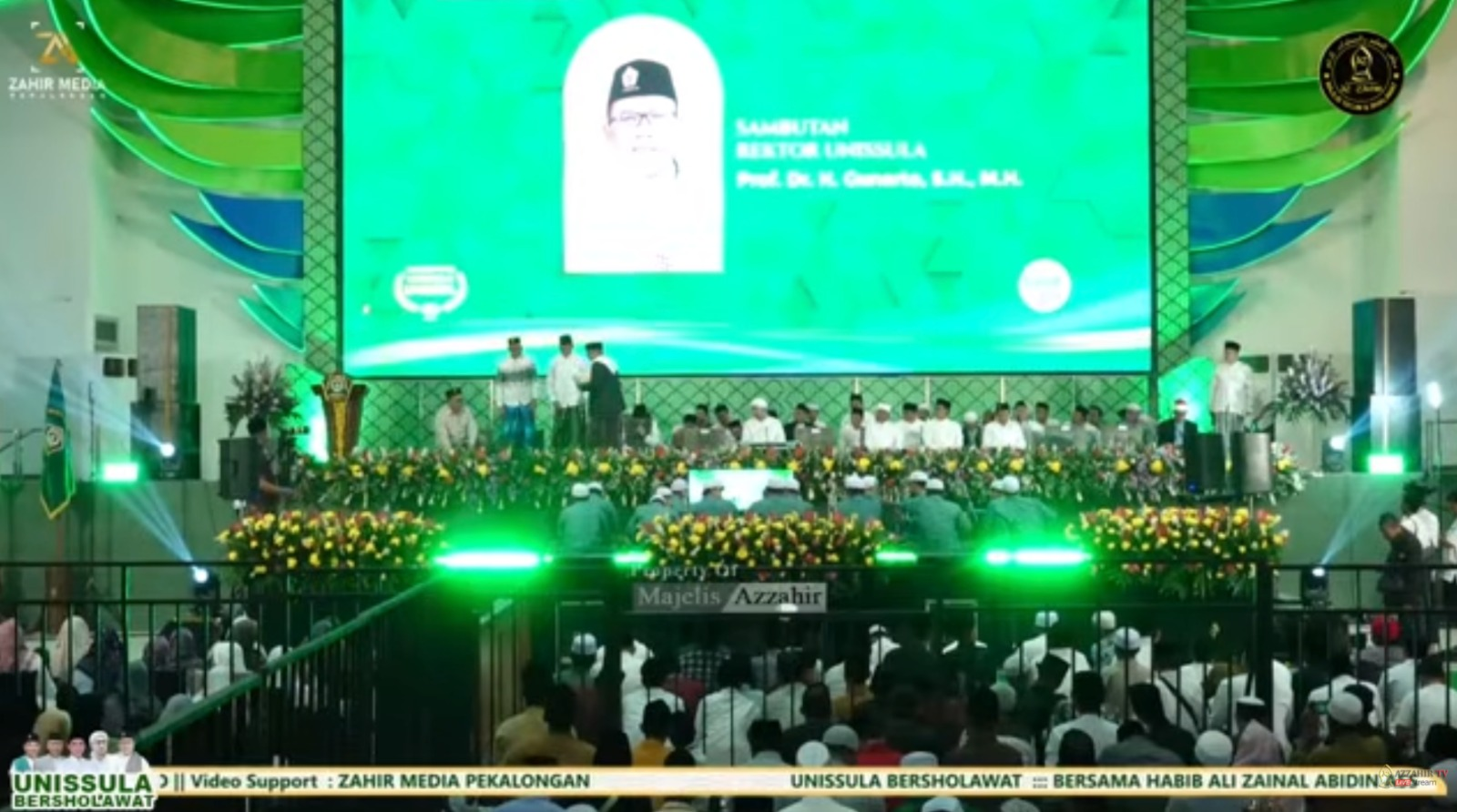
UNISSULA Bersholawat
One example is UNISSULA Bersholawat, a public cultural and religious activity involving collective sholawat and Islamic musical traditions.
The programme brings together the university community and wider public in the continuation of Islamic cultural practices.
Through collective participation, the event supports the transmission of:
- sholawat traditions;
- religious poetry;
- Islamic musical expression;
- community religious practices; and
- cultural knowledge associated with Indonesian Islamic traditions.
The activity is also documented through publicly accessible audiovisual recordings.
Public Audiovisual Documentation
UNISSULA makes recordings of cultural and religious activities available through digital media, allowing these traditions to remain accessible beyond the original event.
Public audiovisual evidence includes:
- UNISSULA cultural heritage video documentation;
- UNISSULA Bersholawat public documentation.
These recordings provide evidence that cultural traditions are not only practised but also recorded and preserved in a reusable digital format.
Rebana and Islamic Musical Heritage
Rebana represents another form of cultural expression supported within UNISSULA’s cultural environment.
Rebana performances combine:
- traditional percussion;
- religious poetry;
- collective singing;
- Islamic cultural expression; and
- community participation.
Supporting these performances contributes to the continuation of a form of cultural knowledge transmitted through practice and performance.
Documentation further allows these traditions to be preserved and disseminated to audiences beyond those attending the original activity.
Oral and Performative Knowledge
Much intangible cultural heritage depends on knowledge that is transmitted orally or through direct participation.
Traditional dance, wayang, sholawat, and rebana are particularly dependent on this process because their cultural value cannot be fully represented by physical objects alone.
They require the continuation of:
- performance skills;
- oral knowledge;
- musical techniques;
- choreography;
- stories;
- values; and
- community practices.
By providing spaces for participation and documentation, UNISSULA helps maintain these forms of knowledge.
Student Participation in Cultural Preservation
Students play an important role in UNISSULA’s cultural heritage activities.
Participation enables students to learn cultural practices directly while also helping maintain their continuity.
Student involvement includes:
- learning traditional performance techniques;
- participating in cultural events;
- performing traditional dance;
- participating in Islamic cultural performances;
- engaging with traditional narratives; and
- supporting documentation and dissemination.
This creates an intergenerational mechanism for cultural transmission.
Public Engagement
UNISSULA cultural activities are not limited to classroom teaching.
Many are presented through public-facing events, ceremonies, community programmes, and digital platforms.
This public dimension helps increase awareness of cultural traditions and enables cultural heritage to reach audiences beyond the university community.
Public participation and public documentation strengthen the social value of heritage preservation.
Digital Preservation
Digital media provide an important additional layer of preservation.
Video documentation enables cultural performances to remain available after the original event has concluded.
Digital preservation supports:
- repeated public viewing;
- educational use;
- documentation of performance traditions;
- preservation of oral and musical practices;
- institutional archives; and
- wider cultural dissemination.
Through public video documentation, UNISSULA extends cultural preservation from physical events into a digital environment.
Cultural Heritage and University Identity
Cultural preservation is also connected with UNISSULA’s institutional identity.
As an Islamic university in Central Java, UNISSULA operates within a cultural environment influenced by:
- Javanese traditions;
- Indonesian national culture;
- Islamic cultural practices; and
- local community traditions.
Activities involving traditional dance, wayang, sholawat, and rebana reflect this combination of local, national, and religious-cultural heritage.
Local, Regional and National Heritage
UNISSULA’s heritage activities address different levels of cultural significance.
Traditional and regional performing arts contribute to the preservation of local and regional heritage, while wayang and broader Indonesian traditions contribute to the preservation of national cultural heritage.
Islamic cultural practices such as sholawat and rebana provide an additional dimension of living religious-cultural heritage.
This creates a diverse preservation framework:
Local and regional traditions + National heritage + Islamic cultural traditions
Heritage through Performance and Documentation
UNISSULA combines two important approaches to cultural preservation.
The first is active practice, where students and communities continue performing traditional arts.
The second is documentation, where cultural activities are captured through photographs, videos, and digital publication.
The resulting model is:
Practice → Performance → Recording → Public dissemination → Preservation
This helps ensure that cultural heritage remains both actively practised and permanently documented.
Supporting Cultural Continuity
Cultural heritage can decline when younger generations no longer practise or experience traditional forms of expression.
University participation can help address this challenge by creating opportunities for students to learn, perform, document, and share cultural traditions.
UNISSULA’s activities therefore support cultural continuity by connecting traditional knowledge with contemporary university life.
Publicly Accessible Cultural Records
Public documentation is especially important because it allows cultural records to be accessed beyond the physical campus.
Online video recordings provide opportunities for:
- students;
- researchers;
- schools;
- cultural communities;
- alumni; and
- members of the public
to view and learn from documented cultural activities.
This increases both the accessibility and durability of cultural records.
Relationship with Arts and Heritage Activities
The heritage-preservation initiatives complement UNISSULA’s broader contribution to arts and culture.
While public performances support 11.2.5 Arts and Heritage Contribution, recording and preserving the knowledge, traditions, practices, and audiovisual documentation associated with those activities supports 11.2.6 Record and Preserve Cultural Heritage.
The distinction can be expressed as:
11.2.5 → Performing cultural arts
11.2.6 → Recording, transmitting and preserving cultural heritage
Contribution to SDG 11
UNISSULA’s activities contribute to SDG 11: Sustainable Cities and Communities, particularly the preservation of cultural heritage.
THE Sustainability Impact Ratings 2027 recognises projects that record and preserve intangible cultural heritage, including local folklore, traditions, language, and knowledge. The methodology separately recognises local/regional heritage, national heritage, and heritage associated with displaced communities.
UNISSULA’s documented activities primarily demonstrate contributions to local/regional and national cultural heritage through traditional arts, wayang, Islamic cultural traditions, and audiovisual documentation.
Evidence of Implementation
UNISSULA’s contribution to recording and preserving intangible cultural heritage is demonstrated through:
- Traditional dance performances preserving regional cultural practices.
- Photographic documentation of traditional dance activities.
- Wayang performances preserving Indonesian traditional storytelling and performance knowledge.
- Audiovisual documentation of wayang activities.
- Preservation of Islamic cultural traditions through sholawat.
- Preservation of rebana and Islamic musical practices.
- UNISSULA Bersholawat as a public religious-cultural tradition.
- Student participation in traditional and cultural performance activities.
- Public cultural performances connecting heritage with wider communities.
- Photographic records of cultural activities.
- Publicly accessible video documentation.
- Digital dissemination enabling cultural activities to remain accessible after the original performances.
- Continued transmission of cultural knowledge through participation, performance, and documentation.
- Preservation of both local/regional and Indonesian national cultural heritage.
11.4.1
Sustainable Practices Targets
11.4.1 Sustainable Commuting Measurement and Targets
University-Wide Sustainable Commuting Strategy
Universitas Islam Sultan Agung (UNISSULA) measures and promotes more sustainable commuting as part of its university-wide commitment to creating a low-emission, accessible, safe, and sustainable campus environment.
The university’s sustainable mobility approach is embedded in the UNISSULA Strategic Plan (RENSTRA) 2025–2029, which integrates the Sustainable Development Goals into institutional performance indicators, annual targets, programmes, monitoring, and evaluation.
For SDG 11, the Strategic Plan specifically addresses public transportation access, low-emission mobility, pedestrian pathways, green open spaces, safety, universal accessibility, and pollution reduction. Performance is measured through indicators that include the use of sustainable transportation, supported by mobility data and other institutional evidence.
Strategic Planning and Annual Targets
UNISSULA’s Strategic Plan establishes a performance-management framework in which institutional objectives are translated into measurable indicators, programmes, activities, and annual targets for the 2025–2029 period.
The university uses this framework to monitor progress and evaluate sustainability-related performance.
The Strategic Plan states that quantitative targets for 2025–2029 are incorporated into institutional performance matrices and subsequently translated into annual work plans and budgets.
Sustainable mobility therefore forms part of a broader institutional system of:
Planning → Measurement → Annual targets → Implementation → Monitoring → Improvement
Sustainable Transportation as an SDG 11 Priority
Within the SDG 11 framework, UNISSULA identifies campus transportation and mobility as important components of sustainable campus management.
The university’s strategy includes:
- access to public transportation;
- low-emission mobility;
- pedestrian infrastructure;
- universal accessibility;
- reduction of environmental pollution;
- safe campus movement; and
- monitoring of sustainable transportation use.
The Strategic Plan also identifies mobility data as evidence for evaluating implementation.
Measuring Sustainable Commuting
UNISSULA measures sustainable commuting through institutional mobility information and the use of sustainable transport modes across the campus.
Measurement can include the use and operation of:
- electric shuttle services;
- university buses;
- electric vehicles;
- electric bicycles;
- pedestrian pathways;
- park-and-ride connections;
- charging infrastructure; and
- other low-emission mobility facilities.
The university uses mobility-related information to support the evaluation of sustainable transportation and campus accessibility.
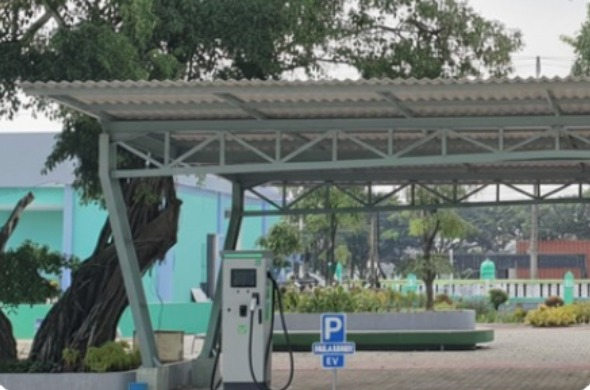
Electric Shuttle Service
UNISSULA operates an on-campus electric shuttle service to connect key university locations.
The service connects areas including:
- campus gates;
- park-and-ride areas;
- faculties;
- the library;
- the teaching hospital;
- dormitories;
- the mosque; and
- student service centres.
The electric shuttle is intended to reduce dependence on private vehicles in core campus corridors, lower emissions and noise, and improve safety for pedestrians and cyclists.
Transportation Support
UNISSULA provides several forms of institutional transportation support to reduce mobility barriers for students and other members of the university community.
The university provides:
- electric campus vehicles;
- electric bicycles;
- electric shuttle vehicles;
- university buses; and
- electric-vehicle charging infrastructure.
These facilities support movement between faculties, academic buildings, administrative units, and other campus facilities.
For short-distance campus mobility, electric vehicles and bicycles provide alternatives to private motorcycles and cars.
This supports the university’s objectives to:
- reduce transportation costs;
- improve connectivity between campus facilities;
- reduce dependence on private vehicles;
- support students with mobility or financial barriers; and
- promote low-emission transportation.
Electric Vehicle Infrastructure
UNISSULA supports the transition towards low-emission transportation through electric mobility infrastructure.
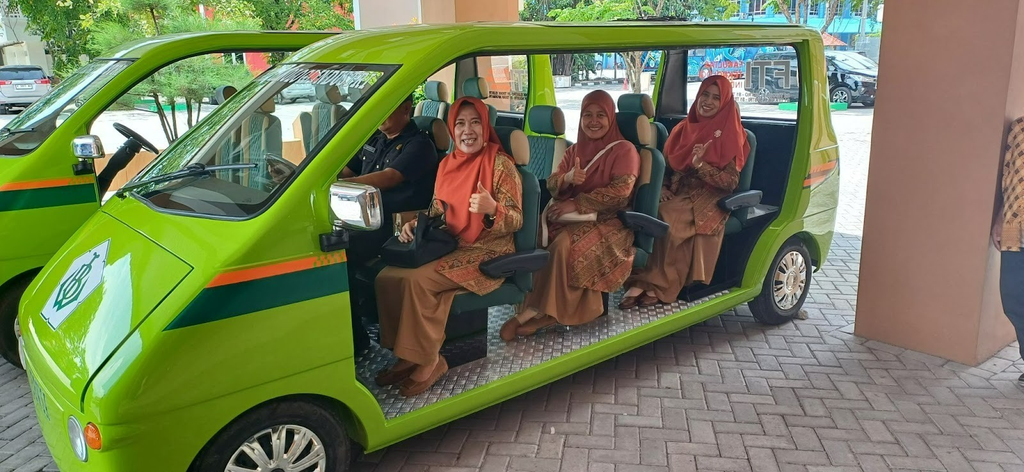
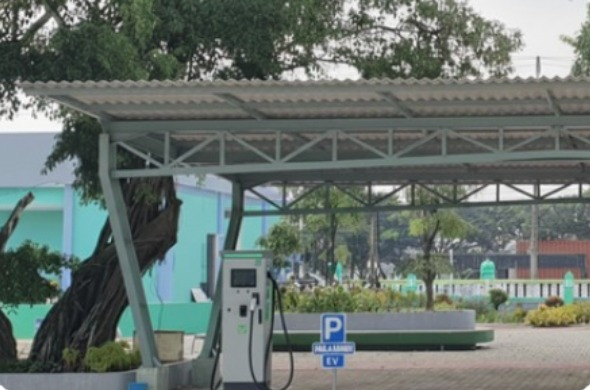
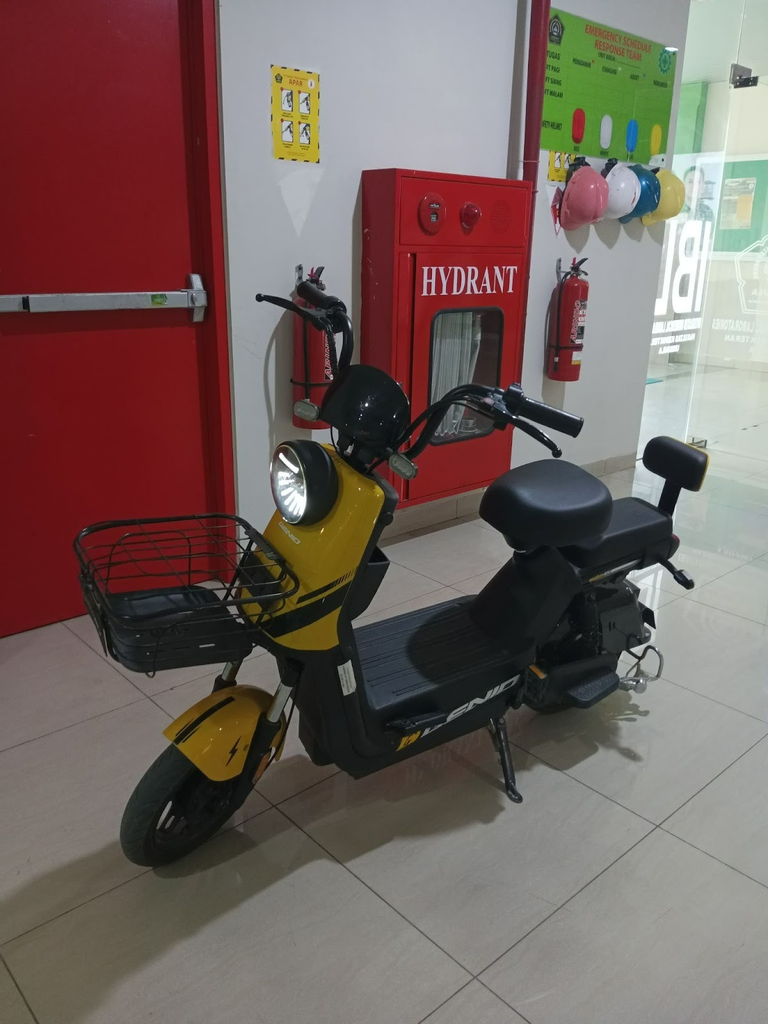
Electric vehicle charging facilities are available on campus to support the operation and use of electric vehicles.
The presence of charging infrastructure complements the university’s electric shuttle and other electric-mobility facilities and supports the gradual development of a lower-emission campus transport system.
University Bus Services
For longer-distance institutional activities, UNISSULA also maintains university buses.
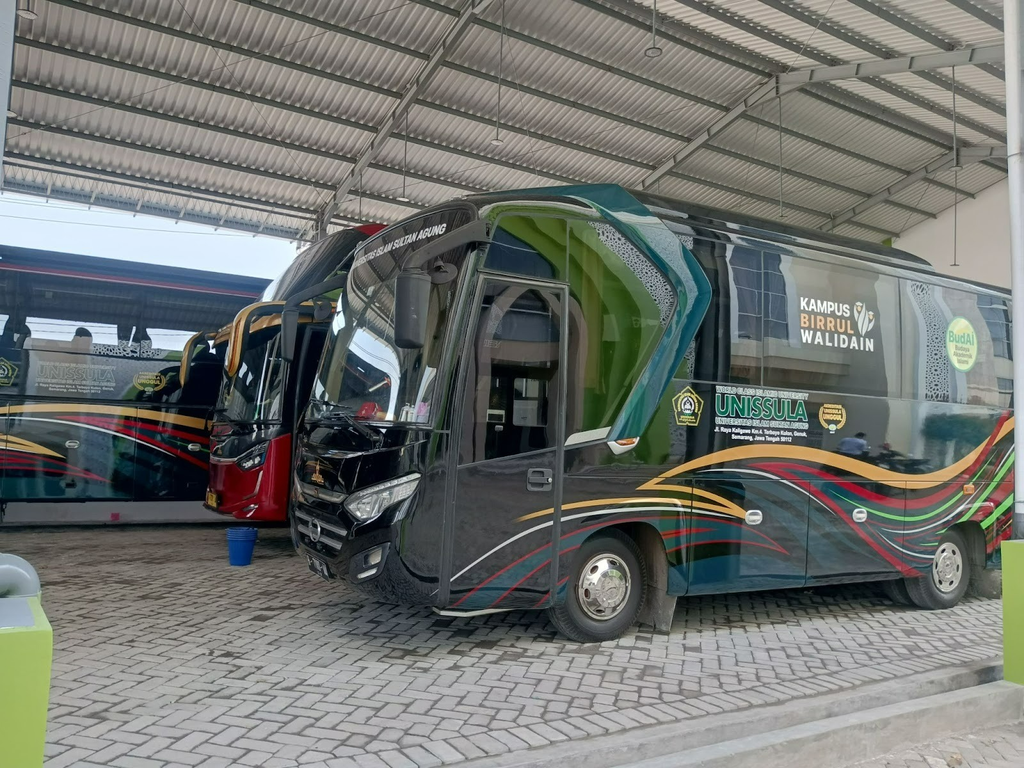
Students and student organisations may request university bus services through established institutional procedures.
Shared university transportation can reduce the need for multiple private vehicles when university groups travel for academic, student, or institutional activities.
Pedestrian-Friendly Campus
Walking is an important component of UNISSULA’s sustainable commuting strategy.

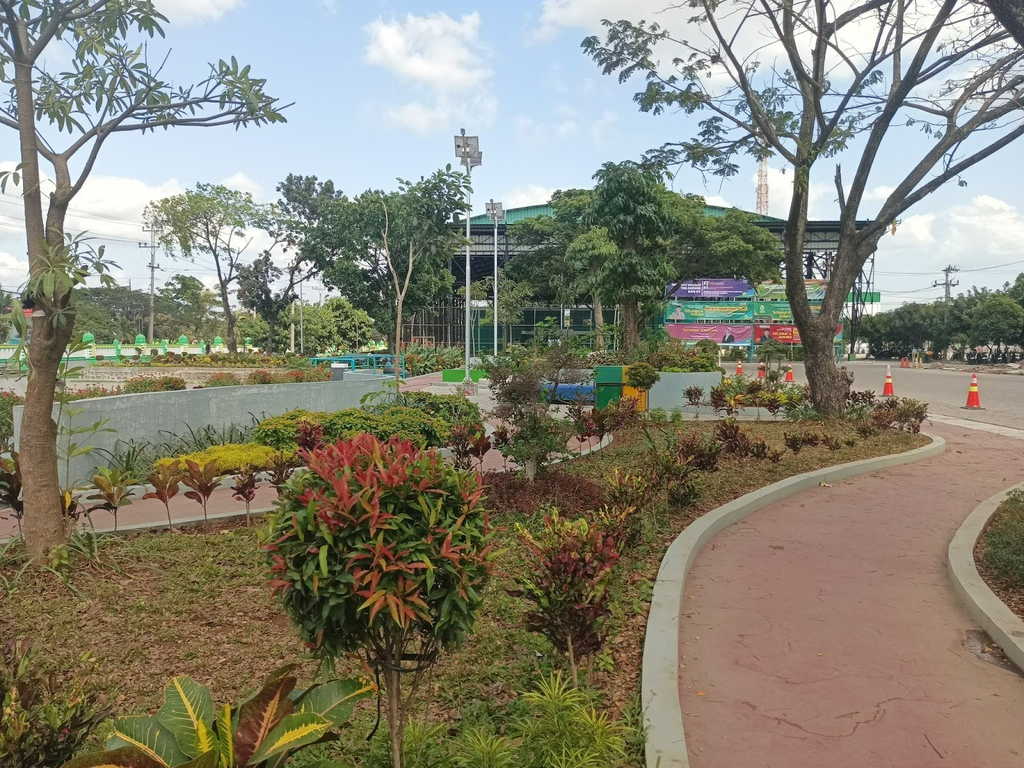
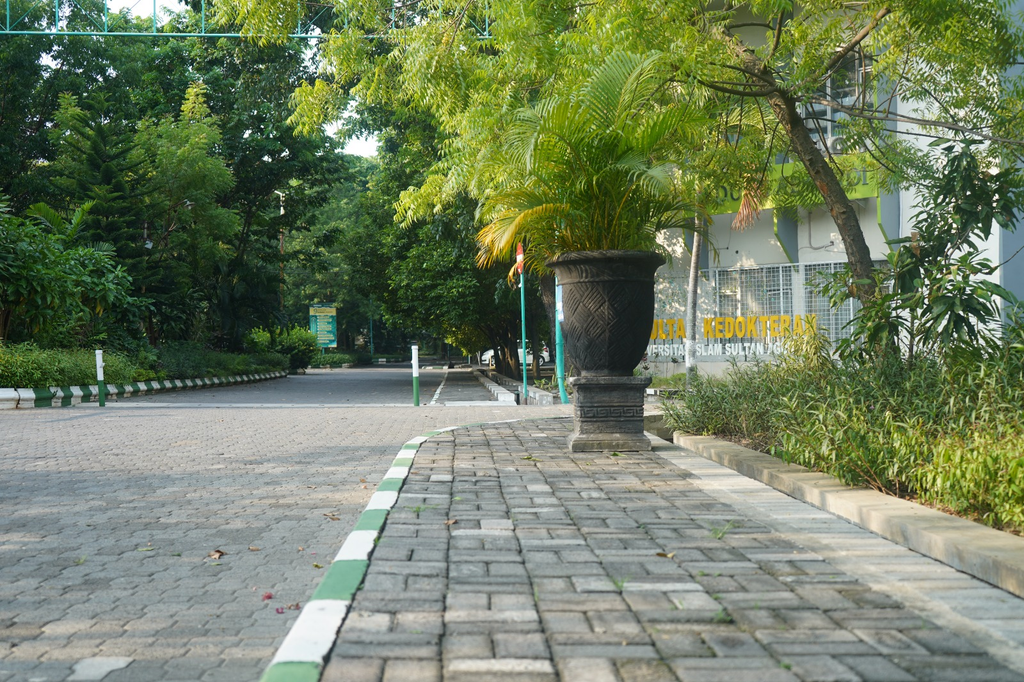


The university provides pedestrian pathways across the campus designed to support safe and accessible movement for students, staff, and visitors.
The pathways include:
- separated pedestrian routes;
- ramps;
- wheelchair-accessible entrances;
- directional signage;
- shaded walking environments; and
- sustainable lighting.
UNISSULA’s pedestrian infrastructure is explicitly intended to reduce reliance on motorised transportation for short-distance movement across campus.
Safe Pedestrian Infrastructure
Physical separators are installed between pedestrian pathways and vehicle roads to improve pedestrian safety.
The campus also provides ramps and accessible paths for wheelchair users and others requiring mobility assistance.
This allows sustainable commuting policies to support both environmental sustainability and universal accessibility.
Sustainable Lighting for Pedestrian Mobility
Pedestrian routes are supported by solar-powered street lighting.
These lights operate according to ambient light intensity and provide sustainable illumination for pedestrian movement during evening and nighttime periods.
This improves both the safety and environmental performance of campus walking infrastructure.
Encouraging Walking
UNISSULA’s pedestrian infrastructure is part of a broader strategy to encourage an active and environmentally responsible campus lifestyle.
By providing safe, comfortable, shaded, and connected pedestrian routes, the university encourages students and staff to walk for short-distance trips rather than relying on motorised vehicles.
This contributes to:
- lower transport emissions;
- reduced traffic pressure;
- improved health and physical activity;
- reduced dependence on private vehicles; and
- a more pedestrian-friendly campus.
Awareness and Behaviour Change
UNISSULA also supports sustainable commuting through awareness and educational activities.
The university promotes the benefits of pedestrian movement and environmentally responsible transportation to the campus community.
These initiatives help build a culture in which mobility choices are understood as part of shared environmental responsibility.
Low-Emission Mobility
The combination of electric mobility, shared transportation, and pedestrian infrastructure supports UNISSULA’s transition toward lower-emission campus transportation.
The university’s approach can be represented as:
Walking + Electric mobility + Shared transport + Public transport access → Reduced private vehicle dependence → Lower emissions
This approach aligns transport infrastructure with institutional sustainability goals.
Integration with Park-and-Ride
The electric shuttle system connects campus gates and park-and-ride areas with academic and service facilities.
This arrangement can reduce the need for private vehicles to travel through central campus areas.
Instead, users can combine:
Private/public arrival → Park-and-ride → Electric shuttle → Walking
This integrated approach supports more sustainable movement within the campus.
Accessibility and Inclusive Mobility
Sustainable transportation at UNISSULA is designed to be inclusive.
The electric shuttle documentation states that vehicles are accessible for persons with disabilities.
Pedestrian routes also incorporate:
- ramps;
- wheelchair-accessible pathways;
- accessible entrances; and
- safe route separation.
This ensures that sustainable mobility improvements also support people with different physical and mobility needs.
Monitoring and Institutional Evaluation
The Strategic Plan establishes monitoring as an integral part of institutional performance management.
Under the SDG 11 framework, achievement is evaluated through measures that include the use of sustainable transport, while supporting evidence includes mobility data, area maps, accessibility audits, and safety audits.
This provides an institutional basis for monitoring sustainable commuting rather than relying only on qualitative observation.
Target-Oriented Sustainable Mobility
UNISSULA’s Strategic Plan 2025–2029 operates through annual targets and periodic performance evaluation.
Sustainable transportation is incorporated into this framework as part of SDG 11 implementation.
The university therefore uses a target-oriented approach in which sustainable mobility measures are:
planned → implemented → measured → evaluated → progressively improved
The framework allows performance and mobility data to be reviewed as part of institutional sustainability management.
Continuous Improvement
UNISSULA continues to strengthen sustainable transportation through the development and improvement of:
- electric vehicles;
- electric shuttle services;
- electric bicycles;
- pedestrian pathways;
- public transportation access;
- shared university transportation;
- EV charging infrastructure;
- mobility monitoring; and
- awareness programmes.
Future improvements can be informed by mobility data and institutional performance evaluation.
Relationship with Green Campus Development
Sustainable commuting forms part of UNISSULA’s broader Green Campus agenda.
The university recognises transportation as one of the environmental areas requiring measurable improvement alongside energy, emissions, water, waste, and green spaces.
RENSTRA identifies the need for sustainability performance to be translated into measurable environmental outcomes, including transportation.
Contribution to SDG 11
UNISSULA’s sustainable commuting strategy contributes to SDG 11: Sustainable Cities and Communities by reducing dependence on private vehicles, supporting low-emission mobility, providing accessible walking infrastructure, and improving sustainable transportation options.
THE Sustainability Impact Ratings 2027 specifically assesses whether universities measure and set targets for more sustainable commuting, including walking, cycling, shuttle buses, public transportation, and electric vehicles.
The indicator provides up to three points based on:
- existence of measures and targets;
- evidence provided; and
- public availability of evidence.
Evidence of Implementation
UNISSULA’s measurement and target-oriented approach to sustainable commuting is demonstrated through:
- UNISSULA Strategic Plan 2025–2029, which integrates SDG 11 into institutional performance management.
- Institutional focus on public transport access and low-emission mobility.
- Measurement of sustainable transportation use as part of SDG 11 performance.
- Use of mobility data as institutional evidence.
- Electric campus shuttle services.
- Electric vehicles for internal campus movement.
- Electric bicycles for short-distance mobility.
- University bus services for shared transportation.
- Electric-vehicle charging infrastructure.
- Park-and-ride connections supported by campus shuttle services.
- Extensive pedestrian pathways.
- Wheelchair-accessible pedestrian infrastructure.
- Physical separation between pedestrian paths and vehicle roads.
- Solar-powered lighting along pedestrian areas.
- Programmes encouraging walking and reduced dependence on motorised transport.
- Annual institutional planning, monitoring, and performance review mechanisms.
11.4.2
Promote Sustainable Commuting
11.4.2 Actions to Promote More Sustainable Commuting
University-Wide Promotion of Sustainable Commuting
Universitas Islam Sultan Agung (UNISSULA) undertakes a range of practical actions to promote more sustainable commuting among students, lecturers, staff, and other members of the university community.
These actions are designed to reduce reliance on private motor vehicles, lower transport-related emissions, improve mobility between campus facilities, and encourage greater use of low-emission and non-motorised transport.
UNISSULA’s sustainable commuting initiatives include:
- electric shuttle services;
- university buses and shared transport;
- electric vehicles for internal mobility;
- electric bicycles;
- electric-vehicle charging infrastructure;
- pedestrian pathways;
- park-and-ride connections; and
- awareness activities encouraging walking and more sustainable travel choices.
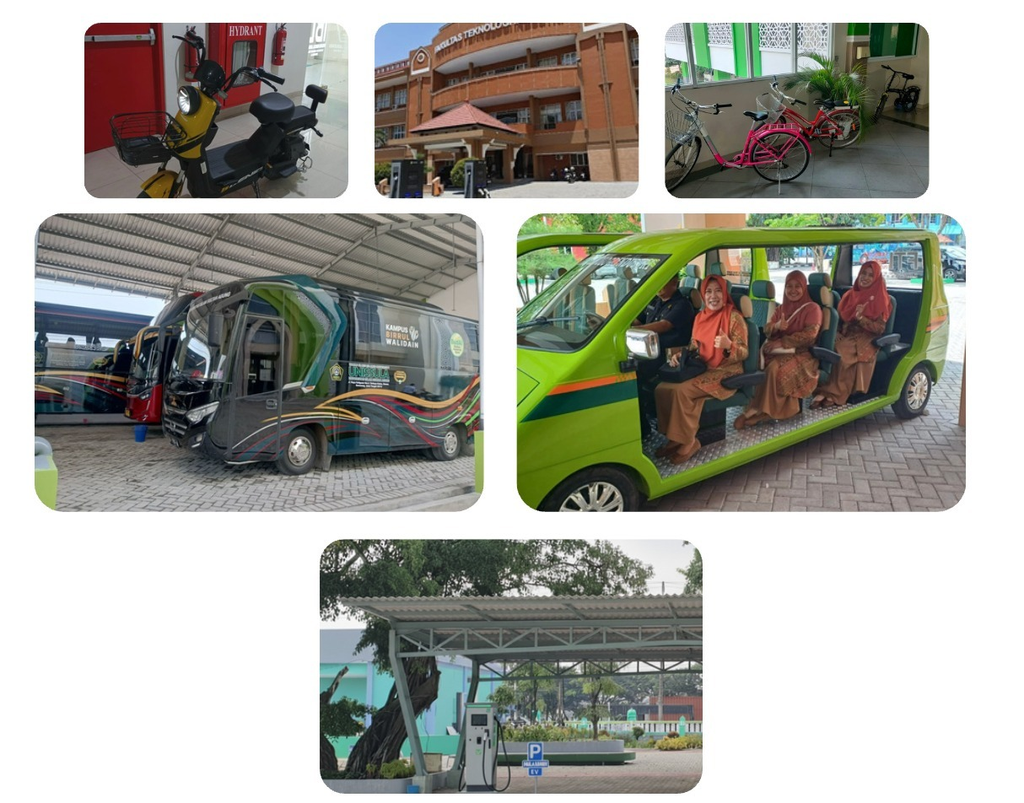
Electric Shuttle Services
UNISSULA operates an electric shuttle service to support low-emission mobility across the campus.
The shuttle connects important campus locations, including:
- campus gates;
- park-and-ride areas;
- faculties;
- the library;
- the teaching hospital;
- dormitories;
- the mosque; and
- student service centres.
The service is specifically designed to reduce private vehicle use in core campus corridors, lower emissions and noise, and improve safety for pedestrians and cyclists.
Shared University Transportation
UNISSULA also provides university buses that can be used for institutional and student activities.
For longer-distance university activities, students and student organisations may request the use of university buses through a formal borrowing procedure.
This shared-transport approach helps reduce the need for multiple private vehicles when groups travel for academic, student, or institutional purposes.
Electric Vehicles for Internal Campus Mobility
For short-distance movement within the campus, UNISSULA provides university-developed electric vehicles.
These vehicles support travel between faculties, academic buildings, administrative units, and other campus facilities.
Electric campus vehicles help:
- reduce dependence on private motorcycles and cars;
- lower emissions from short internal trips;
- improve accessibility between university facilities; and
- provide a more sustainable mobility option for campus users.
Electric Bicycle Support
UNISSULA also provides electric bicycles for internal campus mobility.
Electric bicycles offer a low-emission alternative for short-distance trips and support more sustainable movement between different parts of the campus.
The availability of bicycles contributes to a broader transport approach that combines:
Walking + Cycling + Electric Mobility + Shared Transport
Electric Vehicle Charging Infrastructure
The university supports electric mobility through the provision of electric-vehicle charging stations.
Charging infrastructure helps enable the use of electric vehicles on campus and supports the continued development of low-emission transportation.
The presence of charging stations also demonstrates institutional support for the transition from conventional fuel-based vehicles toward electric mobility.
Park-and-Ride Connectivity
UNISSULA’s shuttle system connects with campus gates and park-and-ride areas.
This allows campus users to reduce the use of private vehicles in central campus areas by combining different transport modes.
The mobility model can be represented as:
Arrival at campus → Park-and-ride → Electric shuttle → Walking
This helps reduce unnecessary vehicle movement within the campus.
Pedestrian-Friendly Campus
Walking forms an important component of UNISSULA’s sustainable commuting strategy.
The university provides pedestrian pathways designed to support safe, comfortable, and accessible movement across campus.
These pathways are constructed with attention to:
- safety;
- accessibility;
- route connectivity;
- comfort;
- environmental quality; and
- separation from vehicular traffic.
The development of these pedestrian routes is part of a broader strategy to reduce reliance on motorised transportation for short-distance travel.
Safe Pedestrian Infrastructure
UNISSULA provides physical separation between pedestrian walkways and vehicle roads to improve safety.
The pedestrian network also includes:
- ramps;
- wheelchair-accessible routes;
- accessible building entrances;
- directional signage; and
- shaded walking areas.
This enables sustainable commuting to support both environmental sustainability and inclusive mobility.
Solar-Powered Lighting
Pedestrian pathways are supported by solar-powered street lamps.
The lighting improves visibility and safety for pedestrians while using a renewable-energy-based solution.
This supports sustainable commuting by making walking more practical during evening and nighttime periods.
Encouraging Walking
UNISSULA encourages walking as a practical alternative to motorised travel for short journeys within campus.
The university’s pedestrian environment is designed to make walking:
- safe;
- convenient;
- attractive;
- shaded; and
- accessible.
This helps reduce dependence on private motor vehicles while also promoting physical activity and well-being.
Awareness and Education
UNISSULA also undertakes awareness and educational activities to encourage the use of pedestrian facilities and more sustainable transportation.
The university promotes understanding of the environmental benefits of walking and reduced reliance on private vehicles.
These efforts help strengthen a shared culture of environmentally responsible mobility.
Reducing Private Vehicle Dependence
A central objective of UNISSULA’s sustainable commuting actions is to reduce dependence on privately operated motorcycles and cars for internal campus movement.
The university addresses this through:
- electric shuttle services;
- shared buses;
- electric vehicles;
- electric bicycles;
- park-and-ride arrangements; and
- pedestrian infrastructure.
This provides campus users with practical alternatives to private vehicle use.
Low-Emission Mobility
The use of electric vehicles and non-motorised transport supports a reduction in transport-related emissions.
UNISSULA’s approach combines several low-emission options rather than relying on a single programme.
The resulting mobility framework is:
Walking + Electric bicycle + Electric vehicle + Electric shuttle + Shared bus
This creates multiple sustainable commuting choices for different travel needs.
Supporting Inclusive Mobility
Sustainable commuting at UNISSULA is designed to be inclusive.
The electric shuttle service is described as accessible for persons with disabilities.
Pedestrian infrastructure also incorporates:
- wheelchair-accessible ramps;
- smooth pathways;
- accessible entrances; and
- safe route design.
This helps ensure that sustainable transportation is available to users with different mobility needs.
Connecting Key Campus Facilities
Sustainable transportation services are designed to connect the most important locations within the university.
These include:
- faculties;
- academic buildings;
- administrative areas;
- the library;
- hospital facilities;
- dormitories;
- religious facilities; and
- student service centres.
Improved connectivity makes sustainable transport more practical as an everyday mobility option.
Institutional Transportation Support
UNISSULA’s transportation-support system helps reduce mobility barriers for members of the university community.
The university provides electric mobility and shared transportation to support:
- affordability;
- accessibility;
- convenience;
- campus connectivity;
- reduced dependence on private vehicles; and
- lower-emission travel.
This makes sustainable commuting part of ordinary campus operations rather than a stand-alone environmental campaign.
Sustainable Mobility Infrastructure
UNISSULA supports commuting behaviour through physical infrastructure.
This includes:
- EV charging stations;
- pedestrian pathways;
- accessible ramps;
- shuttle routes;
- park-and-ride connections;
- shared university vehicles; and
- bicycle facilities.
Infrastructure provision is important because it turns sustainability objectives into practical transport choices.
Relationship with the Strategic Plan
UNISSULA’s sustainable commuting actions are consistent with the UNISSULA Strategic Plan 2025–2029.
Under SDG 11, the Strategic Plan identifies:
- public transportation access;
- low-emission mobility;
- pedestrian pathways;
- universal accessibility;
- safety; and
- pollution reduction
as elements of sustainable campus management.
This connects individual transport initiatives to a wider university sustainability strategy.
From Strategy to Action
UNISSULA’s approach can be represented as:
Institutional sustainability strategy → Sustainable transport infrastructure → Mobility services → Behavioural encouragement → Reduced private vehicle dependence
This demonstrates that the university combines policy direction with practical actions.
Contribution to SDG 11
UNISSULA’s sustainable commuting initiatives contribute to SDG 11: Sustainable Cities and Communities by supporting low-emission, shared, accessible, and non-motorised mobility.
THE Sustainability Impact Ratings 2027 assesses whether universities undertake actions to promote a higher proportion of sustainable commuting.
Relevant examples identified by THE include:
- free or subsidised buses;
- shared transport schemes;
- bicycle facilities;
- bicycle and pedestrian policies;
- bicycle sharing;
- carpooling;
- electric-vehicle charging stations; and
- preferential support for lower-emission transport.
UNISSULA implements several actions directly aligned with these examples.
For 11.4.2, THE awards up to three points based on the existence of actions, supporting evidence, and whether the evidence is publicly available.
Evidence of Implementation
UNISSULA’s actions to promote more sustainable commuting are demonstrated through:
- Electric shuttle services for internal campus mobility.
- Shared university bus services.
- Electric vehicles for movement between campus facilities.
- Electric bicycles for short-distance travel.
- Electric-vehicle charging stations.
- Park-and-ride connectivity.
- Pedestrian pathways throughout the campus.
- Separation between pedestrian and vehicle routes.
- Wheelchair-accessible pedestrian infrastructure.
- Solar-powered pedestrian lighting.
- Accessible electric shuttle services.
- Awareness activities promoting pedestrian mobility.
- Measures aimed at reducing dependence on private motor vehicles.
- Integration of sustainable mobility into the university’s SDG 11 strategy.
11.4.3
Allow Remote Working
11.4.3 Allow Remote Working
University Policy on Remote Working
Universitas Islam Sultan Agung (UNISSULA) promotes and allows remote working and Work From Home (WFH) arrangements for employees as part of its institutional efforts to reduce employee commuting, support work flexibility, and contribute to the reduction of carbon emissions.
The university’s remote-working approach is supported by formal institutional policy and by digital systems that enable suitable academic and administrative activities to be carried out without requiring employees to be physically present on campus at all times.

Formal Work From Home Policy
UNISSULA has an official policy permitting employees to work remotely.
Through Circular Letter No. 7584/J/SA/VI/2024, the university established a Work From Home arrangement in support of efforts to reduce the impact of carbon emissions.
The circular states that all UNISSULA employees are given the opportunity to work from home four times each month. The specific WFH days may be determined by each unit, bureau, or institution according to operational needs.
This provides a clear institutional basis for recurring remote working.
Remote Working as a Regular Institutional Practice
UNISSULA’s remote-working arrangement is established as a regular institutional practice rather than only as an emergency measure.
The policy gives employees the opportunity to undertake WFH four times per month, while individual units are allowed to determine suitable WFH days based on their operational responsibilities.
This recurring arrangement demonstrates that remote working forms part of the university’s working practices and provides a practical mechanism for reducing the frequency of employee commuting.
Reducing Employee Commuting
The WFH policy directly supports efforts to reduce the number of employee journeys to and from the university.
By allowing remote working on designated days, UNISSULA can reduce:
- regular commuting trips;
- private vehicle use;
- fuel consumption;
- transport-related emissions;
- commuting costs for employees; and
- pressure on campus transportation and parking.
Remote working therefore complements other sustainable mobility measures implemented by the university.
Carbon Emission Reduction
The environmental purpose of the policy is explicitly stated in the institutional circular.
The WFH arrangement was introduced in support of policies related to the reduction of the impact of carbon emissions at UNISSULA.
The relationship between remote work and environmental sustainability can be represented as:
Remote working → Fewer commuting journeys → Lower transport demand → Reduced carbon-emission impacts
This makes WFH an important component of UNISSULA’s sustainable campus approach.
Institution-Wide Coverage
The remote-working policy applies broadly across the university.
The circular states that all UNISSULA employees are given the opportunity to undertake WFH four times per month.
This means the arrangement is not limited to a single faculty, department, or administrative unit.
Its institution-wide scope increases the potential contribution of the policy to reducing employee commuting.
Flexible Scheduling by University Units
UNISSULA allows individual units, bureaux, and institutions to determine the appropriate day for Work From Home.
This approach provides flexibility while maintaining essential university operations.
The arrangement enables each unit to balance:
- operational requirements;
- service continuity;
- employee responsibilities;
- productivity; and
- sustainability objectives.
The policy therefore combines institution-wide eligibility with decentralised operational implementation.
Supporting Flexible Working Arrangements
Remote working provides employees with greater flexibility in carrying out suitable work activities.
Activities that can be completed digitally may be carried out without requiring physical presence on campus.
This contributes to a more flexible working environment while reducing unnecessary commuting.
The approach is particularly relevant for administrative, coordination, academic-support, and digital work activities that can be completed through university information systems and online communication platforms.
Digital Infrastructure for Remote Work
UNISSULA’s digital infrastructure supports the practical implementation of remote working.
Digital systems allow employees to perform a range of activities remotely, including:
- communication;
- coordination;
- academic administration;
- documentation;
- online meetings;
- access to university information systems; and
- digital academic services.
The availability of these systems makes remote working operationally feasible.
Remote Academic Activities
For academic staff, UNISSULA also supports online and blended academic activities.
The university has established digital learning infrastructure through platforms such as the SINAU learning management system, enabling lecturers to manage teaching materials, communicate with students, and conduct academic activities digitally.
This digital capacity supports the university’s broader ability to implement remote working where appropriate.
Online and Blended Learning Support
UNISSULA’s academic systems allow learning activities to be conducted through online and blended formats.
The university’s digital environment supports:
- online teaching;
- asynchronous learning;
- synchronous interaction;
- digital learning materials;
- online academic communication; and
- electronic academic administration.
These systems reduce the need for every academic activity to take place physically on campus.
Sustainable Mobility and Remote Working
Remote working complements UNISSULA’s wider sustainable commuting strategy.
The university promotes more sustainable mobility through several approaches, including:
- electric shuttle services;
- electric vehicles;
- shared transportation;
- pedestrian mobility; and
- remote working.
Remote work is particularly important because it can eliminate certain commuting journeys altogether.
The combined approach can be represented as:
Sustainable transport + Remote working → Reduced private vehicle dependence → Lower commuting emissions
Reducing Transport Demand at the Source
Many sustainable transport initiatives focus on replacing high-emission travel with lower-emission alternatives.
Remote working goes one step further by reducing the need for some journeys to occur at all.
By allowing employees to work from home on designated days, UNISSULA can reduce transport demand at its source.
This contributes to a more sustainable pattern of employee mobility.
Environmental Benefits
Remote-working arrangements can provide several environmental benefits.
These may include:
- lower fuel consumption;
- fewer vehicle journeys;
- reduced transport emissions;
- reduced traffic pressure around the campus;
- reduced demand for parking; and
- more efficient use of campus resources.
The university’s remote-working policy therefore supports both organisational flexibility and environmental sustainability.
Employee Benefits
Remote working can also provide benefits for employees.
These include:
- reduced commuting time;
- lower transportation costs;
- greater work flexibility;
- reduced exposure to traffic congestion; and
- improved ability to organise suitable work activities.
The policy therefore provides social and operational benefits alongside environmental advantages.
Institutional Efficiency
Flexible remote-working arrangements can support institutional efficiency when implemented appropriately.
Allowing units to determine suitable WFH days means that remote work can be aligned with each unit’s service responsibilities and operational requirements.
This helps ensure that sustainability objectives do not compromise essential university services.
Remote Working and Organisational Resilience
The ability to work remotely also strengthens institutional resilience.
Digital working systems allow the university to continue suitable activities without requiring every employee to be physically present on campus.
This provides greater flexibility in responding to changing operational conditions while maintaining continuity of university services.
Relationship with Sustainable Campus Development
UNISSULA’s remote-working policy forms part of a broader effort to develop more sustainable university operations.
Sustainable mobility is not limited to changing the type of vehicle used for commuting.
It also includes reducing the number of journeys that need to take place.
Remote working contributes directly to this objective.
Contribution to SDG 11
UNISSULA’s remote-working arrangements contribute to SDG 11: Sustainable Cities and Communities by reducing employee commuting and supporting more sustainable patterns of university operations.
THE Sustainability Impact Ratings 2027 assesses whether universities promote or allow telecommuting or remote working for employees as a matter of policy or standard practice, or offer a condensed working week to reduce employee commuting.
The indicator provides up to three points based on:
- existence of telecommuting;
- evidence provided; and
- public availability of the evidence.
UNISSULA addresses this criterion through its formal and recurring WFH policy.
Evidence of Implementation
UNISSULA’s remote-working arrangements are demonstrated through:
- Circular Letter No. 7584/J/SA/VI/2024 establishing Work From Home arrangements.
- WFH availability for all UNISSULA employees.
- Remote working permitted four times per month.
- Flexible determination of WFH days by individual units, bureaux, and institutions.
- An explicit connection between the WFH policy and efforts to reduce carbon-emission impacts.
- Digital systems supporting remote administrative and academic activities.
- Online communication and coordination infrastructure.
- Digital academic administration.
- Online and blended academic activities.
- Integration of remote working with the university’s broader sustainable mobility approach.
11.4.4
Affordable Housing For Employees
11.4.4 Affordable Housing for Employees
University-Managed Housing for Employees
Universitas Islam Sultan Agung (UNISSULA) provides access to university-managed housing facilities for members of the university community, including lecturers and administrative staff.
Through its Rusunawa (University Flats), UNISSULA provides accommodation facilities that may be used by lecturers, educational staff, and students in accordance with university procedures.
The provision of university-managed accommodation supports employees who require housing close to the campus and contributes to a more accessible and supportive working environment.

Formal Institutional Provision
The availability of Rusunawa for employees is supported by an official university policy.
Through Circular Letter No. 6109/J/SA/VI/2022, UNISSULA states that its Rusunawa may be used by members of the university community, including:
- lecturers;
- educational and administrative staff; and
- students.
The circular also establishes that use of the facility is managed through institutional procedures and that the arrangement serves as a continuing basis for the utilisation of the Rusunawa.
This provides a formal institutional basis for employee access to university-managed accommodation.
Direct Provision of Housing
UNISSULA directly provides the housing facility through the university’s own Rusunawa infrastructure.
This is significant because employees do not depend solely on the private housing market when university accommodation is available.
The Rusunawa provides an additional accommodation option for employees who may need housing close to their workplace.
The university therefore supports employees through direct access to institutionally managed housing.
Housing Access for Lecturers
Lecturers are explicitly included among the groups permitted to use the Rusunawa.
The university circular states that Rusunawa facilities are available to the academic community, including lecturers.
This provides academic employees with an institutional housing option that can support their work and activities at the university.
Housing Access for Administrative and Educational Staff
The policy also explicitly includes tenaga kependidikan, or educational and administrative staff.
This ensures that housing access is not limited to academic personnel.
Employees from different areas of university operations may therefore access the Rusunawa according to established university procedures.
Supporting Employee Accessibility
Providing housing close to the university can help employees address practical challenges associated with commuting and accommodation.
University-managed housing may support:
- employees who live far from campus;
- staff requiring temporary accommodation;
- employees participating in university activities;
- lecturers with intensive academic responsibilities;
- staff whose duties require proximity to campus facilities; and
- members of the university community requiring short- or medium-term accommodation.
This provides employees with an additional housing option within the university environment.
Supporting Reduced Commuting
The availability of housing near the workplace can also contribute to sustainable mobility.
Employees staying in university-managed accommodation can reduce the need for longer-distance daily commuting.
The relationship can be represented as:
Campus housing → Shorter commuting distance → Reduced transport demand → Lower environmental impact
This complements UNISSULA’s broader sustainable commuting initiatives.
University-Managed Accommodation
The Rusunawa is managed as part of UNISSULA’s institutional facilities.
Use of the facility follows university procedures designed to maintain:
- order;
- cleanliness;
- responsible use; and
- appropriate management of the accommodation.
The official circular establishes a continuing institutional basis for the management and utilisation of the Rusunawa.
Supporting the University Community
UNISSULA adopts an inclusive approach to the use of its Rusunawa.
The facility is available to members of the university community across different groups rather than being restricted only to students.
By including lecturers and staff, UNISSULA recognises that housing can also be an important element of employee support.
Employee Well-Being
Access to university-managed housing can contribute to employee well-being by providing an accommodation option close to the workplace.
Potential benefits include:
- reduced commuting time;
- improved access to campus;
- greater convenience;
- reduced travel-related stress;
- improved participation in university activities; and
- greater flexibility for employees with responsibilities on campus.
Housing provision therefore supports both employee welfare and institutional effectiveness.
Supporting Academic and University Activities
The Rusunawa can also support employees who need accommodation in connection with academic, administrative, and university activities.
Its proximity to campus facilities enables easier participation in:
- academic programmes;
- university meetings;
- institutional events;
- student activities;
- community activities; and
- other university responsibilities.
This supports the effective use of university facilities and employee participation in institutional activities.
Inclusive Access to University Facilities
The university’s circular explicitly establishes that the Rusunawa may be used by the broader academic community.
This demonstrates that accommodation facilities are considered part of the university’s shared institutional infrastructure.
Providing access to lecturers, staff, and students strengthens the inclusive use of campus resources.
Housing and Sustainable Campus Development
Employee housing can contribute to sustainable campus development by bringing employees closer to their workplace.
When employees are able to stay near campus, the university may reduce the need for long-distance daily commuting.
This can contribute to:
- reduced transport demand;
- lower fuel consumption;
- reduced commuting costs;
- lower transport-related emissions; and
- improved accessibility to university facilities.
Relationship with Sustainable Mobility
UNISSULA’s employee housing provision complements other sustainable mobility initiatives.
The university’s broader approach includes:
- sustainable transportation;
- pedestrian mobility;
- electric transport;
- remote working; and
- university-managed housing.
Together, these measures can reduce the environmental and financial burden associated with commuting.
Institutional Management and Continuity
The official circular states that the arrangements for the use of the Rusunawa remain in force from the date of establishment and serve as the basis for its continuing utilisation.
This demonstrates that access to the facility is supported by an institutional arrangement rather than an isolated activity.
Contribution to SDG 11
UNISSULA’s provision of housing facilities for employees contributes to SDG 11: Sustainable Cities and Communities by supporting access to accommodation and potentially reducing commuting burdens.
THE Sustainability Impact Ratings 2027 assesses whether universities provide affordable housing for employees.
The indicator provides up to three points. The existence component recognises universities that:
- evaluate housing affordability;
- provide housing directly; and
- provide financial support for housing.
UNISSULA currently demonstrates the direct provision of university-managed housing through its Rusunawa facility, which is accessible to lecturers and educational staff.
Evidence of Implementation
UNISSULA’s employee housing provision is demonstrated through:
- Circular Letter No. 6109/J/SA/VI/2022 governing the use of Rusunawa.
- Direct provision of university-managed accommodation.
- Explicit access for lecturers.
- Explicit access for educational and administrative staff.
- Access for the wider university community.
- Institutional procedures governing use of the accommodation.
- Continuing institutional management of the Rusunawa.
- Provision of accommodation close to university facilities.
- Support for employees participating in university activities.
- Potential reduction in commuting requirements for employees using campus housing.
11.4.5
Affordable Housing For Students
11.4.5 Affordable Housing for Students
University-Managed Housing for Students
Universitas Islam Sultan Agung (UNISSULA) provides access to university-managed housing facilities for students through its Rusunawa (Rumah Susun Mahasiswa).
The university provides this accommodation as part of its institutional facilities to support student access to housing, reduce mobility barriers, and improve students’ ability to participate in academic and university activities.
The Rusunawa is available to members of the university community, including students, lecturers, and educational staff, under established institutional procedures.
Formal Institutional Provision
The availability of Rusunawa for students is formally supported through Circular Letter No. 6109/J/SA/VI/2022.
The circular states that the UNISSULA Rusunawa may be used by members of the academic community, including:
- students;
- lecturers; and
- educational and administrative staff.
The same circular also establishes that use of the Rusunawa follows institutional procedures and that the arrangement provides a continuing basis for the utilisation of the facility.
This demonstrates that student housing is provided directly by the university rather than relying entirely on external private accommodation.
Direct Provision of Student Housing
UNISSULA directly provides housing through its own Rusunawa facility.
This gives students access to a university-managed accommodation option that can support their academic activities and daily life.
Direct university provision can help students who:
- live far from campus;
- require accommodation close to academic facilities;
- need temporary or longer-term housing;
- participate in intensive academic activities;
- require convenient access to university services; or
- would otherwise depend entirely on private rental housing.
Housing Access for Students
Students are explicitly included among the groups permitted to use the Rusunawa.
The university circular identifies students as eligible users of the facility together with lecturers and educational staff.
This provides students with an institutional housing option within the UNISSULA environment.
Supporting Access to Education
Access to housing close to campus can help students participate more effectively in university life.
University-managed accommodation can reduce barriers associated with:
- long commuting distances;
- transportation costs;
- time spent travelling;
- difficulties accessing early or late academic activities; and
- limited access to nearby private accommodation.
Housing provision can therefore contribute indirectly to student access and continuity of study.
Supporting Student Well-Being
Student accommodation can also support well-being by providing an additional housing option close to university facilities.
Potential benefits include:
- reduced commuting time;
- improved access to classrooms and services;
- easier participation in student activities;
- greater convenience;
- reduced travel-related fatigue; and
- stronger integration into the university community.
University-Managed Accommodation
The Rusunawa is managed under institutional procedures designed to ensure orderly and responsible use.
The university circular states that utilisation of the facility is conducted through a formal borrowing or use procedure while maintaining:
- order;
- cleanliness;
- responsibility; and
- proper management of university facilities.
This helps ensure that student accommodation remains part of a structured institutional support system.
Continuing Institutional Availability
The circular further states that the arrangement remains in effect from the date of establishment and serves as the basis for the continuing utilisation of the Rusunawa.
This indicates that access to the facility is not an isolated event, but part of an ongoing university arrangement.
Supporting Students from Different Circumstances
University-managed housing can be particularly valuable for students who come from outside the local area or who face mobility barriers.
By providing accommodation within the university environment, UNISSULA gives students an additional option that can help them remain connected to academic activities and campus services.
This can support a more inclusive learning environment by reducing the practical difficulties associated with housing and commuting.
Reducing Student Commuting
Housing close to campus can also contribute to sustainable mobility.
Students staying in university-managed accommodation may need to travel shorter distances for academic activities.
The relationship can be represented as:
Campus housing → Shorter travel distance → Reduced commuting demand → Lower transport impact
This complements UNISSULA’s wider sustainable commuting initiatives.
Relationship with Sustainable Campus Development
Student housing forms part of a broader sustainable campus approach.
Alongside sustainable transport, pedestrian mobility, electric vehicles, and remote-working arrangements, campus accommodation can help reduce unnecessary travel and improve access to university services.
The provision of housing therefore supports both student welfare and sustainable campus management.
Supporting Academic Participation
Students living close to campus can more easily access:
- lectures;
- laboratories;
- libraries;
- student service centres;
- religious facilities;
- student organisations;
- academic events; and
- other university programmes.
This improves practical access to university resources and can support stronger participation in campus life.
Inclusive Use of University Facilities
UNISSULA’s Rusunawa is not limited to a single group.
The facility is available to students as well as other members of the university community.
This reflects an inclusive approach to the use of institutional infrastructure and helps maximise the social value of university facilities.
Student Housing and Affordability
UNISSULA directly provides university-managed housing for students.
At present, the strongest documented evidence demonstrates the direct provision of housing.
The current evidence does not establish:
- a formal assessment of housing affordability;
- a below-market housing tariff; or
- financial aid specifically for housing.
For this reason, UNISSULA’s evidence for this indicator is strongest under the category of providing housing directly.
Contribution to SDG 11
UNISSULA’s provision of student housing contributes to SDG 11: Sustainable Cities and Communities by improving access to accommodation and reducing barriers related to mobility and distance.
THE Sustainability Impact Ratings 2027 assesses whether universities provide affordable housing for students.
The indicator provides up to three points, with the existence component recognising universities that:
- evaluate housing affordability;
- provide housing directly; and
- provide financial support for housing.
UNISSULA currently demonstrates the direct provision of university-managed housing for students through its Rusunawa facility.
Evidence of Implementation
UNISSULA’s provision of student housing is demonstrated through:
- Circular Letter No. 6109/J/SA/VI/2022 governing Rusunawa utilisation.
- Direct provision of university-managed housing.
- Explicit access for students.
- Access for the wider university community.
- Institutional procedures governing use of the facility.
- Continuing institutional management of the Rusunawa.
- Availability of accommodation close to university facilities.
- Support for students participating in academic and university activities.
- Potential reduction in student commuting requirements.
- Integration of housing provision with broader sustainable campus practices.
11.4.6
Pedestrian Priority On Campus
11.4.6 Pedestrian Priority on Campus
University Commitment to Pedestrian Access
Universitas Islam Sultan Agung (UNISSULA) prioritises pedestrian access across the campus as part of its commitment to creating a safe, accessible, inclusive, and sustainable university environment.
The university provides dedicated pedestrian infrastructure designed to encourage walking, reduce dependence on motorised transportation, improve accessibility, and enhance the safety and comfort of students, lecturers, staff, and visitors.
UNISSULA’s pedestrian-priority approach includes:
- dedicated pedestrian pathways;
- physical separation between pedestrian and vehicle routes;
- wheelchair-accessible ramps and entrances;
- clear directional signage;
- shaded and landscaped walking routes;
- solar-powered pedestrian lighting; and
- awareness activities encouraging walking.
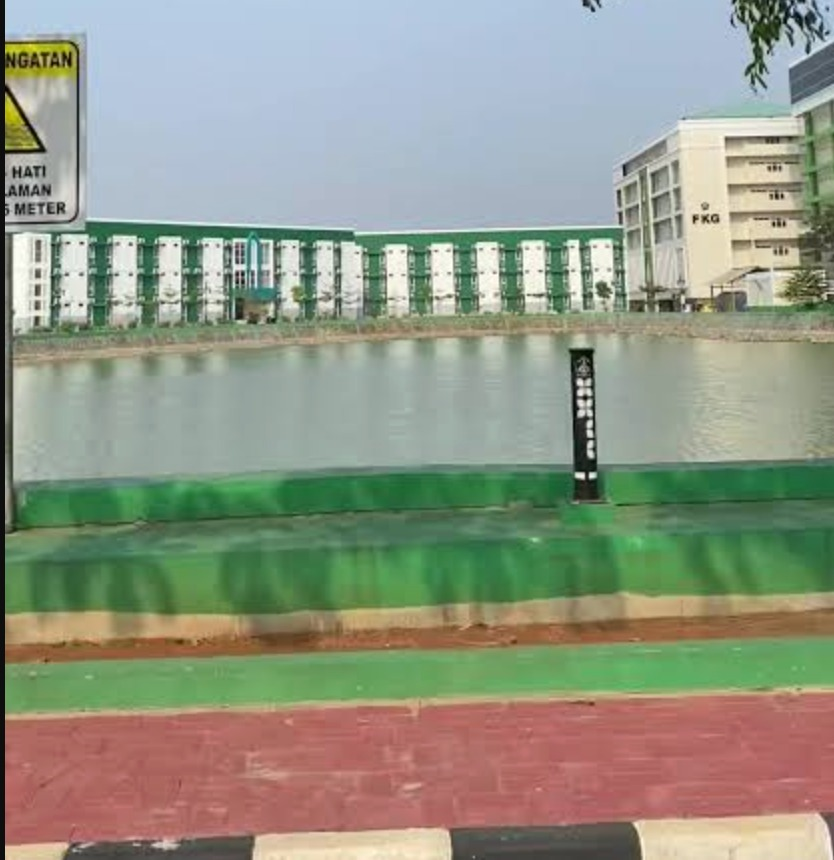
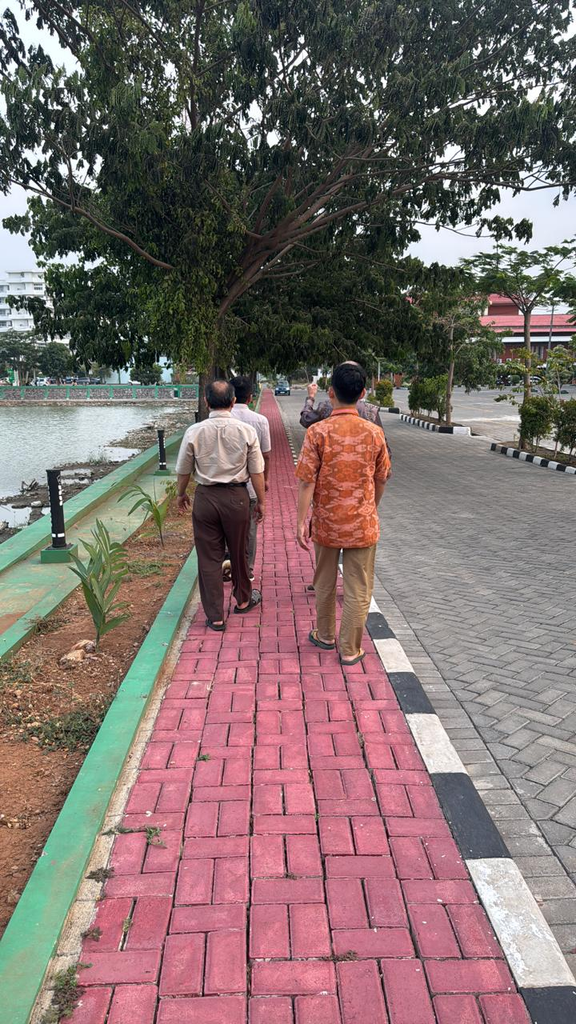
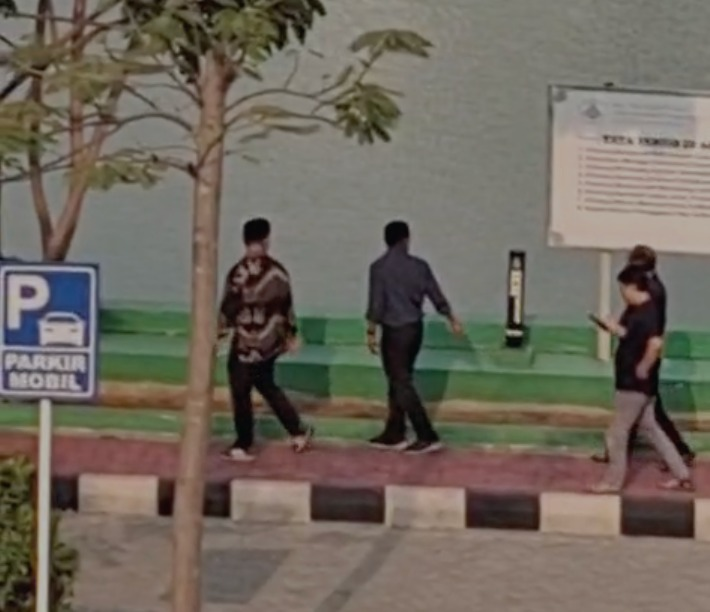
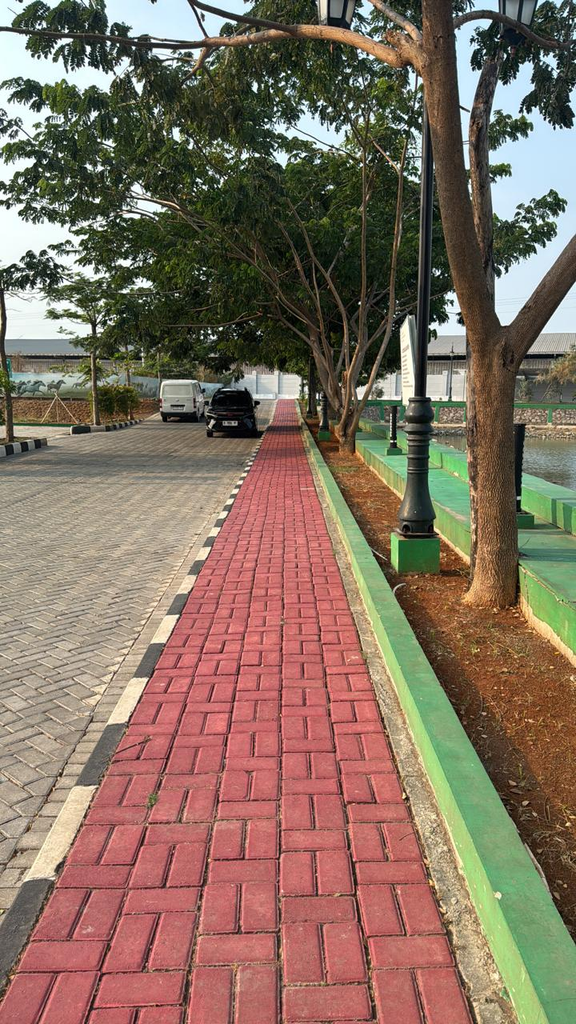
Dedicated Pedestrian Pathways
UNISSULA provides pedestrian pathways throughout the campus to support safe and convenient movement between academic, administrative, religious, residential, and service facilities.
The pathways are designed to prioritise:
- safety;
- accessibility;
- comfort;
- connectivity; and
- environmental sustainability.
The university’s pedestrian infrastructure is intended to provide a practical alternative to short-distance motorised travel.
Separation from Vehicular Traffic
Pedestrian safety is strengthened through physical separation between pedestrian pathways and vehicle roads.
This separation helps clearly distinguish walking routes from motorised traffic areas and reduces the risk of conflicts between pedestrians and vehicles.
UNISSULA’s campus documentation specifically notes that physical separators are installed to improve pedestrian safety and reduce the risk of traffic-related incidents.
Accessible Pedestrian Infrastructure
UNISSULA’s pedestrian network is designed to be accessible to people with different mobility needs.
The campus provides:
- wheelchair-accessible ramps;
- smooth pedestrian surfaces;
- accessible building entrances;
- handrails;
- connected pathways; and
- routes that support independent movement.
These features help ensure that pedestrian access is inclusive for students, staff, and visitors, including persons with disabilities.
Wheelchair-Friendly Campus Access
Pedestrian accessibility is supported by ramps and adapted entrances at key university buildings.
These facilities allow wheelchair users and others requiring mobility assistance to move more independently between campus spaces.
This demonstrates that pedestrian priority at UNISSULA includes not only general walkability but also universal accessibility.
Safe and Comfortable Walking Environment
UNISSULA seeks to create a pedestrian environment that is both functional and comfortable.
Walking routes are supported by greenery and landscaping that provide shade and improve the quality of the surrounding environment.
These features help make walking a more attractive and practical mobility option within the campus.
Directional Signage
Pedestrian pathways are equipped with directional signage to help campus users navigate between important facilities.
Signs guide users toward locations such as:
- lecture halls;
- libraries;
- student centres;
- laboratories;
- administrative facilities; and
- other university services.
Clear navigation supports a more efficient and user-friendly walking environment.
Solar-Powered Pedestrian Lighting
UNISSULA provides solar-powered street lighting along pedestrian pathways.
The lights operate automatically according to ambient light intensity and provide illumination for pedestrians during evening and nighttime periods.
This supports:
- pedestrian safety;
- visibility;
- energy efficiency; and
- sustainable campus infrastructure.
Encouraging Walking for Short-Distance Travel
UNISSULA’s pedestrian infrastructure is not provided only as a physical facility.
It is part of a broader strategy to encourage walking as a preferred mobility option for short-distance movement across campus.
The university explicitly aims to reduce reliance on motorised transportation by providing safe, attractive, and convenient walking routes.
Reducing Dependence on Motorised Transport
By improving pedestrian accessibility, UNISSULA helps reduce the need for private motorcycles and cars for short trips within the campus.
The approach can be represented as:
Safe pedestrian infrastructure → Increased walking → Reduced short-distance vehicle use → Lower transport emissions
This strengthens the environmental value of pedestrian-priority planning.
Promoting Active Mobility
Walking also contributes to healthier and more active campus lifestyles.
UNISSULA’s pedestrian routes support physical activity while enabling sustainable everyday mobility.
The university therefore combines:
- environmental sustainability;
- mobility efficiency;
- accessibility; and
- health promotion
within its pedestrian infrastructure strategy.
Awareness and Education
UNISSULA also supports pedestrian mobility through awareness and educational activities.
The university informs the campus community about the benefits of pedestrian pathways and their role in environmental sustainability.
These activities help encourage students and employees to choose walking where practical.
Green and Shaded Walking Routes
Trees and other forms of greenery are incorporated alongside pedestrian pathways.
These elements provide:
- natural shade;
- improved air quality;
- a more pleasant walking environment;
- reduced heat exposure; and
- improved campus landscape quality.
This makes pedestrian movement more comfortable and supports the university’s broader green-campus objectives.
Integration with Campus Mobility
Pedestrian mobility is integrated with UNISSULA’s broader transportation system.
Campus users can combine walking with:
- electric shuttle services;
- park-and-ride;
- electric vehicles;
- shared transportation; and
- other low-emission mobility options.
This creates a multimodal campus mobility system in which walking plays a central role.
Pedestrian Access to Key Facilities
The pedestrian network supports access to important campus destinations, including:
- faculties;
- classrooms;
- administrative offices;
- libraries;
- student facilities;
- religious facilities;
- laboratories; and
- other campus services.
This connectivity helps ensure that walking is a practical mode of transportation for daily campus activities.
Inclusive Campus Mobility
Prioritising pedestrians contributes to a more inclusive campus.
The combination of accessible ramps, smooth pathways, handrails, safe crossings, signage, and separated walking routes supports users with different levels of mobility.
This helps ensure that sustainability and accessibility are addressed together.
Pedestrian Safety
Safety is a central element of UNISSULA’s pedestrian strategy.
The university uses:
- physical road separators;
- dedicated pedestrian routes;
- accessible surfaces;
- lighting;
- directional signage; and
- route design
to reduce the risk of pedestrian-vehicle conflicts.
This demonstrates that pedestrian access is actively prioritised in campus design and management.
Sustainable Campus Design
UNISSULA’s pedestrian infrastructure contributes to sustainable campus planning by reducing the dominance of motorised vehicles in short-distance movement.
A pedestrian-oriented campus can help:
- reduce traffic congestion;
- reduce transport emissions;
- improve public space quality;
- encourage active mobility; and
- improve the overall campus environment.
Relationship with Sustainable Commuting
Pedestrian priority complements UNISSULA’s other sustainable commuting initiatives.
The university’s mobility approach includes:
Walking + Electric mobility + Shared transport + Remote working
Walking represents the lowest-emission mobility option and is therefore an important component of UNISSULA’s sustainable transportation strategy.
Contribution to SDG 11
UNISSULA’s pedestrian-priority approach contributes to SDG 11: Sustainable Cities and Communities by creating a safer, more accessible, inclusive, and environmentally responsible campus environment.
THE Sustainability Impact Ratings 2027 assesses whether universities prioritise pedestrian access on campus.
The indicator provides up to three points based on:
- existence of pedestrian prioritisation;
- evidence provided; and
- public availability of the evidence.
UNISSULA demonstrates pedestrian prioritisation through dedicated infrastructure, accessibility measures, safety features, sustainable lighting, and initiatives that encourage walking.
Evidence of Implementation
UNISSULA’s pedestrian-priority approach is demonstrated through:
- Dedicated pedestrian pathways across the campus.
- Physical separation between pedestrian and vehicle routes.
- Wheelchair-accessible ramps.
- Accessible building entrances.
- Smooth pedestrian surfaces.
- Handrails and inclusive access features.
- Directional signage for campus navigation.
- Solar-powered pedestrian lighting.
- Shaded and landscaped walking routes.
- Trees and greenery along pedestrian areas.
- Measures to reduce short-distance motorised travel.
- Awareness activities encouraging walking.
- Integration of pedestrian mobility with sustainable transportation.
- Accessible connections between major campus facilities.
11.4.7
Local Authority Collaboration Regarding Planning And Development
11.4.7 Local Authority Collaboration on Planning, Development and Affordable Housing
Working with Local Authorities on Housing and Development
Universitas Islam Sultan Agung (UNISSULA) works with local and regional government authorities to address housing and settlement development issues, including improving access to adequate and affordable housing for local communities.
A major example is UNISSULA’s collaboration with the Government of Central Java Province through the Housing and Settlement Areas Agency (Disperakim) to support programmes addressing Rumah Tidak Layak Huni (RTLH), or inadequate/uninhabitable housing.
This collaboration combines university community engagement with government housing-development programmes to help identify households in need, verify housing conditions, and support improvements in access to decent housing.
Formal Collaboration with the Central Java Provincial Government
In 2025, UNISSULA strengthened its collaboration with the Government of Central Java Province through a formal institutional framework.
UNISSULA reported that a Memorandum of Understanding with the Central Java Provincial Government was established on 16 March 2025. This MoU serves as an umbrella for collaboration with provincial government agencies, including the Housing and Settlement Areas Agency (Disperakim).
The partnership enables university expertise, student participation, and community-engagement programmes to support government priorities related to housing and settlement development.
Addressing Inadequate Housing
One of the main areas of collaboration is the improvement of housing conditions for residents living in Rumah Tidak Layak Huni (RTLH).
Inadequate housing is a significant housing and settlement issue in Central Java. Disperakim has identified RTLH as a priority problem requiring coordinated intervention across districts and municipalities.
UNISSULA contributes to this work through data collection, verification, community engagement, and field-based support.
Supporting Access to Decent Housing
The collaboration is designed to help government housing assistance reach eligible local residents.
UNISSULA students support the verification and validation of housing conditions so that government assistance for housing improvement can be targeted more accurately.
This process helps ensure that residents whose homes do not meet adequate living standards can be correctly identified and considered for government-supported housing improvement programmes.
2025 RTLH Verification Programme
In May 2025, UNISSULA deployed 1,685 community-service students to Sayung and Mranggen in Demak Regency to assist the government in verifying beneficiaries of RTLH renovation assistance.
The initiative was intended to help ensure that housing assistance was accurately targeted and reached eligible households.
The activity demonstrates direct collaboration between the university and public authorities in implementing a housing-development programme for local residents.
Government Housing Improvement Target
The 2025 collaboration was linked to a wider Central Java government programme targeting the renovation of 17,000 inadequate houses across cities and regencies in Central Java.
UNISSULA contributed through field verification and community-based implementation support.
This places the university’s contribution within a large-scale regional housing-development initiative rather than an isolated community activity.
Thematic Community Service for Housing Improvement
UNISSULA continued this work through its Thematic Community Service Programme (KKN Tematik).
In July 2025, 1,991 UNISSULA students participated in activities aimed at improving the quality of inadequate housing in Central Java in collaboration with Disperakim. UNISSULA
The programme focused on helping the government verify and validate housing data and improve the effectiveness of housing interventions.
Supporting “One Household, One Decent House”
The collaboration contributes to the provincial government’s priority programme of “one household, one decent house”.
According to Disperakim representatives, UNISSULA’s thematic community-service activities help government authorities verify and validate inadequate housing data to support this objective. UNISSULA
This establishes a clear connection between university-government collaboration and access to adequate housing for local residents.
Housing Data Verification and Validation
Accurate housing data are essential for effective planning and allocation of public housing assistance.
UNISSULA supports this process by helping local authorities:
- identify inadequate housing;
- verify household and housing conditions;
- validate government housing databases;
- improve targeting of assistance;
- reduce the risk of inaccurate beneficiary selection; and
- support evidence-based housing programmes.
This gives the university a practical role in housing planning and development.
Community-Based Housing Planning
UNISSULA’s participation demonstrates how universities can support local authorities through community-based planning.
Students and university teams work directly in communities, providing local-level information that can help public authorities understand housing conditions more accurately.
This creates a planning model based on:
Government policy → University collaboration → Community data → Verification → Housing assistance → Improved housing conditions
Collaboration Beyond Data Collection
The collaboration with Disperakim has included more than basic data collection.
Earlier cooperation between Disperakim and UNISSULA’s research and community-service institute included activities related to:
- socialisation of adequate housing;
- updating RTLH data;
- facilitation of proposals;
- community assistance; and
- technical training.
This indicates a broader contribution to housing-development processes.
Long-Term Institutional Cooperation
UNISSULA’s collaboration with housing authorities is not limited to a single event.
The university and Disperakim have worked together through thematic community-service programmes and institutional cooperation addressing inadequate housing and settlement issues.
This continuity strengthens the role of UNISSULA as a partner in regional housing development.
Collaboration with Planning Authorities
UNISSULA has also collaborated with the Regional Development Planning Agency of Semarang City (Bappeda Kota Semarang).
The university and Bappeda have discussed expanding collaboration to address development problems in Semarang through research and community-service activities.
Bappeda has recognised universities as strategic partners in supporting the development of Semarang, including through research and participation in planning forums.
This broader relationship complements UNISSULA’s housing-specific collaboration with Disperakim.
University Contribution to Local Development
Through its partnerships with provincial and local authorities, UNISSULA contributes university knowledge and community engagement to practical development challenges.
Relevant areas include:
- housing;
- settlement quality;
- urban development;
- community welfare;
- infrastructure;
- spatial and development planning; and
- local public services.
This demonstrates that the university engages directly with public authorities in addressing development priorities.
Supporting Local Residents
The main beneficiaries of the RTLH programme are local residents whose housing does not meet adequate living standards.
By supporting the identification and verification of eligible households, UNISSULA helps strengthen access to government housing-improvement programmes.
The university’s role therefore supports not only planning and data management but also the practical delivery of housing assistance to communities.
Affordable and Adequate Housing
In the context of this collaboration, access to housing is addressed through government-supported improvement of inadequate homes rather than through commercial housing provision.
The programme helps households that may otherwise face barriers to improving their housing conditions.
UNISSULA’s role in verification and implementation support helps ensure that public housing assistance reaches intended beneficiaries.
Student Participation in Local Development
UNISSULA integrates student community service into its collaboration with government authorities.
Thousands of students participate directly in field activities related to housing conditions and community development.
This approach provides dual benefits:
- supporting local government development programmes; and
- providing students with practical experience in community-based sustainability work.
Research and Community Engagement
UNISSULA’s involvement in housing and settlement development reflects the university’s broader commitment to community engagement.
The university uses its research and community-service functions to support government programmes and address real community needs.
This strengthens the connection between academic institutions, public authorities, and local residents.
Evidence-Based Housing Assistance
Housing programmes are more effective when supported by accurate and verified information.
UNISSULA contributes to evidence-based decision-making by supporting field verification and validation.
This helps authorities improve:
- beneficiary identification;
- allocation of resources;
- housing programme effectiveness;
- accountability; and
- monitoring of housing conditions.
Sustainable Communities
Adequate housing is a central component of sustainable communities.
By working with government authorities to address inadequate housing, UNISSULA contributes to:
- safer housing conditions;
- improved living environments;
- reduced housing vulnerability;
- improved community welfare; and
- more inclusive development.
Contribution to SDG 11
UNISSULA’s collaboration with local and regional authorities contributes directly to SDG 11: Sustainable Cities and Communities.
THE Sustainability Impact Ratings 2027 assesses whether universities work with local authorities to address planning issues and development, including ensuring that local residents are able to access affordable housing.
The indicator provides up to three points based on:
- existence of collaboration;
- evidence provided; and
- public availability of the evidence.
UNISSULA demonstrates this through its formal collaboration with the Central Java Provincial Government and Disperakim on inadequate-housing verification and housing-improvement programmes.
Evidence of Implementation
UNISSULA’s collaboration on planning, development, and housing is demonstrated through:
- A 2025 MoU between UNISSULA and the Central Java Provincial Government. UNISSULA
- Collaboration with the Housing and Settlement Areas Agency of Central Java Province (Disperakim).
- Participation in government programmes addressing Rumah Tidak Layak Huni (RTLH).
- Deployment of 1,685 students in May 2025 to support RTLH verification in Sayung and Mranggen.
- Support for the 2025 provincial target to renovate 17,000 inadequate houses. UNISSULA
- Participation of 1,991 students in the July 2025 thematic housing-improvement programme.
- Verification and validation of housing data.
- Support for the provincial priority of one household, one decent house.
- Community engagement related to adequate housing and settlement improvement.
- Collaboration with Bappeda Kota Semarang on wider planning and development issues.
11.4.8
Planning Development – New Build Standards
11.4.8 Sustainable Standards for New Buildings
University Commitment to Sustainable Building Standards
Universitas Islam Sultan Agung (UNISSULA) requires new buildings and building renovations to follow sustainable building and energy-efficiency standards as part of its commitment to environmentally responsible campus development.
The university applies formal institutional requirements to ensure that new construction and renovation projects incorporate energy conservation, efficient building systems, and relevant Indonesian green-building standards.
This approach supports the development of campus infrastructure that is more energy-efficient, resource-conscious, and aligned with sustainable development principles.
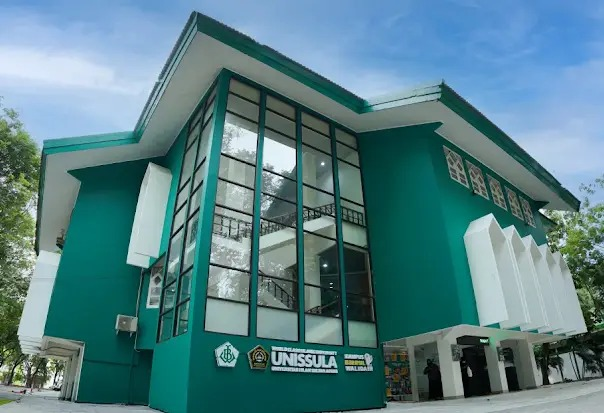
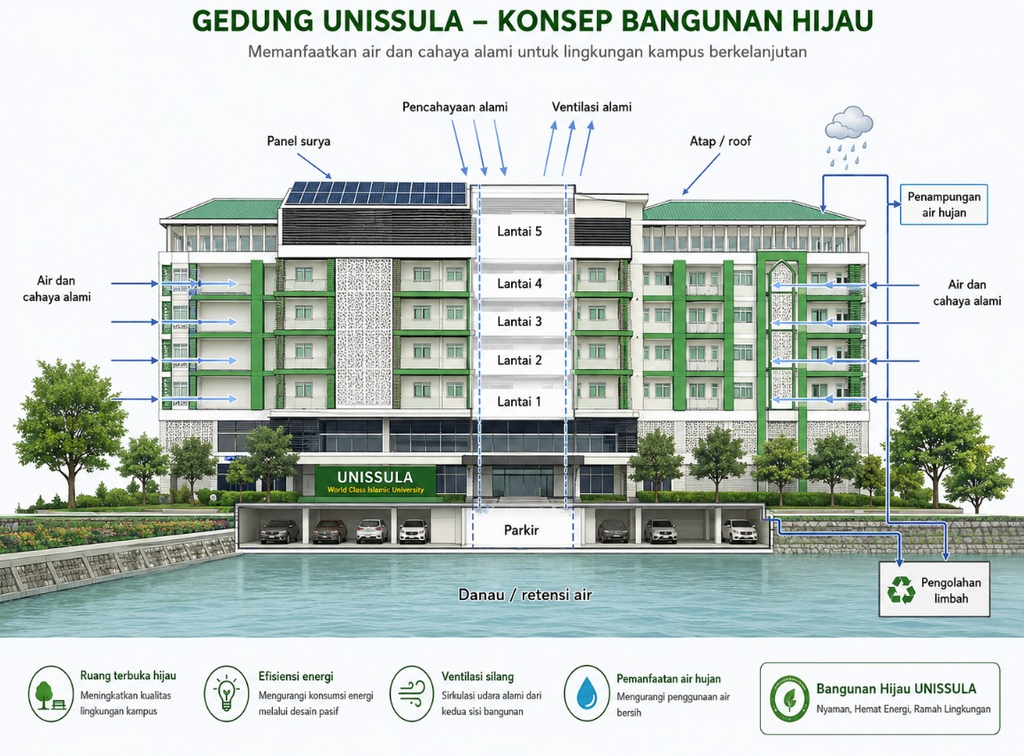
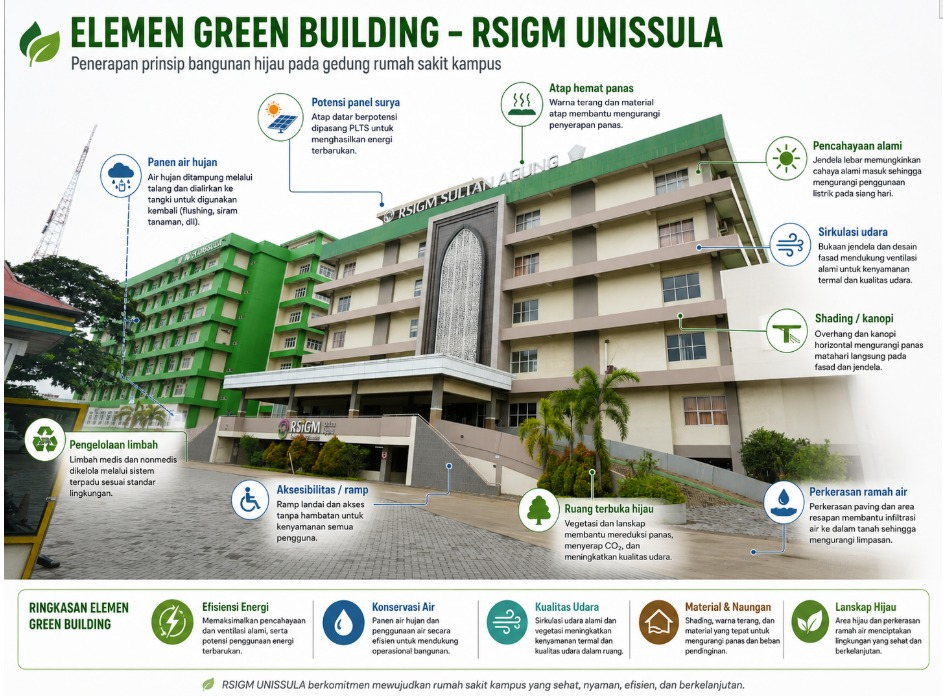
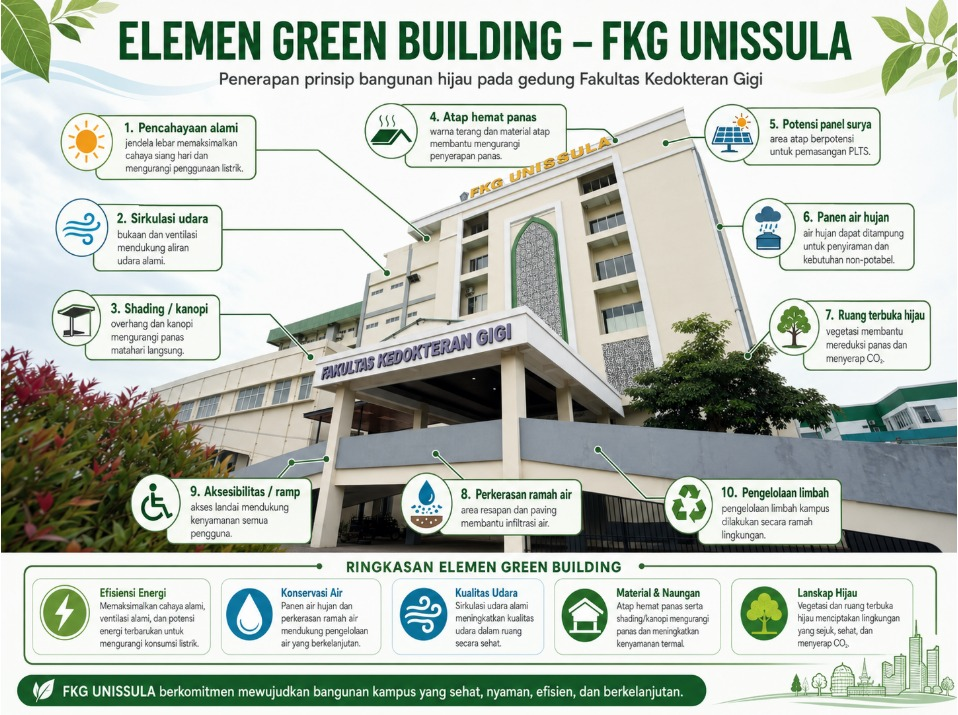


Formal Institutional Requirement
UNISSULA has established a formal policy requiring all new buildings and renovations to comply with energy-efficiency and sustainable-building standards.
Through Circular Letter No. 8391/J/SA/IX/2025, the university requires every new building project and building renovation to apply relevant energy-efficiency standards.
The circular provides an institution-wide framework for sustainable construction and renovation across the university.
National Standards Applied
UNISSULA’s sustainable building requirements refer to recognised Indonesian national standards.
The university requires planning and implementation to follow relevant standards including:
- SNI 6197:2020 for energy conservation in lighting systems;
- SNI 6390:2020 for energy conservation in air-conditioning systems;
- SNI 6389:2020 for building-envelope energy efficiency; and
- applicable Bangunan Gedung Hijau (Green Building) requirements.
These standards provide a technical basis for improving the environmental performance of new and renovated buildings.
Sustainable Building Design
UNISSULA requires sustainable principles to be considered during both the design and implementation stages of building projects.
The university’s approach includes attention to:
- energy-efficient lighting;
- efficient cooling systems;
- building-envelope performance;
- natural lighting;
- natural ventilation;
- efficient electrical equipment; and
- environmentally responsible building operation.
This ensures that sustainability is integrated into building planning rather than added only after construction.
Energy-Efficient Lighting
Lighting is one of the key areas addressed by UNISSULA’s sustainable-building policy.
New buildings and renovations are required to follow SNI 6197:2020, which relates to energy conservation in lighting systems.
The university also promotes the use of energy-efficient technologies such as LED lighting.
This helps reduce:
- electricity consumption;
- operating costs;
- unnecessary energy use; and
- environmental impacts associated with building operation.
Efficient Air-Conditioning Systems
UNISSULA also requires building projects to consider energy efficiency in air-conditioning systems.
The policy refers to SNI 6390:2020 as a relevant standard for energy conservation in air-conditioning.
Efficient cooling systems help reduce electricity demand while maintaining appropriate indoor environmental conditions.
Building-Envelope Efficiency
Building-envelope performance is another important element of sustainable construction.
UNISSULA requires reference to SNI 6389:2020, which addresses energy efficiency in building envelopes.
Efficient building envelopes can reduce heat gain and help lower cooling demand.
This contributes to more efficient overall building performance.
Natural Lighting and Ventilation
UNISSULA’s policy encourages the use of natural lighting and natural ventilation wherever appropriate.
These design strategies can reduce dependence on artificial lighting and mechanical cooling.
Natural building design can contribute to:
- reduced electricity consumption;
- improved indoor environmental quality;
- lower operational costs; and
- more sustainable use of energy.
Energy-Efficient Technology
New construction and renovation projects are required to prioritise energy-efficient technologies.
Examples include:
- LED lighting;
- efficient air-conditioning;
- energy-efficient electrical equipment;
- natural lighting;
- natural ventilation; and
- other technologies that reduce unnecessary energy consumption.
This requirement demonstrates that sustainable building standards are translated into practical design and equipment choices.
Green Building Requirements
In addition to specific SNI standards, UNISSULA requires projects to consider applicable Bangunan Gedung Hijau requirements.
This connects university building development with Indonesia’s broader framework for environmentally responsible buildings.
UNISSULA therefore uses nationally recognised standards rather than relying solely on internal sustainability guidelines.
Pre-Construction Evaluation
An important element of UNISSULA’s sustainable-building policy is the requirement for evaluation before project implementation.
Planning documents for new buildings and renovations must be reviewed before construction begins to ensure compliance with energy-efficiency requirements.
This creates a preventive approach in which sustainability is considered during the planning stage.
Sustainable Construction Governance
The university’s approach can be represented as:
Planning → Standards review → Sustainable design → Construction/renovation → Energy-efficient operation
This helps ensure that environmental performance is considered throughout the building-development process.
New Buildings and Renovations
The policy applies not only to completely new buildings but also to building renovations.
This broadens the impact of the sustainable-building framework because existing facilities can also be improved when renovation occurs.
The university therefore addresses both:
- future campus expansion; and
- improvement of existing building performance.
Reducing Operational Energy Use
Buildings account for a significant share of campus energy consumption.
By requiring efficiency in lighting, cooling, building envelopes, and electrical equipment, UNISSULA aims to reduce operational energy use.
This can contribute to:
- lower electricity demand;
- lower carbon emissions;
- reduced operating costs;
- improved resource efficiency; and
- more sustainable campus infrastructure.
Supporting Long-Term Campus Sustainability
Sustainable building standards support long-term environmental performance.
Buildings constructed or renovated according to energy-efficiency standards can provide benefits throughout their operational life.
This helps ensure that campus development does not increase environmental impacts unnecessarily.
Institutional Standardisation
The use of national standards provides consistency across university development projects.
Rather than assessing each building independently without a common framework, UNISSULA establishes recognised technical requirements for construction and renovation.
This standardisation improves accountability and strengthens institutional sustainability governance.
Relationship with Green Campus Development
Sustainable buildings form part of UNISSULA’s wider Green Campus strategy.
Building performance is closely connected with:
- energy use;
- emissions;
- water;
- transport;
- open space;
- indoor environmental quality; and
- long-term campus resilience.
Applying sustainable standards to new development therefore supports multiple environmental objectives simultaneously.
Contribution to SDG 11
UNISSULA’s sustainable building requirements contribute to SDG 11: Sustainable Cities and Communities by promoting more environmentally responsible infrastructure and campus development.
THE Sustainability Impact Ratings 2027 assesses whether universities build new buildings to sustainable standards.
The methodology recognises the use of formal standards and provides up to three points based on:
- existence of standards;
- evidence provided; and
- public availability of the evidence.
THE gives examples such as recognised green-building certification systems, but UNISSULA’s approach is based on applicable Indonesian national standards and green-building requirements.
Evidence of Implementation
UNISSULA’s sustainable building framework is demonstrated through:
- Circular Letter No. 8391/J/SA/IX/2025 on energy-efficiency standards for new buildings and renovations.
- Mandatory application of energy-efficiency standards to new buildings.
- Mandatory application of standards to renovations.
- Use of SNI 6197:2020 for lighting energy conservation.
- Use of SNI 6390:2020 for air-conditioning energy conservation.
- Use of SNI 6389:2020 for building-envelope energy efficiency.
- Reference to applicable Bangunan Gedung Hijau requirements.
- Priority use of LED lighting.
- Promotion of natural lighting.
- Promotion of natural ventilation.
- Use of efficient air-conditioning systems.
- Use of energy-efficient electrical equipment.
- Pre-construction evaluation of planning documents.
- Institution-wide application of sustainable building requirements.
11.4.9
Building On Brownfield Sites
11.4.9 Building on Brownfield Sites
Prioritising Redevelopment of Previously Developed Campus Sites
Universitas Islam Sultan Agung (UNISSULA) prioritises the redevelopment, renovation, and reuse of previously developed campus sites where possible.
Rather than relying only on expansion into previously undeveloped land, UNISSULA makes use of existing built areas and existing structures within the campus for new academic, research, administrative, and service facilities.
This approach supports more efficient land use, reduces unnecessary expansion, and contributes to more sustainable campus development.


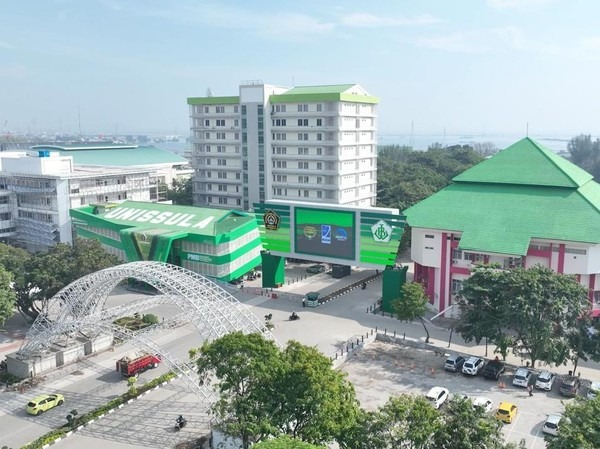
Brownfield Development Approach
THE Sustainability Impact Ratings defines brownfield sites as sites where there has been previous, recent building or development.
UNISSULA applies this principle through redevelopment projects located on sites that were already built and developed.
The university’s approach can be represented as:
Existing developed site → Redevelopment or renovation → New or improved university facility
This enables UNISSULA to make more efficient use of its existing campus footprint.
Redevelopment of Previously Built Structures
A significant example is the redevelopment of an existing building structure within the UNISSULA campus.
The structure had previously been built but remained underutilised and incomplete. Rather than abandoning the site and developing a new location, UNISSULA continued redevelopment on the existing built site.
During 2025, the structure was redeveloped to support new and improved facilities associated with:
- the Faculty of Medicine;
- the Integrated Biomedical Laboratory; and
- the Faculty of Dentistry.
This represents a clear example of reusing a previously developed location for renewed institutional purposes.
Reuse of an Underutilised Existing Building
The redevelopment project demonstrates the university’s preference for making productive use of existing built assets.
The site was not previously undeveloped land. It already contained a substantial building structure.
UNISSULA therefore chose to:
- reuse the existing building footprint;
- continue development on an already built site;
- upgrade the structure;
- expand its functional use; and
- convert the site into productive academic and research space.
This is consistent with the principle of brownfield redevelopment.
2025 Medical and Biomedical Redevelopment
In 2025, redevelopment works on the existing structure supported the creation and improvement of facilities for medicine, biomedical research, and dentistry.
The project enabled UNISSULA to expand academic and laboratory capacity through the reuse of an existing developed site.
The redevelopment supports:
- medical education;
- biomedical laboratory activities;
- dental education;
- research infrastructure; and
- shared academic facilities.
This demonstrates how previously developed land can be reused for higher-value academic purposes.
Integrated Biomedical Laboratory
The development of the Integrated Biomedical Laboratory on a previously developed site supports both land-use efficiency and research infrastructure improvement.
By integrating new research functions into an existing built area, UNISSULA strengthens laboratory capacity while avoiding the need to establish an entirely new site elsewhere.
This supports a more compact and efficient campus-development model.
Faculty of Medicine and Faculty of Dentistry
The redevelopment also supports facilities associated with the Faculty of Medicine and Faculty of Dentistry.
Using an existing developed site allows UNISSULA to strengthen health-science infrastructure while maintaining continuity within the established campus area.
The project therefore combines:
Site reuse + Academic development + Research capacity + Land-use efficiency
Rectorate Building Redevelopment
UNISSULA also applies redevelopment principles to its administrative infrastructure.
The Rectorate Building has undergone renovation and redevelopment within the existing campus site.
Rather than relocating the administrative centre to a new site, the university improved and renewed the existing built facility.
This demonstrates that UNISSULA’s brownfield approach is applied not only to academic buildings but also to institutional and administrative infrastructure.
Reuse Rather than Unnecessary Expansion
The redevelopment of the Rectorate Building illustrates the university’s preference for improving existing facilities before considering unnecessary outward expansion.
This approach can provide several sustainability benefits:
- better use of existing land;
- preservation of the existing campus structure;
- continued use of existing infrastructure;
- improved functionality of established facilities; and
- reduced need for additional site development.
Efficient Use of the Existing Campus Footprint
UNISSULA’s campus contains established academic, administrative, health, religious, residential, and service facilities.
Redeveloping existing sites allows the university to accommodate new needs within this established environment.
This supports a compact campus-development model in which existing land and infrastructure are used more efficiently.
Relationship with Sustainable Building Standards
Brownfield redevelopment also complements UNISSULA’s sustainable building requirements.
The university requires new buildings and renovations to apply relevant energy-efficiency standards, including:
- SNI 6197:2020 for energy conservation in lighting;
- SNI 6390:2020 for air-conditioning energy conservation;
- SNI 6389:2020 for building-envelope efficiency; and
- applicable Green Building requirements.
This means redevelopment can combine site reuse with improved building performance. Surat Edaran Gedung Baru, mengi…
Renovation and Adaptive Reuse
UNISSULA’s approach includes both renovation and adaptive reuse.
Existing structures may be improved, expanded, or repurposed to meet changing academic and institutional needs.
Adaptive reuse can reduce the environmental burden associated with:
- unnecessary land conversion;
- demolition and replacement;
- entirely new infrastructure development; and
- inefficient outward campus expansion.
Sustainable Land-Use Planning
The university’s redevelopment approach supports more sustainable land-use planning.
The underlying principle is:
Use existing developed land first, where feasible, before expanding onto new land.
This approach improves land-use efficiency and supports long-term campus planning.
Resource Efficiency
Redeveloping existing sites can also provide resource-efficiency benefits.
Existing sites may already have access to:
- roads;
- utilities;
- electricity;
- water systems;
- pedestrian networks;
- drainage;
- communications infrastructure; and
- nearby campus services.
Reusing these developed locations can reduce the need to create entirely new supporting infrastructure.
Supporting a Compact Campus
Brownfield redevelopment helps UNISSULA maintain a more compact campus structure.
A compact campus can provide benefits including:
- shorter travel distances;
- easier pedestrian access;
- more efficient infrastructure;
- better integration between faculties and services; and
- reduced dependence on motorised transport.
This connects brownfield development with the university’s wider sustainable mobility objectives.
Evidence Through Existing Development
UNISSULA has clear examples demonstrating reuse of previously developed sites.
These include:
- Redevelopment of an existing and previously underutilised building structure.
- Development of facilities supporting the Faculty of Medicine.
- Development of the Integrated Biomedical Laboratory.
- Development of facilities supporting the Faculty of Dentistry.
- Renovation and redevelopment of the existing Rectorate Building.
These projects demonstrate that UNISSULA makes active use of previously developed campus sites.
Contribution to SDG 11
UNISSULA’s approach contributes to SDG 11: Sustainable Cities and Communities by promoting efficient land use and sustainable redevelopment.
THE Sustainability Impact Ratings 2027 assesses whether universities build on brownfield sites, where possible.
The methodology defines brownfield sites as locations where there has been previous, recent building or development.
The indicator provides up to three points based on:
- existence of building on brownfield sites;
- evidence provided; and
- public availability of the evidence.
UNISSULA demonstrates this criterion through redevelopment and renovation of existing built sites within its established campus.
Evidence of Implementation
UNISSULA’s use of brownfield sites is demonstrated through:
- Redevelopment of a previously built and underutilised structure within the existing campus.
- Continued development of the site during 2025.
- Reuse of the existing building footprint.
- Development of facilities supporting the Faculty of Medicine.
- Development of the Integrated Biomedical Laboratory.
- Development of facilities supporting the Faculty of Dentistry.
- Renovation and redevelopment of the existing Rectorate Building.
- Continued use of existing campus infrastructure and utilities.
- Integration of redevelopment projects within the existing campus footprint.
- Application of redevelopment and adaptive-reuse principles where feasible.