

















UNISSULA SUSTAINABILITY REPORTING
SDG 5 – Gender Equality
Progress Report 2025
2025 Report Overview
In 2025, Universitas Islam Sultan Agung (UNISSULA) documented its progress towards SDG 5 – Gender Equality through monitoring women’s access to higher education, promoting equal opportunities in admissions, encouraging women’s participation in underrepresented academic fields, and providing institutional support for women’s development and well-being. The university recorded 3,127 female applicants, 2,818 accepted applicants, and 2,788 female students entering degree programmes, while strengthening women’s mentoring, childcare services, maternity and paternity policies, non-discrimination measures, and protection against retaliation. This report presents UNISSULA’s institutional initiatives, measurable achievements, and continuing priorities for advancing gender equality during the 2025 reporting period.
Full SDG 5 Progress Report 2025
5.3.1
Tracking Access Measures
5.3.1 Tracking Women’s Applications and Entry
UNISSULA Systematically Monitors Women’s Access to Higher Education
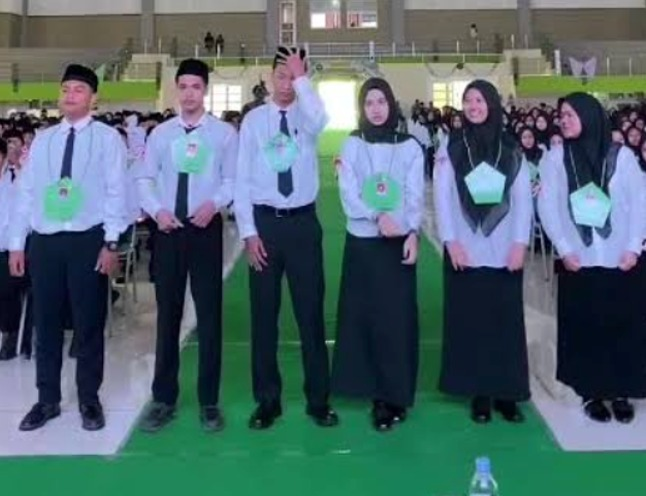
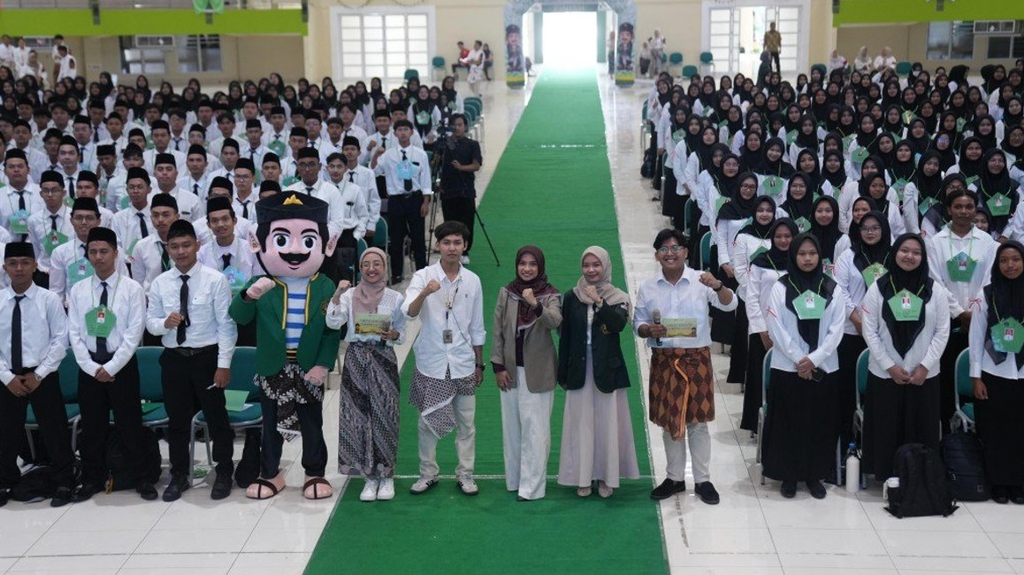
Universitas Islam Sultan Agung (UNISSULA) systematically measures and monitors women’s access to higher education through its admissions and student information systems.
Women’s Admissions Data in 2025
In 2025, UNISSULA recorded:
| Women’s Admissions Indicator | Number |
|---|---|
| Female applicants | 3,127 |
| Female applicants accepted | 2,818 |
| Female students registered/entered | 2,788 |
These figures demonstrate that women’s participation is monitored throughout the admissions pathway rather than only after enrolment.
Women’s Application and Acceptance
A total of 3,127 women applied to UNISSULA in 2025.
Of these applicants, 2,818 were accepted for admission.
This represents a female acceptance rate of 90.12%.
The data provide a clear measure of how women progress from application to admission and enable the university to review whether women are gaining access to degree programmes across the institution.
Women’s Entry into Degree Study
Following admission, 2,788 women completed registration and entered degree study at UNISSULA in 2025.
This means that 98.94% of women who were accepted proceeded to registration and entry.
Viewed across the entire admissions pathway, approximately 89.16% of female applicants ultimately entered degree study.
These results demonstrate that UNISSULA is able to track women’s movement through the admissions process from initial application through final enrolment.
Monitoring across the Admissions Pathway
UNISSULA’s admissions monitoring covers the following stages:
Application → Acceptance → Registration → Entry
At each stage, student data can be reviewed by gender.
This allows the university to monitor:
- the number of female applicants;
- the number of women accepted;
- the number of women completing registration;
- the number of women entering degree programmes; and
- changes in women’s participation between admissions cycles.
This systematic approach enables UNISSULA to monitor women’s access rather than relying only on overall enrolment figures.
Monitoring by Study Programme
Women’s participation differ between academic disciplines.
For this reason, admissions information can also be reviewed at study-programme level.
This enables UNISSULA to identify programmes where:
- women and men participate in relatively balanced numbers;
- women form a high proportion of applicants or entrants; or
- women remain underrepresented.
Such information can be used to guide future recruitment, outreach, mentoring, scholarship, and access initiatives where appropriate.
Relationship with Overall Women’s Entry Data
UNISSULA recorded 5,546 students starting a degree in 2025, of whom 2,788 were women.
Women therefore represented 50.27% of all students starting degree study during the year.
This provides additional context for the university’s monitoring of gender participation at the point of entry.
The university also recorded 992 first-generation women among the 2,788 women starting a degree, showing that admissions monitoring can be combined with other access characteristics to develop a more detailed understanding of women’s participation.
Use of Monitoring Data
Admissions and entry data support institutional planning and help UNISSULA evaluate access to higher education.
The information can be used to support:
- gender equality planning;
- admissions evaluation;
- student recruitment;
- outreach activities;
- scholarship planning;
- mentoring and student-support programmes;
- identification of underrepresented disciplines; and
- assessment of changes in women’s participation over time.
Systematic monitoring therefore provides an evidence base for future actions intended to strengthen equitable access.
2025 Key Findings
UNISSULA’s 2025 monitoring shows that:
- 3,127 women applied to the university;
- 2,818 women were accepted;
- the female acceptance rate was 90.12%;
- 2,788 women completed registration and entered degree study;
- 98.94% of accepted female applicants proceeded to entry; and
- 89.16% of all female applicants ultimately entered degree study.
These figures demonstrate a complete and measurable admissions pathway for women from application to entry.
Institutional Commitment
UNISSULA recognises that gender equality in higher education requires not only equal opportunities but also reliable monitoring of women’s participation.
5.3.2
Policy For Women Application and Entry
5.3.2 Policy for Women’s Applications, Entry and Participation
UNISSULA Ensures Equal Access for Women in Admissions and University Participation
Universitas Islam Sultan Agung (UNISSULA) applies an equal-access approach to student admissions and university participation. Women are provided the same opportunities as other applicants to apply, be accepted, enter degree programmes, and participate fully in academic and student life.
UNISSULA does not impose gender-based admission quotas or restrictions that limit the number or proportion of women entering the university. Admission targets are established according to study programme capacity and institutional planning rather than by gender.
This principle is reflected in Rector Decision No. 9701/D.3/SA/IX/2024 concerning Student Admission Targets for the 2025/2026 Academic Year. The decision establishes admission targets for diploma, undergraduate, postgraduate, and professional programmes and serves as a formal guideline for student admissions in the 2025/2026 academic year.
Equal Opportunity in Applications
Women have equal opportunity to apply to UNISSULA academic programmes.
Application procedures, academic requirements, and programme information are made available without gender-based restrictions. Women are not assigned lower quotas and are not prevented from applying to particular programmes because of gender.
The university’s approach is based on academic eligibility, programme requirements, and available capacity.
Equal Treatment in Acceptance and Entry
Applicants are assessed according to the academic and administrative requirements of the relevant programme.
Gender is not used as a basis for restricting admission.
If the number of qualified women applicants is higher than the number of men, this does not create an institutional barrier. Women may therefore represent an equal or greater proportion of admitted students where this occurs naturally through the admissions process.
For the 2025 admissions cycle, UNISSULA recorded:
| Women’s Admissions Indicator | Number |
|---|---|
| Female applicants | 3,127 |
| Female applicants accepted | 2,818 |
| Female students registered/entered | 2,788 |
These figures demonstrate that women were able to progress from application through acceptance to university entry without a separate gender-based ceiling.
Admission Targets Are Based on Academic Programmes, Not Gender
The 2025/2026 admission targets were formally established through Rector Decision No. 9701/D.3/SA/IX/2024.
The annex sets targets for individual study programmes, including Medicine, Dentistry, Nursing, Civil Engineering, Law, Management, Accounting, Psychology, Pharmacy, Midwifery, and other programmes. The targets are specified according to programme capacity rather than separate male and female quotas.
This structure supports equal opportunity because participation is determined through the relevant programme requirements rather than predetermined gender limits.
Equal Participation after Entry
UNISSULA’s equal-access principle continues after students have entered the university.
Women students have opportunities to participate in:
- teaching and learning;
- academic advising;
- research activities;
- student organisations;
- leadership programmes;
- scholarships and financial assistance;
- mentoring;
- counselling and wellbeing services;
- entrepreneurship programmes;
- community service;
- professional development;
- sports and campus activities; and
- other university services.
Participation is based on the relevant academic, organisational, or programme requirements rather than gender.
Women’s Participation in the 2025 Student Intake
In 2025, UNISSULA recorded 5,546 students starting a degree, including 2,788 women.
Women therefore represented 50.27% of students starting degree study during the year.
This broadly balanced entry profile is consistent with an admissions framework that does not impose gender-based restrictions on women’s participation.
UNISSULA also recorded 992 first-generation women among the 2,788 women starting a degree, indicating that women from first-generation university backgrounds also formed a substantial part of the university’s new student population.
Monitoring Women’s Access and Participation
UNISSULA systematically monitors women’s progression through the admissions process.
The university records and reviews participation across the main stages:
Application → Acceptance → Registration → Entry → Participation
This monitoring allows the university to identify changes in women’s access and participation over time and to recognise academic areas where additional outreach or support may be useful.
Supporting Women throughout University Life
Equal access does not end with admission.
Women students are able to access academic and student support systems available across UNISSULA, including:
- scholarships;
- academic guidance;
- mentoring;
- counselling;
- health and wellbeing services;
- career development;
- student organisations; and
- leadership opportunities.
This approach supports women not only in entering the university but also in participating fully in university life.
Continuity of the Admission Policy Framework
UNISSULA continues to establish admission targets through formal Rector Decisions.
This framework was continued through Rector Decision No. 10604/F/SA/XI/2025 concerning Student Admission Targets for the 2026/2027 Academic Year, issued on 20 November 2025. The decision again establishes admission targets by academic programme and level of study.
The 2025 decision formally states that the targets serve as guidance for new student admissions across diploma, undergraduate, postgraduate, professional, and specialist programmes and take effect from the date of establishment.
The continuation of this programme-based admissions framework demonstrates an ongoing institutional approach to admissions planning without gender-specific admission ceilings.
Institutional Principle
UNISSULA’s approach can be summarised as:
Women have equal opportunity to apply, be accepted, enter, and participate in university education without gender-based admission restrictions or quotas.
The university does not seek to impose a predetermined proportion of women and men. Instead, it seeks to ensure that gender does not become a barrier to access or participation.
Commitment to Gender Equality
UNISSULA recognises equal access to higher education as an important part of gender equality.
By establishing admission targets according to academic programmes rather than gender, applying the same admission framework to women applicants, monitoring women’s access from application to entry, and enabling women to participate fully in university life, UNISSULA supports equitable access to higher education.
5.3.3
Women’s Access Schemes
5.3.3 Women’s Access Schemes
UNISSULA Provides Dedicated Support Schemes for Women
Universitas Islam Sultan Agung (UNISSULA) provides institutional support for women through dedicated structures, mentoring and development activities, and other targeted provisions that strengthen women’s access, participation, wellbeing, and development.
A key institutional mechanism is the Pusat Studi Wanita dan Keluarga Sakinah (PSWKS) under UNISSULA’s Institute for Research and Community Service (LPPM). The centre is formally listed by LPPM as one of UNISSULA’s research centres, and the official page also provides the Rector Decision concerning its establishment and management.
Pusat Studi Wanita dan Keluarga Sakinah
The Pusat Studi Wanita dan Keluarga Sakinah (PSWKS) was formally established through Rector Decree No. 4250/B.1/SA/IV/2022, dated 25 April 2022, concerning the establishment and management of the Centre for Women’s Studies and Sakinah Family at Universitas Islam Sultan Agung (UNISSULA).
The decree established an institutional structure dedicated to women’s development, education, research, advocacy, and community engagement. It also outlined the centre’s vision, mission, objectives, organisational responsibilities, cooperation networks, and planned activities.
The centre provides an institutional platform for programmes and initiatives related to women and families, strengthening UNISSULA’s capacity to address issues affecting women beyond general student services.
Through PSWKS, UNISSULA has established a framework for activities related to:
- women’s empowerment;
- education and capacity building;
- family wellbeing;
- awareness and advocacy;
- women’s social and professional development;
- protection of women; and
- community engagement related to women and families.
Mentoring, Guidance and Development
Women at UNISSULA have access to guidance and development opportunities through institutional programmes and activities involving academic staff, student-support units, and dedicated women-focused initiatives.
These forms of support can include mentoring, educational guidance, leadership development, personal development, and activities that strengthen women’s confidence and participation in university and community life.
PSWKS provides an institutional base through which women-focused mentoring and development initiatives can be organised and strengthened.
Support for Women’s Participation
UNISSULA’s approach to women’s access extends beyond admission.
Women are able to participate in academic, organisational, professional, and community activities while also having access to targeted support when specific issues affecting women need to be addressed.
Such provisions complement the university’s equal-access admissions framework by helping women participate effectively after entering university.
Women’s Protection and Advocacy
UNISSULA also contributes to initiatives concerning the protection of women and children.
The university has collaborated with the Indonesian National Police in the development of legal studies related to the protection of women and children and the prevention of trafficking in persons. The collaboration is intended to strengthen evidence-based approaches to prevention, law enforcement, policy development, and victim protection.
Although the public report on the strengthened collaboration was published in 2026, it states that cooperation between UNISSULA and the Police had already been established from 29 November 2025, providing additional evidence of the university’s institutional engagement with issues affecting women and vulnerable groups.
Other Targeted Provisions for Women
In addition to women-focused study and advocacy, UNISSULA provides broader forms of support that can contribute to women’s access and participation, including:
- counselling and psychological support;
- academic guidance;
- health and reproductive-health services;
- leadership and professional-development opportunities;
- legal and social awareness programmes;
- community empowerment; and
- programmes related to family and women’s wellbeing.
Together, these provisions help create an environment in which women can participate, develop, and seek support when needed.
Scholarships and Financial Support
Women students are also able to access university scholarship and financial-support programmes according to the applicable eligibility requirements.
These forms of financial assistance can help reduce economic barriers to participation in higher education.
Where scholarships are specifically targeted toward women, they can provide an additional dedicated access mechanism. General scholarships that are equally accessible to women also contribute to the wider support environment, although they are distinct from women-specific scholarship schemes.
Institutional Support through a Dedicated Centre
The existence of PSWKS is particularly important because it demonstrates that support for women is embedded within an institutional structure rather than relying solely on occasional activities.
The official LPPM website identifies the Pusat Studi Wanita dan Keluarga Sakinah as a dedicated UNISSULA study centre and provides its establishment documentation.
This institutional structure supports continuity in women-focused research, education, empowerment, advocacy, and engagement.
Contribution to Women’s Access
UNISSULA recognises that equal opportunity in admission should be accompanied by appropriate support throughout university life.
Through the Pusat Studi Wanita dan Keluarga Sakinah, women-focused development initiatives, mentoring and guidance opportunities, protection and advocacy activities, and other support services, UNISSULA strengthens women’s ability to participate in higher education and wider society.
5.3.4
Women’s Application In Underrepresented Subjects
5.3.4 Encouraging Women to Apply in Underrepresented Subjects
UNISSULA Encourages Women to Pursue STEM and Technology Programmes
Universitas Islam Sultan Agung (UNISSULA) actively encourages women to consider and apply to academic fields in which women are traditionally underrepresented, particularly in science, technology, engineering, and informatics.
In 2025, the Faculty of Industrial Technology (FTI) conducted a targeted admissions outreach campaign specifically aimed at prospective female students. The campaign promoted opportunities for women in technology-related disciplines and directly invited women to apply to programmes in Electrical Engineering, Industrial Engineering, and Informatics.
The initiative supports UNISSULA’s broader commitment to expanding women’s participation across academic disciplines and reducing gender imbalance in fields where female representation remains lower.
THE Sustainability Impact Ratings recognises university outreach and collaboration as key approaches for encouraging women to apply to subjects where they are underrepresented.
Targeted Outreach for Women in STEM
The 2025 campaign was presented under the theme:
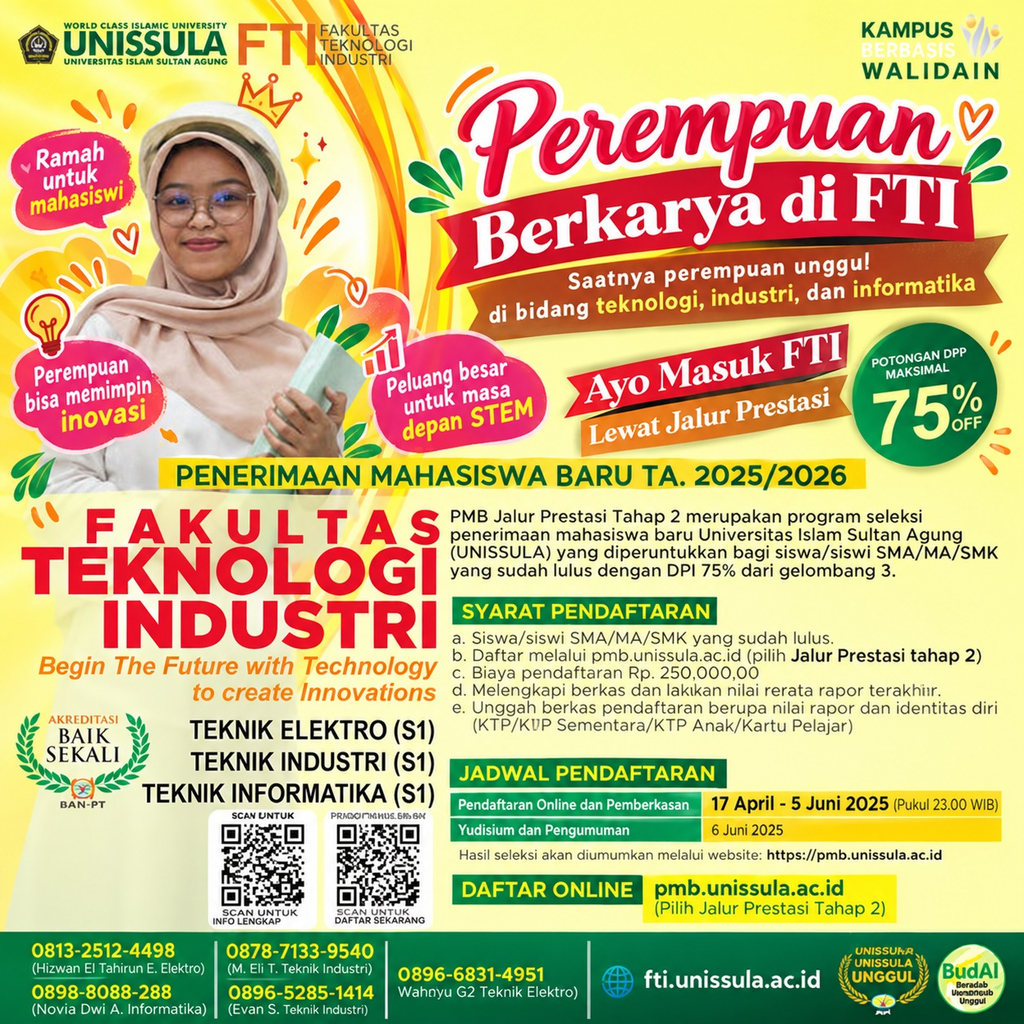
“Perempuan Berkarya di FTI”
The campaign was explicitly designed to encourage women to see themselves as future students and professionals in STEM-related fields.
Its messages included:
- women can lead innovation;
- women have strong opportunities for the future in STEM;
- women can excel in technology, industry, and informatics; and
- prospective female students are encouraged to enter the Faculty of Industrial Technology.
The campaign therefore went beyond general student recruitment by directly addressing women and promoting their participation in academic areas where women are often less represented.
Academic Programmes Promoted
The campaign specifically highlighted three undergraduate programmes:
- Electrical Engineering
- Industrial Engineering
- Informatics
These programmes represent key areas of technology and engineering in which increasing women’s participation is important for strengthening gender diversity in STEM education and future professional careers.
By highlighting these programmes directly to women, UNISSULA provides prospective female students with clear information about available study pathways and future opportunities.
Direct Invitation to Prospective Female Students
The campaign used direct and positive messaging to encourage women to apply.
Messages such as “Saatnya perempuan unggul di bidang teknologi, industri, dan informatika” communicate that women are welcomed and encouraged to participate in these fields.
The campaign also presented the message “Perempuan bisa memimpin inovasi”, reinforcing the idea that women can take active and leading roles in technology and innovation.
Another message, “Peluang besar untuk masa depan STEM,” connected study opportunities with future education and career prospects.
Together, these messages were designed to reduce perceptions that engineering, technology, or informatics are fields primarily intended for men.
Linked Directly to the 2025/2026 Admissions Cycle
The campaign was linked directly to UNISSULA’s 2025/2026 new student admissions process.
Prospective applicants were provided with:
- information about the programmes offered;
- admissions requirements;
- the application schedule;
- online registration information;
- contact information; and
- direct access to the university’s admissions platform.
The campaign therefore functioned as both an awareness initiative and a practical admissions resource.
It did not simply promote women’s participation conceptually; it provided a direct pathway for prospective female students to submit applications.
Supporting Women’s Participation in Technology and Engineering
UNISSULA recognises that equal access alone may not always be sufficient to increase women’s participation in fields where they remain underrepresented.
Targeted outreach can help prospective female students:
- understand available academic opportunities;
- see women represented in technology-related fields;
- develop confidence in choosing STEM programmes;
- access clear information about admissions; and
- connect academic study with future professional opportunities.
The use of female representation in the campaign also provides an important visual message that women belong in engineering and technology education.
Women as Future Innovators and Professionals
The campaign positions women not only as prospective students but also as future innovators, professionals, and leaders.
By linking women with technology, industry, informatics, and innovation, UNISSULA helps broaden perceptions of women’s roles in technical education and professional careers.
This approach supports greater gender diversity in fields that have historically attracted fewer female applicants.
University Outreach as a Gender-Equality Measure
UNISSULA uses outreach and admissions communication as part of its wider gender-equality efforts.
The 2025 FTI campaign represents a clear example of university outreach targeted specifically at women in underrepresented subjects.
THE guidance recognises that university outreach may include information, events, and resources that help inspire female students to apply to subjects where they are underrepresented.
The FTI campaign directly fulfils this role by combining:
- targeted messaging for women;
- representation of women in technology;
- promotion of STEM-related programmes;
- admissions information; and
- a direct invitation to apply.
Relationship with UNISSULA’s Equal-Access Admissions Framework
The campaign complements UNISSULA’s broader equal-access admissions approach.
Women are free to apply to engineering, technology, informatics, and other academic programmes without gender-based admission restrictions.
Targeted outreach adds another layer of support by actively encouraging women to consider fields where they may otherwise be less represented.
This combination of equal access and targeted encouragement strengthens women’s opportunities to participate across the full range of academic disciplines.
Commitment to Expanding Women’s Participation
UNISSULA continues to support greater participation of women in academic areas where representation remains comparatively lower.
Through targeted admissions outreach such as “Perempuan Berkarya di FTI”, the university helps prospective female students recognise that technology and engineering are accessible, relevant, and promising fields for women.
5.6.1
Policy of No-Discrimination Against Women
5.6.1 Policy of Non-Discrimination Against Women
UNISSULA Policy of Non-Discrimination Against Women
Universitas Islam Sultan Agung (UNISSULA) is committed to maintaining an academic and working environment in which women are treated fairly, protected from discrimination, and able to participate fully in university life.
This commitment is formally reflected in the Guidelines for the Prevention and Handling of Sexual Violence at Universitas Islam Sultan Agung, established through Rector Decision No. 1917/E/SA/IV/2022.
The policy provides an institutional framework for gender fairness, non-discrimination, equality, protection, assistance, and recovery across the university community.
Formal Institutional Policy
The Guidelines for the Prevention and Handling of Sexual Violence were established as a university-wide reference for preventing, monitoring, evaluating, and handling sexual violence at UNISSULA. The document is intended for use by the entire university community.
The policy applies to university activities related to education, research, community service, and other activities under UNISSULA’s responsibility. It also establishes mechanisms for reporting, emergency response, referral, protection, assistance, and recovery.
Explicit Principle of Non-Discrimination
A central principle of the policy is non-discrimination.
The Guidelines explicitly state that measures for the prevention and handling of sexual violence must be sensitive to the diversity of individuals’ backgrounds and must be carried out without discrimination based on:
- sex;
- gender identity;
- sexual orientation;
- age;
- ethnicity;
- race;
- religion;
- education;
- social group;
- social class; and
- disability.
This explicit non-discrimination principle provides a clear institutional basis for ensuring that women are not treated less favourably because of their sex or gender.
Gender-Fair Principle
The policy also requires a gender-fair approach.
UNISSULA recognises that gender constructions can make certain groups more vulnerable than others. The Guidelines therefore require prevention and handling processes to understand gender-related vulnerability, enable vulnerable groups to express their concerns, and ensure that their rights are protected and fulfilled.
This principle strengthens the university’s commitment not only to avoiding discrimination but also to addressing conditions that may create unequal experiences for women.
Equal Treatment and Protection of Rights
The Guidelines also establish the principle of equality within the handling process.
They state that prevention and response should be based on respect for individuals, protection of their rights, and avoidance of judgement, coercion, or discriminatory treatment.
Women who experience sexual violence or gender-related harm therefore have access to institutional mechanisms designed to protect their dignity, safety, rights, and ability to continue participating in university life.
University-Wide Coverage
The policy has broad institutional coverage.
It applies to:
- students;
- lecturers;
- teaching assistants and tutors;
- researchers and research assistants;
- educational staff;
- non-academic staff;
- security personnel;
- cleaning personnel;
- interns;
- contract workers; and
- visitors within the UNISSULA environment.
This demonstrates that the university’s non-discrimination and protection framework is not confined to a single faculty or group but applies across the university community.
Reporting, Protection and Assistance Mechanisms
UNISSULA provides institutional mechanisms for handling cases through the UNISSULA Center (UC).
The UC is responsible for providing a safe space for reporting, documenting and verifying cases, assessing survivors’ needs, coordinating follow-up, and ensuring access to protection and recovery services.
Available forms of support include:
- medical assistance;
- psychological and psychosocial support;
- academic assistance;
- legal assistance;
- emergency support;
- protection and safety measures;
- recovery services; and
- referral to relevant external service providers where necessary.
These provisions help ensure that women who experience discrimination, violence, or related harm are able to access appropriate institutional support.
Protection of Survivors’ Rights
The policy establishes specific rights for survivors.
These include the right to prompt and free handling, participation in determining the mechanism for resolving a case, legal assistance, psychological support, health services, and special facilities where required.
Survivors are also entitled to protection from threats, pressure, stigma, further violence, and adverse treatment outside established procedures. Their identity and personal information must remain confidential.
The Guidelines further provide for recovery support, including free health, psychological, legal, and academic assistance where required.
Gender Mainstreaming in Teaching and Student Affairs
UNISSULA’s approach extends beyond responding to individual cases.
The policy includes preventive measures within teaching and student affairs, including regular awareness activities and continuous integration of gender mainstreaming and the elimination of sexual violence into teaching, student affairs, and the governance of academic units.
This shows that gender equality is intended to be incorporated into routine institutional practice rather than addressed only when incidents occur.
Gender Mainstreaming in Research, Community Service and Cooperation
The Guidelines also encourage the development of studies on gender-related issues and require continued gender mainstreaming in research, community service, cooperation, and their governance.
UNISSULA therefore extends its gender-related commitments into the university’s wider academic and social responsibilities.
Prevention through Institutional Governance
The policy also addresses institutional governance.
Preventive measures include supporting programmes on the prevention and elimination of sexual violence, allocating institutional resources, conducting regular socialisation for university members, incorporating anti-sexual-violence provisions into relevant employment and governance arrangements, and ensuring continuous gender mainstreaming in university management and organisational affairs.
These measures strengthen the institutional environment in which women study, work, conduct research, and participate in university activities.
Supporting Women’s Participation
The university recognises that discrimination and gender-based violence can negatively affect women’s academic progress, employment, wellbeing, and participation.
For this reason, the policy provides support mechanisms designed to prevent women from being disadvantaged because of gender-related harm.
Academic assistance may include counselling, safe learning arrangements, academic adjustments, assistance with assignments and examinations, and other measures needed to help affected students continue their studies.
Institutional Commitment
Through Rector Decision No. 1917/E/SA/IV/2022 and the accompanying Guidelines for the Prevention and Handling of Sexual Violence, UNISSULA has established an institutional framework that explicitly incorporates:
- non-discrimination based on sex and gender;
- gender fairness;
- equality;
- protection of rights;
- reporting and complaint mechanisms;
- medical, psychological, legal, and academic support;
- gender mainstreaming; and
- institutional prevention measures.
The policy applies across the university and supports women’s ability to study, work, conduct research, participate in university activities, and pursue academic and professional development without discriminatory treatment.
This institutional framework demonstrates UNISSULA’s commitment to creating a safe, fair, and inclusive university environment for women.
5.6.3
Maternity Policy
5.6.3 Maternity Policy Supporting Women’s Participation
UNISSULA Maternity Policy
Universitas Islam Sultan Agung (UNISSULA) provides a formal maternity policy that supports women’s continued participation in university employment by protecting maternity leave, income, recovery time, and employment rights for female lecturers and educational staff.
The policy is established through Rector Regulation No. 8853/G/SA/IX/2024 concerning Leave for Lecturers and Educational Staff of Universitas Islam Sultan Agung.
The regulation recognises maternity leave as a formal category of leave available to female lecturers and educational staff and provides specific provisions for childbirth, pregnancy-related health conditions, and recovery.
Formal Maternity Leave Entitlement
Under Article 5 of the Rector Regulation, female lecturers and educational staff are entitled to maternity leave.
The regulation provides:
- maternity leave for female lecturers and educational staff;
- a minimum of three months of maternity leave;
- an additional period of at least three months where special medical conditions require it, supported by medical certification; and
- continued income during maternity leave.
These provisions enable women to take necessary time away from work for childbirth and recovery while maintaining their employment relationship with the university.
Continued Income During Maternity Leave
An important element of the policy is the protection of income.
During maternity leave, female lecturers and educational staff continue to receive the income to which they are entitled.
This provision helps reduce the financial disadvantage that could otherwise arise from childbirth and supports women in returning to academic and professional participation after maternity leave.
Support for Pregnancy-Related Health Conditions
The regulation also provides protection for women who experience pregnancy-related health conditions.
Female lecturers and educational staff who experience miscarriage are entitled to leave and recovery time according to medical advice.
This provision recognises that women may require additional physical and emotional recovery following pregnancy complications and ensures that appropriate leave can be taken without immediately losing employment-related income.
Supporting Continued Participation in Academic and Professional Life
UNISSULA’s maternity policy supports women’s continued participation by ensuring that childbirth and pregnancy-related health needs do not automatically interrupt their academic or professional careers.
The maternity leave framework allows women to temporarily step away from work while maintaining institutional support and the opportunity to resume their duties following the leave period.
This is particularly important for female lecturers and educational staff whose roles include teaching, research, academic administration, student support, and other university responsibilities.
Supporting Family Responsibilities
The regulation also recognises shared family responsibilities.
Male lecturers and educational staff are entitled to leave when their wives give birth.
This provision helps support women during childbirth and early recovery by allowing fathers to participate in immediate family responsibilities.
Institutional Coverage
The maternity policy applies to lecturers and educational staff within UNISSULA.
The broader employment framework of Yayasan Badan Wakaf Sultan Agung identifies UNISSULA as a higher-education unit under YBW-SA and includes lecturers and educational staff within its employment structure.
The employment framework also recognises employees’ entitlement to leave under applicable regulations.
This demonstrates that maternity leave is embedded within the university’s formal employment and staff welfare framework.
Protection of Women’s Employment Participation
Through maternity leave, continued income, pregnancy-related recovery provisions, and complementary leave for fathers, UNISSULA provides institutional support that enables women to maintain their connection with employment during and after childbirth.
The policy helps ensure that maternity does not become an unnecessary barrier to women’s participation in university employment.
It also supports women in continuing their roles in:
- teaching;
- research;
- academic administration;
- professional development;
- university leadership; and
- other institutional activities.
Policy Implementation
The maternity policy forms part of UNISSULA’s formal leave regulations for lecturers and educational staff.
Leave requests are administered through the university’s formal procedures, ensuring that maternity leave is recognised as an institutional entitlement rather than an informal arrangement.
This provides female employees with a clear mechanism to access maternity-related leave when required.
Commitment to Women’s Participation
UNISSULA recognises that supporting women’s participation requires appropriate institutional arrangements during pregnancy, childbirth, and recovery.
Through Rector Regulation No. 8853/G/SA/IX/2024, the university provides a formal maternity leave framework that protects employment continuity, income, recovery time, and family support.
These measures contribute to an institutional environment in which women can continue to participate and develop professionally while also fulfilling maternity and family responsibilities.
5.6.4
Childcare Facilities for Students
5.6.4 Childcare Facilities for Students
Sultan Agung Islamic Daycare Supports Student Mothers at UNISSULA
Universitas Islam Sultan Agung (UNISSULA) provides accessible childcare services through Sultan Agung Islamic Daycare, located within the Pesanmasa UNISSULA complex.
The facility provides childcare for babies and toddlers and is designed to support parents who require safe and supervised care for their children while carrying out daily activities. For student mothers, access to childcare can help them continue attending classes and other academic activities while their children are cared for in a dedicated environment.

Childcare Facility within the UNISSULA Environment
Sultan Agung Islamic Daycare operates within the UNISSULA campus environment and offers childcare services for:
- babies;
- toddlers;
- daily care;
- monthly care;
- early childhood activities; and
- moral and character-building programmes.
The public information displayed by the daycare identifies the service as Sultan Agung Islamic Daycare and shows its location at the Pesanmasa UNISSULA complex.
This provides student parents with access to childcare in close proximity to the university.
Supporting Recent Mothers
The availability of childcare close to the university is particularly important for recent mothers who need to continue their studies.
Student mothers may face practical challenges in attending lectures, academic meetings, examinations, or other university activities when childcare is unavailable.
By providing an accessible daycare facility within the UNISSULA environment, the university helps reduce this barrier and supports mothers in maintaining their participation in higher education.
Childcare for Babies and Toddlers
The daycare accepts babies and toddlers and provides structured care appropriate to young children.
Its public materials show childcare activities, supervised play, early learning, and child-development activities.
The service is promoted as providing:
- moral education;
- character building;
- daily supervision; and
- structured activities for young children.
These services provide parents with an organised childcare option while they undertake study, employment, or other responsibilities.
Flexible Daily and Monthly Services
Sultan Agung Islamic Daycare provides both daily and monthly childcare options.
This flexibility can be particularly useful for student mothers because academic schedules may vary between days, semesters, examinations, practical activities, and other university commitments.
Daily childcare allows parents to use the facility when needed, while monthly arrangements provide a more regular childcare option.
Supporting Academic Participation
Accessible childcare can directly support student participation by allowing mothers to attend:
- lectures;
- laboratory and practical sessions;
- academic advising;
- examinations;
- student activities;
- research-related activities; and
- other university programmes.
The availability of childcare within the UNISSULA environment means student mothers have a practical option for arranging care while continuing their academic responsibilities.
Paid but Accessible Childcare
Sultan Agung Islamic Daycare operates as a paid childcare service.
The public information shown by the facility includes registration and monthly fee information, demonstrating that the service has an established operational structure.
Although the childcare service is not presented as free, its availability within the UNISSULA environment still provides an important support mechanism for student parents and recent mothers.
Safe and Structured Childcare Environment
The facility provides a structured environment for children, with activities designed for babies and toddlers.
The daycare’s public communication shows children participating in supervised indoor and outdoor activities, early learning, and developmental programmes.
This gives parents access to childcare that is more than passive supervision, with an emphasis on education, development, and character building.
Institutional Support for Women’s Participation
Childcare availability is an important part of supporting women’s participation in higher education.
For mothers who are also students, the ability to access childcare can reduce one of the practical barriers to attending university.
Through Sultan Agung Islamic Daycare, UNISSULA provides a childcare option that can help student mothers continue their studies while also meeting childcare responsibilities.
Commitment to Student Mothers
UNISSULA recognises that student participation can be affected by family and childcare responsibilities.
The presence of Sultan Agung Islamic Daycare within the university environment demonstrates an institutional effort to provide practical support for parents with babies and toddlers.
By offering accessible daily and monthly childcare services close to the campus, the facility can support recent mothers in continuing to attend university courses and participate in academic life.
5.6.5
Childcare Facilities for Staff and Faculty
5.6.5 Childcare Facilities for Staff and Faculty
Sultan Agung Islamic Daycare Supports Staff and Faculty at UNISSULA
Universitas Islam Sultan Agung (UNISSULA) provides childcare facilities for lecturers, staff, and students through Sultan Agung Islamic Daycare, located within the Pesanmasa UNISSULA complex.
The daycare provides childcare services for babies and toddlers and is accessible to members of the university community, including faculty members, educational staff, and students.
This facility supports employees and students who have childcare responsibilities by providing a nearby and structured childcare option within the UNISSULA environment.
Accessible to Faculty, Staff and Students
Sultan Agung Islamic Daycare is available to:
- lecturers and faculty members;
- educational and administrative staff; and
- students.
This broad accessibility makes the facility relevant both for staff and faculty and for student parents.
For lecturers and staff, the daycare helps them continue their teaching, administrative, research, and professional responsibilities while their children receive supervised care nearby.
Childcare for Babies and Toddlers
The daycare provides services for babies and toddlers and offers structured childcare appropriate to young children.
Its programmes include:
- supervised daily care;
- early childhood activities;
- moral education;
- character building;
- developmental activities; and
- structured play.
The daycare therefore provides more than basic supervision, offering an organised environment for early childhood development.
Daily and Monthly Childcare Options
Sultan Agung Islamic Daycare offers both daily and monthly childcare services.
This flexibility helps faculty and staff adapt childcare arrangements to their work schedules.
Daily childcare can support employees during specific teaching, meeting, examination, research, or administrative activities, while monthly childcare provides a regular arrangement for staff with ongoing childcare needs.
Supporting Work Participation
Childcare responsibilities can affect employees’ ability to participate fully in professional life.
The availability of childcare close to the university supports lecturers and staff in carrying out activities such as:
- teaching;
- academic meetings;
- research;
- student supervision;
- administrative duties;
- professional development; and
- university events.
By providing childcare within the UNISSULA environment, the university reduces a practical barrier that can affect staff and faculty participation.
Supporting Women’s Participation in Employment
The facility is particularly relevant to women’s participation in university employment.
Female lecturers and staff with young children may face additional childcare responsibilities. Access to a nearby daycare can help them remain engaged in teaching, research, administration, and professional development.
This support complements UNISSULA’s maternity policy by providing practical childcare after maternity leave and during continued employment.
Shared Family Support
The daycare is accessible not only to women but also to male staff, faculty, and student parents.
This supports a broader approach to shared family responsibilities and helps ensure that childcare is not treated solely as a women’s responsibility.
By making childcare services available to the university community, UNISSULA supports both parents in balancing work, study, and family responsibilities.
Paid but Accessible Childcare
Sultan Agung Islamic Daycare operates as a paid childcare service.
The facility provides established registration and service arrangements, including daily and monthly options.
Although the service is not free, its location within the UNISSULA environment and its availability to lecturers, staff, and students make it an accessible institutional childcare resource.
Institutional Support for Work–Family Balance
UNISSULA recognises that work–family balance can affect the participation and wellbeing of staff and faculty.
Through Sultan Agung Islamic Daycare, the university provides a practical support facility that helps employees manage childcare responsibilities while remaining active in university life.
The facility supports continuity in:
- employment;
- teaching;
- research;
- academic service;
- professional development; and
- institutional participation.
Commitment to Staff and Faculty Wellbeing
By providing childcare services accessible to faculty, staff, and students, UNISSULA strengthens its support for parents across the university community.
Sultan Agung Islamic Daycare provides a structured and accessible childcare option for babies and toddlers and contributes to a more supportive environment for employees with family responsibilities.
5.6.6
Women’s Mentoring Schemes
5.6.6 Women’s Mentoring Schemes
UNISSULA Provides Continuing Mentoring and Empowerment Programmes for Women Students
Universitas Islam Sultan Agung (UNISSULA) provides continuing mentoring and empowerment programmes for women students through structured university and student-led initiatives that support women’s development, leadership, confidence, participation, and awareness.
These programmes are not limited to one-off activities. They form part of an ongoing women’s development and mentoring framework delivered through recurring seminars, discussions, empowerment activities, leadership development, awareness programmes, and other forms of structured student support.
A key role is played by the Kementerian Pemberdayaan Perempuan BEM KM UNISSULA, which organises and coordinates women-focused programmes designed to strengthen the capacity and participation of female students.
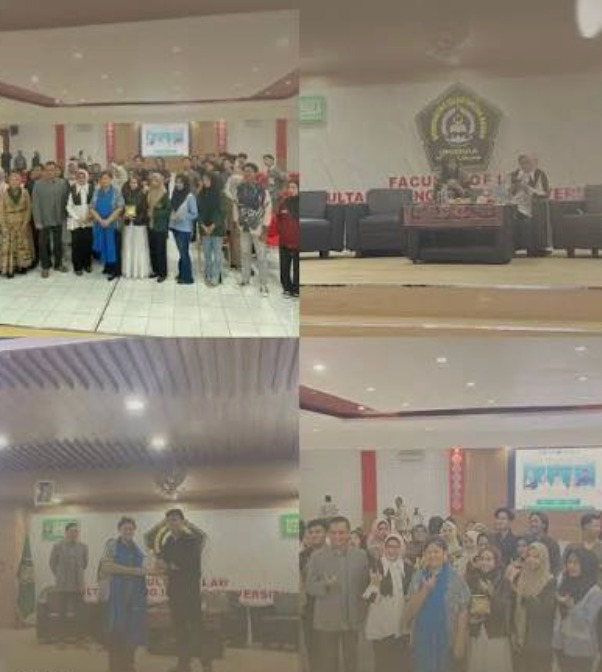
Continuing Women’s Mentoring and Empowerment
UNISSULA’s women’s mentoring scheme is implemented through a series of structured and continuing activities.
The programme includes:
- mentoring and development activities for female students;
- leadership development;
- women’s empowerment programmes;
- discussion forums;
- gender-awareness activities;
- personal and professional development;
- education on women’s rights and protection; and
- opportunities for women to strengthen confidence, networks, and participation in university life.
These activities are intended to provide continuing support rather than isolated interventions.
Women’s Empowerment through Student Development
The Kementerian Pemberdayaan Perempuan BEM KM UNISSULA provides a dedicated platform for women-focused student development.
Its activities include seminars, discussions, educational programmes, women’s empowerment initiatives, and leadership-oriented activities.
These programmes are designed to help female students develop:
- critical awareness;
- confidence;
- leadership ability;
- communication skills;
- social awareness;
- professional readiness; and
- greater participation in academic and student life.
The structured nature of these activities enables women students to receive continuing guidance and development throughout their university experience.
National Seminar on Youth and Women’s Empowerment 2025
One example of the programme in 2025 was the Seminar Nasional Generasi Muda dan Keperempuanan, held on 15 October 2025.
The event was organised by the Kementerian Pemberdayaan Perempuan and initiated in collaboration with Kohati Badko Jawa Tengah–DIY.
The theme was:
“Generasi Muda dan Perempuan Pilar Kebangsaan di Tengah Demokrasi Indonesia”
The programme addressed important issues including:
- gender justice;
- women’s leadership opportunities;
- challenges faced by women in education, employment, and society;
- collaboration and solidarity; and
- women’s empowerment.
The activity encouraged young women to become more aware, critical, confident, and empowered, while also strengthening their capacity to participate in wider social and institutional life.
Leadership and Capacity Building
An important objective of UNISSULA’s mentoring and empowerment scheme is to prepare women students to become active contributors and leaders.
Through mentoring, discussions, seminars, and development activities, female students are encouraged to:
- build leadership capacity;
- participate confidently in organisations;
- develop communication skills;
- strengthen professional networks;
- understand gender-related challenges; and
- take active roles in academic and social activities.
This approach supports women not only during their studies but also in preparing for future careers and wider community participation.
Women-Focused Learning and Discussion
The mentoring scheme also creates spaces where female students can discuss issues that directly affect women.
These may include:
- women’s leadership;
- gender equality;
- personal development;
- career development;
- women’s rights;
- prevention of violence;
- safety;
- confidence building; and
- social participation.
Regular engagement through these forums supports a mentoring environment in which women can learn from lecturers, senior students, professionals, activists, alumni, and external speakers.
Role Models and Mentors
Women’s mentoring at UNISSULA also involves exposure to female role models and professionals.
Through mentoring sessions, seminars, discussions, and women-focused development programmes, students can interact with women who have experience in leadership, law, education, public service, professional practice, and community engagement.
Such interaction helps female students build confidence, develop aspirations, and understand possible academic and career pathways.
Participation Exceeding the Required Threshold
The women’s mentoring and empowerment scheme at UNISSULA has broad participation.
Female student participation in the programme exceeds 10% of the university’s active student population.
Because the participants concerned are female students, this level of participation demonstrates that the scheme reaches a substantial proportion of women students and exceeds the minimum participation threshold expected for women’s mentoring schemes.
The programme therefore has significant reach and is not limited to a small number of participants.
Large-Scale Student Engagement
Several women-focused activities are attended by large numbers of students, including thousands of new students.
This broad participation demonstrates the capacity of the programme to reach women students across different faculties and study programmes.
Large-scale activities are complemented by more focused mentoring, discussion, empowerment, and development sessions that provide continuing engagement throughout the academic year.
Institutional and Student-Level Support
UNISSULA’s women’s mentoring activities are supported through both institutional and student structures.
This includes women-focused programmes organised by student organisations as well as broader university structures concerned with women’s development and support.
Such collaboration strengthens the continuity of women’s mentoring and ensures that female students have multiple channels through which they can access development opportunities.
Supporting Women throughout University Life
The mentoring scheme supports women across different stages of university life.
Students can benefit from programmes related to:
- transition into university;
- academic participation;
- personal development;
- leadership;
- organisational involvement;
- career preparation;
- safety and wellbeing; and
- wider social participation.
This continuing support helps women remain engaged, develop confidence, and maximise their participation in higher education.
Significant and Continuing Impact
UNISSULA’s approach reflects the importance of mentoring schemes that have meaningful reach and impact.
The women’s mentoring and empowerment programme is designed to reach many female students rather than only a small group.
Its continuing activities, broad participation, leadership development, empowerment focus, and women-centred programming demonstrate a sustained institutional commitment to supporting women students.
Commitment to Women’s Success
UNISSULA recognises that women’s success in higher education is strengthened through access to mentoring, guidance, leadership development, supportive networks, and opportunities for personal and professional growth.
Through its continuing women’s mentoring and empowerment schemes, the university provides female students with structured opportunities to develop confidence, leadership, knowledge, and participation.
These initiatives contribute to a supportive university environment in which women are encouraged to grow academically, professionally, and socially.
5.6.7
Track Women’s Graduation Rate
5.6.7 Tracking Women’s Graduation Rate and Addressing Gender Gaps
UNISSULA Tracks Graduation Outcomes by Gender and Maintains Support Schemes to Address Potential Gaps
Universitas Islam Sultan Agung (UNISSULA) monitors student graduation and completion outcomes by gender as part of its commitment to equal educational opportunity and student success.
The university uses cohort-based student data to compare women’s likelihood of graduating with men’s. For the 2021 student cohort, UNISSULA tracked female and male students through 2025 and compared their completion outcomes.
This monitoring enables the university to identify whether differences exist between women and men and to maintain appropriate academic and student-support mechanisms where disparities arise.
Gender-Disaggregated Graduation Tracking
The 2021 cohort consisted of 8,743 students, comprising 4,060 female students and 4,683 male students.
By 2025, a total of 7,043 students from this cohort had graduated. Of these, 3,420 were female students and 3,623 were male students.
The graduation rates were as follows:
| Gender | 2021 Cohort | Graduated by 2025 | Graduation Rate |
|---|---|---|---|
| Female | 4,060 | 3,420 | 84.24% |
| Male | 4,683 | 3,623 | 77.37% |
| Total | 8,743 | 7,043 | 80.55% |
The female graduation rate was therefore 84.24%, while the male graduation rate was 77.37%.
The difference between the two rates was 6.87 percentage points, with female students recording the higher completion rate.
Monitoring Women’s Likelihood of Graduating
The use of gender-disaggregated cohort data allows UNISSULA to measure women’s likelihood of graduating compared with men’s.
Rather than relying only on the total number of graduates, the university compares the number of students entering a cohort with the number from that same cohort who have completed their studies by the monitoring point.
This provides a clearer basis for evaluating completion outcomes and helps the university identify whether women or men experience a relative disadvantage in progressing toward graduation.
For the 2021 cohort monitored through 2025, the data show that women were not less likely to graduate than men.
Interpretation of the 2021–2025 Cohort Results
The results indicate that:
- 84.24% of female students in the monitored cohort had graduated by 2025;
- 77.37% of male students had graduated;
- the overall graduation rate was 80.55%; and
- the difference between female and male graduation rates was 6.87 percentage points.
In this cohort, there was therefore no graduation gap disadvantaging women.
However, UNISSULA continues to monitor outcomes by gender because completion patterns may differ across cohorts, faculties, study programmes, and academic periods.
Regular monitoring allows the university to identify emerging differences and respond appropriately.
Academic Support to Address Potential Graduation Gaps
Graduation monitoring is accompanied by student-support mechanisms intended to reduce barriers to study completion.
UNISSULA provides academic and non-academic support that can be used to assist students whose progress indicates a risk of delayed completion.
These support mechanisms include:
- academic advising;
- supervision of student academic progress;
- mentoring and student-development programmes;
- counselling and wellbeing support;
- academic assistance for students experiencing difficulties;
- support for completing final projects, theses, and other graduation requirements;
- financial support for eligible students;
- women’s mentoring and empowerment programmes; and
- other student-support services designed to help students remain engaged in their studies.
These mechanisms provide the university with practical means to respond when monitoring identifies differences in completion outcomes.
Academic Advising and Progress Monitoring
Academic advising is an important part of UNISSULA’s approach to supporting student completion.
Through academic supervision and progress monitoring, students can receive guidance regarding:
- study planning;
- academic performance;
- course completion;
- final projects;
- thesis progress; and
- other academic requirements related to graduation.
This approach allows potential problems to be identified before they develop into prolonged delays in study completion.
Mentoring and Student Development
Mentoring and student-development activities also contribute to the university’s broader approach to supporting graduation.
Female students have access to women-focused mentoring and empowerment programmes that strengthen confidence, leadership, participation, and personal development.
These programmes complement academic monitoring by helping women remain actively engaged in university life and by providing additional opportunities for guidance and support.
Counselling and Wellbeing Support
Academic performance and completion can also be influenced by personal and social circumstances.
UNISSULA provides counselling and wellbeing support to help students address challenges that may affect their ability to continue and complete their studies.
This support forms part of the university’s wider approach to reducing barriers to graduation and maintaining equal opportunities for student success.
Support for Students with Family Responsibilities
UNISSULA also recognises that students may face family and caregiving responsibilities that affect academic progress.
Support facilities and student services can help students balance their studies with personal and family responsibilities.
For women students in particular, such support contributes to maintaining participation and reducing the risk that family responsibilities become barriers to degree completion.
Responding to Identified Differences
The purpose of gender-disaggregated monitoring is not only to describe graduation outcomes, but also to provide a basis for action.
Where monitoring identifies a group with a lower completion rate, academic advising, mentoring, counselling, student-support services, and other relevant interventions can be strengthened or targeted according to the needs identified.
For the 2021 cohort, women did not experience a lower graduation rate than men. Nevertheless, UNISSULA continues to maintain these support mechanisms so that any future disparity can be identified and addressed.
5.6.8
Policies Protecting Those Reporting Discrimination
5.6.8 Protection for Those Reporting Discrimination
UNISSULA Protects Reporters, Survivors, and Witnesses from Educational and Employment Disadvantage
Universitas Islam Sultan Agung (UNISSULA) has an institutional framework to protect individuals involved in reporting discrimination-related harm and sexual violence from retaliation, academic disadvantage, employment disadvantage, intimidation, and other adverse consequences.
This framework is supported by Rector’s Decree No. 1843/E.1/SA/III/2022, which established the Monitoring, Prevention, and Handling of Sexual Violence Team at UNISSULA. The university’s 2022 Guidelines for the Prevention and Handling of Sexual Violence further establish reporting procedures, protection mechanisms, assistance, and recovery for survivors and witnesses.
Institutional Protection Framework
UNISSULA’s policy framework applies across the university community. The guidelines cover students, lecturers, teaching assistants, tutors, researchers, research assistants, educational staff, non-academic staff, security personnel, cleaning staff, interns, contract workers, and other individuals working within or interacting with the university environment.
This broad scope is important because the potential consequences of reporting misconduct may affect both academic and employment relationships.
For students, retaliation may take the form of academic disadvantage. For employees, it may take the form of adverse employment treatment. UNISSULA’s framework therefore provides safeguards relevant to both groups.
Non-Discrimination in Case Handling
The guidelines establish non-discrimination as one of the principles governing prevention and case handling.
They state that prevention and handling processes must be sensitive to the diversity of survivors and must not discriminate on the basis of sex, gender identity, sexual orientation, age, ethnicity, race, religion, education, social group or class, or disability.
This principle helps ensure that individuals who seek assistance or participate in reporting procedures receive fair treatment regardless of their background or personal characteristics.
Safe Mechanisms for Reporting
UNISSULA provides formal reporting mechanisms through the UNISSULA Center (UC).
The Center is responsible for providing a safe and comfortable space for survivors and witnesses to report cases through available reporting channels, including a hotline. It also documents and verifies reports, assesses the needs of survivors, and follows up cases with the Rectorate, the university Ethics Committee, and relevant investigation structures.
This reporting structure is intended to make it possible for members of the university community to raise concerns without having to face the process alone.
Explicit Protection from Educational and Employment Disadvantage
A particularly strong part of the UNISSULA policy is the explicit protection against adverse consequences imposed outside the formal case-resolution mechanism.
The guidelines provide the right to give information without pressure and the right to confidentiality. They also establish protection from forms of punishment such as:
- delay or cancellation of grades;
- delay or cancellation of graduation;
- job transfer;
- dismissal; and
- other forms of punishment outside the official resolution process.
The guidelines provide the same form of protection for witnesses, including protection against the delay or cancellation of grades or graduation, job transfer, and dismissal.
These provisions directly address the two types of disadvantage that are particularly important in a university environment: educational disadvantage and employment disadvantage.
Protection from Educational Disadvantage
For students, UNISSULA’s policy specifically guards against academic retaliation.
A student involved in reporting or providing information in a case should not suffer disadvantages such as the delay or cancellation of grades or graduation outside the formal resolution mechanism.
These protections help preserve a student’s academic position and reduce the risk that participation in a reporting process will interfere with continued study or degree completion.
Protection from Employment Disadvantage
The policy also provides safeguards relevant to university employees.
Lecturers, researchers, educational staff, and other employees covered by the guidelines are protected against adverse employment consequences such as arbitrary job transfer or dismissal outside the formal case-handling mechanism.
This helps ensure that employees can participate in reporting and case-handling processes without their employment position being used as a means of retaliation.
Protection for Witnesses
The protection framework is not limited to survivors.
Witnesses are also specifically covered. This is important because witnesses may face pressure, intimidation, or retaliation for providing information.
The policy guarantees witnesses the right to provide information without pressure, confidentiality of identity, protection from adverse academic or employment consequences, psychological support, legal assistance, and appropriate facilities where necessary.
This strengthens the university’s reporting system by helping individuals participate in investigations without fear of disadvantage.
Protection and Recovery through UNISSULA Center
UNISSULA Center is also responsible for coordinating and monitoring protection and recovery services for survivors and witnesses.
The guidelines define protection as efforts to provide safety to survivors and witnesses, while recovery includes assistance intended to support them in resolving the case, obtaining their rights, and restoring wellbeing.
The available support includes:
- medical services;
- psychological services;
- academic assistance; and
- legal assistance.
This means that protection is not limited to the moment when a report is submitted. Support can continue throughout the case-handling and recovery process.
Academic Support as Part of Protection
The explicit inclusion of academic assistance within the protection and recovery framework is particularly relevant for students.
Where a case affects a student’s ability to participate in learning or complete academic requirements, the university can provide academic support as part of the response.
Together with the prohibition on retaliatory academic consequences, this helps protect the student’s continued participation in education.
Confidentiality and Freedom from Pressure
The reporting framework also recognises that individuals may hesitate to report misconduct if they fear exposure or coercion.
UNISSULA therefore provides safeguards including:
- the right to provide information without pressure;
- protection of identity and confidentiality;
- access to assistance; and
- protection against improper punishment.
These measures help create safer conditions for reporting and participation in case handling.
Institutional Responsibility
The protection mechanism is supported institutionally through both the university’s formal team and the UNISSULA Center.
The establishment of the Monitoring, Prevention, and Handling of Sexual Violence Team through Rector’s Decree No. 1843/E.1/SA/III/2022 demonstrates that prevention and case handling are formally assigned responsibilities within the university structure.
The UNISSULA Center then provides operational support by receiving reports, coordinating case handling, providing protection, and monitoring recovery services.
Preventing Retaliation after Reporting
UNISSULA’s framework recognises that protection must extend beyond the submission of a complaint.
A person who has reported a case, survived misconduct, or provided evidence as a witness must be able to continue studying or working without being subjected to unofficial punishment.
This is reflected in the policy’s explicit prohibition of adverse consequences such as:
- cancellation or delay of grades;
- cancellation or delay of graduation;
- job transfer; and
- dismissal.
These examples demonstrate that UNISSULA’s protection mechanisms address concrete risks that can affect a person’s educational or employment position.
Commitment to Fair and Safe Reporting
Through its formal reporting structure, non-discrimination principles, protection for survivors and witnesses, confidentiality safeguards, academic assistance, and protection against adverse academic or employment consequences, UNISSULA seeks to ensure that members of the university community can report misconduct safely.
The framework combines prevention, reporting, protection, recovery, and follow-up within a single institutional approach.
It also demonstrates that protection includes not only personal safety but also the preservation of an individual’s academic and professional position.
5.6.9
Paternity Policy
5.6.9 Paternity Policy Supporting Women’s Participation
Paternity Leave and Shared Childcare Responsibilities at UNISSULA
Universitas Islam Sultan Agung (UNISSULA) supports gender equality in the workplace by recognising that childcare responsibilities should be shared between parents. One of the institutional measures supporting this principle is the provision of paternity leave for male lecturers and educational staff.
This provision is regulated through Rector Regulation No. 8853/G/SA/IX/2024 on Leave for Lecturers and Educational Staff, issued on 3 September 2024. The regulation states that male lecturers and educational staff are entitled to leave when their wife gives birth.
Supporting Shared Parenthood
The paternity leave provision enables fathers, as non-gestational parents, to be present at the time of childbirth and to participate in immediate childcare and family responsibilities.
This arrangement supports a more balanced distribution of care between parents and helps reduce the expectation that responsibilities related to childbirth and early childcare should be carried solely by women.
By allowing fathers to take leave during this period, UNISSULA encourages shared responsibility within the family and provides additional support to women following childbirth.
Supporting Women’s Continued Participation in Employment
Childbirth and early childcare can place significant demands on women, particularly when combined with professional responsibilities.
UNISSULA’s paternity leave provision complements maternity leave by allowing fathers to take an active role in supporting their spouse and newborn child. This contributes to a more family-supportive working environment and helps women remain connected to their professional roles.
The policy therefore supports women’s participation not only through maternity protection, but also by recognising the role of non-gestational parents in childcare.
Institutional Coverage
The policy applies to:
- male lecturers;
- male educational staff.
These employees are formally entitled to leave when their wife gives birth.
This provision ensures that both academic and non-academic employees have an institutional mechanism to participate in family responsibilities at the time of childbirth.
Contribution to Gender Equality
UNISSULA views shared childcare responsibilities as an important element of gender equality.
When fathers are enabled to participate in childcare, women receive greater practical and emotional support, while family responsibilities are distributed more evenly.
This contributes to a working environment that supports:
- shared parental responsibility;
- work-family balance;
- women’s continued participation in employment;
- family wellbeing; and
- a more gender-responsive institutional culture.