

















UNISSULA SUSTAINABILITY REPORTING
SDG 17 – Partnerships for the Goals
Progress Report 2025
2025 Report Overview
In 2025, Universitas Islam Sultan Agung (UNISSULA) documented its progress towards SDG 17 – Partnerships for the Goals through collaboration with government institutions, non-governmental organisations, international partners, and local communities to advance sustainable development. The university contributed to national policy discussions, facilitated cross-sectoral dialogue, and strengthened international cooperation in water sustainability, climate resilience, and research-based solutions. UNISSULA also supported sustainability education through curriculum integration, dedicated courses, and community outreach programmes. This report presents the university’s documented achievements, institutional partnerships, educational initiatives, and continuing priorities for advancing the Sustainable Development Goals during the 2025 reporting period.
Full SDG 17 Progress Report 2025
17.2.1
Relationships With Regional NGOs And Government For SDG Policy
17.2.1 UNISSULA Contributes to National SDG Policy Development Through Legislative Recommendations, Government Collaboration and Evidence-Based Public Policy Initiatives
Institutional Commitment to Sustainable Development Policy
Universitas Islam Sultan Agung (UNISSULA) actively supports sustainable development through academic contributions to public policy, institutional cooperation, applied research, and engagement with government institutions.
As part of its commitment to the United Nations Sustainable Development Goals (SDGs), UNISSULA connects academic expertise with the identification of development challenges, the discussion of policy alternatives, the formulation of recommendations, and the monitoring of public development programmes.
During 2025, these contributions were demonstrated through direct engagement with national legislative institutions, cooperation with government agencies, and university participation in initiatives relevant to public-sector decision-making.
One of the university’s most significant contributions was its collaboration with the Regional Representative Council of the Republic of Indonesia (DPD RI) in reviewing national legislative priorities and providing academic recommendations for legal and institutional reform.
This engagement was complemented by university involvement in housing assistance verification, competition policy discussions, and legal policy cooperation.
Direct Academic Contributions to National Legislative Policy Development with DPD RI
On 16 October 2025, the Faculty of Law of UNISSULA collaborated with the Regional Representative Council of the Republic of Indonesia (Dewan Perwakilan Daerah – DPD RI) to organise a Focus Group Discussion (FGD) at the UNISSULA campus in Semarang.
The forum focused on empirical studies supporting the 2026 Priority National Legislative Programme (Prolegnas) and the 2025–2029 Medium-Term National Legislative Programme proposed by DPD RI.
The activity brought together national legislative representatives, legal academics, and experts to examine legislative priorities and the challenges associated with Indonesia’s lawmaking process.
The collaboration represented direct academic participation in national government policy development.
Objectives of the Legislative Policy Discussion
The discussion examined:
- Challenges in the implementation and follow-up of legislative proposals submitted by DPD RI.
- The effectiveness of national legislative priorities in responding to public needs.
- Institutional coordination and the legislative responsibilities of national government bodies.
- Academic and empirical perspectives on proposed legislation.
- Recommendations for strengthening the national legislative framework.
The discussion involved Dr. H. Abdul Kholik, Chair of the Legislative Drafting Committee of DPD RI, and Professor Jawade Hafidz, Dean of the Faculty of Law of UNISSULA, together with legal experts and legislative policy advisers.
The forum provided a mechanism for incorporating university expertise into deliberations concerning national legislative priorities.
UNISSULA’s Direct Policy Recommendation: Asset Forfeiture Legislation
During the discussion, Professor Jawade Hafidz emphasised the importance of progressing the proposed Asset Forfeiture Bill (Rancangan Undang-Undang Perampasan Aset).
He recommended that the national legislative institutions advance the bill as part of efforts to strengthen the legal framework for addressing corruption and protecting public assets.
The recommendation was relevant to governance, accountability, the rule of law, and the strengthening of public institutions.
These objectives contribute to SDG 16 – Peace, Justice and Strong Institutions, particularly efforts to strengthen effective, accountable, and transparent institutions.
UNISSULA’s Direct Policy Recommendation: Regional-Owned Enterprises
Professor Jawade Hafidz also raised the importance of legislation concerning Regional-Owned Enterprises (Badan Usaha Milik Daerah – BUMD).
He highlighted challenges associated with coordination and governance among regional institutions and the potential consequences for communities.
UNISSULA’s academic input addressed the need to strengthen the legal and institutional arrangements governing regional enterprises.
This recommendation is relevant to improving public-sector governance, strengthening regional development institutions, and supporting more effective economic administration.
It also connects to SDG 8 – Decent Work and Economic Growth, SDG 11 – Sustainable Cities and Communities, and SDG 16 – Peace, Justice and Strong Institutions.
Contribution to National Policy Development
The DPD RI–UNISSULA forum is particularly significant because UNISSULA did not participate solely as an observer.

Through its Faculty of Law, the university contributed identifiable academic recommendations concerning specific national legislative priorities.
These contributions demonstrate the university’s role in identifying governance challenges and providing policy input directly to a national legislative institution.
Public Evidence:
DPD RI Gandeng Unissula Bahas Prolegnas, Dorong DPR Sahkan UU Perampasan Aset, Sorot Indonesia, October 2025.
Bahas Prolegnas, DPD RI Minta Masukan Unissula, Radio Republik Indonesia, 16 October 2025.
https://rri.co.id/semarang/regional/1905973/bahas-prolegnas-dpd-ri-minta-masukan-unissula
DPD RI Gandeng Unissula Bahas Prolegnas, Dorong DPR Sahkan UU Perampasan Aset, NU Online Jawa Tengah, 17 October 2025.
Supporting Evidence-Based Housing Policy Through Verification of Inadequate Housing
On 26 May 2025, UNISSULA announced the deployment of 1,685 students through its Community Service Programme (Kuliah Kerja Nyata – KKN) to support the verification of housing assistance beneficiaries in Sayung and Mranggen, Demak Regency.
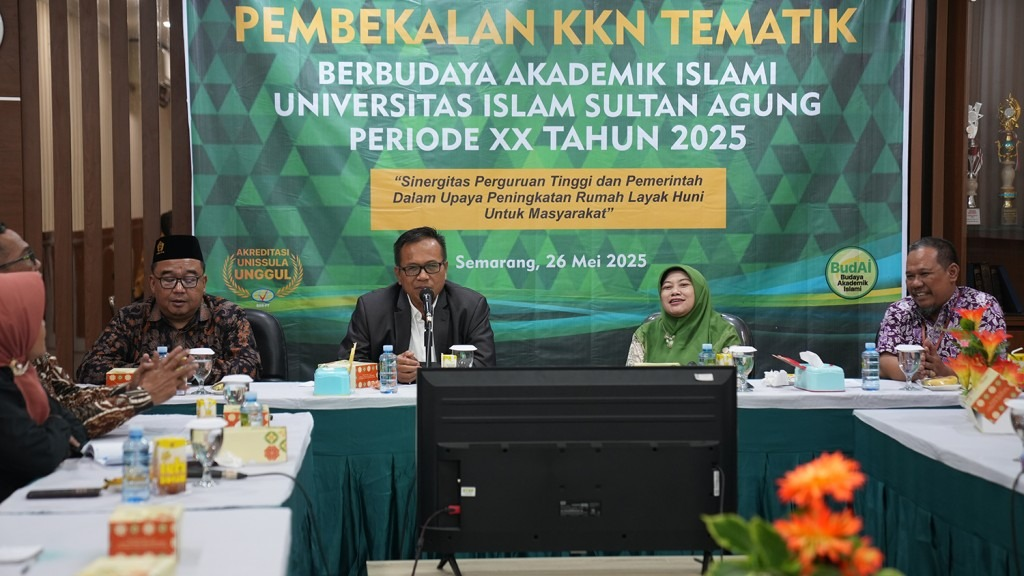
The activity was undertaken in cooperation with the Central Java Provincial Government and the provincial housing and settlement agency.
The initiative focused on the verification of households identified as living in inadequate housing conditions (Rumah Tidak Layak Huni – RTLH).
The verification activities were intended to help ensure that public housing improvement assistance reached eligible beneficiaries.
The programme supported the Central Java Government’s wider housing improvement initiative, which targeted 17,000 housing renovations during 2025.
Identifying Development Challenges
Accurate beneficiary data are essential for ensuring that housing assistance programmes reach households experiencing inadequate living conditions.
Through the involvement of students and academic supervisors, UNISSULA supported the verification process and the identification of potential targeting problems.
This activity contributed to the information-gathering and monitoring aspects of public development programmes.
Supporting Targeted Public Interventions
The collaboration demonstrated how university resources can support government agencies in gathering field-level information relevant to public interventions.
The activity was particularly relevant to SDG 1 – No Poverty and SDG 11 – Sustainable Cities and Communities, including the objective of improving access to adequate housing.
The university’s contribution supported the implementation and monitoring of housing assistance. The publicly available documentation does not establish that UNISSULA independently formulated the provincial housing policy.
Public Evidence:
Agar Tepat Sasaran Unissula Terjunkan 1685 Mahasiswa Bantu Verifikasi RTLH, UNISSULA, 26 May 2025.
Supporting National Competition Policy Development with KPPU
UNISSULA also strengthened its institutional engagement with the Indonesian Competition Commission (Komisi Pengawas Persaingan Usaha – KPPU) during 2025.

On 5 March 2025, UNISSULA and KPPU signed a Memorandum of Understanding establishing a framework for cooperation concerning business competition, partnership supervision, legal issues, education, research, and community engagement.
The agreement was recorded under:
- KPPU Agreement Number: 2/KPPU/NK/III/2025
- UNISSULA Agreement Number: 004/C.2/MoU-DN/SA/III/2025
On 24 April 2025, the Chair of KPPU, M. Fanshurullah Asa, visited UNISSULA and met with Rector Professor Gunarto and university representatives.
The meeting explored opportunities for academic collaboration and discussed policy-relevant research in several strategic areas:
- Digital economy and market competition.
- Support for micro, small, and medium enterprises.
- Public procurement of goods and services.
- Competition regulation and the proposed revision of Law Number 5 of 1999.
The engagement connected university academic expertise with national concerns about competition regulation, fair markets, and economic development.
Such policy discussions are relevant to SDG 8 – Decent Work and Economic Growth, SDG 9 – Industry, Innovation and Infrastructure, and SDG 16 – Peace, Justice and Strong Institutions.
The April 2025 discussion identified potential research cooperation and future academic input. The available publication did not confirm that a joint policy study or legislative recommendation had already been completed.
Public Evidence:
Dukungan Menjaga Persaingan Usaha dari Universitas Sultan Agung Semarang kepada KPPU, Indonesian Competition Commission, 24 April 2025.
Institutional Cooperation on Legal and Judicial Policy
UNISSULA’s Faculty of Law maintains cooperation with the Centre for Legal and Judicial Policy Strategy (Pusat Strategi Kebijakan Hukum dan Peradilan) of the Supreme Court of the Republic of Indonesia.
The cooperation framework is identified through:
Cooperation Agreement Number: 264/A.1/SA-H/II/2025
The partnership provides a formal framework for academic engagement concerning legal and judicial policy recommendations and the evaluation of judicial policy strategies.
This area of cooperation is relevant to SDG 16 because effective justice systems require sound policies, institutional accountability, and informed legal decision-making.
The partnership reflects UNISSULA’s institutional commitment to applying legal expertise to public policy challenges.
The publicly available partnership information documents the cooperation framework; additional project records would be required to confirm specific policy research outputs or recommendations delivered under the agreement during 2025.
Public Evidence:
National Institutional Partnerships, Faculty of Law, UNISSULA.
Summary of UNISSULA’s 2025 SDG-Related Policy Engagement
The following table summarises the university’s documented engagement with public institutions during 2025 and distinguishes direct policy input from supporting activities and institutional cooperation.
| Government Institution / Partner | Activity and Date | UNISSULA’s Contribution | Related SDGs |
|---|---|---|---|
| DPD RI | National Legislative Programme FGD, 16 October 2025 | Direct academic recommendations concerning the Asset Forfeiture Bill and Regional-Owned Enterprises legislation | SDG 8, 11, 16 |
| Central Java Provincial Government and housing agency | RTLH beneficiary verification programme, May 2025 | Support for identifying housing needs, verifying beneficiary data, and monitoring the targeting of housing assistance | SDG 1, 11 |
| Indonesian Competition Commission (KPPU) | MoU on 5 March 2025 and policy cooperation discussion on 24 April 2025 | Academic engagement concerning competition regulation, digital markets, SMEs, and potential joint policy research | SDG 8, 9, 16 |
| Supreme Court – Centre for Legal and Judicial Policy Strategy | Institutional cooperation framework, 2025 | Formal framework for legal and judicial policy research and evaluation | SDG 16 |
Among these examples, the DPD RI engagement provides the clearest documented evidence of direct university input into national policy development.
The other activities demonstrate additional forms of collaboration relevant to development data, monitoring, policy discussion, and research cooperation.
Contribution to SDG 17 – Partnerships for the Goals
UNISSULA recognises that sustainable development depends on cooperation between academic institutions, government bodies, civil society, and other stakeholders.
Its activities during 2025 demonstrate several forms of university engagement relevant to the development and implementation of public policy.
Identifying Development Problems and Challenges
Through participation in legislative discussions and housing verification activities, UNISSULA contributed to identifying legal, governance, and socioeconomic issues requiring public-sector attention.
Providing Input into Policy Development
Through the DPD RI legislative forum, the Faculty of Law made specific recommendations concerning asset forfeiture and regional-owned enterprises legislation.
These recommendations were presented directly within a national government legislative consultation process.
Supporting Monitoring and Data Verification
Through the RTLH programme, UNISSULA supported field-level verification intended to improve the targeting of government housing assistance.
Strengthening Institutional Partnerships
Through cooperation with KPPU and judicial policy institutions, UNISSULA maintained formal channels for academic engagement on national governance and legal development challenges.
These forms of collaboration connect academic knowledge and community engagement with public development priorities.
17.2.2
Cross Sectoral Dialogue About SDGS
17.2.2 UNISSULA Strengthens Cross-Sectoral Dialogue on Sustainable Development Through National and International Conferences
Strengthening Cross-Sectoral Partnerships for Sustainable Development
Universitas Islam Sultan Agung (UNISSULA) actively promotes cross-sectoral dialogue through national and international conferences, focus group discussions, and collaboration with government institutions, non-governmental organisations, and professional communities.
Throughout 2025, UNISSULA initiated and participated in discussions addressing climate change, environmental sustainability, inclusive urban development, public health, legal reform, and institutional governance. These activities brought together academic experts, policymakers, government representatives, international organisations, and professionals to exchange knowledge and address challenges related to the United Nations Sustainable Development Goals (SDGs).
The following initiatives demonstrate UNISSULA’s commitment to fostering dialogue and partnerships across different sectors.
Cross-Sectoral Dialogue on National Criminal Law, Narcotics, and Asset Forfeiture
On 28 November 2025, the Faculty of Law of UNISSULA organised a Focus Group Discussion (FGD) examining Indonesia’s National Criminal Code (KUHP), law enforcement, narcotics-related offences, and asset forfeiture.

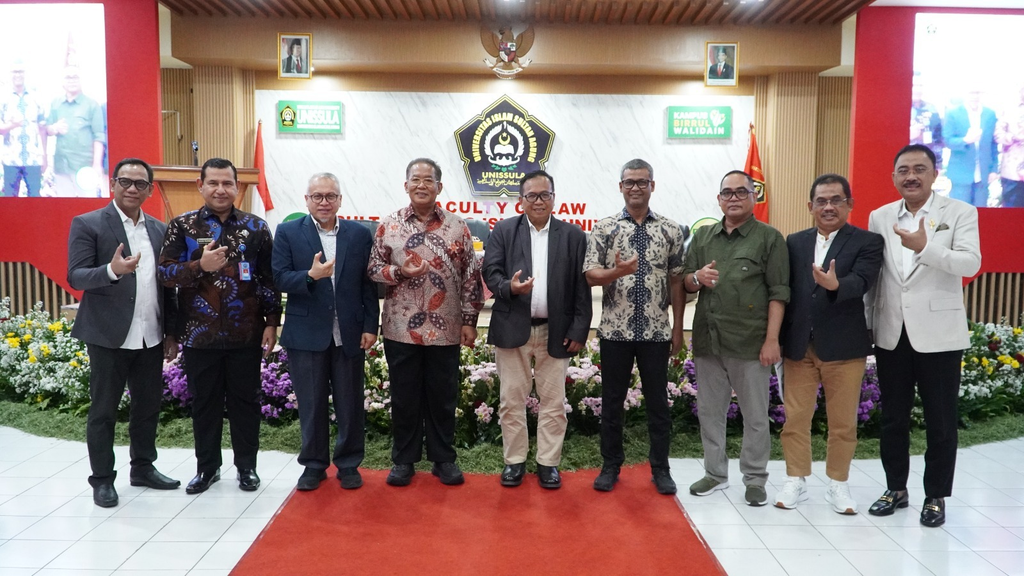
The discussion involved representatives of government law enforcement institutions, including the Central Java Provincial National Narcotics Agency (BNN), the Central Java High Prosecutor’s Office, and legal academics.
Among the speakers were Brigadier General Agus Rohmat, Head of the Central Java Provincial National Narcotics Agency, and Anang Iskandar, former Head of the Indonesian National Narcotics Agency.
The forum addressed the implementation of criminal law, approaches to narcotics rehabilitation and enforcement, and legal mechanisms for recovering assets associated with criminal offences.
By bringing together academics, law enforcement officials, and legal professionals, the FGD facilitated dialogue on public health, criminal justice, institutional accountability, and the strengthening of effective public institutions.
Public Evidence:
International Dialogue on Climate Change and Coastal Sustainability through ICCDA 6
In 2025, UNISSULA organised the 6th International Conference on Coastal and Delta Areas (ICCDA 6), bringing together academics, researchers, international experts, and professionals to discuss climate change and sustainable coastal development.
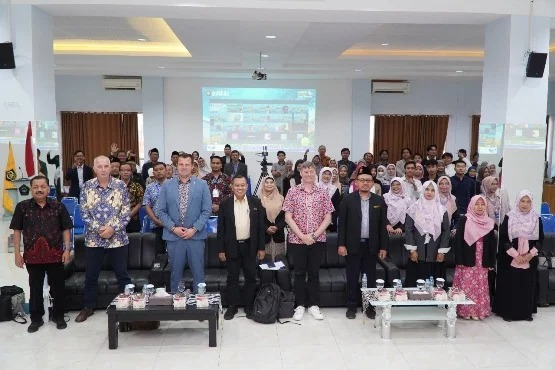
The conference featured expertise from Indonesia and several other countries, including the Netherlands, Denmark, Poland, and Tunisia.
The involvement of Wetskills Foundation from the Netherlands, represented by Johan Oost, demonstrated engagement between academic institutions and external organisations working on sustainable water and environmental development.
Discussions focused on climate change adaptation, coastal resilience, sustainable infrastructure, environmental technology, water resources management, and strategies for addressing environmental challenges affecting coastal communities.
The conference served as a platform for exchanging scientific knowledge and professional perspectives on sustainable development, particularly in relation to climate action, resilient communities, and the sustainable management of coastal environments.
Public Evidence:
International Legal Conference Involving Experts from Five Continents
On 18 June 2025, the Faculty of Law of UNISSULA organised an international conference attended by 13 experts from five continents to discuss legal and institutional responses to global sustainable development challenges.
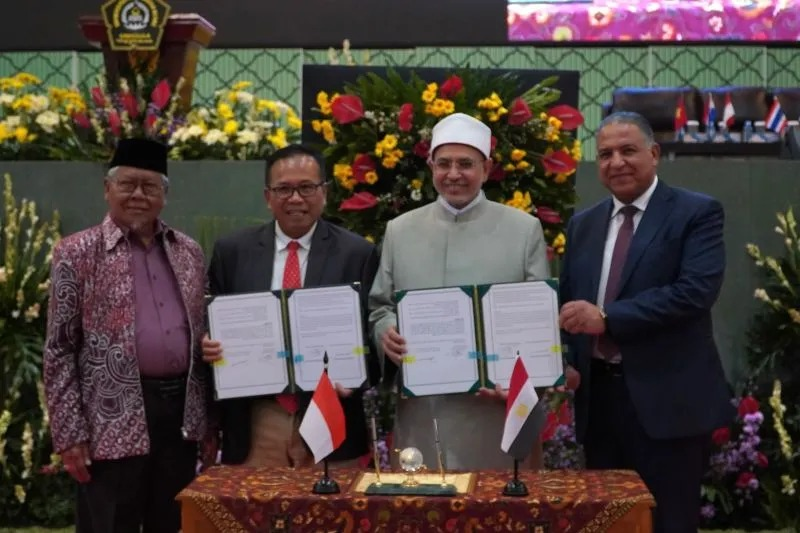
The conference brought together international legal scholars, academics, and representatives from Indonesia’s judicial sector.
The discussions examined climate change, biodiversity protection, environmental law, human rights, and the role of legal institutions in addressing contemporary global challenges.
Through the participation of international experts and judicial representatives, UNISSULA facilitated dialogue across academic, legal, and governmental sectors.
The event strengthened international knowledge exchange and encouraged collaborative approaches to environmental governance, legal reform, and institutional accountability.
Public Evidence:
Strengthening Academic–Government Dialogue through the Police Studies Centre
On 29 November 2025, the Faculty of Law of UNISSULA launched its Police Studies Centre (Pusat Studi Kepolisian) in collaboration with representatives of the Indonesian National Police (POLRI).
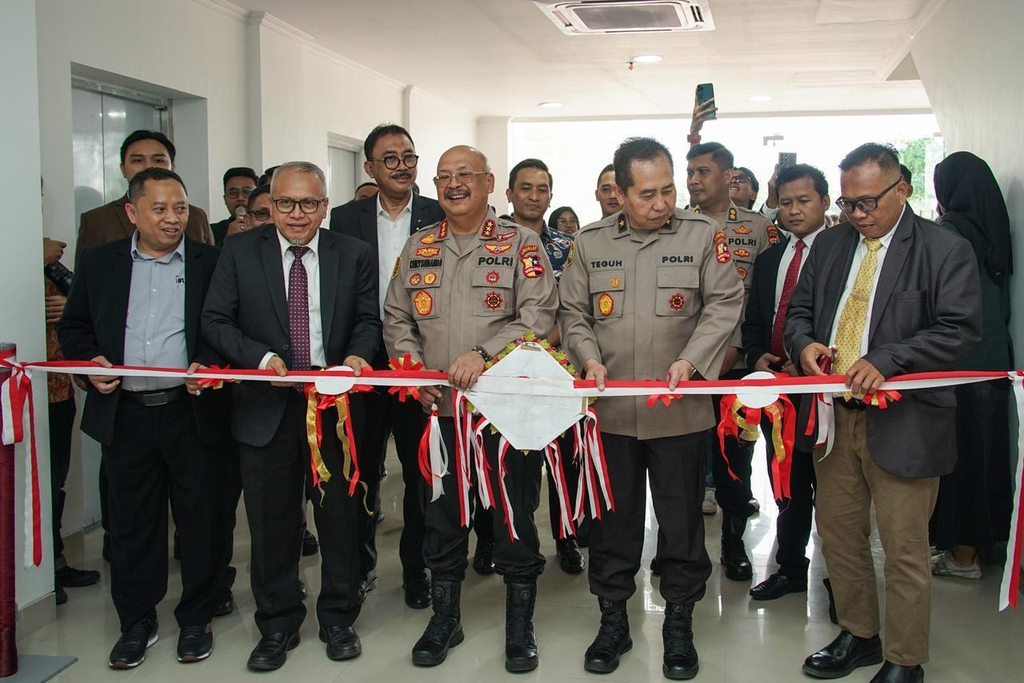
The event involved senior police leadership, including the Deputy Chief of the Indonesian National Police and representatives of the National Police Education and Training Institute.
The initiative highlighted the importance of cooperation between academic institutions and law enforcement agencies in developing research-based approaches to policing, public security, criminal justice, and institutional governance.
The centre provides an institutional platform for academic engagement and knowledge exchange concerning legal and public security challenges.
Through this initiative, UNISSULA strengthens its relationship with government institutions and encourages the application of academic research to issues relevant to public policy and institutional development.
Public Evidence:
U-PLAN #1 2025: International Conference on Inclusive and Sustainable Spatial Planning
The Faculty of Engineering of UNISSULA promoted international and interdisciplinary dialogue through U-PLAN #1 2025, an international conference scheduled for 22–23 April 2025 under the theme:
“Future Challenges of Inclusive, Responsive and Innovative Spatial Planning.”
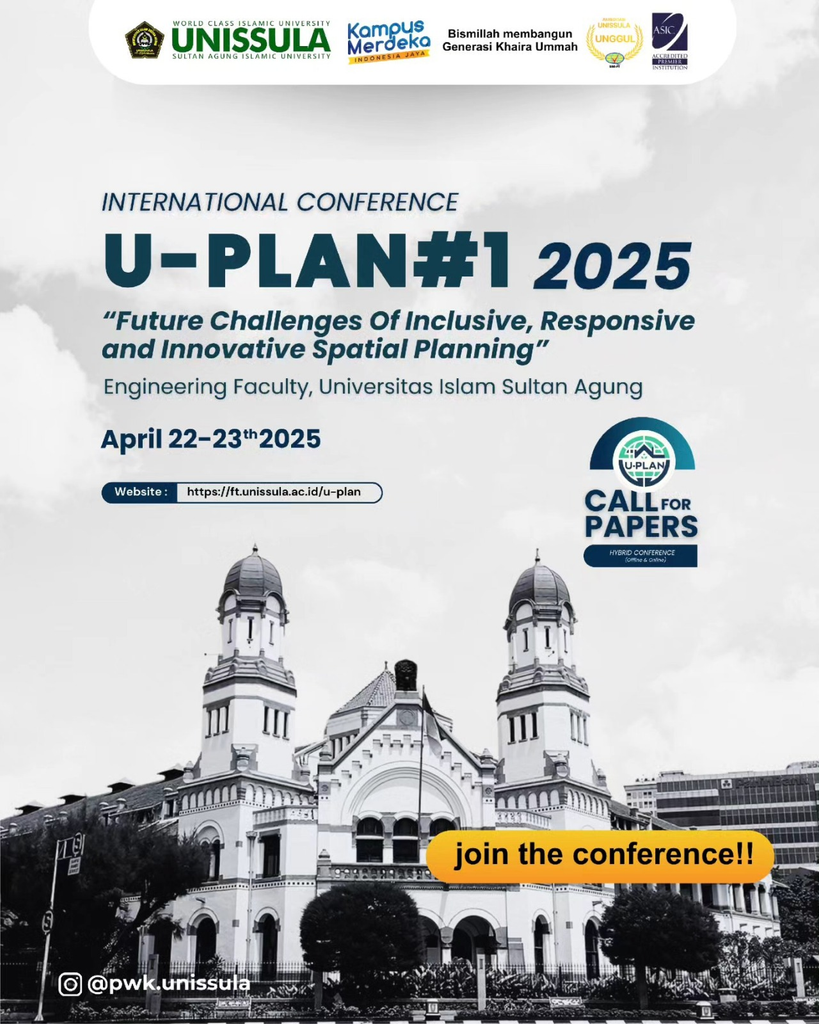
The conference programme brought together expertise from urban and regional planning, engineering, environmental studies, economics, psychology, and sustainable development.
Its invited speakers represented academic and professional institutions from Indonesia, Poland, Italy, the United States, Japan, and Malaysia.
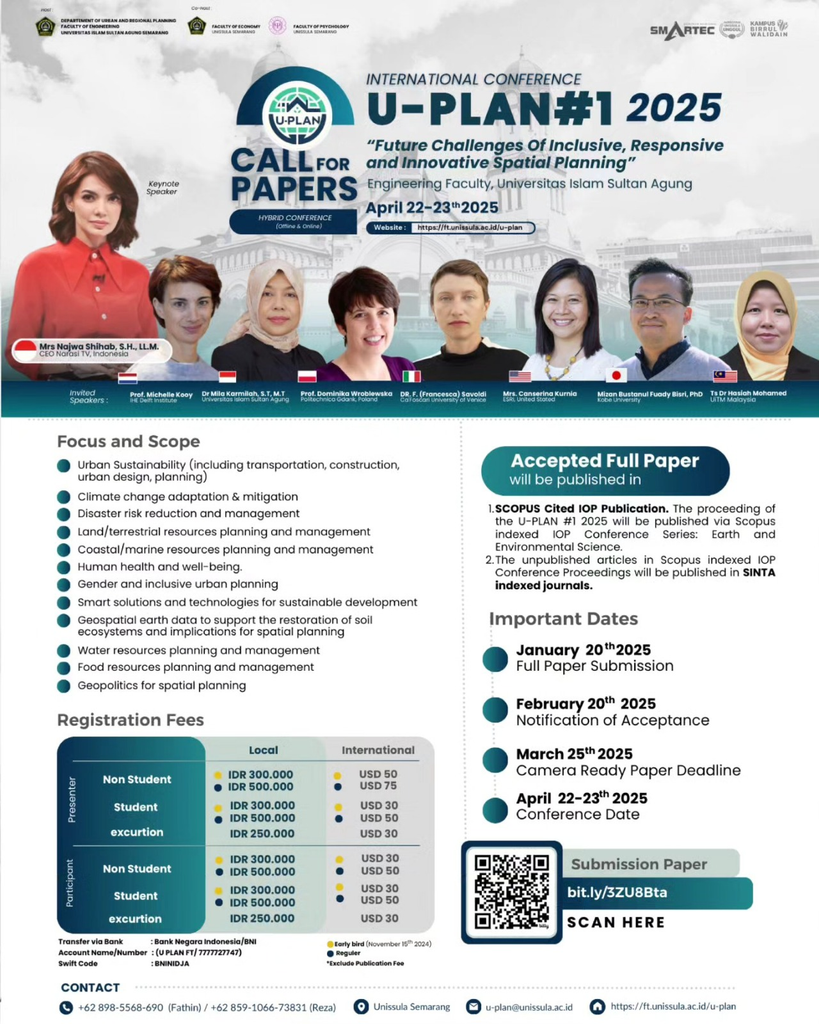
The programme addressed a broad range of sustainable development issues, including:
- urban sustainability;
- climate change adaptation;
- disaster risk reduction;
- inclusive spatial planning;
- transportation;
- water resources management;
- environmental conservation; and
- smart technologies.
Through its interdisciplinary and international scope, U-PLAN #1 provided an opportunity to connect different perspectives on sustainable cities, inclusive development, and environmental resilience.
The official conference posters document the programme, scheduled dates, invited speakers, and discussion themes.
Conference Information:
Summary of Cross-Sectoral Dialogue Initiatives
UNISSULA’s activities in 2025 demonstrate engagement across academic, governmental, professional, and international sectors.
| Activity | Cross-Sectoral Participants | Main Discussion Areas |
|---|---|---|
| National Criminal Law FGD | UNISSULA, BNN, prosecution authorities, legal experts | Criminal law, narcotics, asset forfeiture |
| ICCDA 6 | International academics, environmental professionals, Wetskills Foundation | Climate change, coastal resilience, sustainable infrastructure |
| International Legal Conference | International scholars, judicial representatives, legal experts | Environmental law, biodiversity, human rights |
| Police Studies Centre | UNISSULA, Indonesian National Police | Policing, security, legal research, public policy |
| U-PLAN #1 2025 | International academics and spatial planning professionals | Inclusive urban development, climate adaptation, spatial planning |
These initiatives illustrate the university’s efforts to facilitate collaboration and exchange knowledge across sectors and disciplines.
17.2.3
International Collaboration Data Gathering For SDG
17.2.3 UNISSULA Strengthens International Collaboration on SDG-Related Data and Water Sustainability through Wetskills Foundation
International Collaboration for Sustainable Development Data
Universitas Islam Sultan Agung (UNISSULA) strengthens international collaboration in sustainable development through its partnership with Wetskills Foundation, a Netherlands-based non-profit organisation specialising in international water challenges, applied learning, and knowledge exchange.
In 2025, UNISSULA collaborated with Wetskills Foundation and international water-sector partners to address water management challenges in Semarang, Indonesia. The collaboration connected academic expertise with real-world environmental problems, field observations, technical information, and case-based analysis relevant to the United Nations Sustainable Development Goals (SDGs).
The partnership focused particularly on sustainable water management, urban resilience, climate change adaptation, and water-use efficiency.
International Collaboration through Wetskills-Indonesia 2025
From 8 to 19 June 2025, UNISSULA hosted and supported Wetskills-Indonesia 2025, an international water challenge programme organised in cooperation with Wetskills Foundation from the Netherlands.
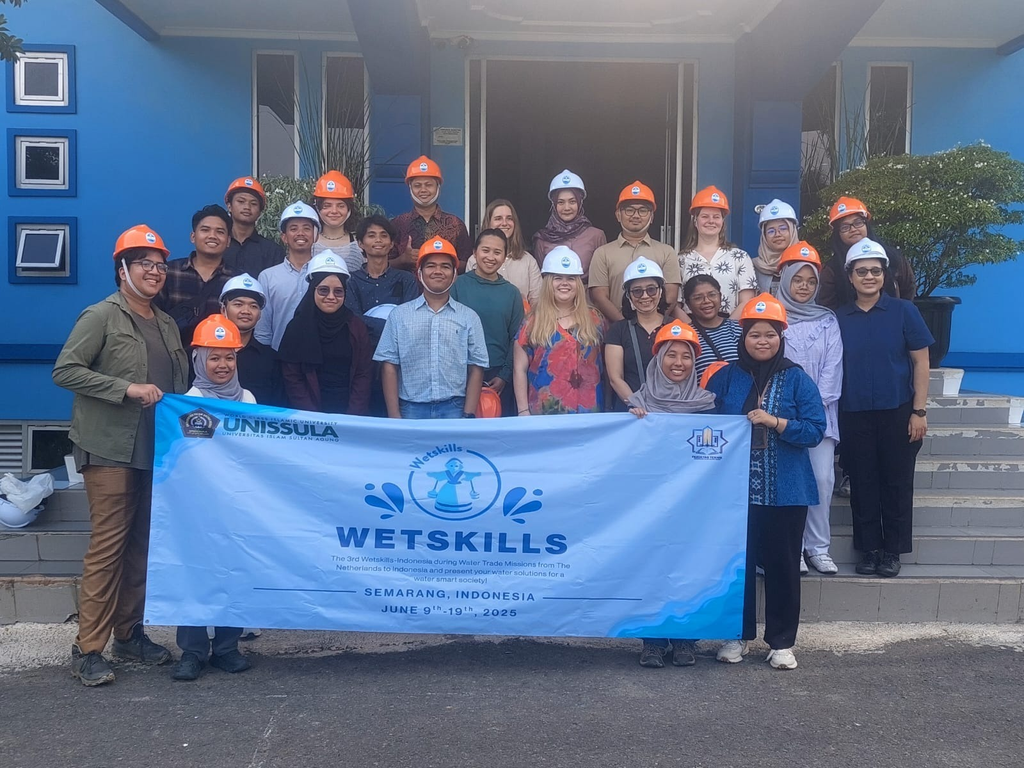
The programme brought together 24 young participants from different countries to collaborate in multidisciplinary teams on real-world water and environmental challenges.
Participants engaged with local water-sector stakeholders, international experts, and professional mentors to examine problems affecting Semarang and surrounding areas.
The programme combined case-based technical analysis, local field visits, expert consultation, and the development of proposed solutions.
Its thematic areas included:
- coastal flooding;
- groundwater depletion;
- water distribution losses;
- wastewater reuse; and
- sustainable water infrastructure.
UNISSULA was identified as an official event partner and served as the programme venue in Semarang.
Public Evidence:
Collaborative Examination of Water-Related Environmental Data
An important component of Wetskills-Indonesia 2025 was the examination of water management challenges through real-life case studies provided by government-related institutions, water utilities, and private-sector organisations.
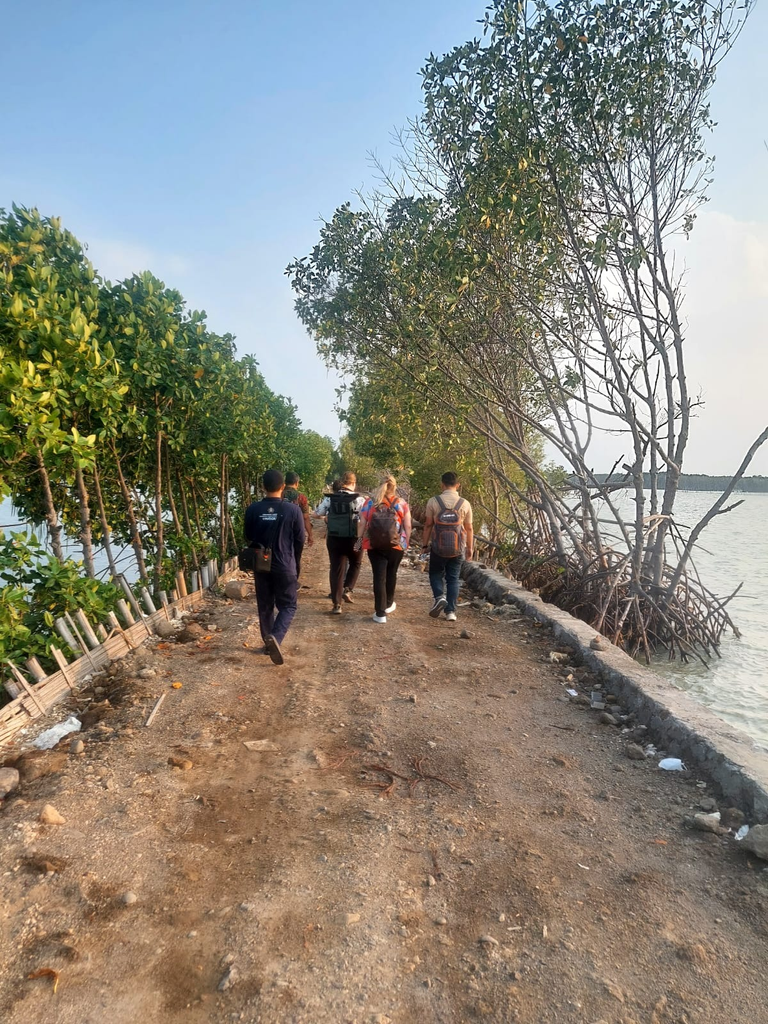
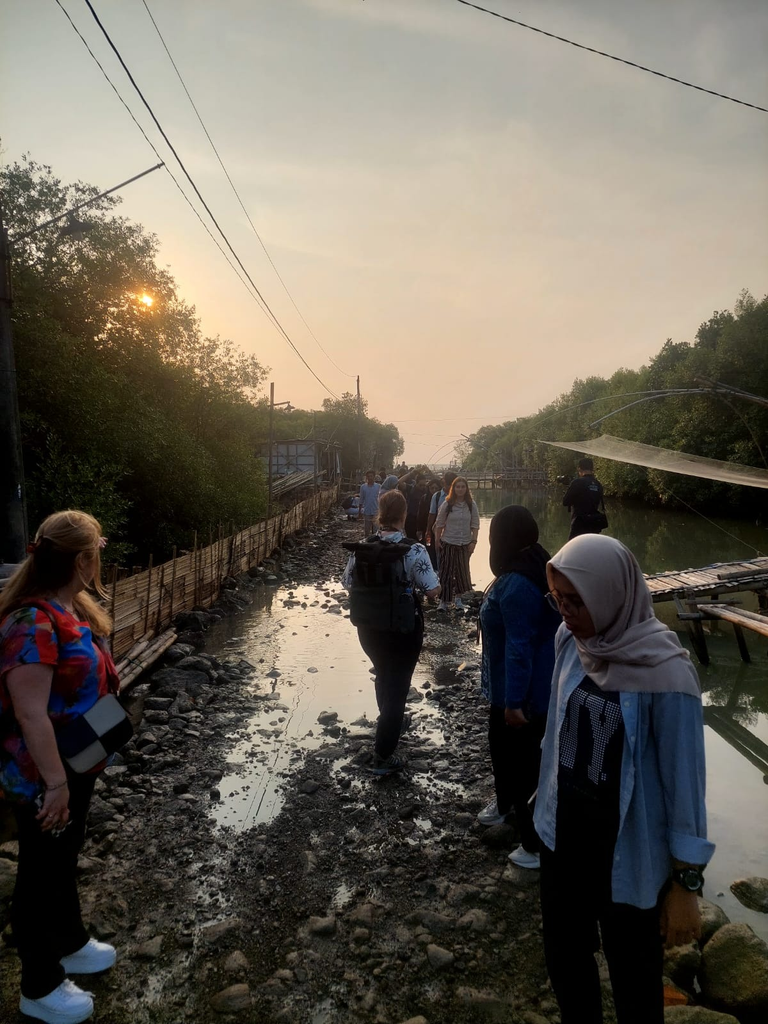
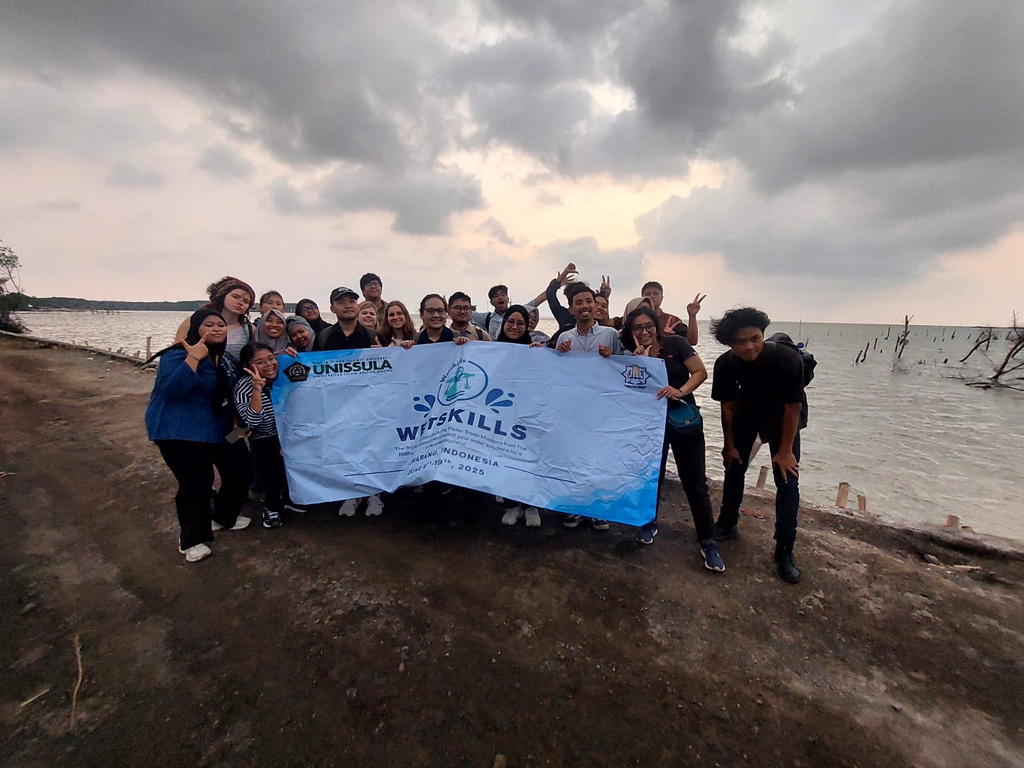
The programme addressed four principal cases.
Community Engagement for Water Solutions
The first case was provided by Blue Deal Indonesia, a programme involving Indonesian local governments and Dutch Water Authorities.
The case examined community participation in addressing flooding and strengthening local resilience.
Participants considered how communities could become more involved in sustainable water management and adaptation initiatives.
Nature-Based Coastal Protection
The second case was provided by Van Oord Dredging and Marine Contractors B.V.
It examined the potential development of natural foreshores in Semarang, including environmental and socioeconomic conditions relevant to coastal protection.
The analysis addressed challenges related to:
- coastal erosion;
- land subsidence;
- flooding; and
- nature-based infrastructure.
Semarang River Revitalisation
The third case, provided by Semarang Old City Heritage, examined the potential revitalisation of the Semarang River.
The case considered the relationship between:
- river management;
- cultural heritage;
- environmental conditions;
- tourism; and
- urban development.
Water Footprint Compensation and Water-Loss Reduction
The fourth case was developed by PDAM Semarang, WaterWorX, and Water Footprint Implementation.
It focused on improving water-use efficiency through the reduction of Non-Revenue Water (NRW), including losses associated with leaks and inefficiencies in water distribution systems.
The case introduced the Water Footprint Compensation framework, which connects corporate water use with water-saving interventions.
This framework emphasises measurable water savings and credible data for water stewardship.
The Wetskills teams examined the practical challenges of developing such an approach in Semarang.
Together, these cases connected international collaboration with locally relevant environmental information, technical analysis, and sustainable water management challenges.
Public Evidence:
Water Footprint Compensation: A Data-Oriented Case Study
The Water Footprint Compensation case provided a particularly relevant example of the programme’s focus on measurement-based water management.

The case was developed in cooperation with PDAM Semarang, WaterWorX, and Water Footprint Implementation.
It addressed the potential use of water-loss reduction projects to compensate for corporate water consumption while supporting improved water security.
The approach considered how water savings could be:
- quantified;
- traced; and
- communicated through credible information.
The case was especially relevant to the monitoring of water-use efficiency and sustainable water resource management.
During the final session on 18 June 2025, the Wetskills teams presented their proposed solutions to an expert jury.
Team 4, which worked on Water Footprint Compensation in Semarang, was announced as the winning team by the Netherlands’ Special Envoy for Water, Meike van Ginneken.
The programme therefore resulted in a documented international team solution addressing a water-management problem for which measurable results are central to the proposed approach.
The available public documentation establishes the case, its measurement-oriented objectives, and the presentation of solutions. It does not independently establish a completed dataset of verified water savings produced by the winning team.
Public Evidence:
Formal International Cooperation Agreement between UNISSULA and Wetskills Foundation
On 16 June 2025, UNISSULA and Wetskills Foundation signed a Memorandum of Agreement (MoA) during the Dutch Trade Mission to Indonesia in Jakarta.

The agreement was signed by:
- Dr. Abdul Rochim, Dean of the Faculty of Engineering, UNISSULA; and
- Johan Oost, Managing Director of Wetskills Foundation.
The signing was witnessed by representatives of the Dutch Trade Mission.
The MoA formalised continued cooperation between UNISSULA and Wetskills Foundation, following their collaboration on international water challenges in Semarang.
The agreement covered several areas of cooperation:
- organisation of future Wetskills international programmes in Indonesia;
- development of follow-up research activities through the WetsNext initiative;
- knowledge exchange between students, researchers, and water-sector professionals; and
- continued engagement with real-world water sustainability challenges.
The partnership strengthens the institutional foundation for international research, knowledge exchange, and future data-oriented activities concerning sustainable water resources.
The agreement also demonstrates the continuity of cooperation between UNISSULA and an international non-profit organisation.
Public Evidence:
International Collaboration and SDG-Related Data Themes
UNISSULA’s collaboration with Wetskills Foundation in 2025 connected international expertise with technical issues relevant to sustainable development measurement.
| Area of Collaboration | Data or Measurement Relevance | Related SDGs |
|---|---|---|
| Groundwater depletion and land subsidence | Groundwater conditions and environmental risks | SDG 6, 11, 13 |
| Flooding and coastal resilience | Flood risk and climate adaptation information | SDG 11, 13 |
| Water distribution efficiency | Water losses and Non-Revenue Water | SDG 6 |
| Water Footprint Compensation | Quantification and traceability of water savings | SDG 6, 12 |
| River revitalisation | Environmental and urban planning information | SDG 11, 14 |
| Community-based water management | Community participation and local resilience information | SDG 6, 11, 13 |
These themes demonstrate the relevance of the collaboration to the collection, interpretation, and potential application of environmental information supporting sustainable development.
The programme’s international case-based approach enabled participants to engage with technical challenges and develop proposals informed by local context and professional expertise.
17.2.4
Collaboration For SDG Best Practice
17.2.4 UNISSULA Advances International Research Collaboration and Best Practices for Sustainable Development
International Research Collaboration for Sustainable Development
Universitas Islam Sultan Agung (UNISSULA) actively promotes international research collaboration to examine different approaches to sustainable development challenges and develop research-based recommendations for effective solutions.
Throughout 2025, UNISSULA strengthened its international research partnerships, particularly with institutions in the Netherlands, through collaborative scientific publications, applied research, international water management programmes, and student research initiatives.
These collaborations focused on drought management, environmental monitoring, flood prevention, climate adaptation, sustainable water resources, and urban resilience.
By combining academic expertise, international research methodologies, local environmental data, and practical problem-solving, UNISSULA contributes to identifying approaches that can inform sustainable development practices in Indonesia and other regions facing similar challenges.
Collaborative Research with Hanze University on Sustainable Drought Management
UNISSULA collaborated with Hanze University of Applied Sciences, the Netherlands, on research examining drought conditions and sustainable water management solutions in Kaliori District, Rembang Regency, Central Java.
The collaborative research was published in the Journal of Advanced Research in Applied Sciences and Engineering Technology, Volume 45, Issue 2, pages 111–118, in 2025.
Research Title:
Identification, Mapping and Solutions for Drought Management in Kaliori District, Rembang Regency, Indonesia.
Researchers:
- Henny Pratiwi Adi – Universitas Islam Sultan Agung, Indonesia.
- Slamet Imam Wahyudi – Universitas Islam Sultan Agung, Indonesia.
- Rahmatia Sarah Wahyudi – Indonesian research institution.
- Floris Boogaard – Hanze University of Applied Sciences, the Netherlands.
Comparative Review of Drought Management Approaches
The research examined drought conditions through field surveys, interviews, focus group discussions, questionnaires, and statistical analysis.
The findings indicated that approximately 70% of Kaliori District experienced drought, demonstrating the need for more effective water management approaches.
The study identified several existing responses and institutional efforts addressing water scarcity, including community-based water supply programmes and local water management initiatives.
Based on the findings, the researchers proposed several alternative approaches:
- improving river connectivity to support water availability;
- developing estuary water gates to improve water management;
- optimising reservoir utilisation; and
- strengthening local water management strategies based on field conditions and community needs.
These recommendations provide practical alternatives for addressing water scarcity and improving sustainable water resource management.
Development of Research-Based Good Practices
The collaboration combined local environmental knowledge and international academic expertise to develop recommendations for drought-prone communities.
The study demonstrates the value of using field evidence, stakeholder consultation, and multiple technical alternatives to inform water management planning.
Its research approach and recommendations may inform similar drought-management studies in other regions experiencing seasonal water shortages.
Public Evidence:
International Research on Environmental DNA for Flood Prevention and Ecosystem Monitoring
UNISSULA further strengthened its international research collaboration through a scientific study with Hanze University of Applied Sciences, the Netherlands, focusing on environmental DNA (eDNA) analysis in river systems.
The research was published in IOP Conference Series: Earth and Environmental Science, Volume 1543, Article 012045, in 2025.
Research Title:
Leveraging DNA Analysis in River Water: A Catalyst for Flood Prevention, Ecosystem Health, and Community Resilience.
Researchers:
- Ari Sentani – Universitas Islam Sultan Agung, Indonesia.
- Slamet Imam Wahyudi – Universitas Islam Sultan Agung, Indonesia.
- Muhammad Mukhlisin – Politeknik Negeri Semarang, Indonesia.
- Floris C. Boogaard – Hanze University of Applied Sciences, the Netherlands.
Reviewing Approaches to Environmental Monitoring
The study examined the potential application of environmental DNA analysis to improve understanding of river ecosystems, water conditions, and flood-related environmental risks.
Environmental DNA analysis enables researchers to detect biological information from environmental samples, offering an additional approach to conventional environmental monitoring.
The research explored the use of eDNA for:
- identifying biological indicators of river ecosystem health;
- monitoring biodiversity and microbial communities;
- detecting potential environmental and public health risks;
- supporting more comprehensive flood risk assessment; and
- informing ecosystem restoration and resilience strategies.
Through scientific literature review, field sampling, and mixed-methods analysis, the research examined how molecular monitoring techniques could complement established environmental assessment approaches.
Developing Improved Environmental Monitoring Practices
The study highlighted the potential of incorporating eDNA into integrated environmental monitoring strategies.
By connecting molecular analysis with flood management, ecosystem assessment, and community-based environmental knowledge, the research proposed a broader approach to environmental monitoring.
The findings provide recommendations for improving the integration of ecological information into flood risk management and environmental decision-making.
This research offers a scientific basis for developing monitoring practices that may be adapted to river systems and communities experiencing similar environmental challenges.
Public Evidence:
https://iopscience.iop.org/article/10.1088/1755-1315/1543/1/012045
Developing International Water Management Solutions through Wetskills-Indonesia 2025
From 8 to 19 June 2025, UNISSULA collaborated with Wetskills Foundation, the Netherlands, in organising Wetskills-Indonesia 2025 in Semarang.
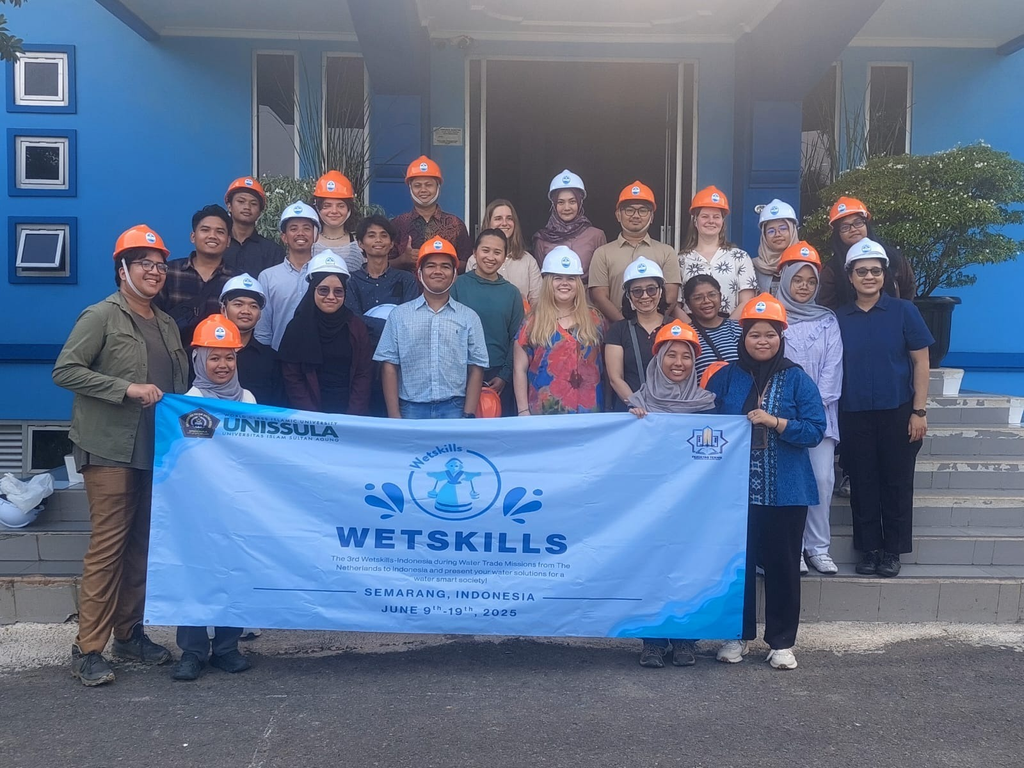
The programme brought together 24 international participants to examine real-world water management challenges through multidisciplinary teamwork, field visits, expert discussions, and the development of innovative solutions.
Participants worked with cases involving water utilities, government-related organisations, professional institutions, and international water-sector partners.
Reviewing Alternative Approaches to Water Sustainability
The programme addressed four principal challenges.
Community-Based Water Management
Participants examined approaches for strengthening community participation in flood management and local climate resilience, supported by the Blue Deal Indonesia programme.
Nature-Based Coastal Protection
Teams explored the application of natural foreshores and ecosystem-based approaches to coastal protection in Semarang, considering environmental and socioeconomic conditions.
Semarang River Revitalisation
Participants developed proposals linking river management, cultural heritage, environmental improvement, and sustainable urban development.
Water Footprint Compensation
Teams explored approaches to reducing water losses and developing water compensation mechanisms involving PDAM Semarang, WaterWorX, and Water Footprint Implementation.
These case studies encouraged participants to examine practical alternatives and develop solutions suited to local environmental and institutional conditions.
Development of Innovative Water Management Solutions
On 18 June 2025, the international teams presented their proposed solutions to a panel of experts.
Team 4, which worked on Water Footprint Compensation in Semarang, was selected as the winning team.
Its proposed approach addressed opportunities for companies to support water-saving interventions through investments in reducing Non-Revenue Water.
The concept connected water stewardship with measurable water savings, improved water-use efficiency, and corporate sustainability responsibilities.
The programme demonstrated how international collaboration can support the development and evaluation of innovative approaches to water sustainability.
The solutions represent practical proposals developed through international teamwork and expert review, rather than formally adopted international standards.
Public Evidence:
Formal Research and Knowledge Exchange Partnership with Wetskills Foundation
On 16 June 2025, UNISSULA and Wetskills Foundation signed a Memorandum of Agreement (MoA) during the Dutch Trade Mission in Jakarta.
The agreement was signed by:
- Dr. Abdul Rochim, Dean of the Faculty of Engineering at UNISSULA; and
- Johan Oost, Managing Director of Wetskills Foundation.
The partnership formalised continued cooperation in international water management and sustainable development initiatives.
The agreement included:
- organising future international Wetskills programmes in Indonesia;
- developing follow-up research through the WetsNext initiative;
- supporting international knowledge exchange among students, researchers, and professionals; and
- strengthening cooperation on sustainable water management challenges.
The agreement provides an institutional framework for continuing collaborative research and developing approaches informed by international expertise.
Its research-related commitments support the university’s longer-term contribution to international sustainable development practices.
Public Evidence:
International Research Internship with Universities in the Netherlands
In September 2025, UNISSULA welcomed four students from Rotterdam University of Applied Sciences and Hanze University of Applied Sciences, the Netherlands, to undertake research internships as part of their final-year academic projects.
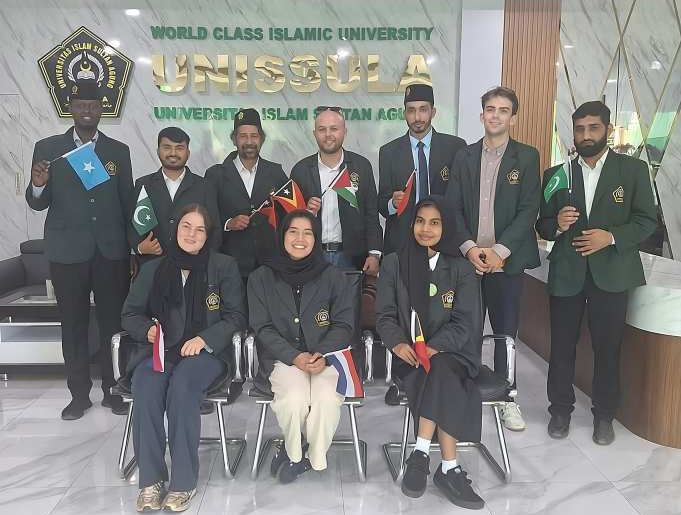
The participating students were:
- Heather Boeije – Rotterdam University of Applied Sciences.
- Natasha Boon – Rotterdam University of Applied Sciences.
- Sam de Haas – Rotterdam University of Applied Sciences.
- Hindrik van Marum – Hanze University of Applied Sciences.
The research internship programme was scheduled to take place from 8 September until the end of December 2025.
During the programme, the students were supported by academic supervisors from the Faculty of Engineering at UNISSULA.
The research activities focused on areas related to water management, civil engineering, and urban and regional planning.
International Exchange of Research Approaches
The programme provided opportunities for international students and UNISSULA academics to exchange research perspectives, technical knowledge, and approaches to local development challenges.
Through academic supervision and research activities in Indonesia, the collaboration connected international higher education expertise with local environmental and infrastructure issues.
The initiative also supported the continuity of research relationships between UNISSULA and universities in the Netherlands.
The research internship demonstrates ongoing international research engagement. Specific comparative research findings or best-practice recommendations from the students’ final projects would require their completed research reports.
Public Evidence:
https://suarabaru.id/2025/09/10/empat-mahasiswa-belanda-kerjakan-tugas-akhir-di-unissula
Summary of International Research and Best-Practice Development Initiatives
UNISSULA’s international collaborations in 2025 demonstrate several approaches to connecting scientific research, applied problem-solving, and international knowledge exchange.
| International Collaboration | Research or Collaborative Activity | Outputs and Good-Practice Relevance |
|---|---|---|
| UNISSULA – Hanze University, Netherlands | Collaborative research on drought management in Kaliori | Drought mapping, field-based analysis, and alternative water management recommendations |
| UNISSULA – Hanze University, Netherlands | Environmental DNA research for river monitoring | Scientific recommendations for integrating eDNA into environmental and flood risk monitoring |
| UNISSULA – Wetskills Foundation, Netherlands | Wetskills-Indonesia 2025 | Four international team solutions addressing water management and coastal sustainability challenges |
| UNISSULA – Wetskills Foundation, Netherlands | Formal research and knowledge exchange cooperation | Framework for future applied research and international water-sector collaboration |
| UNISSULA – Rotterdam and Hanze Universities, Netherlands | International student research internships | Research exchange and academic supervision concerning water management, engineering, and spatial planning |
These activities demonstrate different stages of international research collaboration, ranging from published scientific findings and applied solutions to research exchange and institutional partnerships.
International Knowledge Exchange and Transferable Sustainable Development Practices
UNISSULA’s collaborative research activities contribute to the examination and development of approaches that can inform sustainable development practices beyond individual research locations.
The university’s research partnerships demonstrate several complementary contributions.
Evidence-Based Problem Identification
The Kaliori drought research used environmental information, field surveys, stakeholder consultation, and statistical analysis to identify water scarcity challenges and evaluate potential solutions.
Integration of Research Methods
The eDNA research examined how emerging molecular techniques could complement conventional environmental monitoring to provide more comprehensive ecological information.
International Evaluation of Practical Solutions
Wetskills-Indonesia 2025 brought together participants and professionals from different countries to examine local water-related challenges and develop proposals evaluated by an international expert jury.
Research Knowledge Exchange
The research internship programme and formal partnerships with Dutch institutions created opportunities for continued exchange of scientific and professional approaches.
Together, these collaborations demonstrate UNISSULA’s engagement in reviewing existing approaches, developing research-informed recommendations, and exploring solutions that may be adapted to comparable sustainable development challenges in other locations.
17.2.5
Collaboration With NGOs For SDGS
17.2.5 UNISSULA Strengthens NGO Partnerships through Student Engagement, Collaborative Research, and Educational Outreach
Strengthening Partnerships with Non-Governmental Organisations
Universitas Islam Sultan Agung (UNISSULA) actively collaborates with non-governmental organisations (NGOs) to address sustainable development challenges through student engagement, collaborative research, educational initiatives, and community-oriented programmes.
In 2025, UNISSULA strengthened its partnerships with national and international organisations, including Wetskills Foundation in the Netherlands, Yayasan Kesejahteraan Anak Indonesia (YKAI), and Al Hidayah Foundation in Thailand.
These partnerships support the university’s commitment to environmental sustainability, quality education, community development, and international cooperation.
The collaborations demonstrate how universities and NGOs can combine academic knowledge, student participation, professional expertise, and community networks to contribute to the United Nations Sustainable Development Goals (SDGs).
Student Engagement and Field-Based Activities with Wetskills Foundation
UNISSULA collaborated with Wetskills Foundation, the Netherlands, through Wetskills-Indonesia 2025, an international programme focusing on sustainable water management and environmental challenges.
The programme took place in Semarang during June 2025, bringing together 24 participants from different countries to address real-world water-related challenges through multidisciplinary teamwork.

The programme involved students, young professionals, academic supervisors, water-sector experts, and representatives of participating organisations.
Participants engaged in collaborative learning, field observations, community-oriented environmental activities, and the development of solutions to local sustainability challenges.
Field Engagement in Coastal Communities
As part of the programme, participants visited coastal areas around Semarang to observe environmental conditions and examine the challenges faced by coastal communities.
The activities provided opportunities to observe issues related to:
- coastal flooding;
- environmental degradation;
- water management; and
- climate resilience.
Participants also explored coastal environments and mangrove areas to better understand the relationship between environmental conditions, coastal protection, and community sustainability.
Through these activities, UNISSULA students and international participants contributed to collaborative problem identification and the development of proposed solutions relevant to environmental sustainability.
The programme illustrates NGO-supported, field-based student participation in addressing local development challenges.
It also provides a foundation for student volunteering activities involving environmental education, sustainability awareness, and community engagement.
Public Evidence:
Collaborative Research and Applied Water Sustainability Programmes with Wetskills Foundation
In addition to student engagement, UNISSULA collaborated with Wetskills Foundation on applied, case-based activities addressing sustainable water management.
The Wetskills-Indonesia 2025 programme brought together participants, professional mentors, and external stakeholders to investigate water-related challenges and develop practical recommendations.
Collaborative Research Themes
The programme examined four principal water sustainability challenges.
Community-Based Water Management
Participants examined approaches to strengthening community participation in water management and flood resilience through a case involving Blue Deal Indonesia.
Nature-Based Coastal Protection
A case involving Van Oord explored natural foreshores and nature-based approaches to coastal protection, considering environmental and socioeconomic conditions.
Semarang River Revitalisation
Participants examined potential approaches to improving river environments while supporting cultural heritage, sustainable urban development, and environmental management.
Water Footprint Compensation
A case involving PDAM Semarang, WaterWorX, and Water Footprint Implementation examined approaches to reducing water losses and improving water-use efficiency.
The activities connected international expertise with local environmental conditions and technical water management issues.
Development of Practical Solutions
On 18 June 2025, participating teams presented their solutions to an international expert jury.
The team addressing Water Footprint Compensation in Semarang was selected as the winning team.
Its proposal explored how water-saving interventions, including reductions in Non-Revenue Water, could contribute to more sustainable water management.
The programme demonstrated the potential of international NGO–university cooperation to support applied investigation, interdisciplinary analysis, and the development of sustainability solutions.
Formalisation of Research Cooperation
On 16 June 2025, UNISSULA and Wetskills Foundation signed a Memorandum of Agreement during the Dutch Trade Mission in Jakarta.
The agreement was signed by:
- Dr. Abdul Rochim, Dean of the Faculty of Engineering at UNISSULA; and
- Johan Oost, Managing Director of Wetskills Foundation.
The agreement established a framework for continued collaboration, including future Wetskills programmes, the WetsNext follow-up research initiative, and international knowledge exchange.
The collaboration supports further development of research-oriented initiatives addressing sustainable water resources and environmental resilience.
Public Evidence:
Educational Outreach and International Learning Opportunities with Al Hidayah Foundation, Thailand
UNISSULA also engaged in educational outreach activities in Thailand in cooperation with Al Hidayah Foundation, supporting international educational communication and access to information about higher education opportunities.
The collaboration included participation in an educational exhibition involving students and educational communities in Thailand.
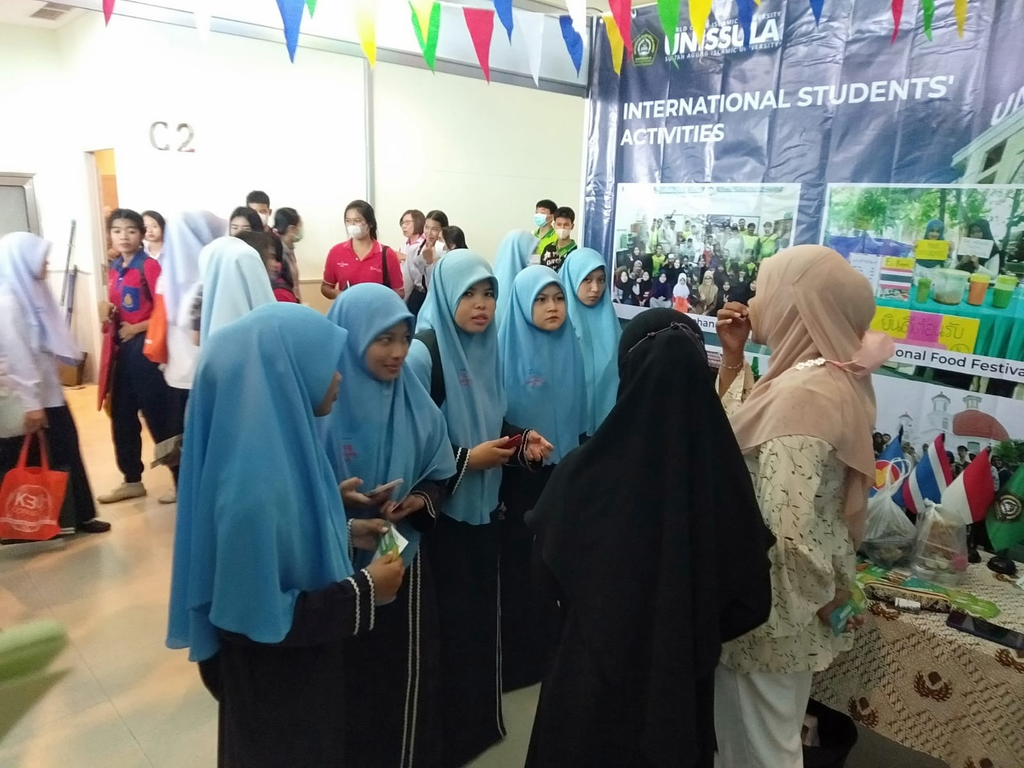
The exhibition provided an opportunity for prospective students to receive information about higher education, university programmes, academic opportunities, and international study pathways.
UNISSULA representatives interacted with visitors, introducing educational opportunities and responding to questions concerning university study.
The activity demonstrated cooperation between a higher education institution and a community-oriented foundation in supporting educational awareness and cross-border engagement.
Educational Information and Knowledge Sharing
Through the exhibition, UNISSULA and its partner facilitated the sharing of educational information with prospective students.
The activity supported:
- access to information about higher education opportunities;
- international educational awareness;
- communication between universities and prospective students; and
- educational engagement across national and institutional boundaries.
This collaboration contributes to educational outreach and knowledge dissemination, particularly in connection with SDG 4 – Quality Education and SDG 17 – Partnerships for the Goals.
The exhibition documents an educational outreach activity. Any jointly developed educational materials, including brochures, guides, or learning resources, should be presented as additional evidence where available.
Supporting Evidence:
Photographic documentation of the UNISSULA educational exhibition with Al Hidayah Foundation in Thailand.
Supporting Access to Higher Education through YKAI and Colruyt Foundation Belgium
UNISSULA strengthened its NGO partnerships through collaboration with Yayasan Kesejahteraan Anak Indonesia (YKAI) and engagement with Colruyt Foundation, Belgium, in supporting educational opportunities for students.
Through this cooperation, YKAI facilitated scholarship assistance from Colruyt Foundation for one UNISSULA student.
The programme illustrates cooperation among a university, a national social foundation, and an international philanthropic organisation to improve access to education.
Scholarship Monitoring and Institutional Engagement
A monitoring visit involving representatives of the participating organisations provided an opportunity to discuss scholarship implementation, student support, and educational progress.
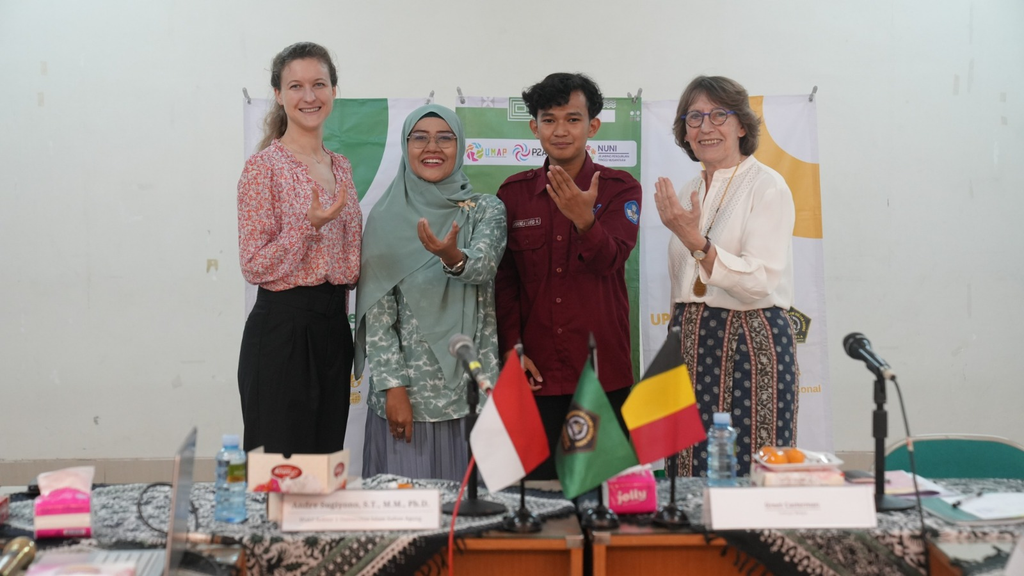
The meeting demonstrated the involvement of national and international partners in supporting students’ access to educational opportunities.
The partnership reflects a shared commitment to reducing financial barriers to higher education and supporting student development.
By cooperating with NGOs and philanthropic institutions, UNISSULA contributes to strengthening inclusive educational opportunities and international partnerships.
This initiative is particularly relevant to SDG 4 – Quality Education, SDG 10 – Reduced Inequalities, and SDG 17 – Partnerships for the Goals.
Supporting Evidence:
Photographic documentation of the YKAI and Colruyt Foundation monitoring visit at UNISSULA.
Summary of NGO Collaboration Activities
UNISSULA’s NGO partnerships demonstrate different forms of cooperation supporting the Sustainable Development Goals.
| NGO Partner | Collaboration Activities | SDG-Related Outcomes |
|---|---|---|
| Wetskills Foundation, Netherlands | Student field engagement and international water challenge programme | Environmental awareness, practical learning, and collaborative problem-solving |
| Wetskills Foundation, Netherlands | Applied case studies, solution development, and research cooperation | Water management recommendations and opportunities for follow-up research |
| Al Hidayah Foundation, Thailand | Educational exhibition and information sharing | International educational outreach and higher education awareness |
| YKAI, Indonesia, with Colruyt Foundation, Belgium | Scholarship facilitation and monitoring | Improved educational access and student support |
These initiatives illustrate the university’s cooperation with NGOs through student participation, research-oriented activities, educational outreach, and support for access to education.
17.4.1
Education For Sdgs Commitment To Meaningful Education
17.4.1 UNISSULA Integrates Sustainable Development Goals Across Its University-Wide Curriculum
University-Wide SDG Curriculum Integration
Universitas Islam Sultan Agung (UNISSULA) is committed to providing meaningful education on the United Nations Sustainable Development Goals (SDGs) for students across its academic programmes.
UNISSULA integrates SDG-related learning into its university-wide curriculum through the Outcome-Based Education (OBE) framework. This approach connects sustainability-related knowledge, skills, and competencies with programme learning outcomes, course learning outcomes, and Semester Learning Plans (Rencana Pembelajaran Semester – RPS).
Rather than limiting sustainability education to selected courses or extracurricular activities, UNISSULA adopts an interdisciplinary approach that incorporates relevant SDG themes into teaching and learning across its academic disciplines.
The university’s Internal Quality Assurance System (Sistem Penjaminan Mutu Internal – SPMI) supports this institutional approach by identifying the SDGs as important considerations in curriculum development.
Institutional References:
https://feb.unissula.ac.id/wp-content/uploads/2024/04/Dokumen-Standar-SPMI.pdf
SDG Integration Across Academic Programmes
UNISSULA implements sustainability-related learning across academic disciplines, including:
- engineering;
- medicine;
- health sciences;
- law;
- economics;
- business;
- education; and
- social sciences.
The university maintains academic curriculum records that identify courses related to the SDGs, including their study programmes, course codes, academic credits (SKS), and relevant sustainability themes.
The following university-wide course mapping presents SDG-related academic offerings across UNISSULA’s study programmes.
UNISSULA SDG Course Mapping – Academic Year 2025
The embedded mapping illustrates the breadth of SDG-related education within UNISSULA’s academic curricula.
It includes courses from different academic programmes and supports institutional review of sustainability education.
The mapping complements the university’s curriculum standards and provides examples of how different academic disciplines contribute to the Sustainable Development Goals.
Implementation through Semester Learning Plans
SDG integration is implemented through the university’s OBE-based Semester Learning Plans (RPS), which connect relevant sustainability themes with course learning outcomes and learning activities.
The approach enables students to develop an understanding of sustainable development issues relevant to their respective academic disciplines.
Representative examples include:
- health and community well-being in medical education;
- environmental sustainability in engineering;
- sustainable spatial planning;
- responsible economic development; and
- environmental governance in legal studies..
Institutional Monitoring and Quality Assurance
UNISSULA supports the implementation and continuous improvement of SDG education through its academic quality assurance framework.
The integration of sustainability-related learning is supported by:
- curriculum development;
- academic documentation;
- Semester Learning Plans; and
- programme-level monitoring.
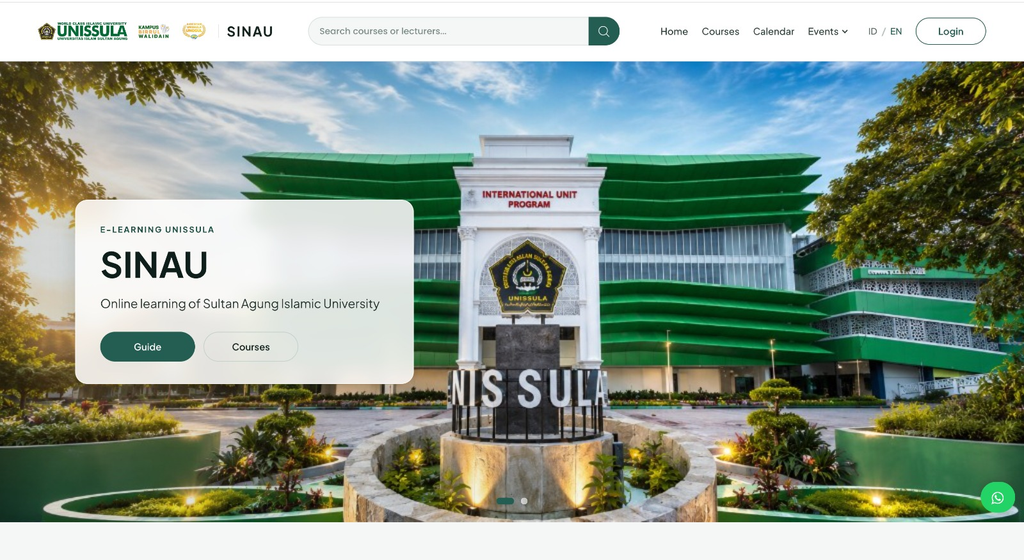
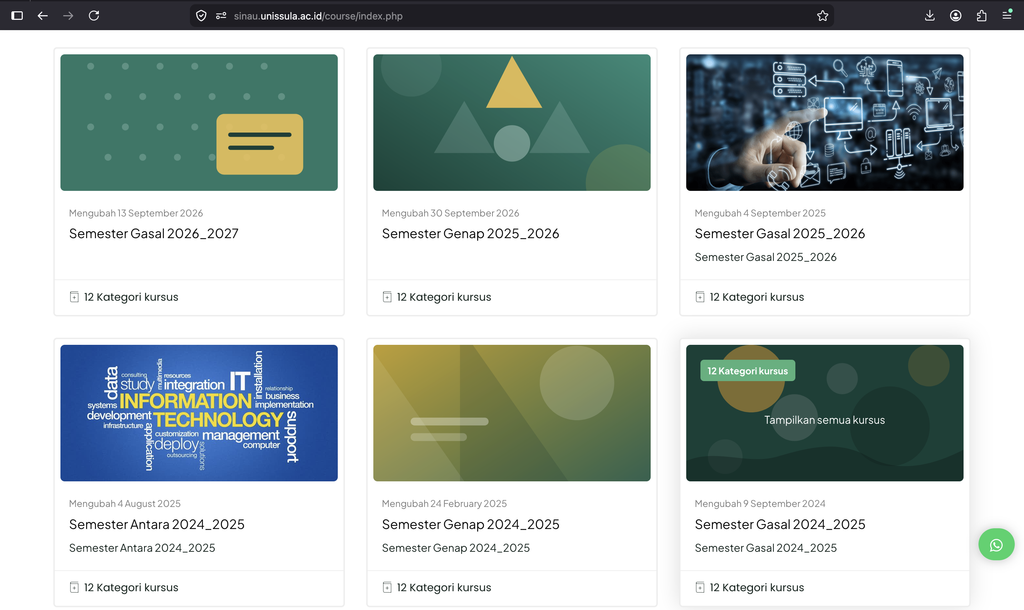
The university’s digital learning platform, Sinau UNISSULA, also supports academic course organisation and delivery across its study programmes.
Academic Learning Platform:
17.4.2
Education For SDGs Specific Courses On Sustainability
17.4.2 UNISSULA Provides Dedicated Sustainability Courses Across Academic Programmes
University-Wide Sustainability Education
Universitas Islam Sultan Agung (UNISSULA) is committed to providing dedicated sustainability education through its formal academic programmes across the university.
Through its Outcome-Based Education (OBE) curriculum framework, UNISSULA integrates the Sustainable Development Goals (SDGs) into course learning plans (Rencana Pembelajaran Semester – RPS) across its study programmes.
In addition to this university-wide integration, UNISSULA offers dedicated courses addressing environmental sustainability, renewable energy, responsible production, climate resilience, spatial planning, and sustainable development.
These courses form part of officially recognised academic curricula and equip students with knowledge and competencies relevant to sustainability challenges.
Dedicated Sustainability Courses
UNISSULA offers sustainability-related courses across different academic disciplines. The following are representative examples of its formal academic offerings.
| Academic Programme | Course | Credits | Related SDGs |
|---|---|---|---|
| Industrial Engineering | Sustainable Manufacturing | 3 SKS | SDG 9, 12 |
| Industrial Engineering | Renewable Energy | 3 SKS | SDG 7, 13 |
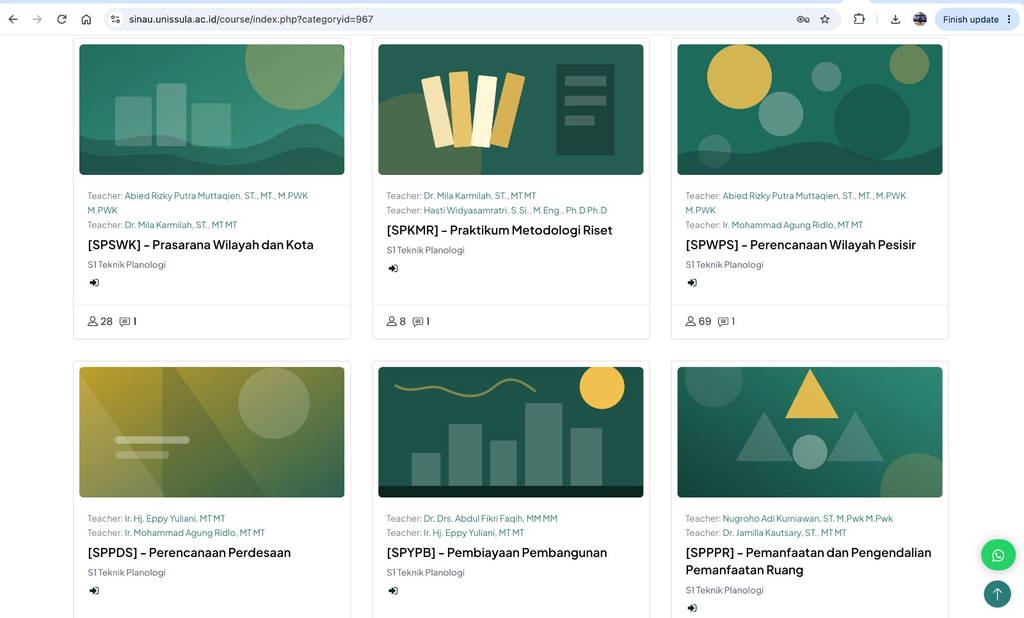
| Urban and Regional Planning | Perencanaan Wilayah Pesisir | 2 SKS | SDG 11, 13, 14 |
| Urban and Regional Planning | Mitigasi Bencana | 2 SKS | SDG 11, 13 |
| Urban and Regional Planning | Pemanfaatan dan Pengendalian Pemanfaatan Ruang | 2 SKS | SDG 11, 15 |
These courses demonstrate the availability of dedicated sustainability education within UNISSULA’s formal academic programmes. They represent selected examples rather than an exhaustive list of sustainability-related courses offered across the university.
Public Evidence:
https://fti.unissula.ac.id/wp-content/uploads/2024/09/Panduan-Akademik-2024-2025-Rev-1.pdf
https://sinau.unissula.ac.id/course/index.php?categoryid=967
Digital Learning through Sinau UNISSULA
UNISSULA supports the delivery and management of formal academic courses through Sinau UNISSULA, its institutional Learning Management System (LMS).
Sinau provides a publicly accessible course catalogue organised by study programme and academic semester, including the 2024/2025 and 2025/2026 academic years.
The platform documents academic courses across UNISSULA, including sustainability-related subjects in urban and regional planning, and supports structured digital teaching and learning activities.
Public Evidence:
Institutional Curriculum and Quality Assurance
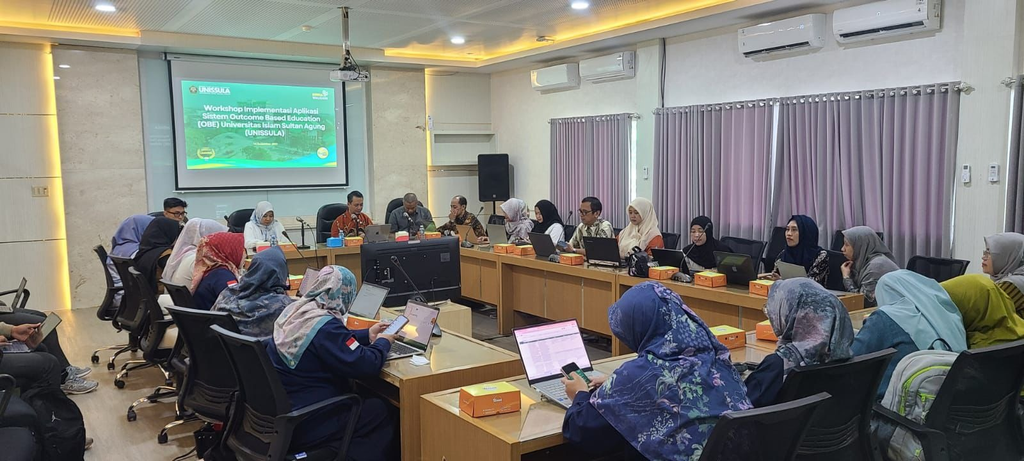
UNISSULA’s sustainability education is supported by its Outcome-Based Education (OBE) curriculum framework and Internal Quality Assurance System (Sistem Penjaminan Mutu Internal – SPMI).
The university’s academic standards recognise the Sustainable Development Goals (SDGs) as relevant considerations in curriculum development, supporting sustainability-related learning across academic disciplines.
Together, these institutional frameworks support the provision of dedicated sustainability courses and the integration of SDG-related competencies into academic learning.

Public Evidence:
https://feb.unissula.ac.id/wp-content/uploads/2024/04/Dokumen-Standar-SPMI.pdf
17.4.3
Education For SDGs In The Wider Community
17.4.3 UNISSULA Expands Education for Sustainable Development Through Community Outreach and Lifelong Learning
University-Wide Commitment to Community Education
Universitas Islam Sultan Agung (UNISSULA) provides dedicated educational outreach activities for the wider community as part of its commitment to sustainable development, lifelong learning, and community empowerment.
Through its Community Service Programme (Pengabdian kepada Masyarakat), Community Service Learning (Kuliah Kerja Nyata – KKN), and faculty-led educational initiatives, UNISSULA extends educational opportunities beyond enrolled students.
These activities involve practical training, workshops, mentoring, and knowledge-sharing initiatives for local residents, community organisations, and other external stakeholders.
The programmes address sustainable development challenges, including responsible consumption, economic empowerment, digital literacy, and inclusive education.
Community Education and Skills Development
During 2025, UNISSULA implemented educational outreach activities for local communities through several academic units. The following activities illustrate the university’s outreach provision.
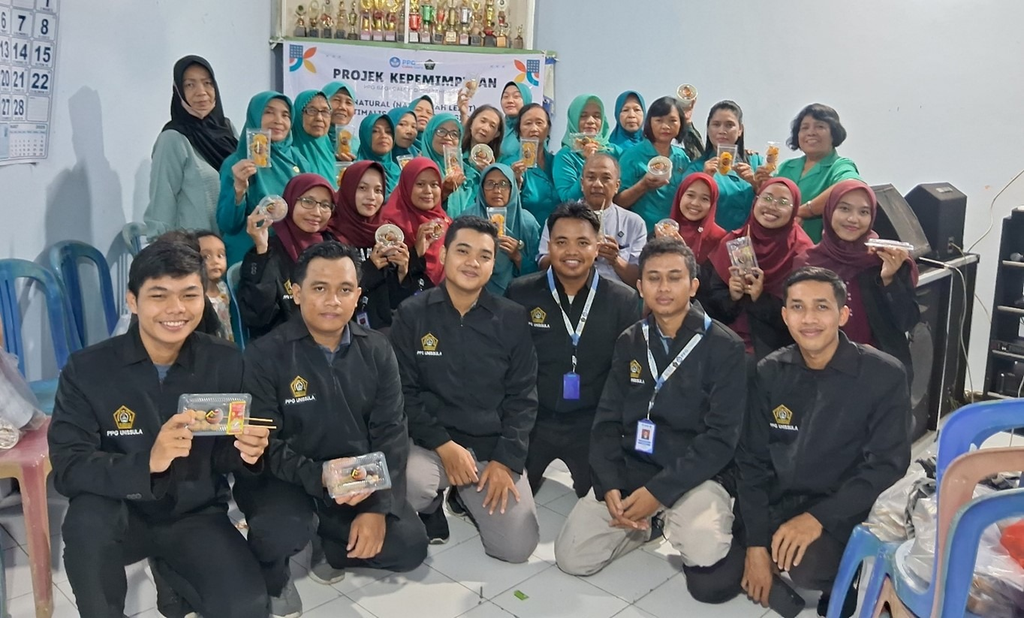
1. Food Waste Reduction Education – Tlogosari, Semarang
On 10 and 14 February 2025, students from UNISSULA’s Teacher Professional Education Programme (PPG) conducted educational workshops for local residents and members of the Family Welfare Movement (PKK) in Tlogosari Kulon, Semarang.
The programme, entitled Natural (Nasi Turah Lezat), focused on reducing household food waste by teaching participants how to transform leftover rice into useful food products.
Participants received:
- practical demonstrations;
- food storage guidance; and
- educational booklets containing recipes that could be applied at home.
The activity supported responsible consumption, resource efficiency, and opportunities for household economic empowerment.
Related SDGs: SDG 2, SDG 4, and SDG 12.
Public Evidence:
2. Community Entrepreneurship and Creative Skills Training – Demak
On 20 February 2025, UNISSULA’s Teacher Professional Education Programme organised a community training activity in Wonowoso Village, Karangtengah, Demak.
The programme involved 30 local residents and provided hands-on training in traditional jumputan textile production.
Participants learned:
- textile preparation;
- pattern-making;
- folding;
- dyeing techniques; and
- basic product development.
The educational activity strengthened practical skills and introduced opportunities for home-based entrepreneurship and income generation.
Related SDGs: SDG 4 and SDG 8.

Public Evidence:
Structured Community Outreach through KKN
Beyond individual workshops, UNISSULA implements community-based learning and outreach through its Kuliah Kerja Nyata (KKN) programme.
KKN provides an institutional mechanism for students and academic staff to engage with communities, identify local development needs, and support educational and empowerment activities.
Through this programme, community education is integrated into UNISSULA’s broader responsibilities in teaching, research, and community service.
Educational Outreach for Alumni and Other Community Groups
UNISSULA’s wider educational engagement also includes professional and community learning opportunities involving alumni and external participants.
A documented example is a leadership development programme conducted through collaboration between UNISSULA’s Faculty of Law and its Student Regiment community, involving student regiment members and alumni associated with IARMI UNISSULA.
The programme employed:
- training;
- counselling; and
- mentoring
approaches to develop leadership knowledge and skills.

Public Evidence:
https://jurnal.unissula.ac.id/index.php/ijocs/article/view/48199
17.4.4
Sustainable Literacy
17.4.4 UNISSULA Measures Students’ Sustainability Literacy Through a Knowledge-Based Assessment
Institutional Sustainability Literacy Assessment
Universitas Islam Sultan Agung (UNISSULA) has developed the UNISSULA Sustainability Literacy Assessment (USLA), a knowledge-based assessment instrument designed to evaluate students’ understanding of sustainable development and the Sustainable Development Goals (SDGs).
The assessment uses 20 multiple-choice questions with objectively correct answers. Its conceptual structure draws on three interconnected sustainability knowledge frameworks inspired by Sulitest TASK:
- Earth Systems;
- Human Welfare; and
- Levers of Opportunity.
USLA is an independently developed institutional assessment and is not an official Sulitest TASK examination.
Assessment Instrument:
Sustainability Knowledge Assessment Framework
The assessment consists of 20 questions organised into three knowledge frameworks.
| Knowledge Framework | Questions | Assessment Scope |
|---|---|---|
| Earth Systems | 7 | Climate change, planetary boundaries, renewable energy, biodiversity, water pollution, circular economy, and ocean acidification |
| Human Welfare | 7 | Poverty, inclusive education, clean water and sanitation, decent work, equality of opportunity, food security, and climate-related social inequality |
| Levers of Opportunity | 6 | Multi-stakeholder partnerships, food waste management, evidence-based policies, flood resilience, sustainable procurement, and student-led sustainability solutions |
| Total | 20 |
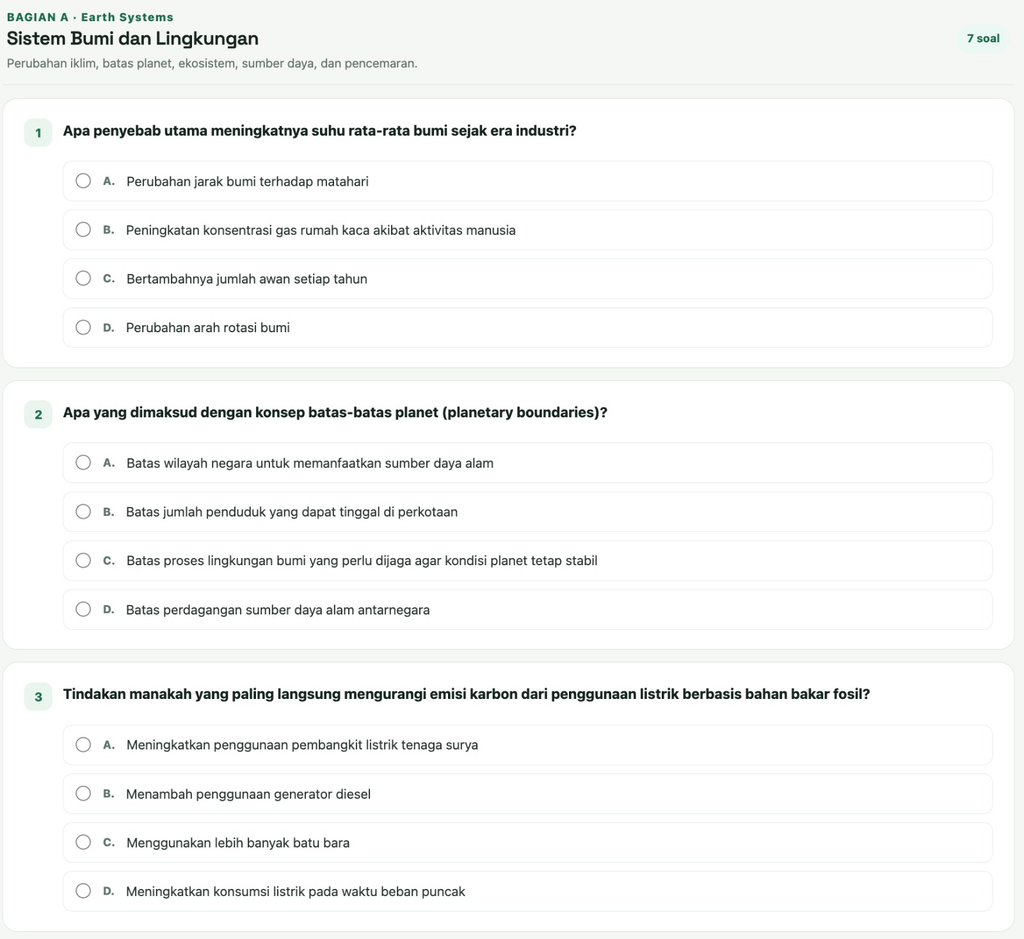
1. Earth Systems – Environmental Sustainability
This framework assesses students’ understanding of the natural systems that support life and the environmental challenges associated with sustainable development.
The seven questions evaluate students’ knowledge of:
- human-induced climate change;
- planetary boundaries;
- renewable energy;
- biodiversity and ecosystem services;
- water pollution;
- circular economy practices; and
- ocean acidification.
Through this framework, students are expected to recognise environmental challenges and identify scientifically informed approaches to protecting natural resources and ecosystems.
Related SDGs: SDG 6, SDG 7, SDG 12, SDG 13, SDG 14, and SDG 15.
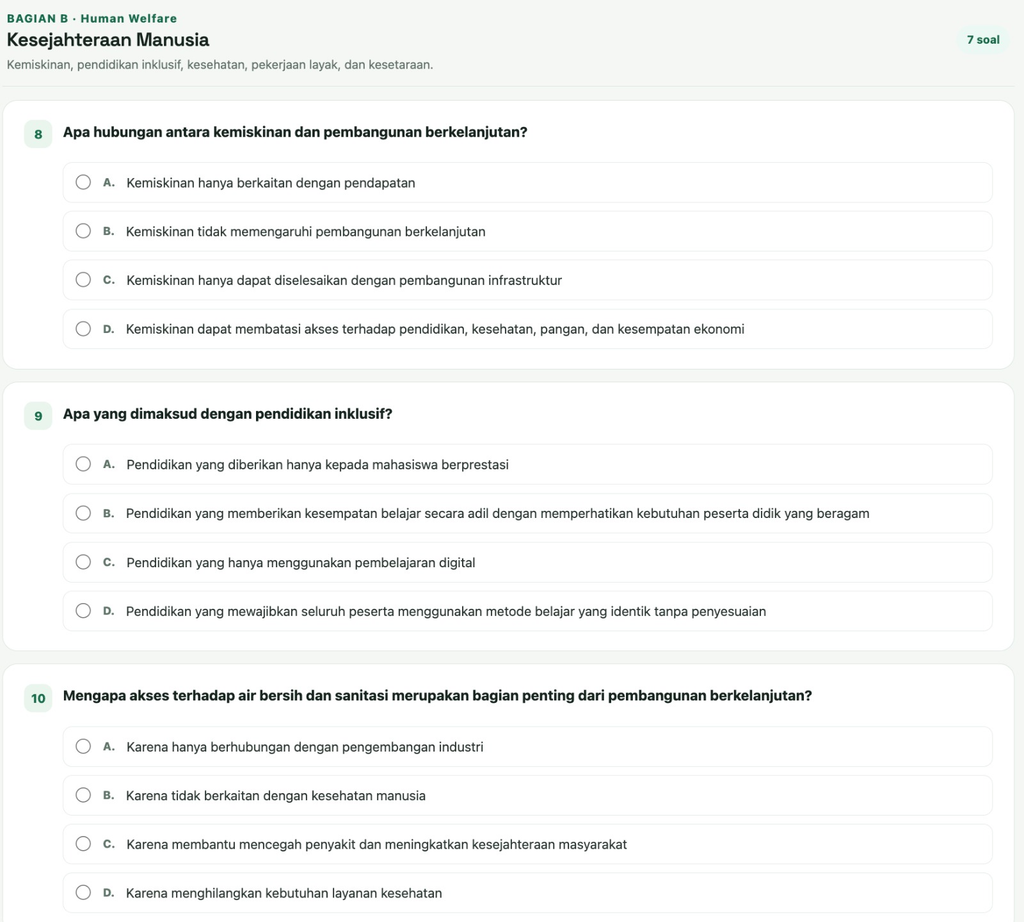
2. Human Welfare – Social Sustainability
This framework assesses students’ understanding of the relationship between sustainable development and human well-being.
The seven questions address:
- the multidimensional impacts of poverty;
- inclusive and equitable education;
- access to clean water and sanitation;
- decent work;
- equal opportunities;
- sustainable food security; and
- the disproportionate impacts of climate change on vulnerable communities.
This framework helps evaluate whether students understand the social and economic conditions required for inclusive and sustainable societies.
Related SDGs: SDG 1, SDG 2, SDG 3, SDG 4, SDG 5, SDG 6, SDG 8, SDG 10, and SDG 13.
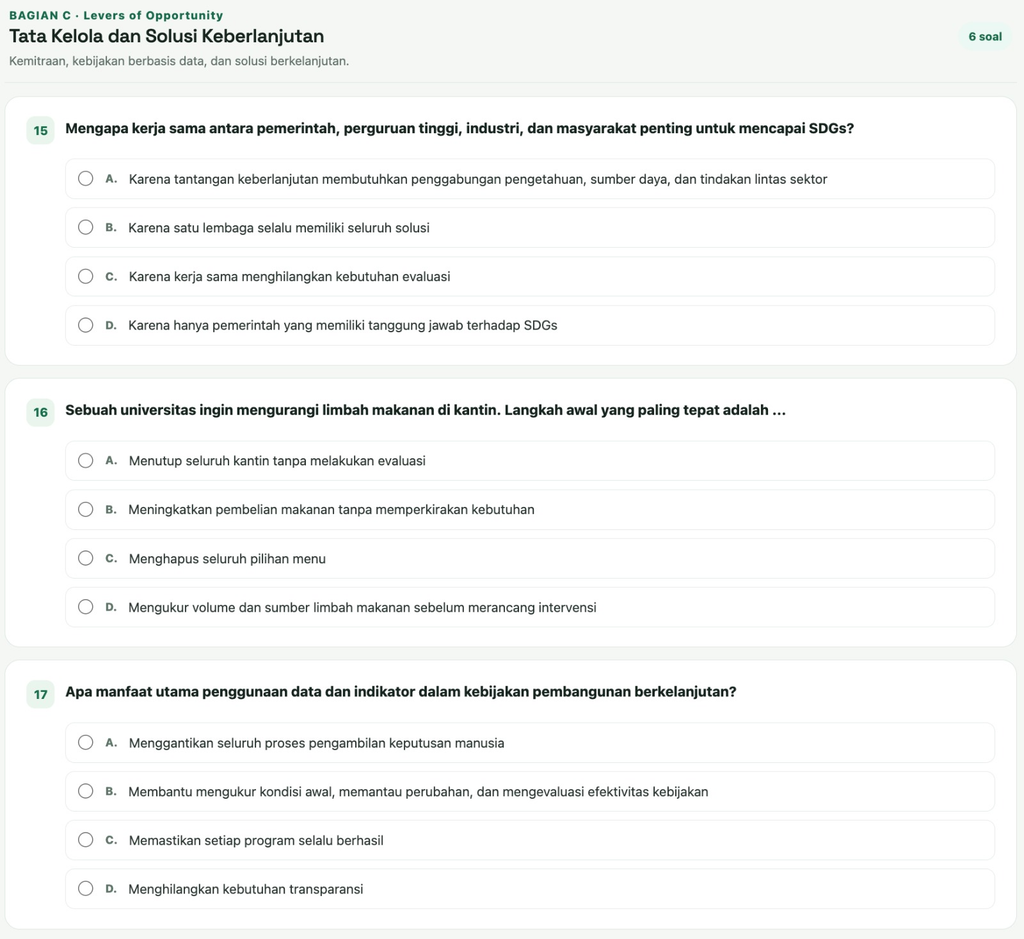
3. Levers of Opportunity – Governance and Sustainability Solutions
This framework assesses students’ knowledge of practical strategies, institutional mechanisms, and collaborative approaches for advancing sustainable development.
The six questions cover:
- partnerships among universities, governments, industry and communities;
- food waste assessment and reduction;
- data-driven public policy;
- integrated flood risk management;
- sustainable procurement; and
- students’ contributions to responsible sustainability solutions.
The framework evaluates students’ ability to identify appropriate actions and evidence-based responses to real-world sustainability challenges.
Assessment Methodology and Scoring
USLA employs a standardised institutional questionnaire containing 20 multiple-choice questions, with four answer options and one correct answer per question.
The assessment covers all three knowledge frameworks and uses an equally weighted scoring system.
| Assessment Component | Description |
|---|---|
| Assessment type | Objective knowledge-based assessment |
| Target participants | UNISSULA students |
| Total questions | 20 |
| Answer options | Four options per question |
| Correct answer | One per question |
| Score per correct answer | 5 points |
| Maximum score | 100 points |
| Assessment frameworks | Three |
Knowledge Score = (Number of Correct Answers ÷ 20) × 100
The assessment is designed to generate overall sustainability knowledge scores and framework-specific results for institutional monitoring.
Student Participation and Assessment Monitoring
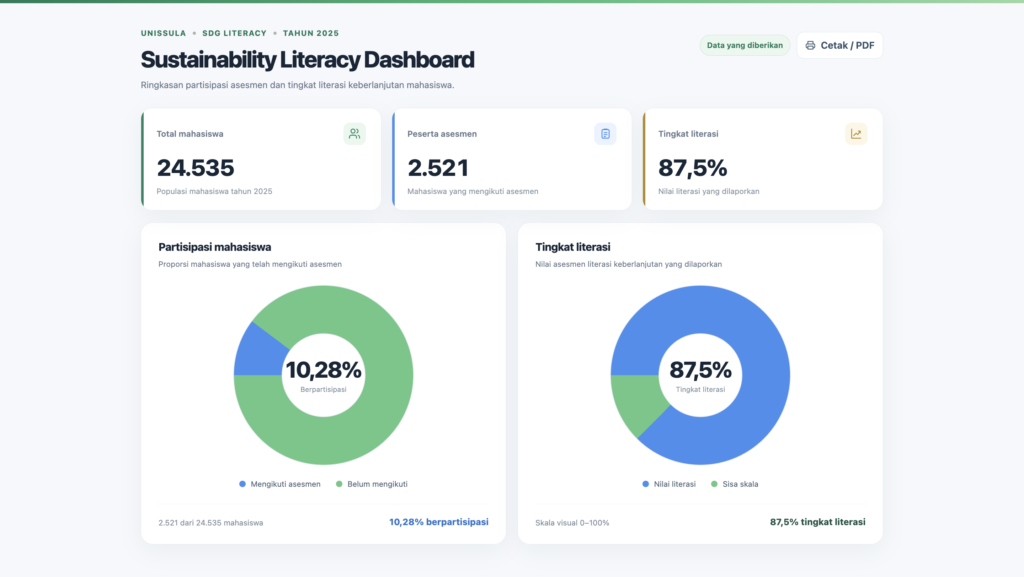
UNISSULA’s existing sustainability literacy survey records for 2025 report participation from 2,521 unique active students, representing 10.28% of the university’s 24,535 students.
| Institutional Indicator | Reported Data |
|---|---|
| Total student population, 2025 | 24,535 |
| Participants in the existing 2025 sustainability literacy survey | 2,521 |
| Participation rate | 10.28% |
| Questions in the USLA objective knowledge assessment | 20 |
| Sustainability knowledge frameworks | 3 |
The historical survey participation figures and the new objective knowledge assessment are recorded as separate measurement activities.
Verified results from the objective assessment will be published once implementation data and scoring records are available.
Institutional Monitoring and Continuous Improvement
UNISSULA’s sustainability literacy assessment framework supports institutional monitoring of students’ knowledge of environmental sustainability, human welfare, and sustainable development solutions.
The results can support:
- curriculum evaluation;
- the development of sustainability-related learning activities; and
- the identification of knowledge areas requiring further educational attention.
Through USLA, UNISSULA strengthens its institutional approach to measuring sustainability knowledge and supporting education for sustainable development.