

















UNISSULA SUSTAINABILITY REPORTING
SDG 15 – Life on Land
Progress Report 2025
2025 Report Overview
In 2025, Universitas Islam Sultan Agung (UNISSULA) documented its progress towards SDG 15 – Life on Land through terrestrial ecosystem conservation, biodiversity protection, sustainable land management, and community-based environmental education. The university supported mangrove restoration in Mangkang and Tambakrejo, participated in the planting of 1,200 mangrove seedlings, and collaborated with local communities to plant and distribute 160 trees in Brumbung Village. UNISSULA also promoted sustainable agriculture through smart hydroponic farming, supported ecotourism planning, and strengthened institutional policies on biodiversity conservation, sustainable food sourcing, invasive species management, and environmentally responsible campus development. This report presents the university’s documented achievements, institutional initiatives, and continuing priorities for protecting terrestrial ecosystems during the 2025 reporting period.
Full SDG 15 Progress Report 2025
15.2.1
Events About Sustainable Use Of Land
15.2.1 Mangrove Conservation and Sustainable Land Stewardship in Mangkang
Universitas Islam Sultan Agung (UNISSULA) supports environmental education and conservation activities that encourage students to understand the importance of protecting terrestrial ecosystems and using land resources sustainably.
In 2025, the Faculty of Industrial Technology (FTI) UNISSULA incorporated a mangrove planting activity in the coastal area of Mangkang, Semarang, into its Student Management Skills Training (Latihan Keterampilan Manajemen Mahasiswa/LKMM) programme for the 2025 student cohort.
The activity combined student development, community engagement, and direct environmental action. By participating in mangrove planting in a coastal landscape outside the university campus, students gained practical experience in the conservation and sustainable stewardship of land and vegetation.

Mangrove Conservation Activity in Mangkang
Approximately 70 FTI UNISSULA students participated in the 2025 LKMM programme organised by the Faculty’s Student Executive Board.
As part of the programme’s community-engagement activities, participants travelled from the UNISSULA campus to Mangkang, Semarang, where they took part in mangrove planting along the coastal area. Participants reached the planting site by walking through the coastal landscape to the shoreline.
The activity was accompanied by the Vice Dean I of FTI UNISSULA, demonstrating institutional support for the student environmental and community programme.
Public evidence:
https://fti.unissula.ac.id/kegiatan-lkmm-bagi-mahasiswa-angkatan-2025
Promoting Conservation Through Direct Action
Mangrove planting provides students with a direct opportunity to participate in the conservation of a land-based ecosystem.
Mangrove landscapes occur at the interface between terrestrial and aquatic environments. Their vegetation contributes to maintaining coastal habitat, stabilising coastal land, and supporting the ecological functions of the surrounding environment.
Through direct participation in planting, students were encouraged to recognise that the sustainable use of land requires the protection and maintenance of vegetation rather than allowing environmentally sensitive coastal areas to deteriorate.
The activity therefore connected environmental awareness with a practical conservation action.
Sustainable Utilisation of Coastal Land
Sustainable land stewardship involves using and managing land while maintaining its ecological functions for the future.
Coastal areas can experience pressure from erosion, land-use changes, pollution, and loss of vegetation. Maintaining mangrove vegetation is therefore an important component of responsible management of coastal landscapes.
The Mangkang activity encouraged students to view coastal land not simply as space for human activities but as an ecosystem requiring appropriate conservation and sustainable management.
Mangrove planting represents a practical way of supporting this approach because it maintains vegetation within an environmentally sensitive landscape.
Learning Beyond the Campus
The activity was undertaken outside the UNISSULA campus, in a coastal environment associated with a local fishing community. After completing the planting activity, participants returned to the nearby fishing settlement before returning to the university.
This off-campus setting is important to UNISSULA’s environmental education approach because students encounter ecosystems that are not directly controlled by the university.
It enables environmental learning to extend beyond classroom discussion and campus management into landscapes where conservation requires wider community awareness and participation.
Connecting Student Education and Environmental Stewardship
The mangrove planting activity was integrated into a wider student-development programme.
This approach demonstrates that leadership and management education can also incorporate environmental responsibility.
Students participating in the programme were encouraged to experience environmental stewardship through direct action, connecting personal and organisational responsibility with the conservation of natural landscapes.
The activity links:
Student education → Community engagement → Mangrove planting → Land conservation → Sustainable environmental stewardship
In this way, conservation becomes part of experiential learning rather than only a theoretical topic.
Conservation of Mangrove Vegetation
Vegetation is a fundamental component of terrestrial ecosystem conservation.
In coastal environments, mangrove vegetation provides structural habitat and contributes to maintaining the physical stability and ecological quality of the landscape.
Planting mangroves therefore supports the maintenance of vegetation cover while promoting awareness of the importance of protecting natural and semi-natural land ecosystems.
The activity also demonstrates how relatively simple community-based environmental actions can contribute to broader conservation objectives when they are connected with education and stewardship.
Promoting Environmental Awareness Among Students
The Mangkang activity gave students an opportunity to observe environmental conditions directly and participate in a conservation activity in the field.
Such experiences can help strengthen understanding of several interconnected environmental principles:
- Conservation of vegetation and habitat;
- Responsible use of coastal land;
- Protection of environmentally sensitive areas;
- Prevention of ecosystem degradation;
- Community responsibility for natural resources; and
- Long-term stewardship of land ecosystems.
By involving students directly, UNISSULA promotes environmental responsibility among future graduates while contributing to conservation activities beyond the university campus.
Community-Oriented Environmental Engagement
The Mangkang activity was conducted as part of the LKMM programme’s community-service component. The planting site was located in a coastal environment connected with a fishing-community settlement.
This setting reinforces the relationship between ecosystem conservation and communities whose lives are connected with coastal landscapes.
Environmental conservation in such locations requires awareness not only of ecological conditions but also of the relationship between people, land, vegetation, and natural resources.
UNISSULA’s participation therefore contributes to an educational approach in which students engage with environmental challenges in their wider social and ecological context.
Supporting Ecosystems Beyond University-Controlled Land
UNISSULA recognises that environmental responsibility extends beyond property directly managed by the university.
The Mangkang mangrove activity took place in an external coastal ecosystem. This enabled students to participate in the stewardship of a landscape that forms part of the wider environmental system surrounding Semarang.
Supporting conservation beyond campus strengthens the connection between university education and wider environmental responsibility.
It also demonstrates that sustainable land management requires collaboration and participation across institutional boundaries.
Evidence of Implementation
- FTI UNISSULA organised the 2025 LKMM programme for approximately 70 students of the 2025 cohort.
- The programme included a community-oriented environmental activity in Mangkang, Semarang.
- Students directly participated in planting mangrove trees along the coastal area, providing a practical conservation activity rather than only classroom-based environmental education.
- The activity took place outside the university campus in a coastal landscape near a fishing-community settlement, extending environmental stewardship to an ecosystem not directly controlled by UNISSULA.
- The Vice Dean I of FTI UNISSULA accompanied the community activity, demonstrating institutional support for the programme.
- Mangrove planting promoted conservation of coastal vegetation and responsible stewardship of environmentally sensitive land, while providing students with practical experience of sustainable land management.
15.2.2
Sustainably Farmed Food On Campus
15.2.2 Sustainable Farming and Responsible Food Sourcing Policy at UNISSULA
Universitas Islam Sultan Agung (UNISSULA) has established an institutional policy to support the procurement and provision of food derived from responsible and sustainable farming practices.
Through Circular Letter No. 9017/J/SA/IX/2025, UNISSULA requires university units, food providers, and relevant third parties to ensure that agricultural food products used or sold within the university are prioritised from sources that apply sustainable farming practices.
The policy connects campus food procurement with responsible management of soil, water, natural resources, biodiversity, agricultural inputs, local sourcing, and supply-chain traceability.
It applies across the university food-service environment, including university units, canteens, catering providers, vendors, and other third parties providing food within UNISSULA.
Institutional Policy for Sustainably Farmed Food
UNISSULA’s policy establishes sustainable farming as a consideration in institutional food sourcing.
Circular Letter No. 9017/J/SA/IX/2025 states that agricultural food products used or sold within the university should be prioritised from sources implementing sustainable agricultural practices.
This provides an institutional basis for linking food consumed on campus with the environmental conditions under which agricultural products are produced.
The policy therefore addresses not only the final food product but also its agricultural origin and the farming practices associated with its production.
Responsible Management of Soil, Water, and Natural Resources
Sustainable agriculture depends on maintaining the environmental resources needed for food production.
UNISSULA’s policy specifies that agricultural food should be sourced from producers applying responsible management of:
- Soil;
- Water; and
- Natural resources.
The policy further requires consideration of environmental sustainability in the management of these resources.
This approach recognises that sustainable food procurement is closely connected with the long-term condition of agricultural land and the natural resources supporting food production.
Reducing Harmful Agricultural Inputs
UNISSULA also addresses the environmental impact of agricultural inputs.
The policy prioritises food products originating from farming practices that reduce the use of:
- Pesticides;
- Chemical fertilisers; and
- Other substances that may damage soil, biodiversity, or the environment.
These requirements are expressly included in the institutional policy.
By incorporating these considerations into food procurement, UNISSULA supports agricultural practices that seek to reduce environmental pressure from food production.
Protecting Soil and Biodiversity
The policy connects food sourcing with broader ecosystem protection.
Agricultural practices that rely excessively on damaging chemical inputs can affect soil quality, surrounding ecosystems, and biological diversity.
UNISSULA therefore incorporates soil protection and biodiversity protection into its sustainable food-sourcing approach.
Food procurement is encouraged to favour agricultural sources whose production practices reduce potential damage to:
Soil → Biodiversity → Natural resources → The wider environment
This establishes an environmental connection between campus purchasing decisions and agricultural land management.
Traceable Food Sources
Traceability is another component of the policy.
University units, canteens, catering providers, and food-service providers are encouraged to prioritise food products whose origins can be identified and traced.
The policy specifically states that food should be prioritised when it is:
- Locally sourced;
- Traceable to its origin; and
- Obtained from farmers or suppliers applying responsible and sustainable agricultural practices.
Traceability strengthens responsible procurement because it improves understanding of where agricultural products come from and the types of suppliers involved in campus food provision.
Supporting Local and Sustainable Agricultural Sources
Local sourcing is integrated into the sustainable food policy.
UNISSULA encourages food providers to prioritise locally available agricultural products when those products can be traced to farmers or suppliers applying responsible farming practices.
This combines environmental considerations with support for local and regional food systems.
The approach can be represented as:
Responsible agricultural production → Traceable sourcing → Local and regional suppliers → Campus food services → University community
Local sourcing also provides opportunities for stronger relationships between institutional purchasers and agricultural suppliers.
Application to Campus Canteens and Catering
The scope of the policy extends directly to food-service activities within UNISSULA.
Circular Letter No.9017/J/SA/IX/2025 specifically refers to:
- University units;
- Canteens;
- Catering providers;
- Food providers;
- Vendors; and
- Third parties providing food within the university.
The policy therefore applies beyond centrally purchased food and reaches different channels through which food may be provided or sold on campus.
This broad scope supports consistent application of sustainable food-sourcing principles across the university environment.
Extending Sustainable Food Requirements to Third Parties
Food services at a university may involve external suppliers and contractors.
UNISSULA therefore extends the policy explicitly to vendors, catering providers, canteens, and third parties that provide food within the university.
This extension is important because sustainable procurement requires consideration of the wider food supply chain rather than only purchases directly made by central university administration.
Through this approach, sustainability expectations can be incorporated into relationships with parties responsible for supplying and serving food on campus.
Integration with the UNISSULA Close Loop System
The sustainable farming policy is complemented by UNISSULA’s institutional procurement mechanism known as the Close Loop System.
Circular Letter No. 4493/J/SA/V/2025 directs faculties, study programmes, administrative units, institutions, bureaux, UPTs, and other university units to purchase goods and services through designated YBW-SA business units.
For food-related procurement, PT Generasi Sultan Agung (Genesa) is specifically identified as providing:
- Catering;
- Snacks;
- Supermarket services; and
- Related services.
The circular also directs university units to operate the Close Loop System while prioritising Sustainable Development Goals values.
The two institutional measures therefore complement each other:
Close Loop procurement mechanism → Food and catering supply channels → Sustainable farming requirements → Responsible food provision on campus
Sustainable Procurement as an Institutional Practice
The combination of the sustainable farming policy and the Close Loop procurement mechanism provides UNISSULA with a structured approach to food sourcing.
The system links institutional procurement with environmental expectations concerning agricultural production.
Rather than considering sustainability only at the stage of consumption, the approach looks further upstream toward:
How food is farmed → How its source is identified → Who supplies it → How it reaches campus
This enables sustainable agricultural considerations to become part of the university’s broader procurement framework.
Policy in Place in 2025
Circular Letter No. 9017/J/SA/IX/2025 was issued on 11 September 2025 and signed on behalf of the Rector by the Vice Rector I of UNISSULA.
The supporting Close Loop System policy was issued earlier in the same year through Circular Letter No. 4493/J/SA/V/2025, dated 14 May 2025, and signed by the Rector.
Together, these institutional documents demonstrate that sustainable food procurement and its supporting procurement mechanism were formally established within UNISSULA in 2025.
Evidence of Implementation
- UNISSULA established Circular Letter No. 9017/J/SA/IX/2025 on sustainable food procurement, requiring agricultural food used or sold within the university to be prioritised from sources implementing sustainable agricultural practices.
- The policy requires responsible management of soil, water, and natural resources and consideration of environmental sustainability in agricultural production.
- Food procurement prioritises farming practices that reduce pesticides, chemical fertilisers, and other potentially damaging inputs, including those affecting soil and biodiversity.
- UNISSULA incorporates traceability into food sourcing, prioritising products whose origin can be identified and that come from farmers or suppliers applying responsible and sustainable farming practices.
- Local agricultural products are explicitly prioritised alongside sustainable farming and traceability considerations.
- The policy applies to canteens, catering providers, food providers, vendors, and other third parties providing food within UNISSULA.
- The policy was formally issued in 2025 and signed on behalf of the Rector by the Vice Rector I, establishing institutional authority for its implementation.
- The policy is supported by the UNISSULA Close Loop System, which establishes an institutional procurement mechanism covering food-related services such as catering, snacks, and supermarket provision.
15.2.3
Maintain And Extend Current Ecosystems’ Biodiversity
15.2.3 Direct Action to Maintain and Extend Coastal Ecosystems and Biodiversity
Universitas Islam Sultan Agung (UNISSULA) undertakes direct environmental action to maintain and extend existing ecosystems and their biodiversity through coastal restoration, mangrove planting, student engagement, and community collaboration.
In 2025, UNISSULA participated in direct mangrove conservation activities in Tambakrejo and Mangkang, Semarang. These activities focused on strengthening existing coastal ecosystems through the planting of mangrove vegetation and supporting the ecological functions of habitats that sustain both plant and animal biodiversity.
The activities were carried out in coastal areas facing environmental pressures such as abrasion, climate-related impacts, and degradation of coastal vegetation.
Direct Coastal Restoration in Tambakrejo
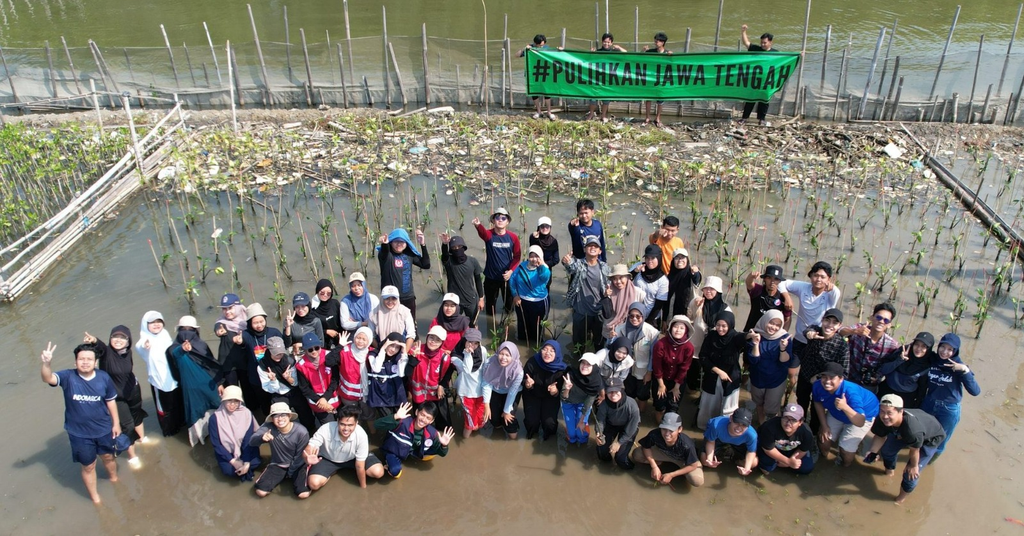
On 27 July 2025, a coastal restoration activity was conducted at Kampung Nelayan Tambakrejo, Semarang, as part of World Mangrove Day.
The programme was organised by WALHI Central Java together with Kelompok Mangrove Nusantara and Ikatan Remaja Tambakrejo and involved multiple community and student organisations, including Fikomedia UNISSULA.
The activity represented direct field-based ecosystem restoration rather than only environmental education or discussion.
A total of 1,200 Rhizophora mangrove seedlings were planted in the existing coastal ecosystem. The planting involved approximately 60 participants consisting of local residents, young people, university students, and volunteers.
Public evidence:
Maintaining an Existing Mangrove Ecosystem
The Tambakrejo activity was conducted within an established coastal mangrove environment.
The objective was not to create an artificial ecosystem disconnected from the surrounding landscape, but to contribute additional mangrove vegetation to an existing coastal ecosystem.
This approach supports both maintenance and extension of the ecosystem.
Maintenance occurs through the protection and restoration of existing coastal habitat, while extension is supported by planting additional mangrove seedlings within the affected area.
The intervention can therefore be described as:
Existing mangrove ecosystem → restoration activity → additional mangrove vegetation → strengthened habitat → continued biodiversity support
Responding to an Ecosystem Under Environmental Pressure
Tambakrejo is particularly relevant because the restoration activity explicitly responds to environmental threats affecting the coastal ecosystem.
The 2025 programme described mangrove restoration as an effort to strengthen coastal ecosystem resilience against abrasion and the climate crisis.
This makes the activity particularly important for environmentally vulnerable land and coastal habitats.
Mangrove vegetation helps maintain the physical structure of the coastline while supporting wider ecological functions within the terrestrial–aquatic transition zone.
Extending Plant Biodiversity and Vegetation
Plant biodiversity is directly supported through mangrove restoration.
The Tambakrejo programme planted Rhizophora mangroves, adding new vegetation to the existing ecosystem.
Increasing mangrove vegetation helps maintain habitat structure and strengthens the continuity of the coastal ecosystem.
UNISSULA’s participation in such restoration therefore represents direct action affecting the plant component of biodiversity rather than only research or awareness raising.
Supporting Animal Biodiversity Through Habitat Protection
Mangrove ecosystems support more than plant communities.
Their root systems, vegetation structure, mudflats, and surrounding waters provide habitat, shelter, feeding areas, and nursery environments for various coastal organisms.
For this reason, restoring mangrove vegetation also contributes to maintaining the habitat conditions required by animal biodiversity.
UNISSULA does not treat the planting activity as evidence that animal populations automatically increased. Rather, the restoration helps maintain and extend habitat capable of supporting animal biodiversity within the existing coastal ecosystem.
This distinction is important because biodiversity conservation requires protecting the ecological conditions on which both plants and animals depend.
Collaboration with Local Communities
The Tambakrejo restoration involved local residents and youth organisations as active participants.
The programme was linked with the establishment of Kelompok Mangrove Nusantara, a local initiative focused on coastal environmental protection and restoration. A mangrove planting map was also launched to support documentation and future planting activities.
The involvement of residents, students, volunteers, environmental organisations, and local groups strengthens the sustainability of ecosystem restoration because long-term conservation depends on continued local stewardship.
Additional Direct Mangrove Planting in Mangkang
UNISSULA’s direct action in 2025 was not limited to Tambakrejo.
Students from the Faculty of Industrial Technology (FTI) UNISSULA also conducted mangrove planting in Mangkang, Semarang, as part of the Student Management Skills Training programme for the 2025 cohort.
Approximately 70 students participated in the programme, which was organised by the FTI Student Executive Board. During the community-service component, students travelled to the Mangkang coastal area and directly planted mangrove trees along the shoreline.
The activity was accompanied by the Vice Dean I of FTI UNISSULA, demonstrating institutional support for the conservation activity.
Public evidence:
https://fti.unissula.ac.id/kegiatan-lkmm-bagi-mahasiswa-angkatan-2025
Strengthening Coastal Vegetation in Mangkang
The Mangkang activity provided another direct intervention in an existing coastal ecosystem.
Rather than only promoting conservation awareness, students physically participated in planting mangrove trees.
This activity contributes to maintaining vegetation cover and extending mangrove habitat within the coastal environment.
The Mangkang activity therefore complements the Tambakrejo restoration by demonstrating direct conservation action in more than one coastal location.
Multiple Forms of Direct Ecosystem Action
The two 2025 activities demonstrate complementary approaches.
In Tambakrejo, UNISSULA participated alongside local communities and environmental organisations in a coordinated coastal restoration programme involving 1,200 mangrove seedlings.
In Mangkang, FTI UNISSULA students directly participated in mangrove planting as part of a community-oriented university programme.
Together, the activities demonstrate:
Direct planting → maintenance of existing vegetation → extension of mangrove habitat → protection of ecological functions → biodiversity support
This is different from activities consisting only of seminars, publications, or environmental campaigns because the work physically affects the ecosystem itself.
Supporting Research on Mangrove Management
Direct restoration activities are complemented by UNISSULA’s academic work on mangrove ecosystem management.
A 2025 UNISSULA study examined Mangrove Edupark Tambakrejo and community participation in its management.
The study highlights the role of the mangrove environment in protecting northern Semarang from abrasion and tidal waves and emphasises the importance of community participation in maintaining and developing mangrove diversity. Unissula Repository
Public evidence:
https://repository.unissula.ac.id/46641
This research provides supporting ecological and management context for the university’s direct conservation activities.
However, the research is treated as supporting evidence; the principal evidence of implementation remains the direct field restoration and mangrove planting carried out in 2025.
Linking Research, Community Engagement, and Direct Conservation
UNISSULA’s approach combines three complementary functions.
Research contributes knowledge about mangrove ecosystems and community participation.
Community engagement connects university activities with residents and local organisations.
Direct conservation action physically maintains and extends vegetation and habitat.
These elements can be represented as:
Knowledge → collaboration → direct restoration → habitat maintenance → biodiversity conservation
The combination strengthens the university’s contribution to the conservation of ecosystems outside its own campus boundaries.
Protecting Existing Ecosystems Rather Than Replacing Them
An important principle of UNISSULA’s conservation activities is that restoration takes place within existing natural or semi-natural ecosystems.
Mangrove planting in Tambakrejo and Mangkang supports ecological continuity rather than converting the areas to unrelated land uses.
The activities therefore contribute to maintaining ecosystem functions while extending vegetation within environmentally sensitive coastal landscapes.
Maintaining Biodiversity of Plants and Animals
The ecological value of mangrove restoration extends across different components of biodiversity.
For plants, direct planting increases and maintains mangrove vegetation.
For animals, maintaining mangrove structure helps preserve habitat conditions used by coastal and aquatic fauna.
For the ecosystem as a whole, mangrove restoration supports the interactions among vegetation, soil, water, coastal organisms, and surrounding communities.
UNISSULA’s direct conservation approach therefore addresses biodiversity at both the habitat and ecosystem levels.
Evidence of Implementation
- UNISSULA participated directly in the Tambakrejo Coastal Restoration programme on 27 July 2025 through Fikomedia UNISSULA.
- The Tambakrejo restoration resulted in the planting of 1,200 Rhizophora mangrove seedlings within an existing coastal ecosystem.
- The activity involved 60 local residents, young people, students, and volunteers, demonstrating direct collaborative ecosystem restoration.
- The restoration specifically addressed a coastal ecosystem threatened by abrasion and climate-related pressures.
- Mangrove planting directly maintains and extends plant vegetation while protecting habitat conditions that support animal biodiversity.
- FTI UNISSULA students also conducted direct mangrove planting in Mangkang during the 2025 student programme, providing a second example of direct ecosystem conservation activity.
- Approximately 70 students participated in the FTI programme, with the mangrove activity conducted as a community-service component.
- The Mangkang activity was institutionally supported and accompanied by the Vice Dean I of FTI UNISSULA.
- UNISSULA’s 2025 research on Mangrove Edupark Tambakrejo provides additional evidence supporting community-based mangrove management and the maintenance of mangrove diversity.
15.2.4
Educational Programmes On Ecosystems
15.2.4 Educational Programme on Local Ecosystems, Wild Flora and Fauna in Manggihan Village
Universitas Islam Sultan Agung (UNISSULA) supports environmental education for local communities through community-based programmes that strengthen understanding of ecosystems, biodiversity, and the sustainable use of natural landscapes.
In 2025, UNISSULA carried out a community-based ecosystem education programme in Manggihan Village, Getasan, Semarang Regency. The programme combined field observation, participatory discussion, community engagement, and environmental planning. Its educational content included the local ecosystem of Manggihan, tourism forests, natural vegetation, wild flora and fauna, biodiversity, habitats, and the importance of maintaining ecological functions while supporting sustainable village development.
The programme involved local community stakeholders and was provided free of charge, allowing participating community members to take part in ecosystem education and discussion without any participation fee.


Community-Based Ecosystem Education
The programme was designed to bring university knowledge directly into the community.
UNISSULA lecturers and students worked with local stakeholders through field activities and participatory discussions to explore the relationship between the natural environment and the future development of Manggihan Village.
Rather than discussing village development only from an economic or infrastructure perspective, the programme introduced an ecosystem-based approach that considers forests, vegetation, wildlife, biodiversity, water resources, landscape characteristics, and human activities as interconnected components.
The programme therefore helped participants understand that sustainable village development requires maintaining the ecological systems that support the community.
Learning About the Manggihan Ecosystem
Manggihan is located in an environmentally significant landscape associated with the highland environment of the Getasan area.
During the programme, discussions addressed the ecological characteristics of the village and the importance of maintaining its natural environment.
Educational topics included:
- The local ecosystem and natural landscape
- Tourism forests and forest-related environmental functions
- Local vegetation and wild flora
- Wild fauna and their habitats
- Biodiversity and ecological balance
- The relationship between vegetation, wildlife, water, and land
- Environmental conservation
- Sustainable use of natural areas for community-based development
The programme encouraged participants to understand the ecosystem as an interconnected system rather than viewing individual natural resources separately.
Education on Tourism Forests
One of the subjects discussed with the community was the role of tourism forests within the environmental and economic development of Manggihan.
Forest and semi-natural areas can provide opportunities for nature-based tourism, environmental education, and community economic development. However, these activities need to be managed in ways that maintain natural vegetation, habitat quality, biodiversity, and ecological functions.
The programme therefore encouraged an approach in which tourism development does not replace environmental conservation.
Participants discussed the importance of maintaining forest characteristics while using natural landscapes responsibly for educational and tourism activities.
Understanding Wild Flora
Education about the local ecosystem included discussion of wild flora and natural vegetation occurring in and around Manggihan.
Vegetation was discussed not simply as part of the physical appearance of the landscape, but as an important component of ecosystem function.
Natural and semi-natural vegetation can contribute to:
- Habitat provision
- Soil protection
- Water regulation
- Landscape stability
- Biodiversity
- The ecological character of tourism areas
Through the programme, community participants were encouraged to recognise the importance of conserving local vegetation when planning future tourism and village-development activities.
Understanding Wild Fauna and Habitat
The programme also addressed wild fauna and the habitats required to support animal life.
Community education emphasised that wildlife depends on the continued availability of suitable vegetation, food sources, water, shelter, and habitat connectivity.
Wild fauna therefore cannot be considered separately from forest condition and vegetation management.
The relationship can be understood as:
Vegetation → habitat → food and shelter → fauna → ecosystem biodiversity
By discussing these relationships, the programme strengthened community understanding of why the conservation of natural areas is important for both plant and animal biodiversity.
Biodiversity as Part of Village Development
Biodiversity was integrated into discussions about the future development of Manggihan.
The programme encouraged participants to consider how development decisions may affect natural habitats and ecological functions.
This included the importance of maintaining a balance between:
Community development → tourism → land use → ecosystem conservation → biodiversity
An ecosystem-based approach helps ensure that development opportunities do not unnecessarily reduce natural vegetation, disturb wildlife habitats, or weaken the environmental character that makes nature-based tourism possible.
Field-Based Ecosystem Observation
Environmental education was supported by direct field observation.
UNISSULA lecturers and students visited locations within Manggihan together with local partners to observe environmental conditions and understand the relationship between settlements, natural landscapes, vegetation, tourism potential, and community activities.
Field observation enabled ecosystem education to be linked with actual local conditions.
Rather than relying solely on classroom-style explanation, participants and the university team could discuss environmental issues in relation to the landscape in which the community lives.
Photo documentation:
UNISSULA team and local partners conducting field observation in Manggihan Village as part of the 2025 community-based ecosystem education programme.
Participatory Community Education and Discussion
Field observation was complemented by educational presentations and participatory discussions.
UNISSULA presented and discussed environmental information with community stakeholders, providing an opportunity to connect field findings with planning and conservation considerations.
Topics included the natural environment of Manggihan, tourism forests, flora and fauna, ecosystem conservation, biodiversity, and environmentally responsible village development.
This participatory approach allowed local knowledge and academic perspectives to be discussed together.
Photo documentation:
Community education and participatory discussion on the Manggihan ecosystem, including tourism forests, wild flora and fauna, biodiversity, and sustainable village development.
Working with Local Community Stakeholders
The programme involved interaction with local community stakeholders rather than being limited to university students.
Community engagement included village representatives and local groups involved in the development and management of Manggihan.
This approach is important because ecosystem conservation ultimately depends on the people who interact with and manage the surrounding landscape.
By working directly with community stakeholders, UNISSULA supported the transfer of environmental knowledge into local planning and stewardship.
Free Access for the Local Community
All ecosystem education, field observation, participatory discussion, and community-engagement activities within the programme were provided free of charge to participating members of the local community.
No participation fee was required.
Providing free access ensured that environmental education was available to community participants without a financial barrier and strengthened the programme’s role as a community-service initiative.
Integrating Conservation and Sustainable Tourism
The programme also connected ecosystem education with sustainable tourism development.
Nature-based tourism depends on maintaining the environmental qualities that attract visitors in the first place.
For this reason, community participants were encouraged to consider conservation as an essential component of tourism development.
A sustainable approach can be represented as:
Healthy ecosystem → conserved flora and fauna → attractive natural landscape → responsible tourism → community benefit → continued conservation
This creates a relationship in which environmental protection and community development reinforce each other.
Building Community Awareness of Ecosystem Stewardship
The programme aimed to strengthen understanding that the natural environment is a shared resource requiring long-term stewardship.
Community members were encouraged to consider the consequences of land-use change, habitat disturbance, vegetation loss, and poorly planned tourism development.
At the same time, the programme highlighted opportunities for village development that retain natural landscape characteristics and biodiversity.
This helps strengthen a community-based approach to environmental stewardship.
Evidence of Implementation
- UNISSULA conducted a community-based educational programme in Manggihan Village in 2025, combining field observation, environmental education, participatory discussion, and community engagement.
- The programme provided education on local ecosystems, including the relationship between land, vegetation, biodiversity, wildlife, and community activities.
- Tourism forests were specifically discussed as natural areas that should be managed in a way that supports both environmental conservation and sustainable community development.
- Wild flora and natural vegetation were included in the educational content, with discussion of their importance for habitat, ecological functions, and landscape conservation.
- Wild fauna and wildlife habitats were also discussed, helping community participants understand the relationship between animal biodiversity and the condition of surrounding vegetation and ecosystems.
- The programme included direct field observation, enabling ecosystem education to be connected with actual environmental conditions in Manggihan.
- Participatory education and discussion involved local community stakeholders, connecting university expertise with local knowledge and environmental priorities.
- All programme activities were provided free of charge to participating local community members, with no participation fee required.
- Photographic documentation records both field-based activities and an educational presentation/discussion session, demonstrating implementation of the community programme.
15.2.5
Sustainable Management Of Land For Agriculture (Educational Outreach)
15.2.5 Sustainable Management of Land for Agriculture (Educational Outreach)
Universitas Islam Sultan Agung (UNISSULA) provides educational outreach for local agricultural communities on the sustainable management of agricultural land and production resources through training, technology transfer, practical mentoring, and community-based implementation.
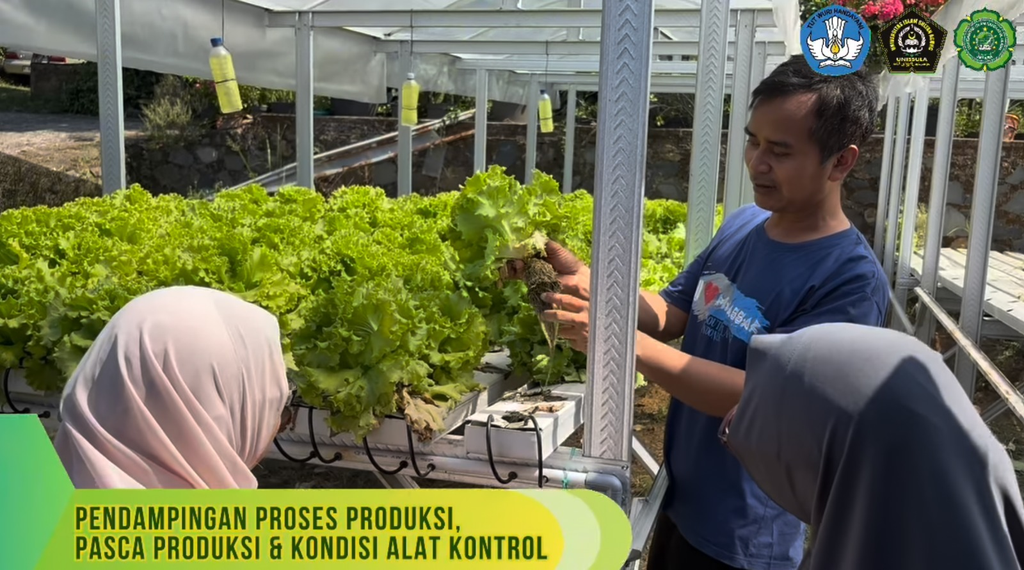
In 2025, UNISSULA implemented a community-service programme in Kedungcino Village, Jepara Regency, focusing on the transformation of sustainable agriculture through smart hydroponic farming and green energy.
The programme worked directly with Oemahku Hydrofarm, a local hydroponic agricultural producer, and provided practical education on efficient agricultural land use, water and nutrient management, environmental monitoring, smart farming technology, automation, and renewable energy.
The educational and mentoring activities were provided free of charge to participating local agricultural partners.




Sustainable Agricultural Management in Kedungcino
The 2025 programme was entitled “Transformasi Pertanian Berkelanjutan melalui Smart Hydroponic Farming dan Green Energy di Desa Kedungcino Kabupaten Jepara.”
The programme addressed challenges faced by local agricultural producers, including limited land availability, changing environmental conditions, manual monitoring of cultivation parameters, unstable nutrient management, water use, and dependence on conventional electricity.
Smart farming was introduced as an approach combining digital technology, Internet of Things (IoT), automation, and renewable energy to improve agricultural productivity and the efficiency of land management. 5099-Article Text-27852-1-10-20…
The programme therefore connected sustainable agricultural management with the practical management of land, water, nutrients, energy, and environmental conditions.
Public evidence:
https://ejournal.uniks.ac.id/index.php/bhakti_nagori/article/view/5099/3552
Educational Outreach to Local Agricultural Producers
The Kedungcino programme was implemented as a community-service activity involving direct interaction between university experts and a local agricultural producer.
The programme was carried out through technology transfer, intensive mentoring, implementation of smart-farming technology, training, and evaluation of programme sustainability.
The approach began with field observation and assessment of the existing greenhouse and nutrient-management system.
UNISSULA then developed and implemented technological solutions that were accompanied by practical education so that participants could understand, operate, and maintain the agricultural system themselves.
This represented educational outreach in a real agricultural production environment rather than education limited to classroom instruction.
Practical Training and Mentoring
Training was an integral part of the programme.
The participating agricultural partner received direct demonstrations on:
- Reading the smart-farming dashboard
- Monitoring temperature and humidity
- Setting environmental thresholds
- Monitoring nutrient conditions
- Using automatic nutrient controls
- Operating the photovoltaic system
- Maintaining agricultural technology
The owner and employees of Oemahku Hydrofarm were actively involved in the training so that technology transfer could be implemented effectively and the system could ultimately be operated independently.
The programme can therefore be described as:
University knowledge → practical demonstration → training → mentoring → agricultural application → independent local management
Supporting public documentation:
Efficient Management of Agricultural Land and Production Areas
The programme promoted more efficient use of agricultural production areas through smart hydroponic farming.
Oemahku Hydrofarm has more than 4,500 planting points, creating a need for effective management of cultivation space and production resources.
Smart hydroponic farming allows agricultural production to be managed systematically within available space while integrating monitoring and control of water, nutrients, temperature, humidity, and energy.
The programme therefore supported sustainable agricultural land management through:
Efficient agricultural space → controlled growing conditions → resource efficiency → stable production → sustainable farming
This approach is particularly relevant where agricultural land is limited and productivity must be balanced with responsible resource use.
Sustainable Water Management
Water efficiency was one of the direct outcomes of the programme.
The smart-farming system used more precise irrigation and environmental control to reduce unnecessary water consumption.
Implementation of the system resulted in a reported reduction in water use of up to 38% through precision irrigation.
This provides a practical example of how technology and farmer education can contribute to more sustainable management of agricultural resources.
The programme helped participants understand that agricultural productivity can be improved while reducing unnecessary pressure on water resources.
Sustainable Nutrient Management
Nutrient management was another important component of the educational programme.
Before the intervention, nutrient concentrations were monitored manually through pH and TDS measurements, making agricultural management highly dependent on regular manual checking.
UNISSULA introduced automatic monitoring and control technologies using pH and TDS sensors.
The system allows nutrient conditions to be monitored more consistently and enables automatic adjustment when necessary.
This provides local agricultural producers with practical knowledge about managing agricultural inputs more efficiently.
Environmental Monitoring through Smart Farming
The programme introduced an IoT-based environmental monitoring system to improve agricultural management.
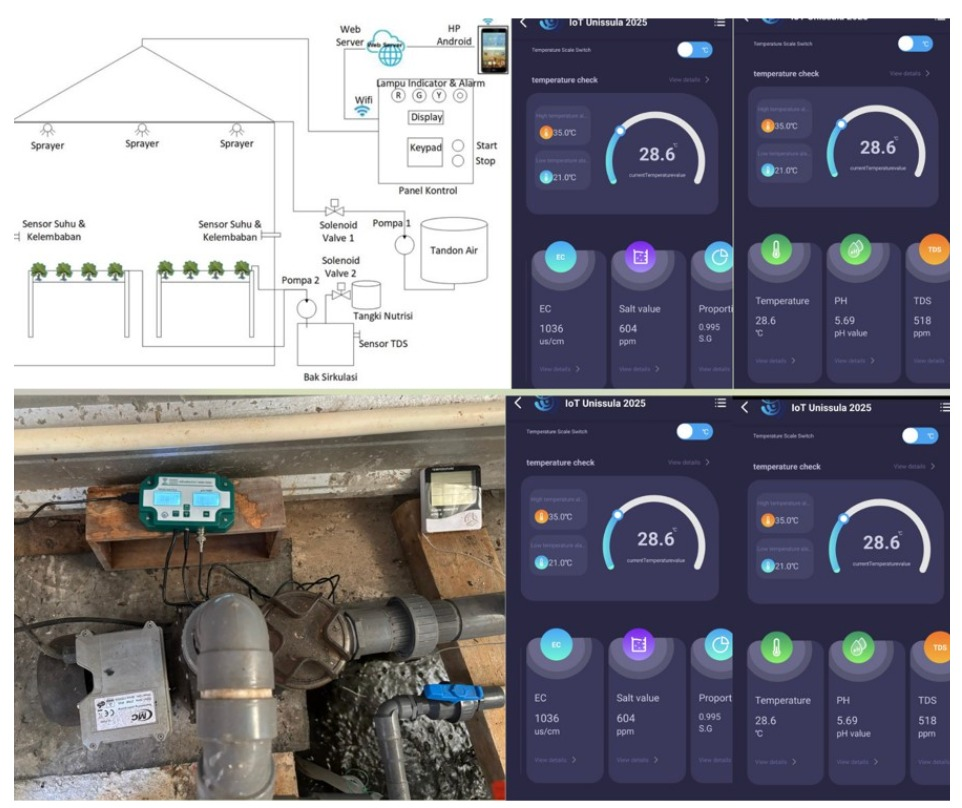
The system monitors:
- Temperature
- Humidity
- pH
- Total Dissolved Solids (TDS)
These parameters can be monitored in real time through a smartphone-based dashboard.
Farmers can observe greenhouse conditions remotely and respond when environmental parameters move beyond the desired range.
This allows agricultural management decisions to be based on actual cultivation conditions rather than relying solely on manual observation.
The educational programme therefore strengthened local knowledge of data-informed and technology-supported agriculture.
Renewable Energy for Agricultural Production
The sustainable-agriculture programme also introduced renewable energy.
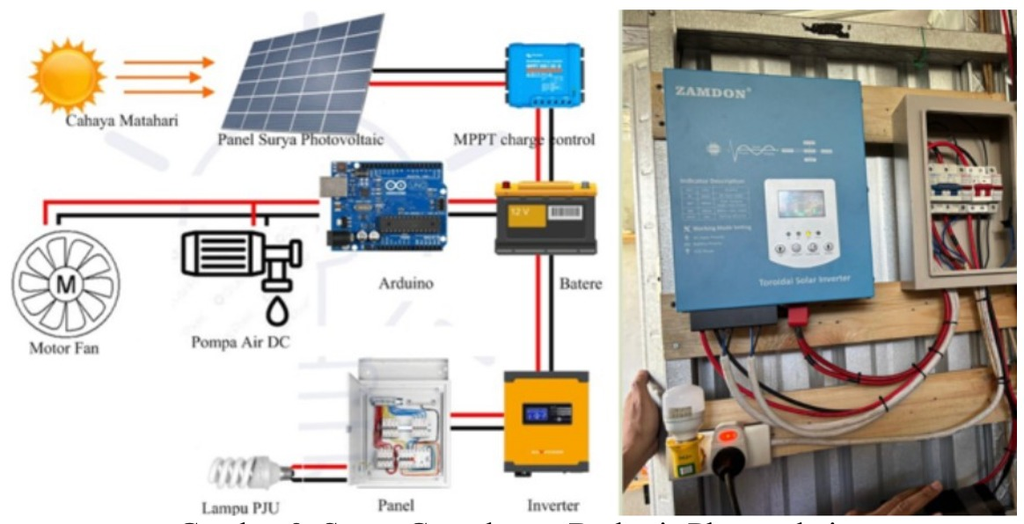
A 500 Wp photovoltaic system was installed to provide an alternative source of electricity for the agricultural control system, nutrient pumps, and IoT monitoring equipment.
The photovoltaic system helps maintain agricultural operations during interruptions to conventional electricity.
The programme reported a reduction of approximately 65% in dependence on electricity from the conventional grid through integration of photovoltaic technology.
This demonstrates how sustainable agricultural management can integrate renewable energy with food-production systems.
Connecting Water, Nutrients, Energy, and Agricultural Land
The Kedungcino programme treats sustainable agriculture as an integrated management process.
The approach connects:
Agricultural land and production space → water efficiency → nutrient management → environmental monitoring → renewable energy → farmer knowledge
These elements are managed together rather than separately.
The result is an agricultural system designed to use available resources more efficiently while maintaining productive growing conditions.
The programme therefore provides a practical example of sustainable agricultural management that local producers can directly observe, learn, and apply.
Building Local Capacity
The educational outreach was designed to ensure that participants could continue using the technology after the period of direct university assistance.
Following training and mentoring, participants were able to operate the IoT system, adjust environmental parameters, and carry out basic maintenance of photovoltaic panels and batteries.
This capacity-building approach is important because sustainable agricultural technology requires local knowledge for long-term operation and maintenance.
UNISSULA therefore did not simply provide technological equipment.
The programme transferred knowledge and practical skills so that the local agricultural partner could manage the system independently.
Measurable Outcomes of the Programme
The 2025 community programme produced measurable agricultural and environmental outcomes.
Implementation of smart farming resulted in:
- Up to 38% reduction in water use through precision irrigation
- Approximately 22% improvement in plant growth associated with more stable nutrient conditions
- Approximately 65% reduction in dependence on conventional grid electricity through photovoltaic integration
- Improved farmer decision-making through real-time IoT monitoring
These outcomes demonstrate that the programme combined education with practical improvements in sustainable agricultural management.
Free Educational Access for the Local Community
The educational outreach, training, demonstrations, technology transfer, and mentoring were provided free of charge to participating local agricultural partners.
No participation or training fee was required from the beneficiaries.
The activity formed part of a community partnership programme supported through the 2025 Community Partnership Service Incentive Programme.
The published programme records that the community-service activities were funded by the Directorate General of Higher Education, Research, and Technology for the 2025 budget year.
Free participation enabled the local agricultural community to access university knowledge, mentoring, and agricultural technology without a financial barrier.
Supporting the Continuity of Sustainable Agricultural Practices
The programme also emphasised the long-term continuation of sustainable agricultural practices.
Participants and farmer groups were encouraged to continue capacity development through further training on the operation and maintenance of smart-farming technologies.
Regular monitoring of sensors and renewable-energy systems was also recommended to maintain the performance of the agricultural system.
This creates the potential for the knowledge and technologies introduced through the programme to continue benefiting agricultural communities beyond the initial outreach period.
Public Evidence
The implementation and outcomes of the 2025 sustainable-agriculture outreach programme are publicly documented in a peer-reviewed community-service publication:
https://ejournal.uniks.ac.id/index.php/bhakti_nagori/article/view/5099/3552
DOI:
https://doi.org/10.36378/bhakti_nagori.v5i2.5099
Supporting video documentation of the programme and technology implementation is publicly available at:
Evidence of Implementation
- UNISSULA implemented a sustainable-agriculture community-service programme in Kedungcino Village, Jepara Regency, in 2025.
- The programme directly involved a local agricultural producer, Oemahku Hydrofarm.
- The programme specifically addressed sustainable agricultural management through smart hydroponic farming, efficient use of agricultural production areas, water management, nutrient management, environmental monitoring, automation, and renewable energy.
- Educational outreach was delivered through direct demonstrations, practical training, technology transfer, and intensive mentoring.
- Local participants were trained to monitor and manage temperature, humidity, pH, TDS, nutrient conditions, IoT systems, and photovoltaic technology.
- The programme reduced water use by up to 38% through precision irrigation.
- Photovoltaic integration reduced dependence on conventional grid electricity by approximately 65%.
- Participants developed the capacity to operate and maintain key smart-farming technologies independently.
- Educational outreach and participation were provided free of charge to the local agricultural participants.
- The programme and its implementation are publicly documented through a peer-reviewed 2025 community-service publication and supporting video documentation.
15.2.6
Sustainable Management Of Land For Tourism (Educational Outreach)
15.2.6 Sustainable Management of Land for Tourism (Educational Outreach)
Universitas Islam Sultan Agung (UNISSULA) provides educational outreach and participatory assistance to local communities on the sustainable management of land for tourism through community engagement, spatial planning, field surveys, participatory discussions, and eco-edutourism development.
In 2025, UNISSULA implemented a community-service programme in Manggihan Village, Getasan, Semarang Regency, assisting the local community in preparing a tourism village masterplan based on education and ecotourism.
The programme directly involved the Manggihan Village Government, Pokdarwis Pepeling, Karang Taruna, Kelompok Usaha Bersama (KUB), UNISSULA lecturers, and students in identifying tourism potential, evaluating land conditions, discussing development priorities, and planning the sustainable use of land for tourism.
The outreach activities were provided free of charge to participating local community stakeholders.
Sustainable Tourism Planning in Manggihan Village
Manggihan is an emerging tourism village with natural, agricultural, livestock, landscape, and educational-tourism potential.
To support its development, UNISSULA conducted a community-service programme aimed at preparing the Manggihan Tourism Village Masterplan based on education and ecotourism through a participatory approach.
The programme included:
- Perception alignment
- Primary field surveys
- Focus Group Discussions
- Aerial mapping using drones
- Spatial analysis
- SWOT analysis
- Preparation of the tourism village masterplan
The programme resulted in a technical planning document designed to strengthen the capacity of Pokdarwis Pepeling and the Manggihan Village Government to manage tourism development based on education and ecology in a more sustainable way.
Public evidence:
Educational Outreach through Participatory Tourism Planning
The Manggihan programme was not limited to preparing a planning document.
It was conducted as a participatory educational and community-engagement process in which local stakeholders were directly involved in understanding the relationship between tourism development, land use, environmental conditions, infrastructure, and community needs.
UNISSULA lecturers and students worked with the Village Government, Pokdarwis Pepeling, Karang Taruna, and KUB through a series of field-based and discussion-based activities.
This enabled local stakeholders to gain practical experience in:
- Identifying tourism resources
- Assessing existing land conditions
- Evaluating tourism development opportunities
- Understanding spatial relationships
- Identifying environmental limitations
- Discussing appropriate tourism functions
- Determining priorities for future tourism development
Primary Survey and Community Learning
The programme began with a participatory survey of village potential and development challenges.
On 22 March 2025, UNISSULA lecturers and students worked collaboratively with the Manggihan Village Government, Pokdarwis Pepeling, Karang Taruna, and KUB.
Survey teams were divided among six hamlets to collect physical, social, and economic information.
This activity enabled local stakeholders to observe and discuss actual village conditions rather than developing tourism plans only from secondary information.
The survey process therefore functioned as both data collection and practical education in understanding how land, community activities, natural resources, and tourism potential are interconnected.
Focus Group Discussion on Tourism Development
Following the field survey, UNISSULA conducted a Focus Group Discussion on 16 April 2025 at the Manggihan Village Hall.
The FGD involved:
- Village officials
- Pokdarwis Pepeling
- Karang Taruna
- KUB
- The UNISSULA Faculty of Engineering community-service team
The discussion presented survey findings, identified key development issues, and gathered community ideas for the future tourism village.
Topics included tourism attractions, development concepts, appropriate locations for tourism activities, gathering areas, rest areas, and parking facilities.
The involvement of Pokdarwis was particularly important because the tourism awareness group is directly involved in managing village tourism.
The participatory process ensured that land-use decisions reflected both technical considerations and local community needs.
Aerial Mapping for Sustainable Tourism Land Management
Sustainable tourism requires an understanding of the physical characteristics of the land.
For this reason, UNISSULA also conducted aerial mapping using drones.
On 23 May 2025, the team worked with village officials and Pokdarwis to obtain aerial information used to assess:
- Village land boundaries
- Existing land conditions
- Access routes
- Relationships between tourism sites and settlements
- Road networks
- The suitability of potential camping-ground locations
The aerial survey provided a spatial basis for tourism planning before site designs were developed.
This activity demonstrated to local stakeholders how spatial information can support more responsible tourism land management.
Managing Tourism Development within Environmental Constraints
The programme recognised that tourism land cannot be developed without considering environmental conditions.
Field surveys and community discussions identified several important physical constraints.
Some areas of Manggihan have steep slopes and are vulnerable to landslides during the rainy season.
The village is also located in the upper Tuntang watershed, meaning that uncontrolled land-use change could affect downstream areas, including Lake Rawapening.
For this reason, tourism planning needs to consider:
Tourism development → land suitability → slope conditions → watershed protection → controlled land use → environmental sustainability
This approach helps prevent tourism development from being separated from the ecological characteristics of the village.
Eco-Educational Tourism as a Sustainable Development Approach
The masterplan was developed using an eco-edutourism approach.
Rather than relying only on conventional tourism facilities, the programme sought to connect tourism activities with local natural resources, agriculture, community livelihoods, environmental education, and village landscapes.
Potential tourism resources include natural landscapes, agricultural activities, community-based educational activities, forest-edge areas, and local environmental practices.
This creates opportunities for tourism development that uses existing village characteristics rather than replacing them with unrelated large-scale development.
The approach can be represented as:
Local landscape → community knowledge → environmental education → tourism experience → community benefit → sustainable land management
Land Zoning for Tourism
A major output of the programme was the identification of a priority tourism-development area covering approximately 124 hectares in Manggihan and Sengon Hamlets.
The area was divided into:
- Reception Zone
- Core Zone
- Supporting Zone
The two principal tourism products identified were a camping ground and community-based educational tourism.
Zoning helps reduce unplanned tourism development by directing activities to appropriate areas according to their function.
This enables tourism facilities, community activities, natural landscapes, and supporting infrastructure to be planned as an integrated system.
Sustainable Management of Tourism Land
The programme demonstrated that tourism development requires more than attracting visitors.
Sustainable tourism land management also requires consideration of:
- Existing land use
- Slope and terrain
- Settlements
- Road access
- Environmental sensitivity
- Natural landscapes
- Local livelihoods
- Community facilities
- Tourism carrying functions
- Long-term spatial organisation
By introducing these concepts through surveys, mapping, FGD, and masterplan preparation, UNISSULA helped local stakeholders strengthen their understanding of responsible tourism development.
Community Participation in Land-Use Decisions
Pokdarwis Pepeling and the Manggihan Village Government played an active role throughout the programme.
They contributed local information, participated in primary surveys across the village, supported community meetings, and participated in the FGD process.
This participatory model is important because tourism land is closely connected with community livelihoods and everyday village activities.
Sustainable tourism planning therefore requires decisions to be developed together with the people who live in and manage the area.
The programme followed the process:
Community participation → local knowledge → field assessment → spatial planning → sustainable tourism management
Strengthening the Capacity of Pokdarwis and Village Government
One of the main purposes of the outreach programme was to strengthen local capacity.
Before the programme, Pokdarwis and the Village Government recognised the importance of planning but had limited technical capacity to prepare a comprehensive tourism-development document.
Through the UNISSULA mentoring programme, local stakeholders were introduced to:
- Tourism planning concepts
- Land-use assessment
- Participatory planning
- Spatial analysis
- Tourism zoning
- Development prioritisation
- Long-term tourism management
The resulting masterplan provides a technical reference that can be used by local stakeholders when considering future tourism projects.
Connecting Tourism with Environmental Education
The tourism concept developed for Manggihan also incorporates educational activities.
Local environmental and livelihood activities can become part of tourism experiences while simultaneously increasing awareness of sustainability.
The programme identified opportunities to integrate tourism with existing community activities, including agriculture and environmentally oriented local practices.
This supports a tourism model in which visitors can learn from the local environment while communities retain control over how their land and resources are used.
Free Access for Local Community Participants
The tourism planning, community education, field survey, FGD, mapping, and mentoring activities were provided free of charge to participating community stakeholders.
No participation fee was required from the Village Government, Pokdarwis, Karang Taruna, KUB, or participating community members.
This enabled local stakeholders to access university knowledge, technical assistance, spatial-planning skills, and tourism-development guidance without a financial barrier.
Maintaining Local Environmental Functions
The programme recognised that the long-term value of tourism depends on maintaining the environmental characteristics that make the village attractive.
Natural landscapes, agricultural areas, forest edges, highland views, and local community activities are part of Manggihan’s tourism potential.
For this reason, tourism development should maintain the relationship between:
Landscape quality → environmental protection → tourism attractiveness → community benefit → long-term tourism sustainability
Uncontrolled land conversion could reduce both ecological quality and tourism value.
The masterplan therefore provides a framework for tourism development that considers both development opportunities and environmental constraints.
Educational Tourism and Camping Ground Development
The masterplan identified community-based educational tourism and a camping ground as principal tourism products.
The camping-ground concept was assessed in relation to land conditions, road access, nearby settlements, and supporting infrastructure.
Educational tourism was designed to connect visitors with local community activities and village resources.
These tourism products were therefore developed within a wider spatial-planning framework rather than being treated as isolated attractions.
Supporting Long-Term Tourism Management
The masterplan provides a basis for future tourism management by the community and Village Government.
It helps local stakeholders understand:
- Where tourism development should be concentrated
- How different tourism functions can be organised
- Which areas require environmental consideration
- How facilities relate to existing settlements
- How tourism can be connected with local livelihoods
- How development can be implemented gradually
This long-term approach is important for reducing fragmented or unplanned land development.
Public Evidence
The Manggihan programme was implemented through field surveys, FGD, drone mapping, participatory planning, and community mentoring during 2025.
The programme was later documented in a peer-reviewed community-service publication describing the preparation of the Manggihan Tourism Village Masterplan based on eco-edutourism.
https://doi.org/10.61251/cej.v4i3.460
The publication documents the community-service process, participating stakeholders, 2025 field activities, spatial analysis, tourism zoning, environmental considerations, and the resulting tourism-development masterplan.
Evidence of Implementation
- UNISSULA implemented a community-based tourism planning and educational outreach programme in Manggihan Village during 2025.
- The programme directly involved the Manggihan Village Government, Pokdarwis Pepeling, Karang Taruna, KUB, UNISSULA lecturers, and students.
- A primary field survey was conducted on 22 March 2025 to assess village conditions, tourism potential, land characteristics, and community needs.
- A participatory FGD was conducted on 16 April 2025 to discuss tourism-development concepts, tourism attractions, land use, facilities, and development priorities.
- Drone-based aerial mapping was conducted on 23 May 2025 to evaluate land boundaries, site conditions, access, settlements, road networks, and potential tourism locations.
- Environmental considerations included steep-slope risks, watershed conditions, and the need to control land-use change to prevent negative environmental impacts.
- A priority tourism-development area of approximately 124 hectares was structured into Reception, Core, and Supporting Zones.
- The tourism plan included camping-ground development and community-based educational tourism within an eco-edutourism framework.
- The programme strengthened the technical capacity of Pokdarwis Pepeling and the Manggihan Village Government to manage tourism development more sustainably.
- Educational outreach, participatory planning, and community mentoring were provided free of charge to participating local stakeholders.
15.3.1
Sustainable Use, Conservation And Restoration Of Land (Policy)
15.3.1 Sustainable Use, Conservation and Restoration of Land (Policy)
Universitas Islam Sultan Agung (UNISSULA) maintains an institutional policy to support the conservation, restoration, and sustainable use of terrestrial ecosystems associated with university activities.
The policy is established through UNISSULA Circular Letter No. 9055/J/SA/IX/2025, dated 11 September 2025, and applies across university units and relevant parties. The policy addresses terrestrial ecosystems including green spaces, vegetation, habitats, forests, mountainous areas, and drylands associated with university activities.
Institutional Policy for Terrestrial Ecosystems
UNISSULA recognises that university activities can interact with terrestrial ecosystems both within the campus environment and in other areas associated with education, research, community service, development, and institutional activities.
For this reason, the university requires the management and use of land and terrestrial ecosystem resources to maintain ecological functions, biodiversity, soil and water conditions, and long-term environmental sustainability.
The policy provides three principal directions:
Conservation → restoration → sustainable use
These three elements form an integrated approach to protecting terrestrial ecosystems associated with university activities.
Conservation of Terrestrial Ecosystems
The first provision of the policy requires terrestrial ecosystems associated with university activities to be protected and conserved.
The policy explicitly covers:
- Green spaces
- Vegetation
- Habitats
- Forests
- Mountainous areas
- Drylands
These ecosystems are to be protected from damage and degradation.
This provision supports the maintenance of existing ecological functions and helps prevent university-related activities from unnecessarily degrading terrestrial habitats.
The conservation approach can be represented as:
Existing ecosystem → protection → prevention of degradation → maintenance of ecological functions
Protection of Green Spaces and Vegetation
Campus green areas and other vegetated land associated with university activities form an important part of terrestrial ecosystem management.
Vegetation contributes to ecological functions through habitat provision, soil protection, water regulation, microclimate management, and biodiversity support.
UNISSULA therefore treats the protection of vegetation and green spaces as part of its broader commitment to terrestrial ecosystem conservation.
The policy also requires attention to habitats, recognising that terrestrial ecosystem conservation involves not only individual plants but also the ecological conditions that support biodiversity.
Forests, Mountains and Drylands
The policy explicitly refers to forests, mountainous areas, and drylands associated with university activities.
These environments can be particularly sensitive to inappropriate land use, habitat disturbance, vegetation loss, erosion, and other forms of environmental degradation.
UNISSULA therefore applies the same principle of conservation to such ecosystems whenever they are associated with university activities.
This approach ensures that environmental responsibility is not limited only to landscaped campus areas, but extends to different types of terrestrial ecosystems relevant to university operations and engagement.
Restoration of Degraded Land
Conservation alone is not sufficient where ecosystem degradation has already occurred.
The second provision of the policy therefore requires degraded or damaged terrestrial areas to be restored.
Restoration measures may include:
- Replanting
- Vegetation rehabilitation
- Plant maintenance
- Other restoration measures appropriate to the characteristics of the ecosystem
The policy explicitly states that areas experiencing damage or degradation should be restored through these measures.
The restoration approach can therefore be described as:
Degraded area → assessment → replanting or rehabilitation → maintenance → ecological recovery
Replanting and Vegetation Rehabilitation
Replanting and vegetation rehabilitation are important mechanisms for restoring terrestrial ecosystems.
Where vegetation has been reduced or damaged, restoration can help re-establish plant cover and support ecological functions.
The policy allows restoration measures to be adapted to local ecosystem conditions rather than applying a single intervention to all locations.
This enables restoration activities to consider the characteristics of the site, vegetation, soil, water conditions, and environmental function of the area.
Sustainable Use of Land and Terrestrial Resources
The third provision establishes the principle of sustainable use.
Land and terrestrial ecosystem resources associated with university activities are to be used in a way that considers:
- Ecological functions
- Biodiversity
- Soil conditions
- Water conditions
- Long-term environmental sustainability
This requirement is stated directly in the Circular Letter.
The principle helps ensure that land use does not focus solely on immediate operational needs but also considers its long-term environmental consequences.
Balancing University Activities and Ecological Functions
UNISSULA recognises that land may support multiple university functions, including education, research, community engagement, infrastructure, green space, and other institutional activities.
Sustainable land management therefore requires a balance between human use and ecological protection.
The policy establishes the following principle:
University activity → responsible land use → maintenance of ecological functions → biodiversity protection → long-term sustainability
This approach allows land to support university activities while reducing unnecessary environmental degradation.
Biodiversity Considerations
Biodiversity is specifically included among the considerations for sustainable land and ecosystem management.
This means that decisions regarding land use should consider the ecological role of vegetation and habitats rather than evaluating land only according to its physical or economic use.
Maintaining biodiversity can support ecosystem resilience and contribute to the continued functioning of terrestrial environments.
The policy therefore links sustainable land management with biodiversity conservation.
Soil and Water Considerations
The policy also explicitly requires consideration of soil and water conditions when using terrestrial ecosystems and land resources.
Soil and water are fundamental components of terrestrial ecosystem health.
Land-management decisions that negatively affect soil stability, water infiltration, vegetation, or ecological functions can produce impacts extending beyond the immediate area.
By incorporating soil and water considerations, UNISSULA promotes a more integrated approach to sustainable land management.
Prevention of Environmental Degradation
A key component of the policy is prevention.
Terrestrial ecosystems are to be protected from damage and degradation before restoration becomes necessary.
The university’s approach therefore prioritises:
Prevention → conservation → restoration where necessary → sustainable continued use
Preventing degradation is generally more effective for maintaining ecosystem functions than attempting to restore severely damaged areas after degradation has occurred.
Application Across University Activities
The Circular Letter is addressed to institutional leaders across UNISSULA, including faculty leadership, bureaus, institutes, units, and other university organisational structures.
This establishes terrestrial ecosystem protection as an institutional responsibility rather than the responsibility of a single academic programme or environmental unit.
The policy provides a common framework for considering terrestrial ecosystem sustainability in university-related activities.
Institutional Responsibility
Implementation of terrestrial ecosystem conservation requires cooperation among different university functions.
Academic units can contribute through research and education.
Community-service programmes can support ecosystem restoration and sustainable land management outside the campus.
Administrative and infrastructure units can protect campus green areas and ensure responsible land management.
Together, these activities support implementation of the institutional policy across different areas of university responsibility.
Policy Adopted in 2025
The policy was formally issued on 11 September 2025 through Circular Letter No. 9055/J/SA/IX/2025.
The document was issued on behalf of the Rector by the Vice Rector I of UNISSULA, providing formal institutional authority for its provisions.
The policy therefore provides a formal institutional basis for terrestrial ecosystem conservation, restoration, and sustainable land use.
Evidence of Policy Implementation Framework
UNISSULA’s terrestrial ecosystem policy establishes the following commitments:
- Conservation — Terrestrial ecosystems associated with university activities, including green spaces, vegetation, habitats, forests, mountainous areas, and drylands, are to be protected and conserved and prevented from damage and degradation.
- Restoration — Damaged or degraded areas are to be restored through replanting, vegetation rehabilitation, plant maintenance, or other appropriate restoration measures.
- Sustainable use — Land and terrestrial ecosystem resources are to be used sustainably while considering ecological functions, biodiversity, soil and water conditions, and long-term environmental sustainability.
These three provisions provide a direct institutional framework for managing terrestrial ecosystems associated with UNISSULA.
15.3.2
Monitoring IUCN And Other Conservation Species (Policies)
15.3.2 Monitoring IUCN and Other Conservation Species (Policy)
Universitas Islam Sultan Agung (UNISSULA) maintains an institutional policy to identify, monitor, and protect species of conservation concern and their habitats in areas managed by or affected by university activities.
The policy is established through UNISSULA Circular Letter No. 9022/J/SA/IX/2025, dated 11 September 2025. It specifically covers flora and fauna included in the IUCN Red List and species included in national conservation lists whenever their habitats occur in areas under university management or affected by university activities.
The policy establishes three principal responsibilities:
Identification → monitoring → protection
These responsibilities provide a framework for ensuring that species of conservation concern and their habitats are considered in university activities.
Identification of Species of Conservation Concern
The first provision requires relevant university units to identify flora and fauna included in the IUCN Red List or national conservation lists when such species have habitats in areas managed by or affected by UNISSULA activities.
The policy states that these species are to be identified within relevant habitats so that their presence can be recognised before or during university activities.
Identification is an essential first step because conservation action depends on knowing which species may occur within an area and understanding where their habitats are located.
The policy therefore establishes the following principle:
Area affected by university activities → identification of flora and fauna → conservation-status assessment → appropriate management response
IUCN Red Listed Species
The policy explicitly refers to the IUCN Red List.
This ensures that species recognised internationally as being of conservation concern are included within UNISSULA’s biodiversity-protection framework.
Where an IUCN Red Listed species is identified in an area managed by or affected by university activities, its presence and habitat are to be considered in environmental management and protection measures.
The policy does not assume that every university site contains an IUCN Red Listed species. Instead, it establishes the institutional requirement to identify and respond appropriately if such species are present.
National Conservation List Species
The policy also covers flora and fauna included in national conservation lists.
This ensures that biodiversity protection is not limited to international conservation classifications.
Species recognised under national conservation frameworks are also included within the university’s identification, monitoring, and protection responsibilities.
This dual approach enables UNISSULA to consider both:
International conservation status + national conservation status
when managing biodiversity in areas associated with university operations.
Habitats Affected by University Operations
The policy applies not only to species located directly within the main campus.
It specifically covers habitats in areas that are:
- Under university management; or
- Affected by university activities.
This broader scope is important because university operations can extend through education, research, community engagement, infrastructure, field activities, and institutional partnerships.
The policy therefore recognises that biodiversity responsibility may extend beyond formally owned campus land to other locations where university activities can affect terrestrial habitats.
Regular Monitoring of Conservation Species
Identification alone is not sufficient.
The second provision requires the presence and condition of conservation species and their habitats to be monitored periodically.
Monitoring may be conducted through:
- Inventories
- Direct observation
- Appropriate recording according to local conditions
These requirements are stated directly in the Circular Letter.
Periodic monitoring enables the university to observe changes in species presence, habitat condition, or environmental pressures over time.
Monitoring Species and Their Habitats Together
The policy does not treat species separately from their habitats.
Both the species and the condition of their habitats are included within the monitoring requirement.
This is important because the long-term survival of flora and fauna depends on the ecological conditions required for feeding, shelter, reproduction, movement, and other biological functions.
The monitoring framework can therefore be described as:
Species presence → habitat condition → periodic observation → recording → conservation response
Biodiversity Inventories
Inventory activities provide one method for implementing the monitoring policy.
An inventory can document the flora and fauna present within an area and provide a reference for future monitoring.
Where relevant, conservation status can then be compared with the IUCN Red List and applicable national conservation lists.
Repeated inventories can also help identify changes over time and provide information for environmental management.
Field Observation
Direct field observation is another monitoring mechanism recognised in the policy.
Observation can help document:
- Species occurrence
- Habitat use
- Visible environmental changes
- Disturbance
- Habitat degradation
- Other conditions relevant to conservation
The policy allows monitoring approaches to be adapted to the environmental characteristics of each location rather than requiring one identical method for every site.
Recording and Documentation
The policy also allows appropriate recording of conservation observations.
Documentation is important for establishing an institutional record of biodiversity conditions and supporting future comparisons.
Records can assist university units in determining whether further monitoring, habitat management, or protective action is required.
The combination of inventory, observation, and recording creates a practical framework for biodiversity monitoring.
Protection of Conservation Species
The third provision of the policy requires species of conservation concern and their habitats to be protected from activities that may threaten their sustainability.
The Circular Letter specifically refers to protection from activities that may cause:
- Habitat damage
- Disturbance
- Population decline
- Other threats to species sustainability
This makes protection an explicit institutional responsibility rather than limiting the policy to identification and documentation.
Habitat Protection
Protecting conservation species requires protection of the habitats on which they depend.
For this reason, the policy explicitly includes both species and their habitats.
The institutional approach can be represented as:
Identify species → monitor species and habitat → detect threats → protect habitat and species
This helps ensure that conservation measures address ecological conditions rather than focusing only on individual organisms.
Preventing Habitat Damage
University-related activities that could cause habitat damage need to consider the possible presence of conservation species.
Where such species or important habitats are identified, appropriate action should seek to avoid or reduce negative impacts.
The policy therefore supports a preventive approach in which biodiversity considerations are incorporated before environmental degradation becomes severe.
Preventing Disturbance
Disturbance can affect conservation species even when habitat is not physically removed.
The policy consequently includes protection from activities that may disturb species or affect their ability to continue using their habitats.
This provides a broader protection framework than simply preventing vegetation clearance.
Preventing Population Decline
The Circular Letter explicitly identifies population decline as an outcome that should be prevented.
This connects university biodiversity management with the long-term sustainability of conservation species.
Where monitoring indicates threats that could contribute to population decline, the policy provides a basis for protective action.
Protection from Other Conservation Threats
The policy also includes other threats that may affect the continued sustainability of conservation species.
This wording allows the policy to respond to different environmental conditions and emerging threats without restricting protection to a single type of impact.
The approach therefore remains applicable across different locations and types of university activity.
Relationship between Identification, Monitoring, and Protection
The three policy responsibilities are designed to operate together.
Identification determines whether conservation species may be present.
Monitoring provides information about their continued presence and habitat condition.
Protection responds to threats or risks that could negatively affect those species or their habitats.
The complete framework is:
Identify → monitor → evaluate condition → protect → continue monitoring
This creates an ongoing rather than one-time approach to biodiversity conservation.
Application across University Units
Circular Letter No. 9022/J/SA/IX/2025 is addressed to university leadership across faculties, bureaus, institutes, technical implementation units, administrative units, and other relevant organisational structures.
The policy therefore establishes biodiversity protection as an institution-wide responsibility.
Relevant units are expected to consider species conservation when their activities interact with habitats under university management or habitats that may be affected by university operations.
Supporting Responsible University Activities
UNISSULA undertakes a range of activities that may interact with natural environments, including:
- Education
- Research
- Community service
- Infrastructure and facilities management
- Field-based activities
- Institutional collaboration
The conservation policy provides a common framework for ensuring that these activities consider the possible presence of protected or threatened species.
This helps integrate biodiversity considerations into university operations.
Policy Adopted in 2025
Circular Letter No. 9022/J/SA/IX/2025 was formally issued on 11 September 2025.
The document was issued on behalf of the Rector by the Vice Rector I of UNISSULA, providing institutional authority for the policy.
The policy establishes a formal university framework for identifying, monitoring, and protecting conservation species and their habitats.
Evidence of Policy
UNISSULA’s policy establishes the following requirements:
- Identification — Flora and fauna included in the IUCN Red List or national conservation lists are to be identified where their habitats occur in areas managed by or affected by university activities.
- Monitoring — The presence and condition of conservation species and their habitats are to be monitored periodically through inventories, observations, or appropriate recording.
- Protection — Conservation species and their habitats are to be protected from habitat damage, disturbance, population decline, and other threats to their sustainability.
15.3.3
Local Biodiversity Included In Planning And Development
15.3.3 Local Biodiversity Included in Planning and Development
Universitas Islam Sultan Agung (UNISSULA) integrates local biodiversity considerations into campus planning, construction, and renovation processes to ensure that physical development is carried out alongside the protection of existing trees, vegetation, green spaces, and local habitats.
In 2025, this approach was formally incorporated into UNISSULA Circular Letter No. 8391/J/SA/IX/2025, which applies to the construction of new buildings and renovation of existing buildings across the university.
The Circular Letter requires new construction and renovation projects to consider the presence of trees, vegetation, green spaces, and local habitats at development sites. Planning documents must also be evaluated before implementation to ensure the protection of local biodiversity, with restoration or replanting required where vegetation or green space is affected.
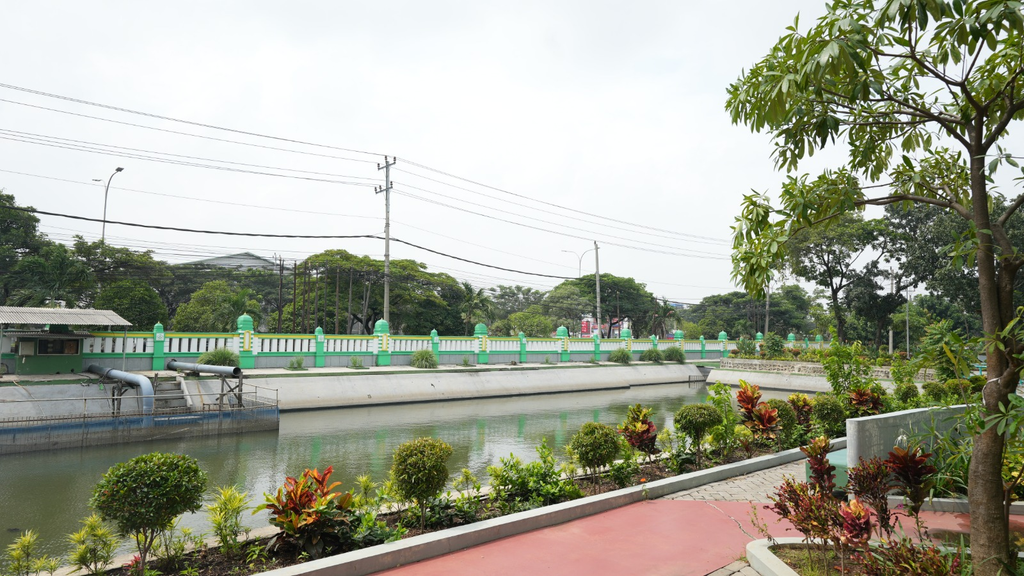
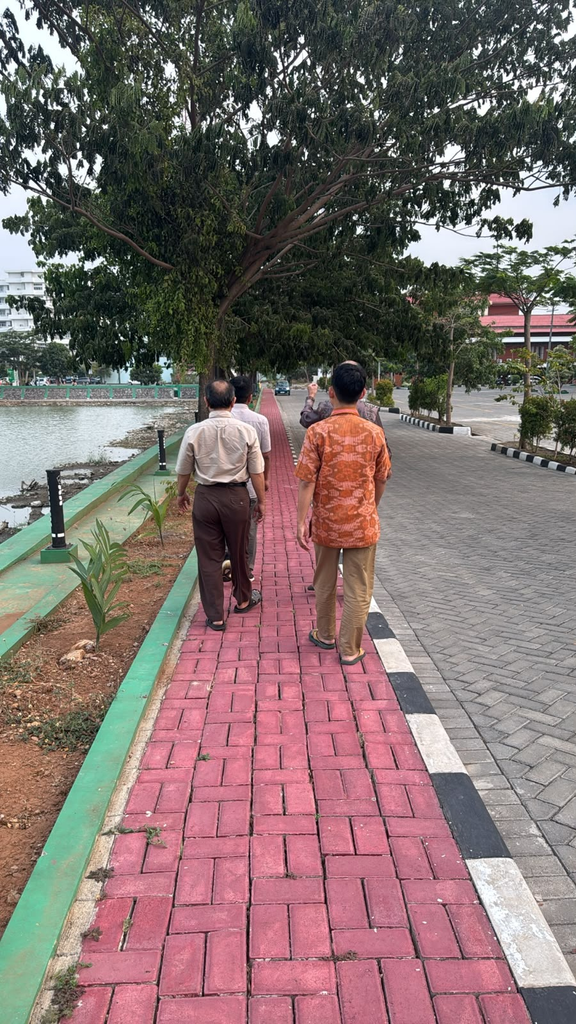
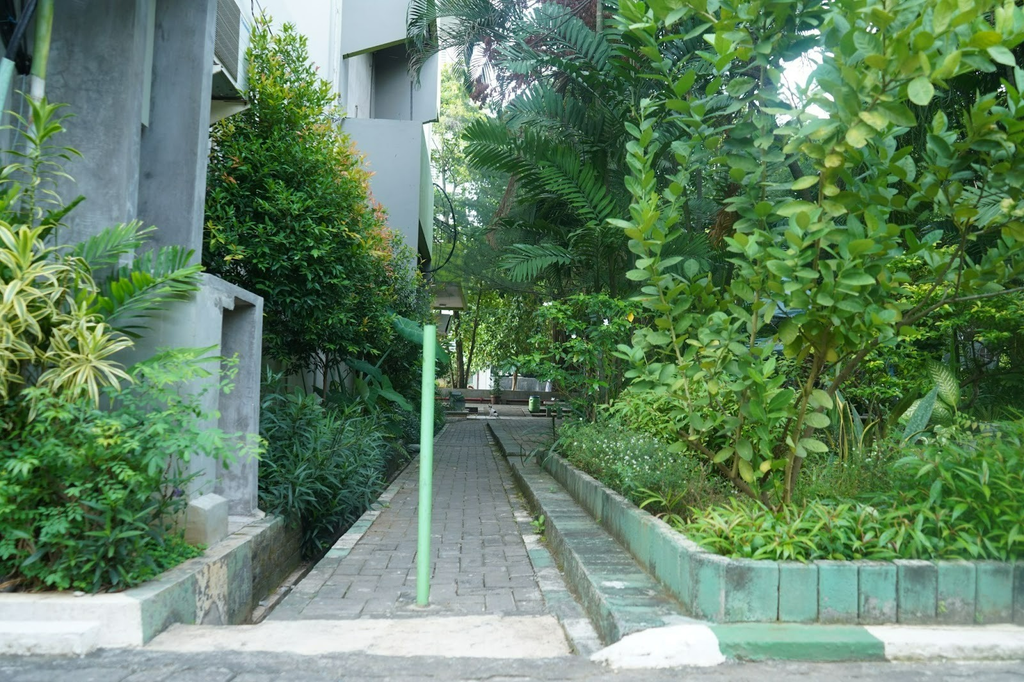
Integrating Biodiversity into Development Planning
UNISSULA recognises that campus development should not be considered only in terms of buildings and infrastructure.
Trees, vegetation, green spaces, and habitats are also part of the physical and ecological characteristics of the campus.
For this reason, biodiversity considerations are incorporated from the planning stage of new construction and renovation.
The approach can be described as:
Development planning → identification of existing green elements → biodiversity consideration → protection during implementation → restoration where necessary
This enables the university to develop its facilities while continuing to maintain the ecological functions of its campus environment.
Considering Existing Trees and Vegetation
The 2025 Circular Letter explicitly requires construction and renovation activities to consider existing trees and vegetation at the development location.
This is particularly important in a developed campus environment, where mature trees and established vegetation contribute to:
- Shade and thermal comfort
- Habitat availability
- Landscape continuity
- Soil protection
- Rainwater absorption
- Local microclimate regulation
- Overall campus biodiversity
Considering these elements during planning helps prevent unnecessary removal of established vegetation.
Green Spaces as Part of the Built Environment
UNISSULA’s campus development approach integrates green space with buildings, pedestrian areas, roads, and other infrastructure.
Campus documentation shows buildings and circulation areas located alongside established trees, planted landscapes, gardens, and vegetated corridors.
Rather than separating built infrastructure from the natural environment, the campus layout allows green areas to remain part of the everyday academic environment.
This demonstrates an approach in which:
Buildings + pedestrian areas + existing trees + gardens + green corridors
are planned as interconnected parts of the campus.
Protecting Local Habitats
The Circular Letter also identifies local habitats as an element that must be considered during construction and renovation planning.
Vegetated areas can provide habitat and ecological resources for organisms living within or moving through the campus environment.
Protecting vegetation and green spaces therefore contributes not only to campus aesthetics but also to maintaining ecological functions.
The consideration of habitats encourages development decisions that avoid unnecessary disturbance to existing ecological areas.
Biodiversity Review before Construction
An important component of the UNISSULA approach is the requirement to evaluate planning documents before implementation.
This evaluation is intended to ensure both energy efficiency and the protection of local biodiversity.
Biodiversity is therefore not considered only after a construction project has been completed.
Instead, it becomes part of the pre-construction planning process.
This approach allows potential effects on trees, vegetation, green areas, and habitats to be considered before physical work begins.
Restoration and Replanting
Where construction or renovation affects vegetation or green space, the Circular Letter requires appropriate restoration or replanting.
This creates a mitigation process:
Avoid unnecessary impact → protect existing vegetation → minimise disturbance → restore or replant when impact occurs
The restoration requirement helps ensure that physical development does not result in unnecessary long-term loss of green space.
Biodiversity-Sensitive Renovation
Renovation provides an important opportunity to improve university facilities without replacing existing ecological features unnecessarily.
UNISSULA’s campus documentation shows renovated and developed areas where mature trees, vegetation, landscaped areas, and green corridors continue to exist alongside buildings and pedestrian infrastructure.
In several areas, pedestrian routes have been arranged through or alongside established vegetation, allowing trees and planted areas to remain integrated within campus circulation.
This reflects a development approach that seeks to accommodate physical improvements while maintaining existing green elements.
Maintaining Mature Trees
Mature trees are an important component of campus biodiversity and landscape structure.
Campus documentation shows large established trees retained within developed areas, including trees located close to buildings, pedestrian paths, roads, and landscaped public spaces.
Maintaining mature trees provides continuity in canopy cover and avoids the ecological loss that would occur if established vegetation were routinely removed during development.
The physical arrangement of campus spaces demonstrates that infrastructure can be adapted around existing trees rather than requiring their automatic removal.
Green Landscaping around Buildings
Landscape areas surrounding campus buildings include combinations of trees, shrubs, ground vegetation, planted beds, and other greenery.
These areas help maintain a transition between built structures and the natural environment.
Green landscaping can also support:
- Habitat functions
- Infiltration of rainwater
- Shaded outdoor spaces
- Environmental comfort
- Biodiversity
- Visual continuity across the campus
UNISSULA therefore treats landscape planning as part of sustainable campus development rather than simply as decoration.
Green Corridors and Pedestrian Areas
Campus pedestrian areas also demonstrate integration between development and local vegetation.
Walkways are located alongside trees and landscaped areas, allowing users to move through shaded and vegetated spaces.
This arrangement helps maintain green connections within developed parts of the campus.
Such green corridors can contribute to ecological continuity while simultaneously improving the quality of pedestrian spaces.
Maintaining and Managing Campus Vegetation
Protection of biodiversity requires continued management after planning and construction are completed.
Campus landscaping is maintained as an active part of the university environment.
The presence of irrigation systems within landscaped areas demonstrates continuing management of vegetation and green spaces.
Maintaining planted areas helps sustain the ecological and environmental functions intended through biodiversity-sensitive planning.
Connection with Green Building Principles
The biodiversity provisions are integrated within a broader approach to sustainable building development.
The same Circular Letter requires new buildings and renovations to apply relevant energy-efficiency standards, including energy conservation standards for lighting, air-conditioning systems, building envelopes, and applicable Green Building requirements.
This means that sustainable campus development at UNISSULA considers both the performance of buildings and the environmental characteristics surrounding them.
The approach combines:
Energy efficiency + green building + local biodiversity + green-space protection
Planning before Development
UNISSULA’s approach places environmental consideration at the planning stage.
Before development is implemented, planning documents are reviewed to ensure that both technical sustainability requirements and biodiversity protection are addressed.
This is important because biodiversity conservation is most effective when incorporated before construction decisions become irreversible.
The planning process therefore supports a preventive rather than purely corrective approach.
2025 Institutional Implementation
Circular Letter No. 8391/J/SA/IX/2025 was issued on 4 September 2025 on behalf of the Rector by the Vice Rector II of UNISSULA.
Its application to new buildings and renovations provides an institutional basis for incorporating biodiversity considerations into campus development during 2025.
The provisions ensure that development planning considers existing ecological elements while providing measures for protection and restoration where impacts occur.
Evidence of Implementation
- UNISSULA formally incorporated local biodiversity into construction and renovation planning in 2025 through Circular Letter No. 8391/J/SA/IX/2025
- New construction and renovation projects are required to consider existing trees, vegetation, green spaces, and local habitats at development locations.
- Planning documents must be evaluated before implementation to ensure protection of local biodiversity.
- Where vegetation or green space is affected by development, the planning process requires restoration or replanting.
- Campus documentation demonstrates the continued presence of mature trees, vegetated areas, landscaped gardens, and green corridors alongside buildings and pedestrian infrastructure.
- Developed campus areas show that buildings, circulation routes, and public spaces can coexist with established vegetation rather than automatically replacing green areas.
- Landscaped areas continue to be maintained, including through irrigation and vegetation management.
- Biodiversity-sensitive planning is integrated with broader sustainable-building measures, including energy-efficiency and Green Building requirements.
15.3.4
Alien Species Impact Reduction (Policies)
15.3.4 Alien Species Impact Reduction (Policy)
Universitas Islam Sultan Agung (UNISSULA) maintains an institutional policy to reduce the ecological impact of alien flora and fauna on the university campus, with particular attention to protecting local species, habitats, and ecosystem balance.
The policy is established through UNISSULA Circular Letter No. 9025/J/SA/IX/2025, dated 11 September 2025. It requires university units and relevant parties to manage alien species responsibly through controlled introduction, monitoring, prevention of spread, and appropriate control measures where ecological impacts occur.
Institutional Management of Alien Species
UNISSULA recognises that the introduction or spread of alien flora and fauna may affect local biodiversity and ecological balance if not appropriately managed.
For this reason, the university’s policy establishes a preventive and responsive framework based on:
Controlled introduction → Monitoring → Prevention of spread → Impact reduction
The policy applies to alien flora and fauna introduced, planted, released, or found within the campus environment.
Its primary objective is to minimise potential negative effects on local species, habitats, biodiversity, and ecosystem stability.
Controlled Introduction of Alien Flora and Fauna
The first provision of the policy addresses the introduction of alien species.
The procurement, planting, or release of alien flora and fauna on campus must be conducted in a controlled manner, with consideration given to their potential effects on:
- Local species
- Local habitats
- Ecosystem balance
This requirement is explicitly stated in the Circular Letter.
This preventive approach allows potential ecological risks to be considered before alien plants or animals become established within the campus environment.
Protecting Local Species
The policy places local biodiversity at the centre of alien-species management.
Before alien flora or fauna are introduced, their possible effects on existing local species must be considered.
This approach supports the continued presence of native and locally established biodiversity within campus green areas.
The underlying principle is:
Alien species introduction → Ecological consideration → Protection of local species
Protecting Campus Habitats
Alien species management is not limited to individual plants or animals.
The policy also explicitly considers potential impacts on habitats.
Campus habitats may include green spaces, planted areas, tree-covered areas, gardens, and other vegetated environments that support biodiversity.
Protecting these habitats helps maintain the ecological conditions required by local flora and fauna.
Maintaining Ecosystem Balance
The policy also requires consideration of the potential effect of alien species on ecosystem balance.
This recognises that ecological impacts can extend beyond competition between individual species.
Changes in vegetation, habitat structure, resource availability, or species interactions may influence the wider campus ecosystem.
For this reason, UNISSULA seeks to manage alien species before significant ecological disturbance occurs.
Monitoring Alien Species on Campus
The second policy provision requires alien species that may cause disturbance to campus ecosystems to be monitored.
Monitoring enables the university to observe whether alien species are spreading or creating negative effects on local biodiversity.
The Circular Letter requires potentially disruptive alien species to be monitored and controlled in order to prevent their spread and reduce negative impacts.
The management process can therefore be represented as:
Presence of alien species → Monitoring → Assessment of ecological impact → Control where necessary
Preventing the Spread of Alien Species
Preventing unnecessary spread is a central part of the policy.
Where an alien species has the potential to disturb the campus ecosystem, management measures should prevent it from spreading into additional areas.
This is particularly important because ecological impacts can become more difficult to manage once a species becomes widely established.
The university therefore prioritises early monitoring and control rather than waiting until ecological impacts become severe.
Reducing Negative Impacts on Local Biodiversity
The second provision directly links alien-species control with the protection of local biodiversity.
Monitoring and control are intended not only to restrict the spread of alien species, but also to reduce negative effects on local flora, fauna, and habitats.
This establishes a clear institutional relationship:
Alien species management → Reduction of ecological impact → Protection of local biodiversity
Response to Ecological Impacts
The third policy provision addresses situations in which an alien species has already caused, or is causing, ecological impacts.
Where such impacts are identified, appropriate management actions may include:
- Control
- Restriction
- Relocation
- Other appropriate measures
These actions are intended to protect local species and campus habitats.
This ensures that the policy includes not only prevention but also corrective action.
Appropriate Control Measures
Alien species do not necessarily require the same management response in every situation.
The Circular Letter therefore allows different forms of intervention depending on ecological conditions.
Possible responses include controlling numbers or distribution, restricting further spread, relocating organisms where appropriate, or applying other management measures suited to the situation.
This flexible approach enables the university to respond proportionately to actual ecological impacts.
Protection of Campus Biodiversity
The alien-species policy forms part of UNISSULA’s broader approach to maintaining biodiversity within the campus environment.
Campus biodiversity includes the interaction between:
Local flora + Local fauna + Vegetation + Habitat + Soil and water conditions + Ecological processes
Alien species management helps protect these relationships by reducing ecological pressures that may affect existing species or habitats.
Prevention before Ecological Damage
An important characteristic of the policy is its emphasis on prevention.
The university does not rely solely on removing or controlling alien species after environmental damage occurs.
Instead, the policy begins at the point of procurement, planting, or release.
This provides a management hierarchy:
Prevent → Monitor → Contain → Control impacts
Such an approach supports more responsible campus biodiversity management.
Campus-Wide Institutional Responsibility
Circular Letter No. 9025/J/SA/IX/2025 is addressed to leadership across faculties, bureaus, institutes, technical implementation units, administrative units, and other organisational structures within UNISSULA.
Alien-species management is therefore treated as an institutional responsibility rather than an issue limited to a single unit.
This is relevant to units responsible for:
- Landscaping and green spaces
- Campus facilities
- Construction and renovation
- Procurement
- Environmental management
- Other activities that may involve plants or animals
Responsible Landscaping and Plant Selection
Campus landscaping is one area where alien-species considerations are especially relevant.
The policy requires the introduction and planting of alien flora to be controlled and assessed for potential effects on local biodiversity.
This encourages responsible selection of vegetation for gardens, green spaces, and landscape development.
The objective is not simply to increase the amount of vegetation, but to ensure that landscaping does not create unnecessary ecological risks.
Alien Fauna Management
The policy also includes alien fauna.
Any release or introduction of alien animals on campus should be managed carefully, with consideration of potential effects on local species and habitats.
If alien fauna are found to cause ecological disturbance, appropriate controls may be applied in accordance with the policy.
This ensures that both flora and fauna are covered within the university’s biodiversity management framework.
Relationship with Habitat Conservation
Reducing alien-species impacts contributes directly to habitat protection.
Local habitats can be affected when alien species dominate vegetation, compete for resources, disturb ecological interactions, or alter environmental conditions.
By monitoring and controlling potentially harmful alien species, UNISSULA supports the continued ecological functioning of campus habitats.
Policy Adopted in 2025
Circular Letter No. 9025/J/SA/IX/2025 was formally issued on 11 September 2025.
The document was issued on behalf of the Rector by the Vice Rector I of UNISSULA, establishing institutional authority for alien-species management across the university.
Evidence of Policy
UNISSULA’s alien-species policy establishes three principal requirements:
- Controlled introduction — Procurement, planting, or release of alien flora and fauna on campus must consider potential impacts on local species, habitats, and ecosystem balance.
- Monitoring and prevention of spread — Alien species that may disturb campus ecosystems must be monitored and controlled to prevent spread and reduce negative impacts on local biodiversity.
- Ecological impact reduction — Where alien species cause ecological impacts, appropriate control, restriction, relocation, or other management measures should be undertaken to protect local species and campus habitats.
15.3.5
Collaboration For Shared Land Ecosystems
15.3.5 Collaboration for Shared Land Ecosystems
Universitas Islam Sultan Agung (UNISSULA) collaborates directly with local communities to maintain and improve shared land ecosystems through community-based environmental programmes, tree planting, land rehabilitation, and continuing local participation.
In 2025, UNISSULA implemented a collaborative environmental programme in Brumbung Village, Mranggen District, Demak Regency, through its Community Service Programme (KKN). The programme brought together UNISSULA students, village leaders, neighbourhood representatives, village officials, and local residents to restore and maintain shared village land through tree planting and environmental care.
The activity was conducted on 9 August 2025 and involved the planting and distribution of 160 guava and rambutan seedlings. Its stated purposes included ecosystem conservation, improvement of environmental quality, and prevention of land degradation.

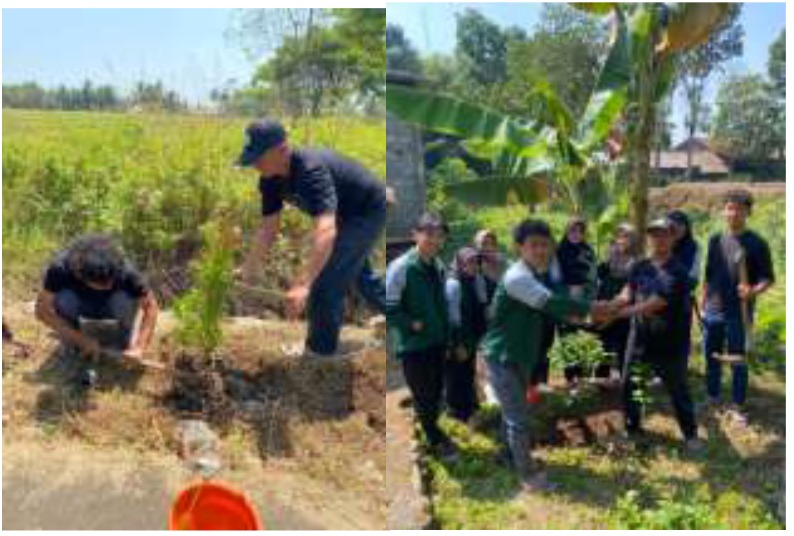

Collaboration with the Local Community
The Brumbung programme was implemented as a collaborative activity rather than a university-only intervention.
Participants included:
- UNISSULA students
- The Head of Brumbung Village
- The heads of RT 01 and RW 02
- Village officials
- Local residents
The programme therefore connected university community service with local leadership and community participation.
The tree-planting activity was carried out across gardens, residential yards, and village roads, making the programme directly relevant to land that is used and experienced collectively by the local community.
This collaborative approach can be represented as:
University involvement → Local leadership → Community participation → Tree planting → Land protection → Continued ecosystem maintenance
Maintaining Shared Village Land
The programme focused on maintaining and improving land within the village environment.
Tree planting was undertaken not only to increase greenery, but also to support ecosystem conservation and help prevent environmental degradation.
The programme recognised that land in rapidly developing areas can face pressures from changing land use, population growth, and environmental disturbance.
Tree planting therefore served as a practical intervention to help maintain vegetation cover and improve the ecological condition of shared village areas.
Preventing Land Degradation
One of the explicit objectives of the programme was to help prevent land degradation.
The planting of trees in gardens, residential areas, and along village roads contributed to increasing vegetation coverage and improving land condition.
The programme also linked tree planting with environmental protection, ecosystem conservation, and improved soil conditions.
These activities support a broader approach to land management:
Vegetation establishment → Soil protection → Ecosystem maintenance → Reduced degradation
Direct Community Participation
Community participation formed a central part of the programme.
Local residents did not act only as recipients of seedlings.
The programme encouraged active participation in planting, caring for vegetation, and maintaining the local environment.
The documentation states that the programme aimed to increase environmental awareness and involve local communities directly in maintaining their local environment. Residents were encouraged to understand the importance of ecosystem conservation through collective tree planting and plant maintenance.
Joint Tree Planting
Tree planting was conducted collaboratively by UNISSULA participants and the local community.
The activity included preparation of seedlings, planting equipment, site preparation, and direct planting in village land areas.
The Head of Brumbung Village, neighbourhood leaders, village officials, and residents participated in the implementation of the programme.
This direct participation demonstrates that the programme was not limited to environmental education or awareness raising.
It involved physical action to maintain and improve the land ecosystem itself.
160 Tree Seedlings for Ecosystem Rehabilitation
The programme successfully planted and distributed 160 guava and rambutan seedlings.
These seedlings were selected for use in village greening and land rehabilitation.
The trees were expected to contribute to:
- Increasing vegetation cover
- Improving local environmental quality
- Supporting soil stability
- Providing shade
- Reducing environmental degradation
- Strengthening community responsibility for maintaining the local environment
The programme therefore combined environmental restoration with community involvement.
Shared Responsibility for Ecosystem Maintenance
UNISSULA’s approach recognises that shared land ecosystems cannot be maintained by the university alone.
Long-term conservation requires local participation because the community interacts with and manages these areas on a daily basis.
The Brumbung programme therefore promoted shared responsibility:
UNISSULA contributes knowledge and action → Community participates directly → Vegetation is established → Local stewardship continues
This shared approach strengthens the sustainability of environmental interventions after the university programme has ended.
Community-Based Environmental Stewardship
The programme also aimed to increase environmental awareness among local residents.
By participating directly in tree planting and environmental care, community members were encouraged to understand the relationship between vegetation, soil, land quality, and ecosystem sustainability.
This approach helps transform environmental protection from a one-time activity into a shared community responsibility.
Land, Vegetation and Local Environmental Quality
Maintaining shared land ecosystems requires more than increasing the number of trees.
Vegetation contributes to several environmental functions, including:
- Reducing soil exposure
- Supporting water infiltration
- Providing shade
- Improving microclimate
- Supporting local biodiversity
- Improving overall environmental quality
By increasing vegetation in community areas, the programme contributed to maintaining the ecological functions of village land.
Long-Term Community Involvement
The programme emphasised that planted trees require continued maintenance.
Local participation in watering, protecting, and caring for vegetation is therefore important for the long-term success of the programme.
This continuing role means that community members remain active partners in maintaining the shared land ecosystem after the initial planting activity.
Evidence of 2025 Implementation
The 2025 Brumbung programme provides direct evidence of collaboration between UNISSULA and the local community.
The evidence demonstrates that:
- The activity took place in 2025, with tree planting conducted on 9 August 2025.
- UNISSULA participated directly through its 2025 Community Service Programme.
- Local community representatives participated, including the Village Head, RT/RW leaders, village officials, and residents.
- The activity took place on shared village land, including gardens, residential areas, and village roads.
- The programme involved direct ecosystem-maintenance action, not only education or discussion.
- A total of 160 guava and rambutan seedlings were planted or distributed.
- The programme explicitly aimed to support ecosystem conservation and prevent land degradation.
- Community members participated in planting and were encouraged to continue maintaining the local environment.
15.4.1
Water Discharge Guidelines And Standards
15.4.1 Water Discharge Guidelines and Standards
Universitas Islam Sultan Agung (UNISSULA) applies institutional standards and guidelines for the management, treatment, monitoring, and discharge of wastewater in order to maintain water quality and protect ecosystems, biodiversity, wildlife, and human health.
The institutional framework is established through UNISSULA Circular Letter No. 9026/J/SA/IX/2025, dated 11 September 2025. The Circular Letter requires wastewater to be treated before discharge, requires discharged water to meet applicable wastewater quality standards, establishes periodic monitoring of discharge quality, and prohibits the direct discharge of wastewater that has not met the required standards.
Institutional Standards for Water Discharge
UNISSULA recognises that wastewater discharge can affect water bodies, soil, ecosystems, wildlife, and human health if it is not properly managed.
For this reason, the university applies a clear sequence of wastewater management:
Treatment → Quality monitoring → Compliance verification → Discharge
Wastewater may only be released to the environment after appropriate treatment and after meeting the applicable wastewater quality requirements.
This framework applies across university units and relevant parties responsible for wastewater generation or management.
Wastewater Must Be Treated before Discharge
The first requirement of Circular Letter No. 9026/J/SA/IX/2025 states that wastewater intended for discharge to the environment must first undergo treatment and comply with applicable wastewater quality standards.
This requirement establishes a fundamental principle:
Untreated wastewater must not be discharged directly into the environment.
Treatment is required to reduce pollutants and ensure that discharged water does not create unnecessary risks to environmental and human health.
Compliance with Applicable Water Quality Standards
UNISSULA requires wastewater discharge to comply with the applicable wastewater quality standards.
The university therefore does not rely only on the physical presence of wastewater treatment facilities.
Treated water must also satisfy the required quality criteria before being released.
This approach connects wastewater management with measurable environmental compliance:
Wastewater generation → Treatment → Quality assessment → Compliance with standards → Controlled discharge
Periodic Monitoring of Discharge Quality
Water-discharge quality must be monitored periodically.
The Circular Letter requires examination of the parameters required under applicable standards to confirm that treated wastewater meets the necessary quality requirements before being released to the environment.
Periodic monitoring enables UNISSULA to:
- Verify treatment performance
- Identify potential problems
- Detect non-compliant wastewater
- Implement corrective measures
- Prevent pollution before discharge occurs
Monitoring therefore serves as an essential control mechanism within the wastewater management system.
Quality Testing before Environmental Release
The purpose of wastewater-quality monitoring is not simply administrative documentation.
Testing is carried out to determine whether treated wastewater is suitable for discharge.
Only wastewater that complies with applicable requirements should proceed to environmental release.
This provides a preventive environmental-management framework rather than relying on corrective action after pollution has already occurred.
Prohibition on Non-Compliant Discharge
The third provision of the Circular Letter explicitly prohibits wastewater that has not yet met the required quality standards from being discharged directly into the environment.
Where wastewater does not comply with the applicable standards, additional treatment or corrective action must be undertaken first.
The procedure can therefore be represented as:
Quality test → Compliant → Controlled discharge
Or, where standards are not met:
Quality test → Non-compliant → Further treatment/corrective action → Re-evaluation
This helps prevent untreated or insufficiently treated wastewater from entering the environment.
Protection of Ecosystems
The Circular Letter directly links wastewater standards with ecosystem protection.
Poor-quality wastewater can affect aquatic environments, terrestrial habitats, drainage systems, soil, vegetation, and organisms that depend on clean water.
UNISSULA therefore manages water discharge not simply as an operational issue, but as an environmental responsibility.
Wastewater treatment and discharge controls help reduce the risk of pollutants entering surrounding ecosystems.
Protection of Biodiversity and Wildlife
Maintaining water quality is also important for biodiversity.
Wildlife can be affected directly or indirectly when contaminated water enters habitats, drainage systems, ponds, rivers, soil, or vegetation.
The UNISSULA water-discharge framework therefore supports the protection of wildlife and biodiversity by preventing inappropriate wastewater release and requiring compliance with discharge-quality requirements.
Protection of Human Health
Water pollution can also create risks to human health and welfare.
The policy therefore explicitly includes human health within the purpose of wastewater management.
By requiring treatment, monitoring, and corrective action before discharge, UNISSULA reduces the possibility that wastewater from university activities will create unnecessary exposure risks for the university community or surrounding communities.
Wastewater Treatment Facilities
UNISSULA supports the institutional guidelines through the operation of wastewater-treatment facilities.
The UNISSULA Sustainability Report documents wastewater treatment through campus wastewater units and at Sultan Agung Islamic Hospital (RSI Sultan Agung). The report states that wastewater receives tertiary treatment to improve effluent quality.
This demonstrates that wastewater standards are supported by operational infrastructure rather than existing only as written requirements.
Water Pollution Control
UNISSULA also conducts regular water audits and quality testing as part of its water-pollution-control practices.
The Sustainability Report records that these activities are supported by the installation and operation of Wastewater Treatment Plants to ensure that discharged water meets the required quality standards.
The university’s approach can therefore be summarised as:
Standards + Treatment facilities + Periodic testing + Discharge control
Treatment and Reuse of Water
The Sustainability Report also documents the reuse of treated non-potable water for purposes including fish ponds, landscape and ornamental plants, and controlled drainage recharge.
Water reuse provides an additional environmental benefit because it can reduce the volume of treated wastewater requiring final discharge while making productive use of water after treatment.
This supports a more circular approach:
Wastewater → Treatment → Quality improvement → Reuse where appropriate → Reduced environmental discharge
Environmental Compliance
Water-discharge management at UNISSULA is aligned with applicable environmental requirements.
Rather than establishing arbitrary internal thresholds, the Circular Letter requires compliance with relevant wastewater quality standards and legally applicable environmental provisions.
This allows the university’s wastewater management system to remain aligned with the technical requirements applicable to each facility and type of wastewater.
Corrective Action
Wastewater treatment systems may require adjustment if monitoring identifies non-compliance.
UNISSULA therefore requires corrective action before non-compliant wastewater can be discharged.
Possible corrective measures may involve additional treatment, operational adjustment, maintenance, or other necessary interventions appropriate to the wastewater-management system.
The important institutional principle is that non-compliant wastewater must not proceed directly to environmental discharge.
Application across University Operations
Circular Letter No. 9026/J/SA/IX/2025 is addressed to leadership across faculties, bureaus, institutes, technical units, administrative units, and relevant institutional structures within UNISSULA.
This establishes water-discharge management as an institution-wide environmental responsibility.
Different units may generate different forms and volumes of wastewater, but the same general principle applies:
Treat appropriately → Verify quality → Prevent non-compliant discharge
Institutional Framework Adopted in 2025
Circular Letter No. 9026/J/SA/IX/2025 was formally issued on 11 September 2025.
The document was issued on behalf of the Rector by the Vice Rector I of UNISSULA, providing institutional authority for the implementation of wastewater-quality requirements throughout the university.
Evidence of Implementation
UNISSULA’s water-discharge management framework is demonstrated through the following measures:
- Wastewater treatment before dischargeWastewater intended for environmental discharge must first undergo treatment.
- Compliance with wastewater quality standardsTreated wastewater must comply with applicable wastewater-quality requirements before release.
- Periodic quality monitoringDischarged water is subject to periodic monitoring using the parameters required by applicable standards.
- Prohibition of non-compliant dischargeWastewater that has not met the required standards may not be discharged directly to the environment.
- Corrective action before dischargeAdditional treatment or corrective measures must be undertaken where wastewater does not meet the required quality standards.
- Operation of wastewater-treatment facilitiesWastewater is treated through campus facilities and wastewater-treatment systems associated with Sultan Agung Islamic Hospital.
- Regular water-quality testingUNISSULA documents regular water audits and quality testing to support water-pollution control.
- Reuse of treated waterTreated non-potable water is reused where appropriate, including for landscaping and other controlled purposes.
15.4.2
Policy On Plastic Waste Reduction
15.4.2 Plastic Waste Reduction Policy
Universitas Islam Sultan Agung (UNISSULA) maintains an institutional policy to reduce plastic waste across campus activities, with particular emphasis on reducing single-use plastics, promoting reusable alternatives, and integrating plastic reduction into university procurement and services.
The policy is established through UNISSULA Circular Letter No. 8411/J/SA/IX/2025, dated 10 September 2025. It applies to university units and extends to outsourcing providers, third parties, suppliers in the university supply chain, and providers involved in construction or other contracted work.
Institutional Commitment to Plastic Waste Reduction
UNISSULA recognises that reducing plastic waste requires action before waste is generated.
The university therefore adopts an approach based on:
Reducing plastic use → Avoiding unnecessary single-use plastics → Promoting reusable alternatives → Integrating reduction into procurement → Extending requirements to third parties
This approach addresses plastic waste at its source rather than relying only on waste collection after plastic products have already been used.
Reducing Single-Use Plastics
The first provision of Circular Letter No. 8411/J/SA/IX/2025 requires all university units to reduce the use of plastic, particularly single-use plastic, in:
- Academic activities
- Administrative activities
- Meetings
- Seminars
- Student activities
- University services
This requirement establishes plastic reduction as an institution-wide responsibility rather than an initiative limited to particular events or departments.
The principle is straightforward:
Avoid unnecessary plastic use before plastic waste is generated.
Promoting Reusable Alternatives
Reducing single-use plastics requires practical alternatives.
The policy therefore encourages university units to use reusable products or more environmentally responsible materials.
Examples identified in the Circular Letter include:
- Reusable food containers
- Reusable drink containers
- Refillable bottles
- Reusable bags
- Non-plastic packaging
These alternatives support repeated use and help reduce dependence on disposable plastic products.
Refillable Bottles and Reusable Drink Containers
Bottled beverages and disposable drinking containers can contribute significantly to single-use plastic waste.
The university therefore promotes refillable bottles and reusable drinking containers as practical alternatives.
Encouraging repeated use contributes to a simple waste-prevention hierarchy:
Refill → Reuse → Reduce disposal
This approach places waste prevention before end-of-life waste treatment.
Reusable Food Containers
The same principle applies to food services and university events.
Reusable food containers can reduce the need for disposable plastic packaging associated with meetings, seminars, student activities, and other university events.
The policy therefore encourages units to consider reusable containers whenever practical.
Reusable Bags
Reusable bags are also explicitly included within the policy.
Replacing disposable plastic bags with reusable alternatives can reduce the repeated generation of plastic waste from procurement, distribution, events, and daily campus activities.
Non-Plastic Packaging
Where reusable products are not suitable, UNISSULA encourages the use of alternative materials that reduce dependence on plastic packaging.
The policy therefore creates flexibility while maintaining the overall objective of reducing plastic consumption and plastic waste.
Plastic Reduction in University Procurement
Plastic-waste reduction is incorporated into university procurement and consumption practices.
The policy requires procurement of goods and consumption for university activities to prioritise products with minimal plastic use.
It also calls for single-use plastics to be avoided where more sustainable alternatives are available.
This is important because procurement decisions determine which materials enter the university environment.
The approach can be represented as:
Procurement decision → Lower plastic use → Reduced single-use consumption → Reduced plastic waste
Prevention at the Purchasing Stage
Waste reduction is more effective when considered before purchasing.
By incorporating plastic reduction into procurement, UNISSULA seeks to reduce waste generation at its source.
Units are therefore encouraged to consider:
- Whether plastic packaging is necessary
- Whether reusable products are available
- Whether non-plastic alternatives can be used
- Whether products with lower plastic content can be selected
This moves plastic management upstream from disposal to purchasing decisions.
Application to University Events
The policy applies to university activities such as meetings, seminars, academic activities, and student programmes.
These activities can generate plastic waste through bottled beverages, food packaging, plastic bags, disposable utensils, and other single-use products.
The university’s approach encourages organisers to reduce such materials and replace them with reusable or lower-waste alternatives whenever practical.
Application to Academic and Administrative Activities
Plastic reduction is not limited to ceremonial events.
The Circular Letter explicitly covers both academic and administrative activities, ensuring that routine university operations also contribute to waste reduction.
This campus-wide scope helps make plastic reduction part of normal institutional practice.
Application to Student Activities
Student activities are also explicitly included within the policy.
This extends plastic-waste reduction to student organisations, events, training activities, and other programmes conducted within the university environment.
Student participation is important because sustainable campus practices depend on the involvement of the wider university community.
Application to University Services
The policy also applies to university services.
This allows plastic reduction considerations to extend across operational activities that support students, staff, visitors, and institutional functions.
The broad scope strengthens consistency across the campus.
Extending the Policy to Third Parties
An important feature of UNISSULA’s plastic-reduction policy is that it is not limited to internal university units.
The Circular Letter also applies to:
- Outsourcing service providers
- Other third parties
- Suppliers within the UNISSULA supply chain
- Providers under construction or other work contracts
This requirement extends the university’s environmental expectations beyond direct internal operations.
Plastic Reduction in the Supply Chain
Including suppliers in the policy enables plastic reduction to be considered earlier in the supply chain.
This is particularly relevant where products, packaging, catering, or other services are provided by external organisations.
The approach can therefore be represented as:
Supplier → Procurement → University activity → Consumption → Waste
By reducing plastic at the supplier and procurement stages, the amount of plastic waste generated at the end of the process can also be reduced.
Outsourcing and Service Providers
Outsourced services may operate regularly within the university environment.
Including outsourcing providers within the policy ensures that plastic-reduction expectations remain applicable even when services are delivered by external organisations rather than directly by UNISSULA staff.
This supports a consistent institutional approach.
Construction and Other Contracted Work
The policy also extends to providers involved in construction and other contracted work.
This broadens plastic-reduction responsibility beyond routine food and event consumption.
It demonstrates that plastic reduction is considered across different categories of university operations and contractual relationships.
Waste Prevention before Recycling
The UNISSULA policy prioritises reducing plastic consumption before waste is generated.
This follows a preventive hierarchy:
Reduce → Reuse → Choose alternatives → Manage remaining waste
Reducing plastic at source can decrease the volume requiring collection, segregation, recycling, or final disposal.
Supporting Sustainable Consumption
Plastic reduction is closely connected with responsible consumption.
By encouraging reusable products and procurement with less plastic, the university seeks to reduce unnecessary material use.
This supports a shift from disposable consumption patterns toward repeated use and more sustainable purchasing decisions.
Institutional Scope
Circular Letter No. 8411/J/SA/IX/2025 is addressed to leadership across faculties, bureaus, institutes, technical units, administrative units, and other organisational structures within UNISSULA.
The scope establishes plastic reduction as an institutional responsibility shared across the university.
Policy Adopted in 2025
Circular Letter No. 8411/J/SA/IX/2025 was formally issued on 10 September 2025.
The document was issued on behalf of the Rector by the Vice Rector I of UNISSULA, providing institutional authority for the implementation of the plastic-waste reduction policy.
Evidence of Policy
UNISSULA’s plastic-waste reduction framework includes four principal commitments:
- Reduction of plastic useAll university units are required to reduce plastic use, particularly single-use plastic, in academic, administrative, meeting, seminar, student, and service activities.
- Promotion of reusable and lower-impact alternativesUnits are encouraged to use reusable containers, refillable bottles, reusable bags, and non-plastic packaging.
- Plastic reduction in procurementProcurement and consumption should prioritise products using as little plastic as possible and avoid single-use plastics where sustainable alternatives are available.
- Extension to suppliers and third partiesThe plastic-reduction requirements also apply to outsourcing providers, third parties, supply-chain suppliers, and providers under construction or other work contracts.
15.4.3
Policy On Hazardous Waste Disposal
15.4.3 Hazardous Waste Disposal Policy and Practice
Universitas Islam Sultan Agung (UNISSULA) maintains an institutional policy and management process for the safe handling, storage, transport, treatment, and final disposal of hazardous waste generated through university activities.
The policy is established through UNISSULA Circular Letter No. 8409/J/SA/IX/2025, dated 10 September 2025. The Circular Letter requires hazardous waste to be managed safely and responsibly and explicitly covers hazardous and toxic waste (B3), medical waste, infectious waste, chemical waste, pharmaceutical waste, sharps, and laboratory waste.
Institutional Policy for Hazardous Waste
UNISSULA recognises that hazardous materials and hazardous waste can create risks to human health and the environment if they are not handled correctly.
The university therefore applies a management sequence based on:
Identification → Segregation → Labelling → Storage → Transport → Authorised treatment/disposal → Documentation
This approach helps ensure that hazardous waste is controlled throughout its lifecycle rather than being treated in the same way as ordinary domestic waste.
Types of Hazardous Waste Covered
The policy explicitly covers a broad range of hazardous waste streams, including:
- Hazardous and toxic waste (B3)
- Medical waste
- Infectious waste
- Chemical waste
- Pharmaceutical waste
- Sharps
- Laboratory waste
These categories reflect the different forms of hazardous materials that may arise from academic, laboratory, healthcare, research, and operational activities across the university.
Safe and Responsible Waste Management
The first provision of the Circular Letter requires hazardous waste to be managed safely and responsibly.
This establishes a general institutional principle that hazardous waste must be handled in a way that prevents unnecessary exposure, contamination, leakage, mixing, or environmental release.
The purpose is to protect both:
Human health + Environmental quality
Waste Segregation
Each unit that generates hazardous waste is required to segregate waste according to its type.
Segregation helps prevent incompatible or hazardous waste streams from being mixed together and enables appropriate treatment or disposal.
The policy therefore requires hazardous waste to remain distinguishable from ordinary domestic waste.
Labelling of Hazardous Waste
The Circular Letter also requires hazardous waste to be properly labelled.
Labelling is important because it helps identify:
- The nature of the waste
- Its potential hazard
- The appropriate handling procedure
- The correct storage and transport route
Clear identification supports safer handling throughout the waste-management process.
Safe Storage
Hazardous waste must be stored appropriately before further transport or treatment.
Storage should prevent waste from creating risks to people or the surrounding environment while awaiting transfer to the next stage of management.
This supports the broader principle that hazardous waste remains under controlled management from generation to final disposal.
Controlled Transport and Transfer
The policy requires hazardous waste to be transported and handed over according to its type and applicable requirements.
This ensures that waste is not moved informally or disposed of through uncontrolled routes.
The management sequence therefore continues beyond the generating unit:
Generation → Segregation → Storage → Controlled transport → Authorised recipient
Prohibition on Mixing with Domestic Waste
A particularly important requirement is the prohibition on mixing hazardous waste with ordinary domestic waste.
The Circular Letter states that hazardous waste must not be mixed with domestic waste.
This separation reduces the risk that hazardous materials will enter conventional waste streams that are not designed to manage them.
Prohibition on Direct Environmental Disposal
The policy also explicitly prohibits hazardous waste from being discharged or disposed of directly into the environment.
This protects soil, water, vegetation, wildlife, and human health from uncontrolled exposure.
The institutional principle is clear:
Hazardous waste → Controlled management
Not:
Hazardous waste → Direct environmental disposal
Authorised Treatment and Final Disposal
The final treatment and disposal of hazardous waste must be carried out through authorised units and/or licensed waste-management providers.
This requirement ensures that hazardous waste is transferred only to parties with the appropriate authority to manage it.
It also reduces the risk of unsafe informal disposal practices.
Use of Licensed Waste Management Providers
Where waste is transferred to an external provider, the policy requires the use of authorised or licensed waste managers.
This is particularly important for waste streams requiring specialist treatment, such as:
- Medical and infectious waste
- Pharmaceutical waste
- Chemical waste
- Sharps
- Laboratory hazardous waste
The use of licensed providers supports legal compliance and proper waste handling beyond the university boundary.
Documentation and Record Keeping
The Circular Letter requires hazardous-waste treatment and final disposal to be accompanied by recording and documentation.
Documentation provides an institutional record of waste management and helps support:
- Monitoring
- Accountability
- Traceability
- Internal control
- Environmental compliance
This is important because hazardous-waste management requires evidence that waste has been handled appropriately throughout the process.
Monitoring and Accountability
Recording and documentation also allow the university to monitor whether hazardous waste has been transferred through appropriate channels.
This strengthens accountability across generating units and waste-management providers.
The process can therefore be represented as:
Hazardous waste generated → Handling recorded → Transfer documented → Final treatment/disposal accounted for
Protection of Human Health
Hazardous waste can expose staff, students, healthcare workers, waste handlers, and surrounding communities to physical, chemical, or biological hazards.
The Circular Letter explicitly states that the policy is intended to prevent negative waste impacts on human health and the environment.
Safe segregation, labelling, storage, and transport all contribute to reducing exposure risks.
Environmental Protection
Improper hazardous-waste disposal can contaminate soil, water, and ecosystems.
UNISSULA therefore prohibits direct environmental disposal and requires hazardous waste to be processed through authorised management routes.
This supports protection of:
- Soil quality
- Surface and groundwater
- Campus ecosystems
- Biodiversity
- Surrounding communities
Medical and Infectious Waste
Medical and infectious waste are explicitly included within the policy.
These waste streams require careful management because of their potential biological hazards.
Segregation, appropriate storage, controlled transport, and authorised final treatment help reduce the risk of exposure and environmental contamination.
Chemical and Pharmaceutical Waste
The policy also explicitly covers chemical and pharmaceutical waste.
These materials may have properties that make them unsuitable for ordinary disposal.
Their inclusion ensures that hazardous chemical and pharmaceutical residues remain within controlled waste-management channels.
Sharps
Sharps are also identified as a hazardous waste category.
Sharps require separate handling because they may cause physical injury and may also carry biological or chemical contamination.
Their explicit inclusion ensures that they are managed through the hazardous-waste process rather than the domestic-waste stream.
Laboratory Waste
Laboratory waste is another category covered by the policy.
University laboratories may generate waste with chemical, biological, or other hazardous characteristics.
The policy therefore requires laboratory waste to be segregated, labelled, stored, transported, and transferred according to the appropriate requirements.
Institution-Wide Responsibility
Circular Letter No. 8409/J/SA/IX/2025 is addressed to leadership across faculties, bureaus, institutes, technical units, administrative units, and relevant organisational structures within UNISSULA.
This makes hazardous-waste management an institution-wide responsibility rather than the responsibility of a single laboratory or healthcare facility.
Hazardous Waste Management Process
The overall process established by the Circular Letter can be summarised as:
Hazardous waste generation → Segregation by type → Labelling → Safe storage → Controlled transport and transfer → Authorised treatment/final disposal → Recording and documentation
This creates a complete waste-management pathway from the point of generation to final disposal.
Policy Adopted in 2025
Circular Letter No. 8409/J/SA/IX/2025 was formally issued on 10 September 2025.
The document was issued on behalf of the Rector by the Vice Rector I of UNISSULA, giving institutional authority to the hazardous-waste management requirements.
Evidence of Policy and Practice
UNISSULA’s hazardous-waste management framework includes the following key measures:
- Coverage of hazardous waste under university policyHazardous waste is explicitly covered by university policy, including B3, medical, infectious, chemical, pharmaceutical, sharps, and laboratory waste.
- Waste segregation and labellingHazardous waste must be segregated and labelled according to its type.
- Safe storage and controlled transportHazardous waste must be stored and transported through controlled procedures before transfer.
- Prohibition on mixing with domestic wasteHazardous waste must not be mixed with domestic waste.
- Prohibition on direct environmental disposalDirect disposal of hazardous waste into the environment is prohibited.
- Authorised treatment and final disposalFinal treatment and disposal must be carried out through authorised units or licensed waste-management providers.
- Recording and documentationRecording and documentation are required to support monitoring and accountability.