

















7.4.5 Assistance for Start-ups Supporting a Low-Carbon Economy and Technology
Supporting Low-Carbon Entrepreneurship and Innovation
Universitas Islam Sultan Agung (UNISSULA) provides assistance to emerging businesses, student entrepreneurs, ecopreneurs, and local enterprises whose innovations can contribute to a low-carbon economy, cleaner production, renewable energy, circular-economy practices, and sustainable technology.
In 2025, this support was delivered through entrepreneurship development programmes, mentoring and business training, international ecopreneurship collaboration, technology transfer, and direct assistance for enterprises implementing low-carbon technologies.
UNISSULA’s approach combines:
entrepreneurship development → mentoring → sustainable innovation → technology transfer → low-carbon business application
Through these activities, the university helps entrepreneurial ventures develop both their business capacity and their contribution to environmental sustainability.

Start-up Assistance through the P2MW Entrepreneurship Programme
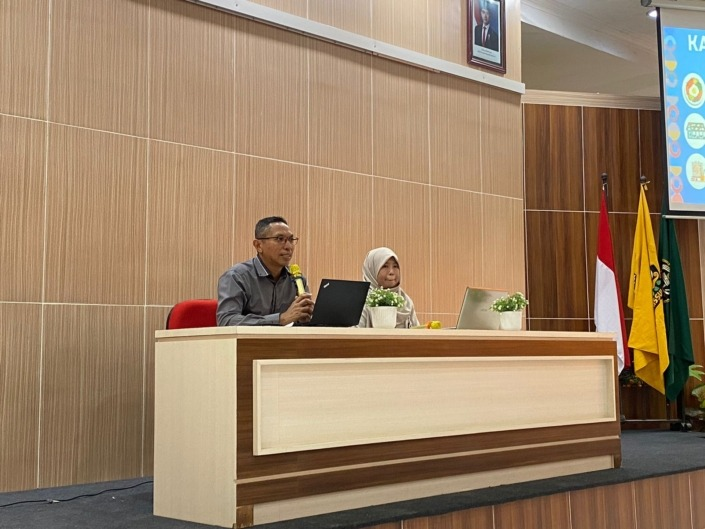
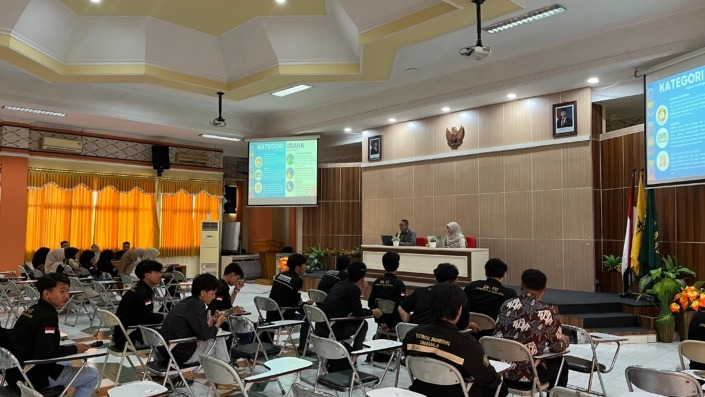
In 2025, the Faculty of Industrial Technology (FTI) of UNISSULA organised training and socialisation for the Program Pembinaan Mahasiswa Wirausaha (P2MW), or Student Entrepreneurship Development Programme.
The activity was held on 22 January 2025 and was organised by FTI’s academic and student-affairs division in cooperation with UNISSULA’s student and alumni development institution.
P2MW is designed to strengthen the entrepreneurship ecosystem in higher education. Importantly, the programme covers both:
- early-stage businesses; and
- growing businesses.
Participants receive entrepreneurship assistance through coaching, mentoring, and business training, providing a structured mechanism through which UNISSULA supports the development of new and growing entrepreneurial ventures.
This programme provides an institutional foundation through which emerging entrepreneurs can develop innovative and sustainability-oriented business ideas.
Developing Ecopreneurs for a Sustainable Economy
UNISSULA also strengthened the sustainability orientation of entrepreneurship through international collaboration.
In January 2025, the Faculty of Economics of UNISSULA and Universiti Teknologi MARA (UiTM), Malaysia, implemented the annual UNISSULA–UiTM CT International Collaborative Program (UUICP 2025) under the theme:
“Ecopreneurs of Tomorrow: Digital Innovations for a Sustainable Future in Indonesia and Malaysia.”
The programme was specifically designed to promote sustainable innovation through digital approaches and to develop a new generation of ecopreneurs capable of addressing global sustainability challenges.
This is significant for low-carbon entrepreneurship because ecopreneurship links entrepreneurial development with environmental responsibility, sustainable innovation, and business models that can contribute to lower-impact economic activities.
Through international seminars, academic collaboration, and knowledge exchange, UNISSULA provides future entrepreneurs with exposure to sustainability-oriented business development and innovation.
From Entrepreneurship to a Low-Carbon Economy
UNISSULA’s entrepreneurship support encourages a transition from conventional business development toward entrepreneurship that considers environmental impacts and sustainability.
Low-carbon entrepreneurship can involve businesses and technologies that:
- reduce fossil-energy dependence;
- use renewable energy;
- improve energy efficiency;
- transform waste into useful resources;
- reduce emissions;
- improve resource efficiency;
- introduce cleaner production technologies; and
- implement circular-economy business models.
The ecopreneurship orientation of UUICP 2025 complements UNISSULA’s broader entrepreneurship mentoring programmes by embedding sustainability into entrepreneurial development.
Direct Assistance for Low-Carbon Enterprise Technology
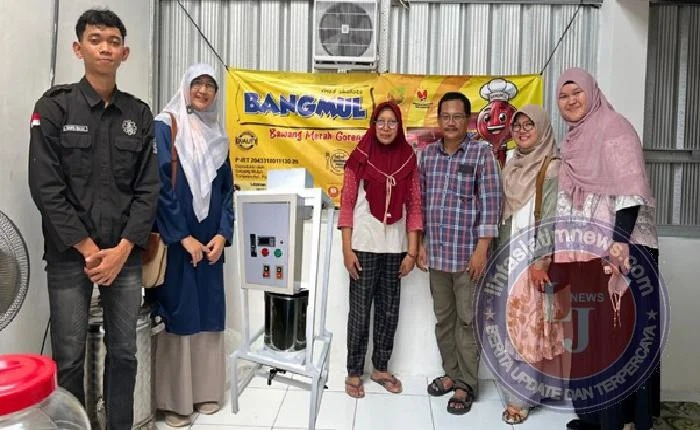
A particularly strong example of UNISSULA’s support for low-carbon economic activity in 2025 was its assistance to small-scale businesses in the fried-shallot industrial centre in Batangan District, Pati Regency.
These businesses generate significant quantities of used cooking oil as a production waste stream.
UNISSULA’s community-service team introduced a technological solution that enables the waste oil to be converted into biodiesel, creating an alternative energy source while reducing environmental pollution.
The university did not merely provide information. It provided direct assistance through:
- biodiesel-production training;
- operational mentoring;
- technology transfer; and
- construction of a small-industry-scale biodiesel reactor.
This represents a practical example of university assistance enabling a local enterprise to adopt low-carbon and circular-economy technology.
Converting Waste into Renewable Fuel
Before the intervention, used cooking oil generated by the local fried-shallot industry was largely discarded or stored without productive use.
The UNISSULA programme demonstrated that this waste could instead become an economically useful energy resource.
The technology converts used cooking oil into biodiesel using a transesterification process developed through UNISSULA research. The resulting biodiesel met the relevant parameters reported against SNI 7182:2015 in the university’s programme documentation.
The intervention therefore creates a transition:
Waste cooking oil → Processing technology → Biodiesel → Alternative energy → Economic value
This links waste management, renewable fuel production, technological innovation, and local enterprise development.
Supporting Circular-Economy Business Development
The biodiesel programme is also relevant to the circular economy because a material previously treated as waste becomes an input for a new productive process.
Instead of following a conventional linear model:
production → waste → disposal
the programme promotes:
production → waste recovery → conversion → renewable fuel → new economic value
The local enterprises can therefore potentially gain two benefits:
- reduced environmental impact from used cooking-oil disposal; and
- new economic opportunities associated with biodiesel production.
UNISSULA reported that the installation of the production unit provides participating enterprises with opportunities to generate additional economic value while reducing environmental pollution.
Research Supporting Low-Carbon Enterprise Development
UNISSULA’s assistance is also supported by research into the technical, environmental, and financial feasibility of biodiesel production from used cooking oil.
A 2025 UNISSULA study analysed used cooking oil from a local fried-shallot SME in Pati as a biodiesel feedstock.
The research examined:
- technical feasibility;
- financial feasibility;
- environmental impacts;
- life-cycle impacts; and
- the potential contribution to sustainable industry.
The study found that converting the waste oil into biodiesel offered environmental advantages compared with direct disposal and supported circular-economy and sustainable-industry principles.
This demonstrates an important feature of UNISSULA’s approach: entrepreneurial support is connected to research-based technological development, rather than being limited to general business training.
Technology Transfer to Emerging and Small Businesses
UNISSULA uses technology transfer as a mechanism for helping enterprises adopt sustainable innovations.
In the biodiesel programme, assistance included both knowledge and physical technology.
The university provided:
- technical knowledge;
- operating guidance;
- production training;
- mentoring;
- research-based processing technology; and
- an operational biodiesel reactor.
This model reduces barriers that small enterprises may otherwise face when attempting to adopt low-carbon technologies.
It also demonstrates how university research can move beyond laboratories and become commercially and environmentally useful technology.
Entrepreneurship Assistance across Different Development Stages
UNISSULA’s 2025 activities support entrepreneurial development across multiple stages.
For early-stage and growing student businesses, P2MW provides coaching, mentoring, and business training.
For sustainability-oriented future entrepreneurs, UUICP 2025 promotes ecopreneurship and sustainable digital innovation.
For existing small businesses transitioning toward cleaner production, the biodiesel programme provides technical assistance, technology transfer, mentoring, and renewable-energy applications.
Together, these activities create an entrepreneurial support ecosystem that can move ideas from business development toward practical low-carbon implementation.
Forms of Assistance Provided by UNISSULA
UNISSULA’s assistance for entrepreneurship and low-carbon innovation in 2025 included:
- entrepreneurship coaching;
- start-up and early-business mentoring;
- business-development training;
- ecopreneurship education;
- international knowledge exchange;
- sustainable-innovation development;
- technical mentoring;
- renewable-energy technology transfer;
- prototype and equipment support;
- applied research;
- circular-economy solutions; and
- support for the commercial and operational application of low-carbon technology.
This combination of business and technological assistance helps emerging ventures translate sustainable ideas into practical activities.
Contribution to a Low-Carbon Economy
The programmes support a low-carbon economy through several pathways.
Renewable energy: Used cooking oil is converted into biodiesel as an alternative energy source.
Circular economy: Production waste is converted into a resource with economic value.
Cleaner production: Businesses are assisted in reducing harmful waste disposal.
Sustainable entrepreneurship: Students and future entrepreneurs are encouraged to develop sustainability-oriented businesses.
Technology transfer: Research-based low-carbon technology is transferred from the university to enterprises.
Economic opportunity: Environmentally beneficial activities are connected with new potential sources of income.
These characteristics demonstrate that environmental sustainability and economic development can be pursued together.
International Dimension of Sustainable Entrepreneurship
The collaboration with UiTM Malaysia further expands the programme beyond the local level.
Through the “Ecopreneurs of Tomorrow” programme, UNISSULA and UiTM seek to develop entrepreneurs capable of responding to sustainability challenges in both Indonesia and Malaysia.
The programme emphasises digital innovation and sustainable development and is intended to help build a generation of ecopreneurs prepared for global sustainability challenges.
This provides an international knowledge environment for sustainability-oriented entrepreneurship while complementing UNISSULA’s local technology-transfer activities.
Linking University Innovation with Entrepreneurial Development
UNISSULA’s model can therefore be represented as:
University research and expertise
↓
Entrepreneurship training and mentoring
↓
Ecopreneurship and sustainable innovation
↓
Technology transfer
↓
Business application
↓
Low-carbon and circular economy
This model helps connect education, research, entrepreneurship, and sustainability.
Contribution to SDG 7
These activities contribute to SDG 7: Affordable and Clean Energy by supporting entrepreneurial activity related to renewable energy and low-carbon technologies.
In particular, the biodiesel programme demonstrates how university assistance can enable small enterprises to use waste-derived renewable fuel technology.
The wider entrepreneurship programmes help create the human and business capacity needed to develop further sustainability-oriented ventures.
The programmes also contribute to related sustainability objectives, particularly responsible production, innovation, circular economy, and climate mitigation.