

















7.4.1 Local Community Programmes for Energy Efficiency and Clean Energy at UNISSULA
Community Learning on Energy Efficiency and Clean Energy
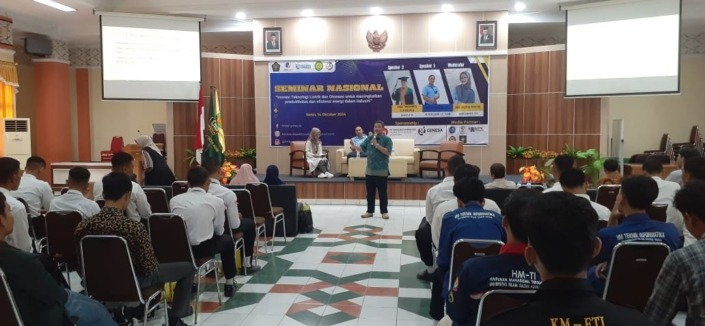
Universitas Islam Sultan Agung (UNISSULA) provides programmes and applied learning activities that introduce communities outside the university to the importance and practical application of energy efficiency, renewable energy, and clean-energy technologies.
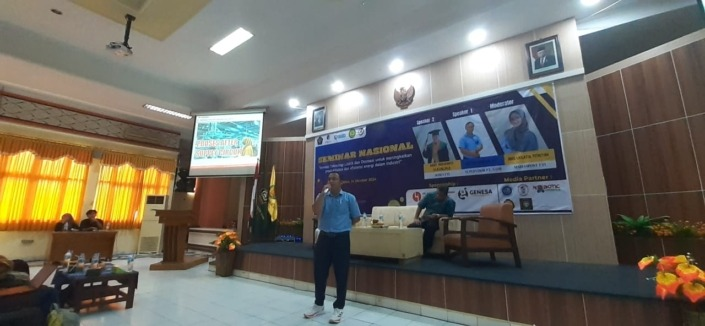
In 2025, these activities included the field application and demonstration of solar-powered technologies for agriculture as well as renewable-energy learning applications in schools. Through these programmes, UNISSULA connects university research and technological innovation with practical learning opportunities for farmers, students, schools, and other community stakeholders.
The programmes demonstrate that clean energy can be applied not only at university facilities but also in agriculture, education, and everyday community activities.
Floating Solar PV for Agricultural Irrigation
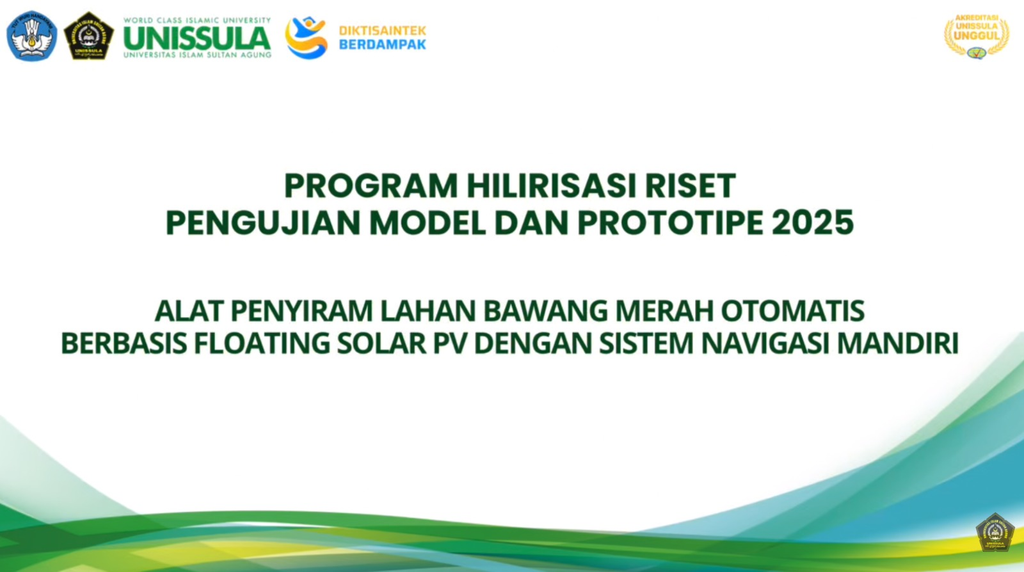
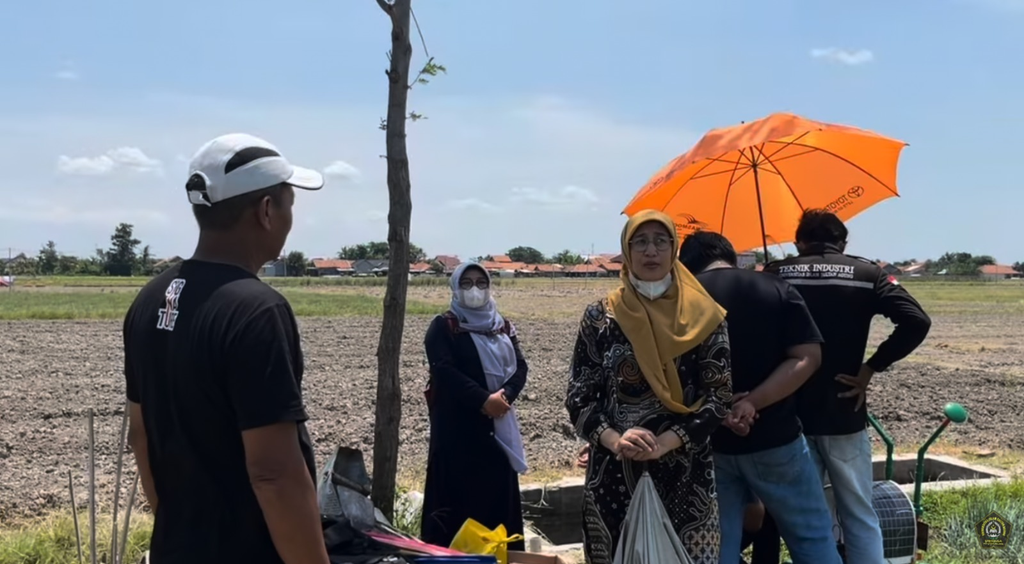
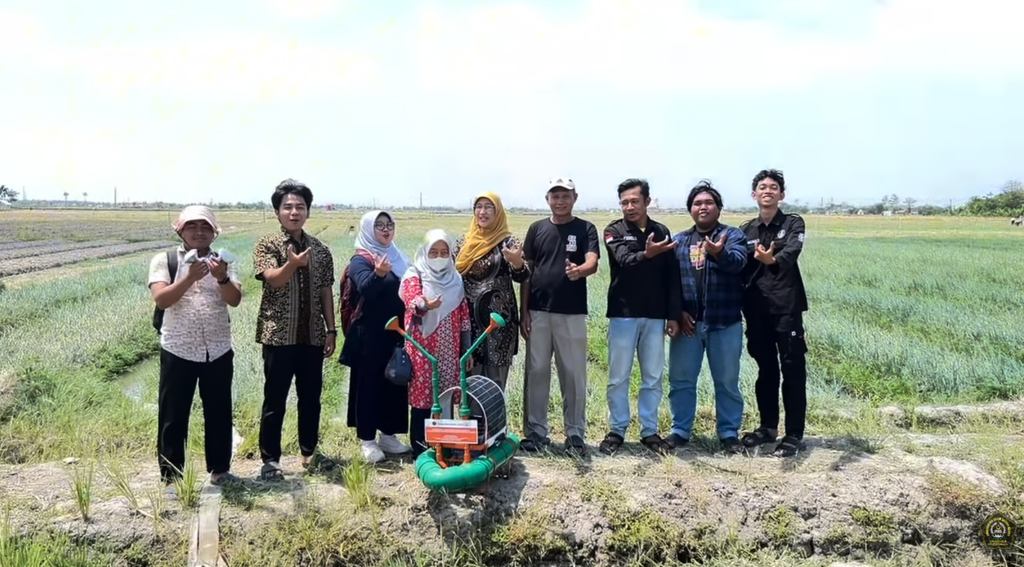
One of UNISSULA’s 2025 clean-energy initiatives was the Research Downstreaming Programme for Model and Prototype Testing (Program Hilirisasi Riset Pengujian Model dan Prototipe 2025).
The programme developed and tested an:
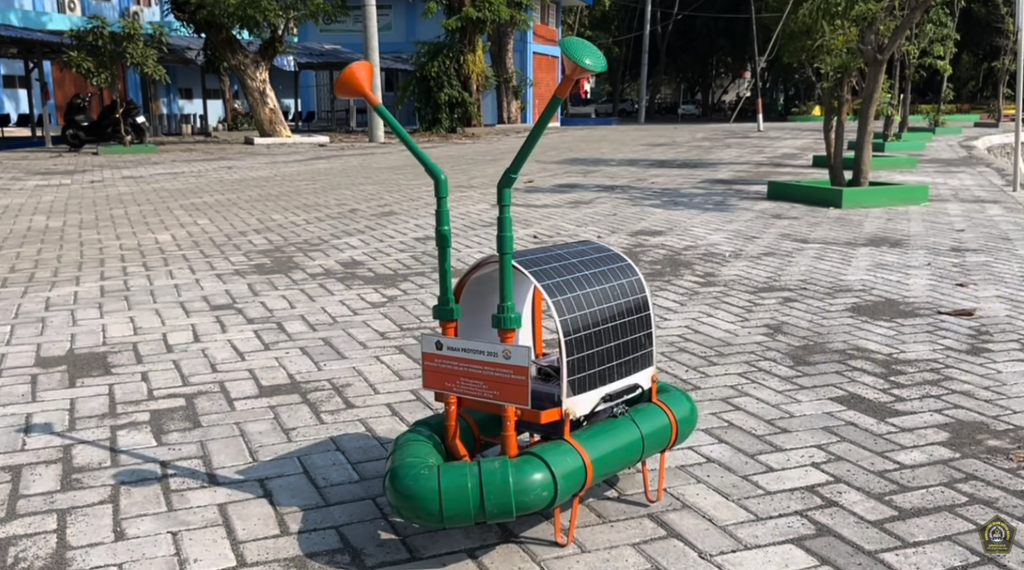
Automatic Shallot Field Irrigation System Based on Floating Solar PV with an Autonomous Navigation System.
The technology uses solar photovoltaic energy as part of an automated agricultural irrigation system.
Through field testing and demonstration in an agricultural environment, the programme provides a practical example of how renewable energy can support agricultural activities while reducing dependence on conventional electricity or fossil-fuel-based energy sources.
The programme connects several sustainability concepts:
- solar photovoltaic energy;
- efficient use of energy in agricultural operations;
- automation of irrigation;
- efficient use of resources;
- application of clean technology in farming; and
- practical implementation of renewable-energy research.
The field implementation also creates opportunities for agricultural stakeholders to observe how solar-powered technology can be applied directly to farming operations.
Clean Energy as a Practical Learning Experience
UNISSULA’s approach to community clean-energy education is based not only on lectures or theoretical explanations, but also on technology demonstration and practical implementation.
In the floating solar PV irrigation programme, renewable energy is demonstrated through a functioning technology that converts solar energy into useful power for agricultural applications.
This allows participants and community stakeholders to understand the relationship between:
solar energy → electricity generation → automated equipment → efficient agricultural operation
Such practical exposure helps communicate the value of renewable energy in a form that can be directly connected to community needs.
Solar-Powered Hydroponic Learning at SMAN 12 Palembang
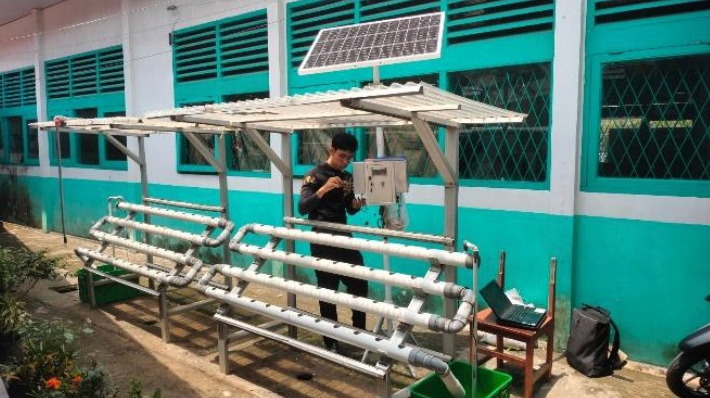
UNISSULA also developed the TANI-V1 automatic hydroponic system at SMAN 12 Palembang.
The system was designed and developed using renewable energy from a solar power system together with microcontroller-based automation. It uses a 100 WP monocrystalline solar panel and a 12 V 5 Ah battery as the main power supply for sensors, microcontrollers, and other system components.
The system combines:
- solar photovoltaic energy;
- hydroponic agriculture;
- automated water management;
- environmental sensors;
- microcontrollers;
- Internet of Things technology; and
- digital monitoring.
The research explicitly identifies TANI-V1 as having the potential to become a practical learning medium for students to understand the application of renewable energy and IoT-based automation.
Learning About How Solar Energy Works
The TANI-V1 programme provides students with a practical example of how solar energy can replace or reduce reliance on conventional sources for selected electrical loads.
The system uses a semi-off-grid architecture in which a 100 WP solar panel charges a battery through a solar charge controller. The stored energy supplies low-power equipment such as sensors and microcontrollers, while heavier loads are managed separately.
This provides an educational environment in which students can learn about:
- photovoltaic energy conversion;
- batteries and energy storage;
- efficient electricity use;
- renewable-energy integration;
- automated energy management; and
- the relationship between clean energy and modern agriculture.
Energy Efficiency Through Low-Power Technology
The TANI-V1 system also demonstrates the importance of energy efficiency.
The measured power demand of the control system is relatively low, with the system consuming approximately 5 watts.
This provides a practical example of how an automated system can perform monitoring and control functions while maintaining low electricity consumption.
The project therefore introduces students not only to renewable energy, but also to the principle that technology should be designed to use energy efficiently.
Renewable Energy as an Educational Tool
The TANI-V1 implementation demonstrates how renewable energy can serve simultaneously as:
- an energy source;
- an educational technology;
- an agricultural innovation; and
- a sustainability learning platform.
The published study concludes that the system operates using solar energy, consumes only around 5 watts, and provides an environmentally friendly and educational example of renewable-energy technology in a school environment.
This makes the project particularly relevant to community learning because students can see renewable-energy technology operating directly within their own educational environment.
Linking Research with Community Application
UNISSULA uses research downstreaming to bring university-developed technology into settings where it can be observed and used by communities.
The 2025 floating solar PV irrigation programme demonstrates renewable-energy applications in agriculture, while TANI-V1 demonstrates renewable energy and efficient technology in a school environment.
Together, these activities show a broader approach:
research → prototype development → field implementation → demonstration → community learning
Through this process, clean-energy concepts are translated from academic research into technologies that can be understood through direct application.
Topics Communicated Through the Programmes
The programmes help external communities understand several important clean-energy concepts, including:
- the importance of reducing dependence on conventional energy sources;
- the role of solar photovoltaic technology as a renewable-energy source;
- the use of efficient electrical systems;
- the integration of renewable energy with agriculture;
- the use of automation to reduce unnecessary resource consumption;
- the role of energy storage and batteries; and
- the potential of clean-energy technology to support sustainable community activities.
These topics help participants see energy efficiency and clean energy as practical solutions rather than purely theoretical concepts.
Practical Benefits for Communities
For agricultural communities, solar-powered technologies offer the potential to support irrigation and other activities using renewable energy.
For schools, technologies such as TANI-V1 provide students with direct exposure to solar panels, batteries, sensors, automation, and energy-efficient system design.
The programmes therefore strengthen public understanding of clean energy through applications that are connected to real community needs.