









1.3.1 Bottom financial quintile admission target
Universitas Islam Sultan Agung (UNISSULA) consistently demonstrates its commitment to ensuring inclusive and equitable access to higher education for all members of society, particularly students from low-income and economically disadvantaged households. As part of its commitment to widening participation in higher education, UNISSULA provides dedicated admission pathways and financial support mechanisms designed to enable academically qualified students to pursue university education regardless of their socioeconomic background.
This commitment is primarily implemented through the Kartu Indonesia Pintar Kuliah (KIP-Kuliah) admission pathway, a national higher education assistance programme specifically intended for students with strong academic potential who face financial constraints. UNISSULA has consistently participated in the KIP-Kuliah programme and provides a dedicated admission route for eligible prospective students. For the 2026/2027 academic year, UNISSULA opened the KIP-Kuliah pathway across a wide range of undergraduate and diploma programmes, providing successful recipients with tuition support as well as monthly living-cost assistance.
Eligibility for the programme prioritises students whose economic circumstances can be demonstrated through recognised national social protection mechanisms, including the Kartu Indonesia Pintar (KIP), Program Keluarga Harapan (PKH), Kartu Keluarga Sejahtera (KKS), students from orphanages or social institutions, as well as other applicants who can provide valid evidence of financial hardship. This mechanism enables UNISSULA to specifically identify and support prospective students from economically vulnerable households rather than relying solely on general admissions processes.
UNISSULA also demonstrates institutional transparency in implementing this affirmative admission policy. Selection results for KIP-Kuliah recipients are publicly announced through the university and admissions websites, including staged announcements for the 2026/2027 academic year following formal selection meetings conducted by the university’s new student admission committee.
Beyond the national KIP-Kuliah programme, UNISSULA further supports widening access through university-based scholarship and tuition-relief schemes targeted at economically vulnerable groups, including children of labourers, farmers, fishermen, and dhuafa families. Together, these initiatives demonstrate UNISSULA’s sustained commitment to reducing financial barriers to higher education and expanding opportunities for students from low-income backgrounds.
Lalu nanti disini bisa ditempel SK keputusan rektor unissula daftar penetapan mahasiswa penerima KIP kuliah
In 2025, UNISSULA provided financial assistance to [X] students from low-income households out of a total student population of [Y], demonstrating measurable progress toward the university’s target for supporting students from the bottom financial quintile.”
Universitas Islam Sultan Agung (UNISSULA) demonstrates its commitment to supporting students from low-income and economically disadvantaged backgrounds through a range of financial assistance and scholarship schemes. These programmes are intended to reduce financial barriers to higher education and ensure that students with limited economic resources are able to access, continue, and successfully complete their studies at the university.
One of the primary forms of financial support is the Kartu Indonesia Pintar Kuliah (KIP-Kuliah) programme. Through this programme, eligible UNISSULA students from economically disadvantaged families receive support covering tuition fees as well as living-cost assistance provided under the national KIP-Kuliah scheme. UNISSULA provides a dedicated KIP-Kuliah admission pathway through its new student admission system and regularly announces the results of the selection process through the university’s official website. This demonstrates that financial support for low-income students is implemented through a structured, transparent, and recurring mechanism.
In addition to KIP-Kuliah, UNISSULA provides and facilitates various other scholarship and tuition-support schemes to broaden educational opportunities for students from different socioeconomic backgrounds. University scholarship initiatives have included support for students from dhuafa families as well as children of labourers, farmers, and fishermen. These targeted forms of assistance strengthen UNISSULA’s commitment to ensuring that household economic circumstances do not become a barrier to participation in higher education.
UNISSULA also supports students’ participation in academic and community engagement activities as an integral part of the educational process. Through programmes such as Kuliah Kerja Nyata (KKN) Tematik, students are provided with an organised framework for undertaking community-based learning and service activities. The university coordinates student participation, field supervision, monitoring, evaluation, and academic recognition of KKN activities, enabling students from different financial backgrounds to participate within an institutionally managed academic programme.
Student well-being is also incorporated into UNISSULA’s student admission and support processes. For example, KIP-Kuliah recipients are required to provide evidence of BPJS Kesehatan or other health insurance coverage during registration and are facilitated to undertake relevant health examinations through health services within the Sultan Agung ecosystem. These measures contribute to ensuring that students, including those from economically vulnerable backgrounds, have access to appropriate health protection and support while pursuing their education.
Furthermore, information on scholarships and financial assistance is made accessible through UNISSULA’s official New Student Admission (PMB) platform and university websites. The system provides information on scholarship pathways, including KIP-Kuliah and other scholarship opportunities, as well as registration procedures and selection announcements. The availability of these digital services supports a more transparent and structured process for identifying, selecting, and assisting eligible students.
Through these combined mechanisms, UNISSULA seeks not only to provide access to higher education but also to establish a broader support environment that helps economically disadvantaged students remain engaged in their studies. The combination of targeted admissions, tuition assistance, living-cost support, scholarship programmes, student services, health protection requirements, and institutionally managed academic activities reflects UNISSULA’s continuing commitment to inclusive and equitable higher education, particularly for students from low-income households.
KIP Kuliah Scholarship
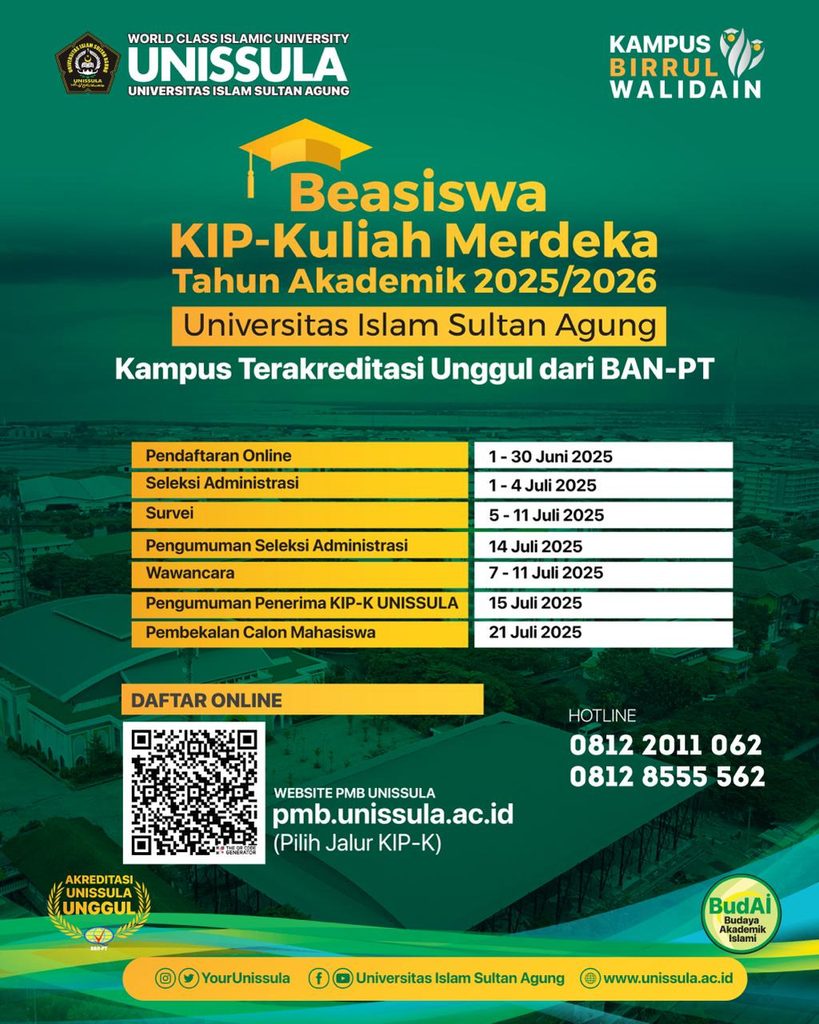
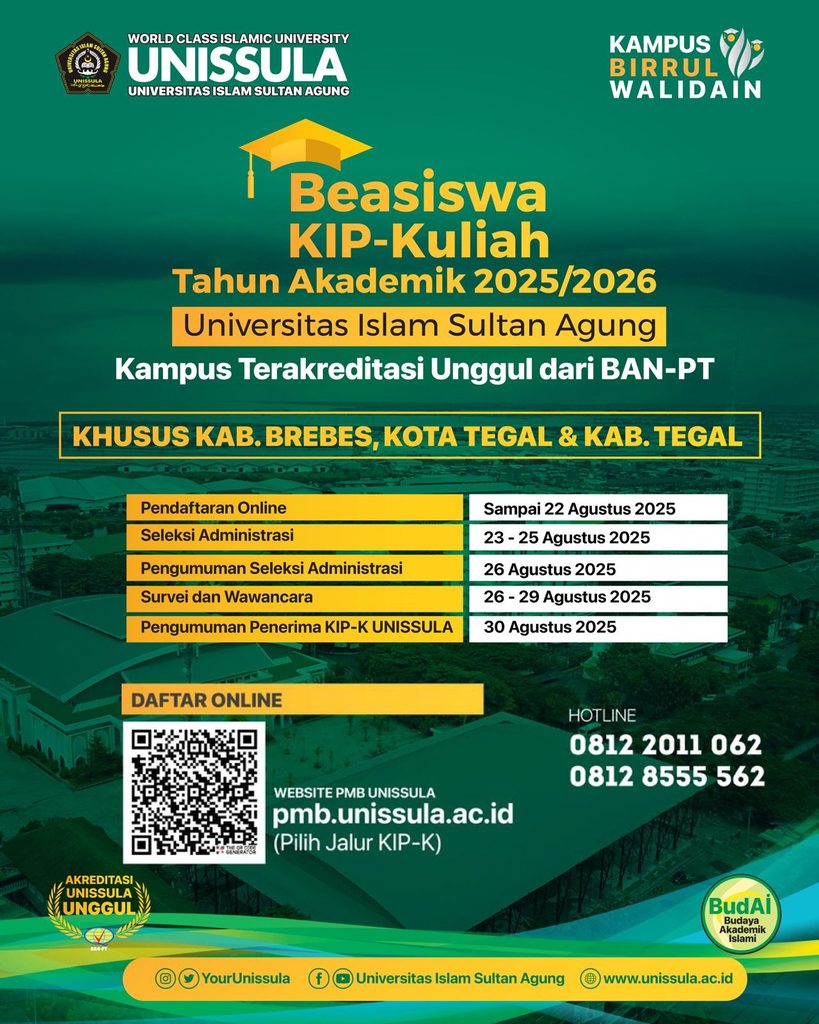
Universitas Islam Sultan Agung (UNISSULA) also implements the Kartu Indonesia Pintar (KIP) Kuliah Scholarship, a government-funded financial assistance programme intended to support students from low-income and economically disadvantaged families. The programme is implemented through a dedicated admission and selection process for eligible prospective students and continues to serve as one of UNISSULA’s main mechanisms for expanding equitable access to higher education.
Through the KIP Kuliah programme, verified recipients receive financial assistance in the form of tuition support and living-cost allowances in accordance with applicable government regulations. This support helps reduce the financial burden faced by students from economically vulnerable households and enables them to continue their studies without being hindered by tuition and basic living expenses.
By consistently participating in and implementing the KIP Kuliah programme, UNISSULA reinforces its commitment to ensuring that students from low-income households, including those within the bottom financial quintile, have greater opportunities to access, participate in, and successfully complete higher education.
Source :
Regular Admission Pathway with 50% DPI Discount
Universitas Islam Sultan Agung (UNISSULA) provides a Regular Admission Pathway with a 50% discount on the Institutional Development Fee (Dana Pengembangan Institusi/DPI) as part of its effort to improve affordability and widen access to higher education. This financial incentive is available to eligible prospective students who register through the regular admission scheme in accordance with the university’s admission policies and applicable terms and conditions.
The 50% DPI discount is designed to reduce the initial financial burden associated with university enrolment, particularly for families who may face constraints in meeting upfront education costs. By lowering a significant component of the admission fee, UNISSULA enables a broader range of prospective students to consider and access higher education opportunities.
This initiative complements UNISSULA’s broader financial support framework, including scholarships and other tuition assistance schemes. Through the provision of admission fee reductions under the regular pathway, UNISSULA demonstrates its commitment to creating a more inclusive and accessible admissions system while supporting students from diverse socioeconomic backgrounds.
Source :
Independent Achievement Admission Pathway with 50% DPI Discount
Universitas Islam Sultan Agung (UNISSULA) provides an Independent Achievement Admission Pathway for prospective students who demonstrate outstanding academic or non-academic achievements. This pathway is designed to recognise student potential while providing greater opportunities for high-achieving applicants to access higher education at UNISSULA.
As part of this admission scheme, eligible applicants receive a 50% discount on the Institutional Development Fee (Dana Pengembangan Institusi/DPI). The reduction in DPI helps lower the initial financial burden of university enrolment and makes higher education more accessible for talented students from diverse socioeconomic backgrounds.
The Independent Achievement Admission Pathway reflects UNISSULA’s commitment to combining merit-based admission with financial support. By recognising student achievement and providing a substantial reduction in admission-related costs, UNISSULA encourages talented prospective students to continue their education without being disproportionately constrained by financial considerations.
This initiative complements UNISSULA’s wider range of scholarship, tuition assistance, and admission support programmes, strengthening the university’s commitment to inclusive, equitable, and merit-based access to higher education.
Source :
Hafiz and Hafidzah Scholarship
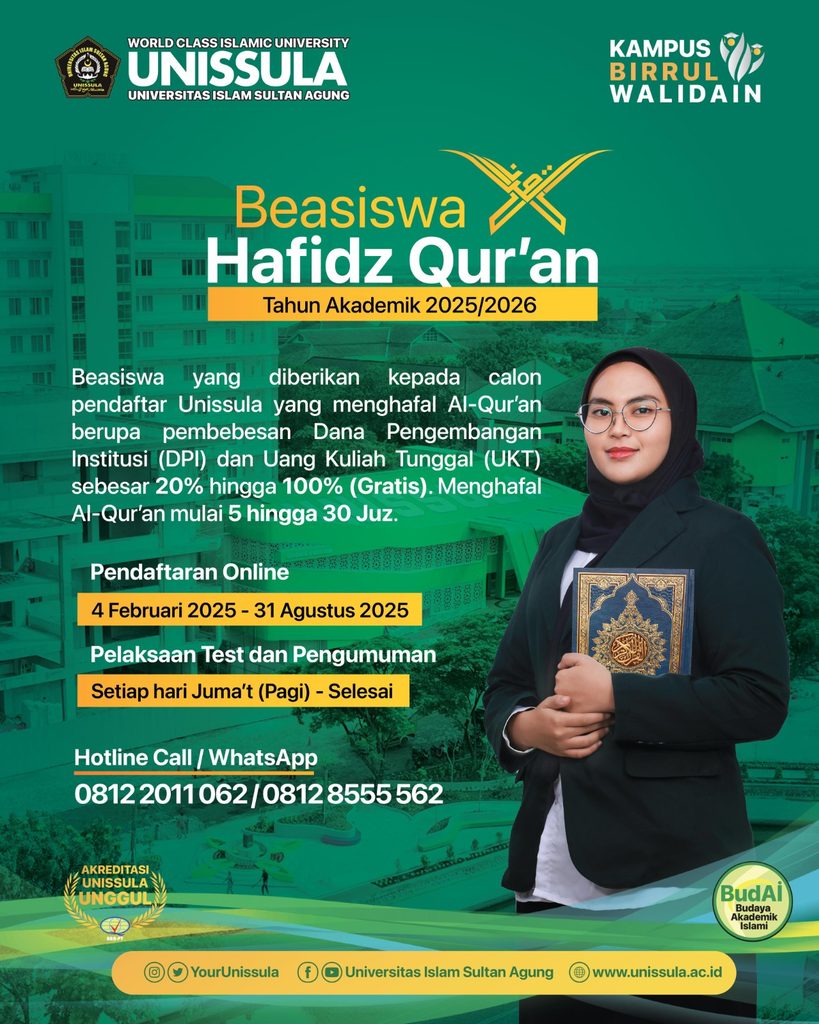
Universitas Islam Sultan Agung (UNISSULA) provides the Hafiz and Hafidzah Al-Qur’an Scholarship as part of its commitment to widening access to higher education while recognising prospective students who have demonstrated outstanding achievement in memorising the Qur’an. The programme provides a dedicated scholarship pathway for male and female Qur’an memorisers who meet the university’s admission and tahfidz selection requirements.
Through this scholarship programme, eligible prospective students receive significant financial support to reduce the cost of entering and continuing higher education. UNISSULA provides a 100% exemption from the Institutional Development Fee (Dana Pengembangan Institusi/DPI) for students admitted through the Hafidz Al-Qur’an Scholarship programme.
The scholarship is available to prospective students with demonstrated Qur’an memorisation ability. Applicants are required to provide evidence of their memorisation and participate in a tahfidz selection process. Scholarship support may also be differentiated according to the number of juz memorised, thereby recognising different levels of achievement while providing opportunities for Qur’an memorisers to pursue university education. UNISSULA information indicates that prospective students with memorisation starting from five juz may apply, subject to the applicable selection requirements.
The programme is implemented as a structured component of UNISSULA’s new student admission process. Selection results for the 2026/2027 academic year, for example, were formally determined through a university admission selection meeting involving university leaders, faculty representatives, and the New Student Admission Committee and were publicly announced through the official UNISSULA admission website.
Through the Hafiz and Hafidzah Scholarship, UNISSULA combines merit-based recognition with financial assistance, helping reduce financial barriers for talented prospective students and broadening opportunities to access higher education. The initiative also reflects UNISSULA’s institutional identity as an Islamic university by supporting the development of academically capable graduates who maintain strong Qur’anic values and contribute positively to society.
Source :