

















1.3.4 Bottom Financial Quintile Student Support
Universitas Islam Sultan Agung (UNISSULA) provides targeted programmes and initiatives to support students from the bottom 20% of household income groups, or more tightly defined poverty-based categories, in successfully completing their university studies.
These initiatives combine financial assistance, scholarship-recipient communities, academic monitoring, counselling, peer support, mentoring, and student-development mechanisms designed to reduce the risk that poverty-related difficulties lead to delayed academic progression, interruption of study, or withdrawal from university.
Target Population
UNISSULA’s bottom-financial-quintile student-support initiatives focus on students whose socioeconomic circumstances place them within the lowest-income or poverty-affected groups, including:
- students within the bottom 20% of household income groups;
- students falling within more tightly defined poverty-based categories;
- KIP Kuliah recipients who meet economic eligibility requirements;
- students identified through nationally recognised poverty and social-protection criteria; and
- students with documented serious financial disadvantage.
This targeted approach helps ensure that support is directed toward students whose ability to continue and complete higher education may be affected by financial hardship or poverty-related barriers.
FORBISA UNISSULA – Peer and Scholarship Recipient Support
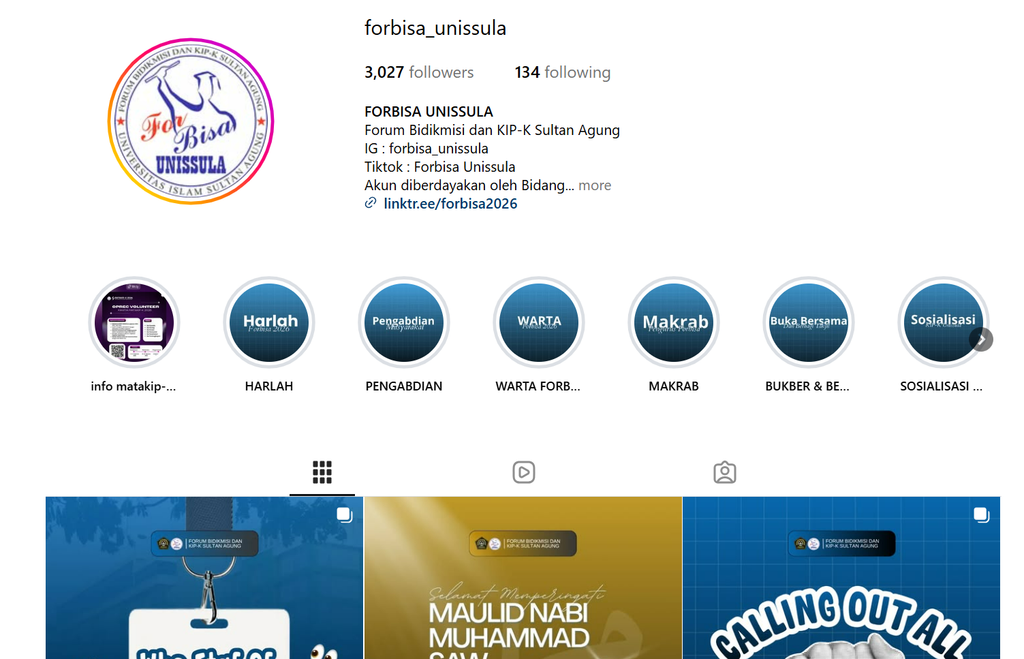
One of the key initiatives supporting economically disadvantaged students is FORBISA UNISSULA, a student community that brings together scholarship recipients, including students supported through KIP Kuliah and related financial-assistance schemes.
FORBISA provides a structured environment for:
- scholarship information sharing;
- peer support;
- motivation and encouragement;
- communication among scholarship recipients;
- mutual assistance;
- social inclusion; and
- student engagement.
Through FORBISA, students from financially disadvantaged backgrounds can build peer-support networks, exchange information about scholarship requirements and university activities, and receive encouragement throughout their studies.
This support is particularly important for students from the bottom financial quintile because financial hardship may be accompanied by academic, social, and psychological pressures that can affect study continuity and academic progression.
FORBISA therefore serves as a complementary support mechanism alongside formal financial assistance by strengthening students’ sense of community, access to information, and engagement with university life.
Academic Monitoring and Counselling
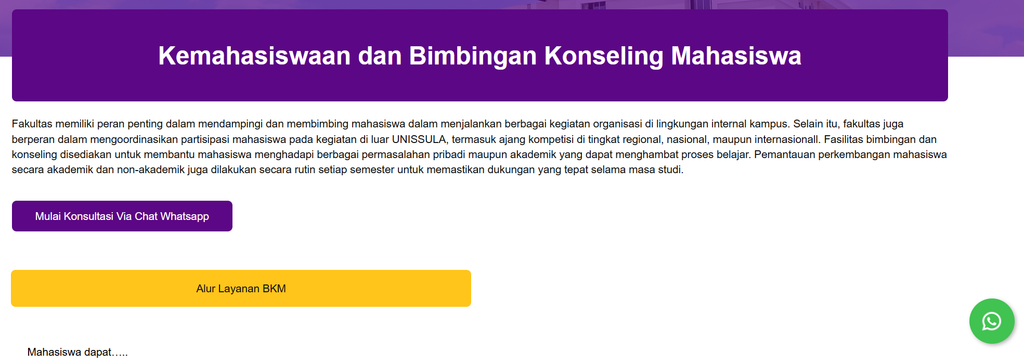
UNISSULA complements financial and peer support with structured academic guidance and counselling mechanisms.
Students have access to academic and personal counselling through available institutional consultation channels, including direct consultation and accessible communication services.
Academic and non-academic development is also monitored periodically, including through semester-based academic monitoring. This enables faculties, study programmes, and academic advisors to identify students experiencing difficulties and provide appropriate guidance before those difficulties significantly affect academic progression.
For students from the bottom 20% of household income groups or more tightly defined poverty-based categories, these mechanisms provide an additional safeguard against interruption of study
Financial Support for Completion
Students from economically disadvantaged backgrounds are also supported through a range of financial-assistance mechanisms, including:
- KIP Kuliah tuition assistance;
- KIP Kuliah living-cost assistance;
- LAZIS Sultan Agung support;
- Khaira Ummah Scholarship;
- institutional fee relief; and
- other poverty-targeted financial-support mechanisms.
In 2025, UNISSULA formally continued financial assistance for 1,074 KIP Kuliah beneficiaries from the 2022, 2023, and 2024 student cohorts, as established under Rector Decree No. 6683/F/SA/VIII/2025, dated 14 August 2025. The decree confirms the continuation of tuition and living-cost assistance during the odd semester of the 2025/2026 academic year, supporting student retention and academic progression.
These forms of assistance reduce the financial pressures that could otherwise prevent students from maintaining active enrolment, meeting essential educational and living costs, and successfully completing their degrees.
Financial support is therefore integrated with broader academic and student-support initiatives rather than being limited to initial access to university.
Mentoring and Student-Development Support
UNISSULA also provides mentoring, referral, follow-up, and student-development mechanisms to support students who experience academic, personal, social, or financial difficulties.
These mechanisms are intended to help students access appropriate assistance and remain engaged with their academic responsibilities.
For students from low-income backgrounds, mentoring and follow-up support can complement financial assistance by helping them address non-financial barriers that may affect academic performance or study continuity.
Supporting Successful Completion
UNISSULA recognises that students affected by poverty require continued support throughout their academic journey, not only at the point of admission.
By combining financial aid, scholarship-recipient communities, peer support, counselling, academic monitoring, mentoring, and student-development mechanisms, UNISSULA provides targeted support for students from the bottom 20% of household income groups or more tightly defined poverty-based categories.
These initiatives are designed to help students:
- remain actively enrolled;
- maintain satisfactory academic progress;
- access appropriate academic and personal support;
- overcome poverty-related financial and non-financial barriers; and
- successfully complete their university education.
Through this integrated approach, UNISSULA strengthens the continuity of support from admission through to successful graduation.
Evidence of Implementation
UNISSULA’s bottom-financial-quintile student-support framework is demonstrated through the following institutional mechanisms:
- FORBISA UNISSULA, providing peer support, scholarship information, motivation, communication, and mutual assistance for scholarship recipients.
- KIP Kuliah financial and living-cost assistance for economically disadvantaged students.
- LAZIS Sultan Agung and Khaira Ummah Scholarship support for students experiencing financial disadvantage.
- Academic advising and semester-based academic monitoring to support continued academic progression.
- Guidance and counselling services, including accessible consultation channels for academic and personal support.
- Student mentoring, referral, follow-up, and student-development mechanisms designed to address academic and non-academic difficulties.
- Institutional support mechanisms designed to help students from the bottom 20% of household income groups, or more tightly defined poverty-based categories, remain enrolled, progress academically, and successfully complete their studies