







17.2.1 UNISSULA Contributes to National SDG Policy Development Through Legislative Recommendations, Government Collaboration and Evidence-Based Public Policy Initiatives
Institutional Commitment to Sustainable Development Policy
Universitas Islam Sultan Agung (UNISSULA) actively supports sustainable development through academic contributions to public policy, institutional cooperation, applied research, and engagement with government institutions.
As part of its commitment to the United Nations Sustainable Development Goals (SDGs), UNISSULA connects academic expertise with the identification of development challenges, the discussion of policy alternatives, the formulation of recommendations, and the monitoring of public development programmes.
During 2025, these contributions were demonstrated through direct engagement with national legislative institutions, cooperation with government agencies, and university participation in initiatives relevant to public-sector decision-making.
One of the university’s most significant contributions was its collaboration with the Regional Representative Council of the Republic of Indonesia (DPD RI) in reviewing national legislative priorities and providing academic recommendations for legal and institutional reform.
This engagement was complemented by university involvement in housing assistance verification, competition policy discussions, and legal policy cooperation.
Direct Academic Contributions to National Legislative Policy Development with DPD RI
On 16 October 2025, the Faculty of Law of UNISSULA collaborated with the Regional Representative Council of the Republic of Indonesia (Dewan Perwakilan Daerah – DPD RI) to organise a Focus Group Discussion (FGD) at the UNISSULA campus in Semarang.
The forum focused on empirical studies supporting the 2026 Priority National Legislative Programme (Prolegnas) and the 2025–2029 Medium-Term National Legislative Programme proposed by DPD RI.
The activity brought together national legislative representatives, legal academics, and experts to examine legislative priorities and the challenges associated with Indonesia’s lawmaking process.
The collaboration represented direct academic participation in national government policy development.
Objectives of the Legislative Policy Discussion
The discussion examined:
- Challenges in the implementation and follow-up of legislative proposals submitted by DPD RI.
- The effectiveness of national legislative priorities in responding to public needs.
- Institutional coordination and the legislative responsibilities of national government bodies.
- Academic and empirical perspectives on proposed legislation.
- Recommendations for strengthening the national legislative framework.
The discussion involved Dr. H. Abdul Kholik, Chair of the Legislative Drafting Committee of DPD RI, and Professor Jawade Hafidz, Dean of the Faculty of Law of UNISSULA, together with legal experts and legislative policy advisers.
The forum provided a mechanism for incorporating university expertise into deliberations concerning national legislative priorities.
UNISSULA’s Direct Policy Recommendation: Asset Forfeiture Legislation
During the discussion, Professor Jawade Hafidz emphasised the importance of progressing the proposed Asset Forfeiture Bill (Rancangan Undang-Undang Perampasan Aset).
He recommended that the national legislative institutions advance the bill as part of efforts to strengthen the legal framework for addressing corruption and protecting public assets.
The recommendation was relevant to governance, accountability, the rule of law, and the strengthening of public institutions.
These objectives contribute to SDG 16 – Peace, Justice and Strong Institutions, particularly efforts to strengthen effective, accountable, and transparent institutions.
UNISSULA’s Direct Policy Recommendation: Regional-Owned Enterprises
Professor Jawade Hafidz also raised the importance of legislation concerning Regional-Owned Enterprises (Badan Usaha Milik Daerah – BUMD).
He highlighted challenges associated with coordination and governance among regional institutions and the potential consequences for communities.
UNISSULA’s academic input addressed the need to strengthen the legal and institutional arrangements governing regional enterprises.
This recommendation is relevant to improving public-sector governance, strengthening regional development institutions, and supporting more effective economic administration.
It also connects to SDG 8 – Decent Work and Economic Growth, SDG 11 – Sustainable Cities and Communities, and SDG 16 – Peace, Justice and Strong Institutions.
Contribution to National Policy Development
The DPD RI–UNISSULA forum is particularly significant because UNISSULA did not participate solely as an observer.

Through its Faculty of Law, the university contributed identifiable academic recommendations concerning specific national legislative priorities.
These contributions demonstrate the university’s role in identifying governance challenges and providing policy input directly to a national legislative institution.
Public Evidence:
DPD RI Gandeng Unissula Bahas Prolegnas, Dorong DPR Sahkan UU Perampasan Aset, Sorot Indonesia, October 2025.
Bahas Prolegnas, DPD RI Minta Masukan Unissula, Radio Republik Indonesia, 16 October 2025.
https://rri.co.id/semarang/regional/1905973/bahas-prolegnas-dpd-ri-minta-masukan-unissula
DPD RI Gandeng Unissula Bahas Prolegnas, Dorong DPR Sahkan UU Perampasan Aset, NU Online Jawa Tengah, 17 October 2025.
Supporting Evidence-Based Housing Policy Through Verification of Inadequate Housing
On 26 May 2025, UNISSULA announced the deployment of 1,685 students through its Community Service Programme (Kuliah Kerja Nyata – KKN) to support the verification of housing assistance beneficiaries in Sayung and Mranggen, Demak Regency.
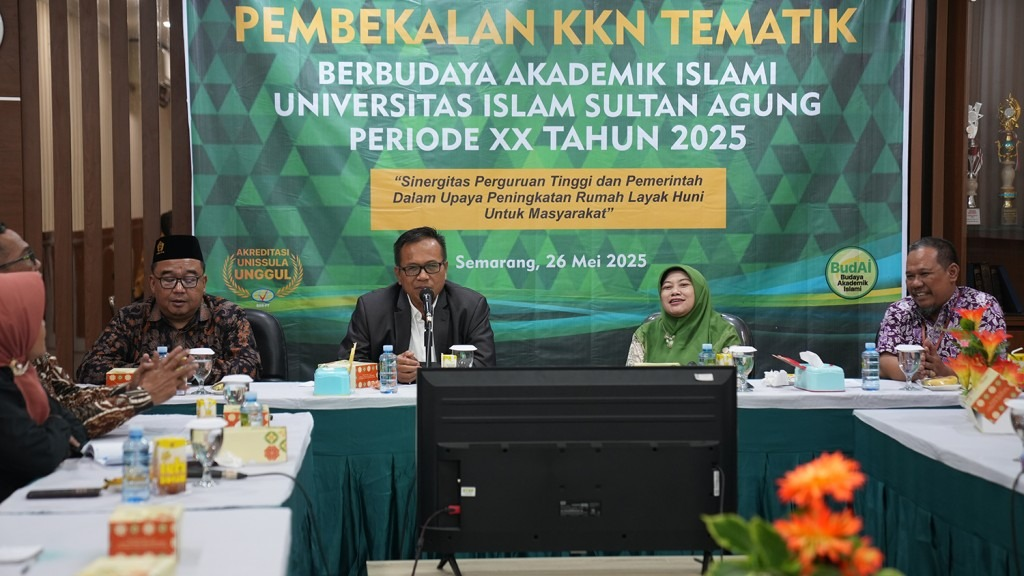
The activity was undertaken in cooperation with the Central Java Provincial Government and the provincial housing and settlement agency.
The initiative focused on the verification of households identified as living in inadequate housing conditions (Rumah Tidak Layak Huni – RTLH).
The verification activities were intended to help ensure that public housing improvement assistance reached eligible beneficiaries.
The programme supported the Central Java Government’s wider housing improvement initiative, which targeted 17,000 housing renovations during 2025.
Identifying Development Challenges
Accurate beneficiary data are essential for ensuring that housing assistance programmes reach households experiencing inadequate living conditions.
Through the involvement of students and academic supervisors, UNISSULA supported the verification process and the identification of potential targeting problems.
This activity contributed to the information-gathering and monitoring aspects of public development programmes.
Supporting Targeted Public Interventions
The collaboration demonstrated how university resources can support government agencies in gathering field-level information relevant to public interventions.
The activity was particularly relevant to SDG 1 – No Poverty and SDG 11 – Sustainable Cities and Communities, including the objective of improving access to adequate housing.
The university’s contribution supported the implementation and monitoring of housing assistance. The publicly available documentation does not establish that UNISSULA independently formulated the provincial housing policy.
Public Evidence:
Agar Tepat Sasaran Unissula Terjunkan 1685 Mahasiswa Bantu Verifikasi RTLH, UNISSULA, 26 May 2025.
Supporting National Competition Policy Development with KPPU
UNISSULA also strengthened its institutional engagement with the Indonesian Competition Commission (Komisi Pengawas Persaingan Usaha – KPPU) during 2025.

On 5 March 2025, UNISSULA and KPPU signed a Memorandum of Understanding establishing a framework for cooperation concerning business competition, partnership supervision, legal issues, education, research, and community engagement.
The agreement was recorded under:
- KPPU Agreement Number: 2/KPPU/NK/III/2025
- UNISSULA Agreement Number: 004/C.2/MoU-DN/SA/III/2025
On 24 April 2025, the Chair of KPPU, M. Fanshurullah Asa, visited UNISSULA and met with Rector Professor Gunarto and university representatives.
The meeting explored opportunities for academic collaboration and discussed policy-relevant research in several strategic areas:
- Digital economy and market competition.
- Support for micro, small, and medium enterprises.
- Public procurement of goods and services.
- Competition regulation and the proposed revision of Law Number 5 of 1999.
The engagement connected university academic expertise with national concerns about competition regulation, fair markets, and economic development.
Such policy discussions are relevant to SDG 8 – Decent Work and Economic Growth, SDG 9 – Industry, Innovation and Infrastructure, and SDG 16 – Peace, Justice and Strong Institutions.
The April 2025 discussion identified potential research cooperation and future academic input. The available publication did not confirm that a joint policy study or legislative recommendation had already been completed.
Public Evidence:
Dukungan Menjaga Persaingan Usaha dari Universitas Sultan Agung Semarang kepada KPPU, Indonesian Competition Commission, 24 April 2025.
Institutional Cooperation on Legal and Judicial Policy
UNISSULA’s Faculty of Law maintains cooperation with the Centre for Legal and Judicial Policy Strategy (Pusat Strategi Kebijakan Hukum dan Peradilan) of the Supreme Court of the Republic of Indonesia.
The cooperation framework is identified through:
Cooperation Agreement Number: 264/A.1/SA-H/II/2025
The partnership provides a formal framework for academic engagement concerning legal and judicial policy recommendations and the evaluation of judicial policy strategies.
This area of cooperation is relevant to SDG 16 because effective justice systems require sound policies, institutional accountability, and informed legal decision-making.
The partnership reflects UNISSULA’s institutional commitment to applying legal expertise to public policy challenges.
The publicly available partnership information documents the cooperation framework; additional project records would be required to confirm specific policy research outputs or recommendations delivered under the agreement during 2025.
Public Evidence:
National Institutional Partnerships, Faculty of Law, UNISSULA.
Summary of UNISSULA’s 2025 SDG-Related Policy Engagement
The following table summarises the university’s documented engagement with public institutions during 2025 and distinguishes direct policy input from supporting activities and institutional cooperation.
| Government Institution / Partner | Activity and Date | UNISSULA’s Contribution | Related SDGs |
|---|---|---|---|
| DPD RI | National Legislative Programme FGD, 16 October 2025 | Direct academic recommendations concerning the Asset Forfeiture Bill and Regional-Owned Enterprises legislation | SDG 8, 11, 16 |
| Central Java Provincial Government and housing agency | RTLH beneficiary verification programme, May 2025 | Support for identifying housing needs, verifying beneficiary data, and monitoring the targeting of housing assistance | SDG 1, 11 |
| Indonesian Competition Commission (KPPU) | MoU on 5 March 2025 and policy cooperation discussion on 24 April 2025 | Academic engagement concerning competition regulation, digital markets, SMEs, and potential joint policy research | SDG 8, 9, 16 |
| Supreme Court – Centre for Legal and Judicial Policy Strategy | Institutional cooperation framework, 2025 | Formal framework for legal and judicial policy research and evaluation | SDG 16 |
Among these examples, the DPD RI engagement provides the clearest documented evidence of direct university input into national policy development.
The other activities demonstrate additional forms of collaboration relevant to development data, monitoring, policy discussion, and research cooperation.
Contribution to SDG 17 – Partnerships for the Goals
UNISSULA recognises that sustainable development depends on cooperation between academic institutions, government bodies, civil society, and other stakeholders.
Its activities during 2025 demonstrate several forms of university engagement relevant to the development and implementation of public policy.
Identifying Development Problems and Challenges
Through participation in legislative discussions and housing verification activities, UNISSULA contributed to identifying legal, governance, and socioeconomic issues requiring public-sector attention.
Providing Input into Policy Development
Through the DPD RI legislative forum, the Faculty of Law made specific recommendations concerning asset forfeiture and regional-owned enterprises legislation.
These recommendations were presented directly within a national government legislative consultation process.
Supporting Monitoring and Data Verification
Through the RTLH programme, UNISSULA supported field-level verification intended to improve the targeting of government housing assistance.
Strengthening Institutional Partnerships
Through cooperation with KPPU and judicial policy institutions, UNISSULA maintained formal channels for academic engagement on national governance and legal development challenges.
These forms of collaboration connect academic knowledge and community engagement with public development priorities.