17.2.4 UNISSULA Advances International Research Collaboration and Best Practices for Sustainable Development
International Research Collaboration for Sustainable Development
Universitas Islam Sultan Agung (UNISSULA) actively promotes international research collaboration to examine different approaches to sustainable development challenges and develop research-based recommendations for effective solutions.
Throughout 2025, UNISSULA strengthened its international research partnerships, particularly with institutions in the Netherlands, through collaborative scientific publications, applied research, international water management programmes, and student research initiatives.
These collaborations focused on drought management, environmental monitoring, flood prevention, climate adaptation, sustainable water resources, and urban resilience.
By combining academic expertise, international research methodologies, local environmental data, and practical problem-solving, UNISSULA contributes to identifying approaches that can inform sustainable development practices in Indonesia and other regions facing similar challenges.
Collaborative Research with Hanze University on Sustainable Drought Management
UNISSULA collaborated with Hanze University of Applied Sciences, the Netherlands, on research examining drought conditions and sustainable water management solutions in Kaliori District, Rembang Regency, Central Java.
The collaborative research was published in the Journal of Advanced Research in Applied Sciences and Engineering Technology, Volume 45, Issue 2, pages 111–118, in 2025.
Research Title:
Identification, Mapping and Solutions for Drought Management in Kaliori District, Rembang Regency, Indonesia.
Researchers:
- Henny Pratiwi Adi – Universitas Islam Sultan Agung, Indonesia.
- Slamet Imam Wahyudi – Universitas Islam Sultan Agung, Indonesia.
- Rahmatia Sarah Wahyudi – Indonesian research institution.
- Floris Boogaard – Hanze University of Applied Sciences, the Netherlands.
Comparative Review of Drought Management Approaches
The research examined drought conditions through field surveys, interviews, focus group discussions, questionnaires, and statistical analysis.
The findings indicated that approximately 70% of Kaliori District experienced drought, demonstrating the need for more effective water management approaches.
The study identified several existing responses and institutional efforts addressing water scarcity, including community-based water supply programmes and local water management initiatives.
Based on the findings, the researchers proposed several alternative approaches:
- improving river connectivity to support water availability;
- developing estuary water gates to improve water management;
- optimising reservoir utilisation; and
- strengthening local water management strategies based on field conditions and community needs.
These recommendations provide practical alternatives for addressing water scarcity and improving sustainable water resource management.
Development of Research-Based Good Practices
The collaboration combined local environmental knowledge and international academic expertise to develop recommendations for drought-prone communities.
The study demonstrates the value of using field evidence, stakeholder consultation, and multiple technical alternatives to inform water management planning.
Its research approach and recommendations may inform similar drought-management studies in other regions experiencing seasonal water shortages.
Public Evidence:
International Research on Environmental DNA for Flood Prevention and Ecosystem Monitoring
UNISSULA further strengthened its international research collaboration through a scientific study with Hanze University of Applied Sciences, the Netherlands, focusing on environmental DNA (eDNA) analysis in river systems.
The research was published in IOP Conference Series: Earth and Environmental Science, Volume 1543, Article 012045, in 2025.
Research Title:
Leveraging DNA Analysis in River Water: A Catalyst for Flood Prevention, Ecosystem Health, and Community Resilience.
Researchers:
- Ari Sentani – Universitas Islam Sultan Agung, Indonesia.
- Slamet Imam Wahyudi – Universitas Islam Sultan Agung, Indonesia.
- Muhammad Mukhlisin – Politeknik Negeri Semarang, Indonesia.
- Floris C. Boogaard – Hanze University of Applied Sciences, the Netherlands.
Reviewing Approaches to Environmental Monitoring
The study examined the potential application of environmental DNA analysis to improve understanding of river ecosystems, water conditions, and flood-related environmental risks.
Environmental DNA analysis enables researchers to detect biological information from environmental samples, offering an additional approach to conventional environmental monitoring.
The research explored the use of eDNA for:
- identifying biological indicators of river ecosystem health;
- monitoring biodiversity and microbial communities;
- detecting potential environmental and public health risks;
- supporting more comprehensive flood risk assessment; and
- informing ecosystem restoration and resilience strategies.
Through scientific literature review, field sampling, and mixed-methods analysis, the research examined how molecular monitoring techniques could complement established environmental assessment approaches.
Developing Improved Environmental Monitoring Practices
The study highlighted the potential of incorporating eDNA into integrated environmental monitoring strategies.
By connecting molecular analysis with flood management, ecosystem assessment, and community-based environmental knowledge, the research proposed a broader approach to environmental monitoring.
The findings provide recommendations for improving the integration of ecological information into flood risk management and environmental decision-making.
This research offers a scientific basis for developing monitoring practices that may be adapted to river systems and communities experiencing similar environmental challenges.
Public Evidence:
https://iopscience.iop.org/article/10.1088/1755-1315/1543/1/012045
Developing International Water Management Solutions through Wetskills-Indonesia 2025
From 8 to 19 June 2025, UNISSULA collaborated with Wetskills Foundation, the Netherlands, in organising Wetskills-Indonesia 2025 in Semarang.
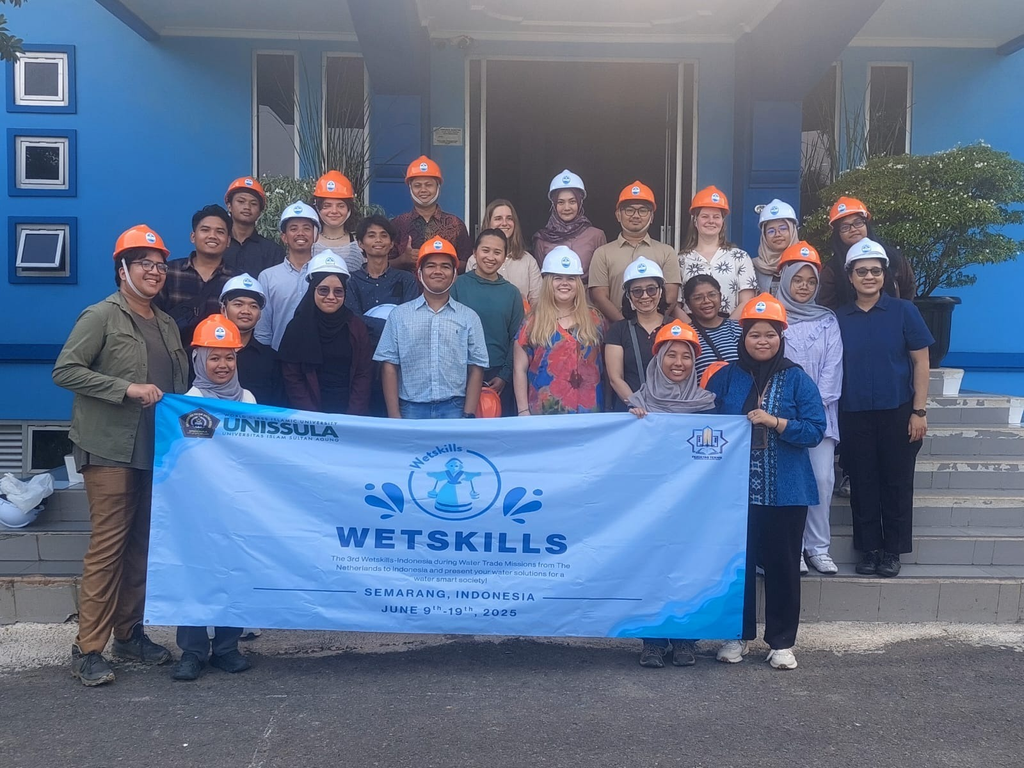
The programme brought together 24 international participants to examine real-world water management challenges through multidisciplinary teamwork, field visits, expert discussions, and the development of innovative solutions.
Participants worked with cases involving water utilities, government-related organisations, professional institutions, and international water-sector partners.
Reviewing Alternative Approaches to Water Sustainability
The programme addressed four principal challenges.
Community-Based Water Management
Participants examined approaches for strengthening community participation in flood management and local climate resilience, supported by the Blue Deal Indonesia programme.
Nature-Based Coastal Protection
Teams explored the application of natural foreshores and ecosystem-based approaches to coastal protection in Semarang, considering environmental and socioeconomic conditions.
Semarang River Revitalisation
Participants developed proposals linking river management, cultural heritage, environmental improvement, and sustainable urban development.
Water Footprint Compensation
Teams explored approaches to reducing water losses and developing water compensation mechanisms involving PDAM Semarang, WaterWorX, and Water Footprint Implementation.
These case studies encouraged participants to examine practical alternatives and develop solutions suited to local environmental and institutional conditions.
Development of Innovative Water Management Solutions
On 18 June 2025, the international teams presented their proposed solutions to a panel of experts.

Team 4, which worked on Water Footprint Compensation in Semarang, was selected as the winning team.
Its proposed approach addressed opportunities for companies to support water-saving interventions through investments in reducing Non-Revenue Water.
The concept connected water stewardship with measurable water savings, improved water-use efficiency, and corporate sustainability responsibilities.
The programme demonstrated how international collaboration can support the development and evaluation of innovative approaches to water sustainability.
The solutions represent practical proposals developed through international teamwork and expert review, rather than formally adopted international standards.
Public Evidence:
Formal Research and Knowledge Exchange Partnership with Wetskills Foundation
On 16 June 2025, UNISSULA and Wetskills Foundation signed a Memorandum of Agreement (MoA) during the Dutch Trade Mission in Jakarta.

The agreement was signed by:
- Dr. Abdul Rochim, Dean of the Faculty of Engineering at UNISSULA; and
- Johan Oost, Managing Director of Wetskills Foundation.
The partnership formalised continued cooperation in international water management and sustainable development initiatives.
The agreement included:
- organising future international Wetskills programmes in Indonesia;
- developing follow-up research through the WetsNext initiative;
- supporting international knowledge exchange among students, researchers, and professionals; and
- strengthening cooperation on sustainable water management challenges.
The agreement provides an institutional framework for continuing collaborative research and developing approaches informed by international expertise.
Its research-related commitments support the university’s longer-term contribution to international sustainable development practices.
Public Evidence:
International Research Internship with Universities in the Netherlands
In September 2025, UNISSULA welcomed four students from Rotterdam University of Applied Sciences and Hanze University of Applied Sciences, the Netherlands, to undertake research internships as part of their final-year academic projects.
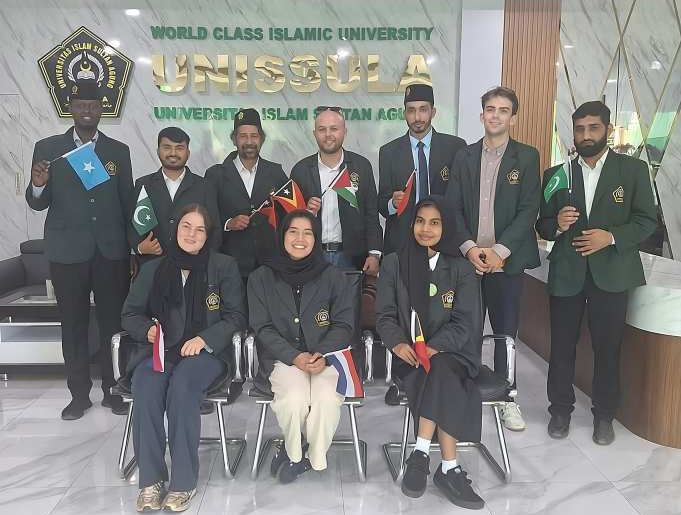
The participating students were:
- Heather Boeije – Rotterdam University of Applied Sciences.
- Natasha Boon – Rotterdam University of Applied Sciences.
- Sam de Haas – Rotterdam University of Applied Sciences.
- Hindrik van Marum – Hanze University of Applied Sciences.
The research internship programme was scheduled to take place from 8 September until the end of December 2025.
During the programme, the students were supported by academic supervisors from the Faculty of Engineering at UNISSULA.
The research activities focused on areas related to water management, civil engineering, and urban and regional planning.
International Exchange of Research Approaches
The programme provided opportunities for international students and UNISSULA academics to exchange research perspectives, technical knowledge, and approaches to local development challenges.
Through academic supervision and research activities in Indonesia, the collaboration connected international higher education expertise with local environmental and infrastructure issues.
The initiative also supported the continuity of research relationships between UNISSULA and universities in the Netherlands.
The research internship demonstrates ongoing international research engagement. Specific comparative research findings or best-practice recommendations from the students’ final projects would require their completed research reports.
Public Evidence:
https://suarabaru.id/2025/09/10/empat-mahasiswa-belanda-kerjakan-tugas-akhir-di-unissula
Summary of International Research and Best-Practice Development Initiatives
UNISSULA’s international collaborations in 2025 demonstrate several approaches to connecting scientific research, applied problem-solving, and international knowledge exchange.
| International Collaboration | Research or Collaborative Activity | Outputs and Good-Practice Relevance |
|---|---|---|
| UNISSULA – Hanze University, Netherlands | Collaborative research on drought management in Kaliori | Drought mapping, field-based analysis, and alternative water management recommendations |
| UNISSULA – Hanze University, Netherlands | Environmental DNA research for river monitoring | Scientific recommendations for integrating eDNA into environmental and flood risk monitoring |
| UNISSULA – Wetskills Foundation, Netherlands | Wetskills-Indonesia 2025 | Four international team solutions addressing water management and coastal sustainability challenges |
| UNISSULA – Wetskills Foundation, Netherlands | Formal research and knowledge exchange cooperation | Framework for future applied research and international water-sector collaboration |
| UNISSULA – Rotterdam and Hanze Universities, Netherlands | International student research internships | Research exchange and academic supervision concerning water management, engineering, and spatial planning |
These activities demonstrate different stages of international research collaboration, ranging from published scientific findings and applied solutions to research exchange and institutional partnerships.
International Knowledge Exchange and Transferable Sustainable Development Practices
UNISSULA’s collaborative research activities contribute to the examination and development of approaches that can inform sustainable development practices beyond individual research locations.
The university’s research partnerships demonstrate several complementary contributions.
Evidence-Based Problem Identification
The Kaliori drought research used environmental information, field surveys, stakeholder consultation, and statistical analysis to identify water scarcity challenges and evaluate potential solutions.
Integration of Research Methods
The eDNA research examined how emerging molecular techniques could complement conventional environmental monitoring to provide more comprehensive ecological information.
International Evaluation of Practical Solutions
Wetskills-Indonesia 2025 brought together participants and professionals from different countries to examine local water-related challenges and develop proposals evaluated by an international expert jury.
Research Knowledge Exchange
The research internship programme and formal partnerships with Dutch institutions created opportunities for continued exchange of scientific and professional approaches.
Together, these collaborations demonstrate UNISSULA’s engagement in reviewing existing approaches, developing research-informed recommendations, and exploring solutions that may be adapted to comparable sustainable development challenges in other locations.