

















7.4.4 Supporting Government in Clean-Energy and Energy-Efficient Technology Policy Development
Supporting Government through Research, Policy Recommendations, and Technical Expertise
Universitas Islam Sultan Agung (UNISSULA) supports government institutions in the development of clean-energy and energy-efficient technology policy through policy-oriented research, academic expertise, collaboration with government agencies, and international knowledge exchange.
In 2025, this support was demonstrated through three complementary approaches:
- research specifically producing renewable-energy policy recommendations for Central Java;
- collaboration with BRIDA Jawa Tengah and representatives of regional government agencies; and
- an international policy-oriented seminar involving government institutions and international experts in renewable energy and sustainable infrastructure.
These activities provide a pathway through which academic research and technical knowledge can inform government planning and policy discussions related to clean energy, renewable energy, and sustainable technology.
Renewable-Energy Policy Brief for Central Java
One of UNISSULA’s clearest policy-oriented research activities in 2025 was:
“Rekomendasi Policy Brief Pembangunan Jawa Tengah pada Sektor Energi Terbarukan Menggunakan Metode Sentence-BERT Berbasis Retrieval Augmented Generation.”
In English:
“Policy Brief Recommendations for Central Java Development in the Renewable Energy Sector Using Sentence-BERT Based on Retrieval Augmented Generation.”
The project is officially listed among UNISSULA’s 2025 faculty research activities and is led by Imam Much Ibnu Subroto, ST., M.Sc., Ph.D.
The research directly combines three elements relevant to public policy:
Central Java development → renewable energy → policy brief recommendations
Its policy-oriented design provides an academic basis for organising and translating research evidence into recommendations relevant to renewable-energy development in Central Java.
The project also applies Sentence-BERT and Retrieval Augmented Generation (RAG) as methods to support the retrieval, organisation, and synthesis of information for policy-oriented analysis.
Through this research, UNISSULA contributes evidence and academic expertise that can inform government discussion and planning in the renewable-energy sector.
Collaboration with BRIDA Jawa Tengah
UNISSULA also strengthened its direct engagement with regional government institutions through collaboration with the Central Java Regional Research and Innovation Agency (BRIDA Jawa Tengah).
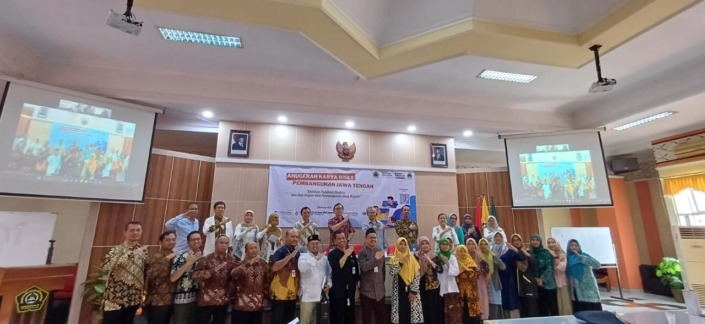
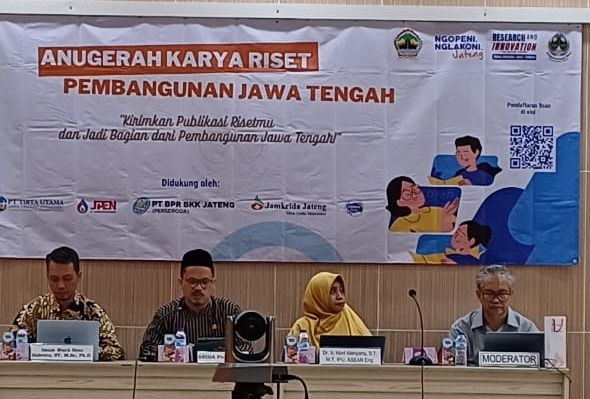
On 15 May 2025, the Faculty of Industrial Technology of UNISSULA and BRIDA Jawa Tengah held the socialisation of the 2025 Regional Research Work Appreciation Programme.
According to the official UNISSULA report, the activity brought together academics, researchers, and representatives of Regional Government Organisations (Organisasi Perangkat Daerah / OPD) across Central Java to strengthen research and innovation synergy for regional development. UNISSULA academics also served as speakers in the programme.
The programme therefore created a direct interface between university researchers and regional government stakeholders.
This relationship is important for policy development because it provides a channel through which university research and technological expertise can be connected with government development priorities.
Connecting Renewable-Energy Research with Government Engagement
UNISSULA’s renewable-energy policy research and its engagement with BRIDA Jawa Tengah complement each other.
The policy-brief research provides clean-energy policy content, while collaboration with BRIDA and OPD provides a government engagement mechanism.
Together, they create the following pathway:
Research evidence → Renewable-energy policy recommendations → University–government engagement → Regional policy discussion
This demonstrates that UNISSULA’s role extends beyond conducting renewable-energy research internally. The university also engages with government institutions and regional innovation stakeholders in ways that can support evidence-based policymaking.
International Knowledge Exchange for Government Policy Development
UNISSULA also facilitated international knowledge exchange involving government institutions and experts in fields relevant to clean energy and sustainable technology.
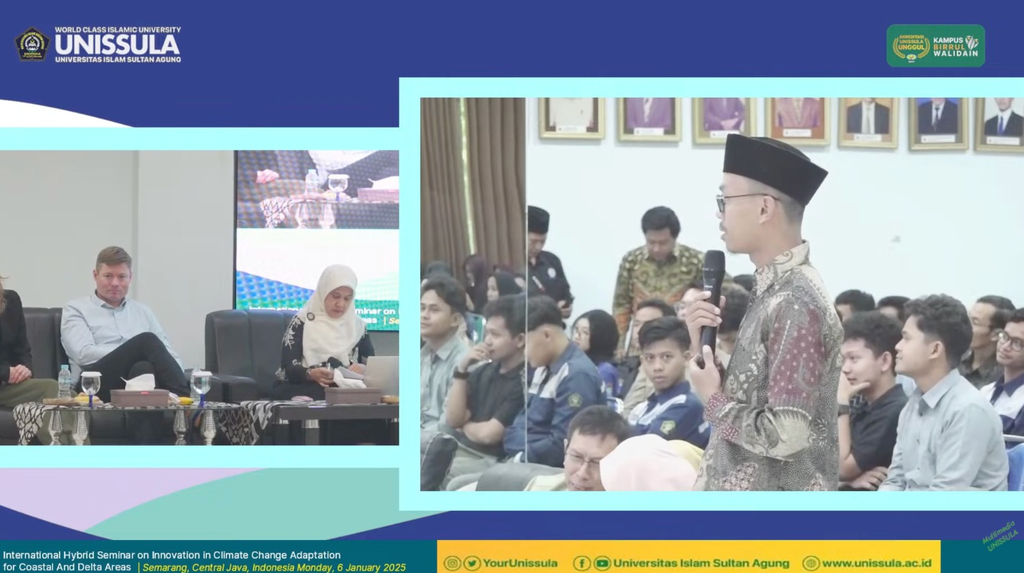
On 6 January 2025, the Faculty of Engineering organised the International Hybrid Seminar:
“Innovation in Climate Change Adaptation for Coastal and Delta Areas.”
The seminar was designed as a platform for academics, researchers, practitioners, and policymakers to exchange knowledge and innovative solutions. Its objectives included strengthening regional and global partnerships and promoting knowledge-sharing among government, academia, the private sector, and local communities.
Government and International Expert Participation
The seminar programme included government and international stakeholders directly relevant to policy and sustainable technology.
The proposal listed the Minister of Environment of the Republic of Indonesia as a speaker on national policies and strategic frameworks for climate mitigation and adaptation.
It also included international experts from:
- Hanze University of Applied Sciences, the Netherlands, discussing advanced water management, flood control, and sustainable urban planning;
- VIA University College, Denmark, presenting approaches to climate resilience through renewable-energy integration, sustainable infrastructure, and community-based solutions; and
- UNISSULA experts discussing adaptive infrastructure and policy in the Indonesian context.
Government-linked participants included the Central Java Provincial Environmental Service, environmental agencies from regencies and cities in Central Java, the Central Java public works and water-resources authority, BBWS Pemali Juana, and other regional institutions.
Policy Recommendations as an Intended Outcome
The international seminar was not designed only as an academic discussion.
Its stated expected outcomes included:
“a practical framework for addressing climate change in Indonesia, including actionable strategies and policy recommendations.”
It also sought to document international best practices from the Netherlands and Denmark, strengthen collaboration among stakeholders, and identify technological innovation opportunities.
Because renewable-energy integration and sustainable infrastructure were included in the seminar’s international knowledge exchange, the programme provided government stakeholders with access to expertise relevant to clean-energy and energy-efficient technology development.
Forms of Support Provided by UNISSULA
Through these 2025 activities, UNISSULA supported government policy development in several ways:
- producing policy-oriented research on renewable-energy development;
- preparing research specifically framed as a policy brief for Central Java;
- engaging directly with BRIDA Jawa Tengah and regional government organisations;
- providing university experts in government-linked research and innovation forums;
- facilitating dialogue between government institutions and international experts;
- sharing knowledge on renewable-energy integration and sustainable infrastructure; and
- supporting the development of actionable strategies and policy recommendations.
These forms of assistance demonstrate an institutional role in informing government through academic evidence and technical expertise.
Technical Expertise Relevant to Clean-Energy Policy
UNISSULA’s policy contribution is supported by broader research competence in clean and efficient energy technologies.
Official 2025 research records include work on:
- an adaptive energy-management and efficiency model for green hydrogen production;
- Floating Solar PV technology;
- solar-powered monitoring systems; and
- renewable-energy policy recommendations.
This technical research base strengthens the university’s capacity to contribute informed perspectives to government discussions on renewable-energy and energy-efficient technologies.
Evidence-Based University–Government Cooperation
UNISSULA’s approach can be summarised as:
Technical research → Policy analysis → Policy recommendations → Government engagement → Knowledge exchange
This model allows academic expertise to contribute to public decision-making while respecting the government’s formal role in policymaking.
UNISSULA does not claim to determine government policy. Rather, it provides information, research evidence, expertise, and recommendations that can support government institutions in developing more informed policies related to clean energy and sustainable technology.
Contribution to Sustainable Energy Development
By linking renewable-energy research with government collaboration and international expertise, UNISSULA contributes to broader efforts to:
- expand renewable-energy adoption;
- improve energy efficiency;
- support cleaner technologies;
- strengthen evidence-based regional planning;
- encourage low-carbon development; and
- increase collaboration between government, academia, and international partners.
This strengthens the role of research and innovation in supporting sustainable energy policy.