

















11.4.3 Allow Remote Working
University Policy on Remote Working
Universitas Islam Sultan Agung (UNISSULA) promotes and allows remote working and Work From Home (WFH) arrangements for employees as part of its institutional efforts to reduce employee commuting, support work flexibility, and contribute to the reduction of carbon emissions.
The university’s remote-working approach is supported by formal institutional policy and by digital systems that enable suitable academic and administrative activities to be carried out without requiring employees to be physically present on campus at all times.
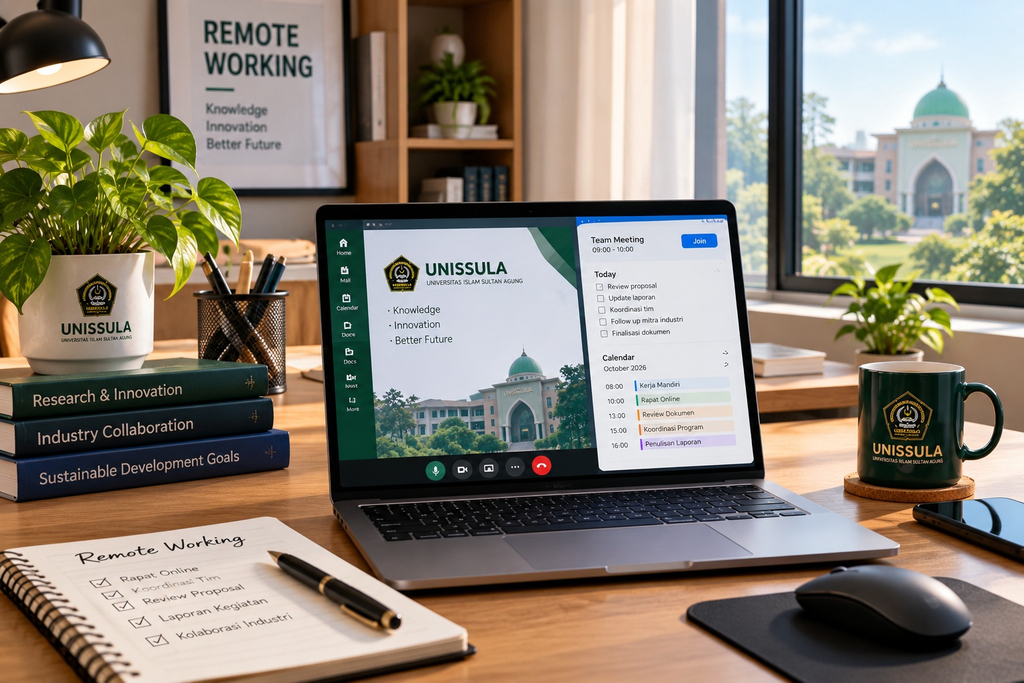
Formal Work From Home Policy
UNISSULA has an official policy permitting employees to work remotely.
Through Circular Letter No. 7584/J/SA/VI/2024, the university established a Work From Home arrangement in support of efforts to reduce the impact of carbon emissions.
The circular states that all UNISSULA employees are given the opportunity to work from home four times each month. The specific WFH days may be determined by each unit, bureau, or institution according to operational needs.
This provides a clear institutional basis for recurring remote working.
Remote Working as a Regular Institutional Practice
UNISSULA’s remote-working arrangement is established as a regular institutional practice rather than only as an emergency measure.
The policy gives employees the opportunity to undertake WFH four times per month, while individual units are allowed to determine suitable WFH days based on their operational responsibilities.
This recurring arrangement demonstrates that remote working forms part of the university’s working practices and provides a practical mechanism for reducing the frequency of employee commuting.
Reducing Employee Commuting
The WFH policy directly supports efforts to reduce the number of employee journeys to and from the university.
By allowing remote working on designated days, UNISSULA can reduce:
- regular commuting trips;
- private vehicle use;
- fuel consumption;
- transport-related emissions;
- commuting costs for employees; and
- pressure on campus transportation and parking.
Remote working therefore complements other sustainable mobility measures implemented by the university.
Carbon Emission Reduction
The environmental purpose of the policy is explicitly stated in the institutional circular.
The WFH arrangement was introduced in support of policies related to the reduction of the impact of carbon emissions at UNISSULA.
The relationship between remote work and environmental sustainability can be represented as:
Remote working → Fewer commuting journeys → Lower transport demand → Reduced carbon-emission impacts
This makes WFH an important component of UNISSULA’s sustainable campus approach.
Institution-Wide Coverage
The remote-working policy applies broadly across the university.
The circular states that all UNISSULA employees are given the opportunity to undertake WFH four times per month.
This means the arrangement is not limited to a single faculty, department, or administrative unit.
Its institution-wide scope increases the potential contribution of the policy to reducing employee commuting.
Flexible Scheduling by University Units
UNISSULA allows individual units, bureaux, and institutions to determine the appropriate day for Work From Home.
This approach provides flexibility while maintaining essential university operations.
The arrangement enables each unit to balance:
- operational requirements;
- service continuity;
- employee responsibilities;
- productivity; and
- sustainability objectives.
The policy therefore combines institution-wide eligibility with decentralised operational implementation.
Supporting Flexible Working Arrangements
Remote working provides employees with greater flexibility in carrying out suitable work activities.
Activities that can be completed digitally may be carried out without requiring physical presence on campus.
This contributes to a more flexible working environment while reducing unnecessary commuting.
The approach is particularly relevant for administrative, coordination, academic-support, and digital work activities that can be completed through university information systems and online communication platforms.
Digital Infrastructure for Remote Work
UNISSULA’s digital infrastructure supports the practical implementation of remote working.
Digital systems allow employees to perform a range of activities remotely, including:
- communication;
- coordination;
- academic administration;
- documentation;
- online meetings;
- access to university information systems; and
- digital academic services.
The availability of these systems makes remote working operationally feasible.
Remote Academic Activities
For academic staff, UNISSULA also supports online and blended academic activities.
The university has established digital learning infrastructure through platforms such as the SINAU learning management system, enabling lecturers to manage teaching materials, communicate with students, and conduct academic activities digitally.
This digital capacity supports the university’s broader ability to implement remote working where appropriate.
Online and Blended Learning Support
UNISSULA’s academic systems allow learning activities to be conducted through online and blended formats.
The university’s digital environment supports:
- online teaching;
- asynchronous learning;
- synchronous interaction;
- digital learning materials;
- online academic communication; and
- electronic academic administration.
These systems reduce the need for every academic activity to take place physically on campus.
Sustainable Mobility and Remote Working
Remote working complements UNISSULA’s wider sustainable commuting strategy.
The university promotes more sustainable mobility through several approaches, including:
- electric shuttle services;
- electric vehicles;
- shared transportation;
- pedestrian mobility; and
- remote working.
Remote work is particularly important because it can eliminate certain commuting journeys altogether.
The combined approach can be represented as:
Sustainable transport + Remote working → Reduced private vehicle dependence → Lower commuting emissions
Reducing Transport Demand at the Source
Many sustainable transport initiatives focus on replacing high-emission travel with lower-emission alternatives.
Remote working goes one step further by reducing the need for some journeys to occur at all.
By allowing employees to work from home on designated days, UNISSULA can reduce transport demand at its source.
This contributes to a more sustainable pattern of employee mobility.
Environmental Benefits
Remote-working arrangements can provide several environmental benefits.
These may include:
- lower fuel consumption;
- fewer vehicle journeys;
- reduced transport emissions;
- reduced traffic pressure around the campus;
- reduced demand for parking; and
- more efficient use of campus resources.
The university’s remote-working policy therefore supports both organisational flexibility and environmental sustainability.
Employee Benefits
Remote working can also provide benefits for employees.
These include:
- reduced commuting time;
- lower transportation costs;
- greater work flexibility;
- reduced exposure to traffic congestion; and
- improved ability to organise suitable work activities.
The policy therefore provides social and operational benefits alongside environmental advantages.
Institutional Efficiency
Flexible remote-working arrangements can support institutional efficiency when implemented appropriately.
Allowing units to determine suitable WFH days means that remote work can be aligned with each unit’s service responsibilities and operational requirements.
This helps ensure that sustainability objectives do not compromise essential university services.
Remote Working and Organisational Resilience
The ability to work remotely also strengthens institutional resilience.
Digital working systems allow the university to continue suitable activities without requiring every employee to be physically present on campus.
This provides greater flexibility in responding to changing operational conditions while maintaining continuity of university services.
Relationship with Sustainable Campus Development
UNISSULA’s remote-working policy forms part of a broader effort to develop more sustainable university operations.
Sustainable mobility is not limited to changing the type of vehicle used for commuting.
It also includes reducing the number of journeys that need to take place.
Remote working contributes directly to this objective.
Contribution to SDG 11
UNISSULA’s remote-working arrangements contribute to SDG 11: Sustainable Cities and Communities by reducing employee commuting and supporting more sustainable patterns of university operations.
THE Sustainability Impact Ratings 2027 assesses whether universities promote or allow telecommuting or remote working for employees as a matter of policy or standard practice, or offer a condensed working week to reduce employee commuting.
The indicator provides up to three points based on:
- existence of telecommuting;
- evidence provided; and
- public availability of the evidence.
UNISSULA addresses this criterion through its formal and recurring WFH policy.
Evidence of Implementation
UNISSULA’s remote-working arrangements are demonstrated through:
- Circular Letter No. 7584/J/SA/VI/2024 establishing Work From Home arrangements.
- WFH availability for all UNISSULA employees.
- Remote working permitted four times per month.
- Flexible determination of WFH days by individual units, bureaux, and institutions.
- An explicit connection between the WFH policy and efforts to reduce carbon-emission impacts.
- Digital systems supporting remote administrative and academic activities.
- Online communication and coordination infrastructure.
- Digital academic administration.
- Online and blended academic activities.
- Integration of remote working with the university’s broader sustainable mobility approach.