


















11.2.3 Public Access to Museums, Exhibition Spaces, Galleries, Works of Art and Artefacts
Public Access to Sultan Agung Corner
Universitas Islam Sultan Agung (UNISSULA) provides public access to Sultan Agung Corner, a permanent historical and cultural exhibition space located within the UNISSULA Library.
The exhibition presents visual and historical materials related to Sultan Agung, including portraits, historical photographs, information panels, and other interpretive displays. Through this exhibition space, UNISSULA preserves and communicates cultural and historical knowledge to students, researchers, visitors, and members of the wider public.
Sultan Agung Corner functions as an educational and cultural space rather than merely as a decorative area within the library.
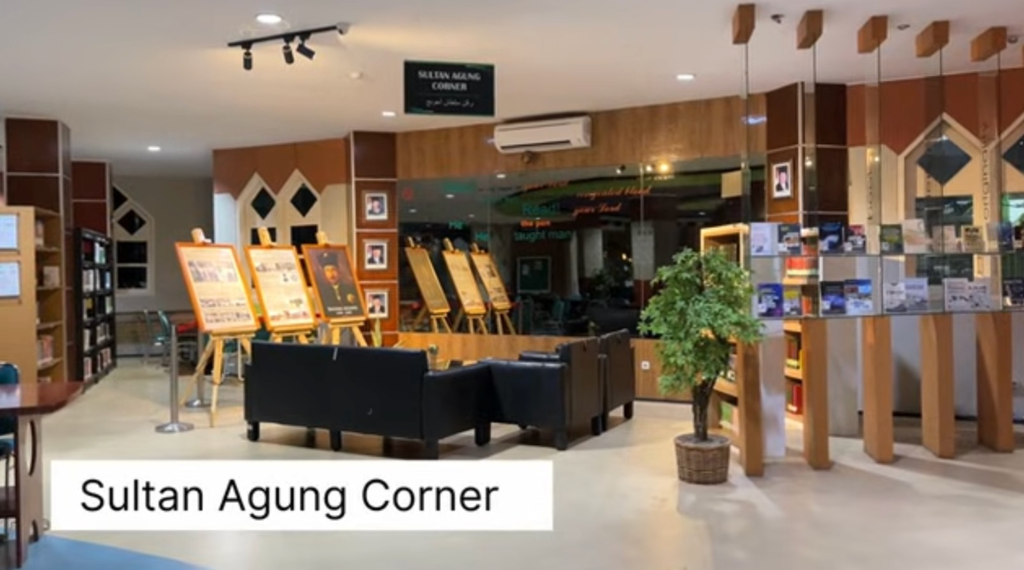
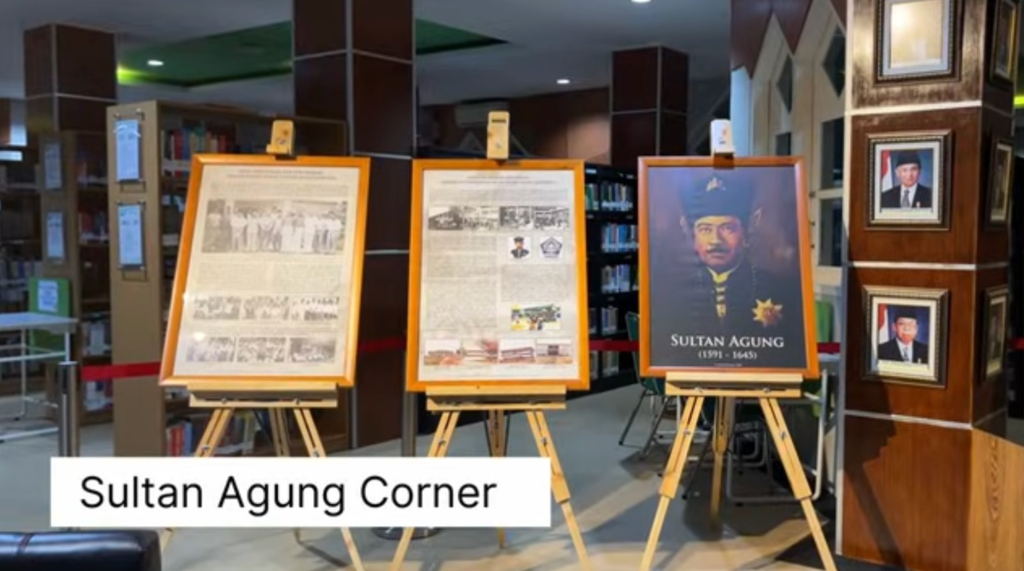
Permanent Historical and Cultural Exhibition
Sultan Agung Corner is designed as a permanent exhibition area that presents historical and cultural materials in an accessible visual format.
The exhibition includes:
- portraits of Sultan Agung;
- historical photographs;
- interpretive information panels;
- documentary images;
- cultural and historical narratives; and
- visual displays related to Sultan Agung and the historical identity associated with UNISSULA.
The arrangement of framed displays and information panels creates a gallery-like environment within the university library.
Historical Significance of Sultan Agung
Sultan Agung is an important historical figure whose name forms part of the identity of Universitas Islam Sultan Agung.
The exhibition therefore has particular cultural significance to the university because it connects the institution’s contemporary academic identity with historical and cultural memory.
By presenting information about Sultan Agung in a dedicated exhibition space, UNISSULA provides opportunities for visitors to learn about the historical figure associated with the university’s name and identity.
Visual Historical Documentation
The exhibition uses visual documentation to communicate historical information.
The materials displayed include:
- framed historical photographs;
- archival-style images;
- explanatory panels;
- portraits; and
- historical narratives.
This visual approach allows visitors to engage with historical information in a form that is accessible beyond formal classroom teaching.
Portrait of Sultan Agung
One of the central visual elements of the exhibition is a portrait of Sultan Agung (1591–1645).
The portrait is displayed alongside historical panels and documentary material, making it part of a broader interpretive exhibition rather than an isolated decorative object.
Educational Function
Sultan Agung Corner supports education by providing historical and cultural information in a public learning environment.
Visitors can use the exhibition to:
- learn about Sultan Agung;
- understand the historical context associated with the university’s identity;
- view historical photographs and documentary materials;
- engage with visual historical narratives; and
- strengthen awareness of cultural heritage.
The exhibition therefore complements the academic and educational functions of the university library.
Cultural Heritage and Institutional Identity
The exhibition also contributes to the preservation and communication of UNISSULA’s cultural identity.
The name and historical significance of Sultan Agung form an important part of the institution’s identity.
By maintaining a dedicated exhibition area, UNISSULA helps preserve this historical connection and makes it visible to present and future generations of students and visitors.
Location within the UNISSULA Library
Sultan Agung Corner is located within the UNISSULA Library, placing the exhibition in an academic environment where historical and cultural learning can be integrated with access to books, publications, and other educational resources.
The location also makes the exhibition accessible to library visitors.
This arrangement creates a link between:
Library resources → Historical exhibition → Cultural learning
Public Access through Library Visitor Registration
Members of the wider public can access the UNISSULA Library through the applicable visitor registration mechanism.
Because Sultan Agung Corner is located within the library, public visitors who access the library are also able to view the exhibition.
This means the exhibition is not restricted exclusively to UNISSULA students or staff.
Public access can therefore be represented as:
Visitor registration → Library access → Access to Sultan Agung Corner
Exhibition Space for the Wider Community
The exhibition provides a cultural-learning opportunity for:
- students;
- lecturers;
- researchers;
- visiting academics;
- school visitors;
- community members; and
- other external visitors.
This extends the cultural and educational value of the exhibition beyond the university’s internal community.
Public Engagement with Cultural History
Providing access to Sultan Agung Corner enables members of the public to engage directly with historical and cultural information.
Visitors are able to view historical materials in person and gain a better understanding of the cultural background associated with the university.
This supports the wider role of universities as institutions that preserve and disseminate knowledge, including cultural and historical knowledge.
Exhibition as a Learning Space
Sultan Agung Corner functions as a learning space by combining historical information with visual presentation.
The exhibition format allows historical knowledge to be communicated through:
- images;
- portraits;
- photographs;
- documentary displays; and
- interpretive text.
This makes cultural heritage more visible and approachable to a broad audience.
Preserving Historical Memory
Maintaining Sultan Agung Corner also helps preserve historical memory within the university environment.
Historical photographs and information panels provide documentation that can remain accessible to successive generations of university students and visitors.
This contributes to the preservation of institutional and cultural heritage.
Connection between Knowledge and Heritage
The placement of Sultan Agung Corner within the library reflects an integrated approach to knowledge and heritage.
The library provides access to scholarly information, while the exhibition provides access to historical and cultural information.
Together, they create an environment where visitors can engage with both:
Academic knowledge + Cultural heritage
Works of Art and Historical Displays
Sultan Agung Corner also includes visual works that can be understood as cultural and historical display materials.
These include:
- framed portraits;
- photographic displays;
- historical images;
- artistic presentation of historical figures; and
- interpretive exhibition panels.
These works contribute to the educational and cultural character of the space.
Continuous Public Availability
Unlike a temporary event, Sultan Agung Corner is maintained as a dedicated exhibition area within the library.
This allows the historical and cultural materials to remain available to visitors on an ongoing basis during library access periods.
Continuous availability strengthens its value as a public cultural resource.
Relationship with the UNISSULA Library
Sultan Agung Corner complements the broader public-access role of the UNISSULA Library.
While the library provides access to:
- books;
- reference materials;
- research publications;
- institutional repository resources; and
- journal publications,
Sultan Agung Corner provides access to:
- historical information;
- cultural displays;
- portraits;
- photographs; and
- visual heritage materials.
Together, these resources broaden the university’s contribution to public knowledge.
Contribution to SDG 11
Sultan Agung Corner supports SDG 11: Sustainable Cities and Communities, particularly the role of universities in preserving and making cultural heritage accessible.
THE Sustainability Impact Ratings 2027 recognises public access to museums, exhibition spaces, galleries, works of art, and artefacts under Indicator 11.2.3. The indicator evaluates the existence of public access, supporting evidence, and whether that evidence is publicly available.
Sultan Agung Corner provides a relevant example because it functions as a permanent historical and cultural exhibition space that can be accessed by library visitors, including members of the wider public.
Evidence of Implementation
UNISSULA’s public access to exhibition spaces, cultural displays, and historical works is demonstrated through the following institutional evidence:
- Sultan Agung Corner as a permanent historical and cultural exhibition space within the UNISSULA Library.
- Display of a prominent portrait of Sultan Agung (1591–1645).
- Display of historical photographs and documentary images.
- Interpretive panels presenting historical and cultural information.
- Visual materials explaining the historical figure associated with the university’s identity.
- Gallery-style arrangement of cultural and historical materials.
- Location within the university library, enabling access to library visitors.
- Public access through the library’s external visitor registration mechanism.
- Educational use of the exhibition to communicate cultural and historical knowledge.
- Ongoing availability of the exhibition as a permanent cultural-learning space.