

















13.3.4 Informing and Supporting Government in Climate-Related Disaster Risk Early Warning and Monitoring
Universitas Islam Sultan Agung (UNISSULA) supports local and regional government efforts in disaster-risk monitoring, preparedness, information exchange, research, and community resilience through formal institutional cooperation, particularly with the Government of Central Java through the Regional Disaster Management Agency (BPBD Provinsi Jawa Tengah).
This collaboration provides an institutional framework through which university expertise, research capacity, academic resources, community-service activities, and disaster-related information can support government efforts to understand, monitor, communicate, and respond to climate-related disaster risks.
The cooperation is particularly relevant to climate-related hazards affecting Central Java, including flooding, tidal flooding, extreme rainfall, coastal hazards, water-related risks, and other environmental conditions that require monitoring, preparedness, and effective communication with communities.
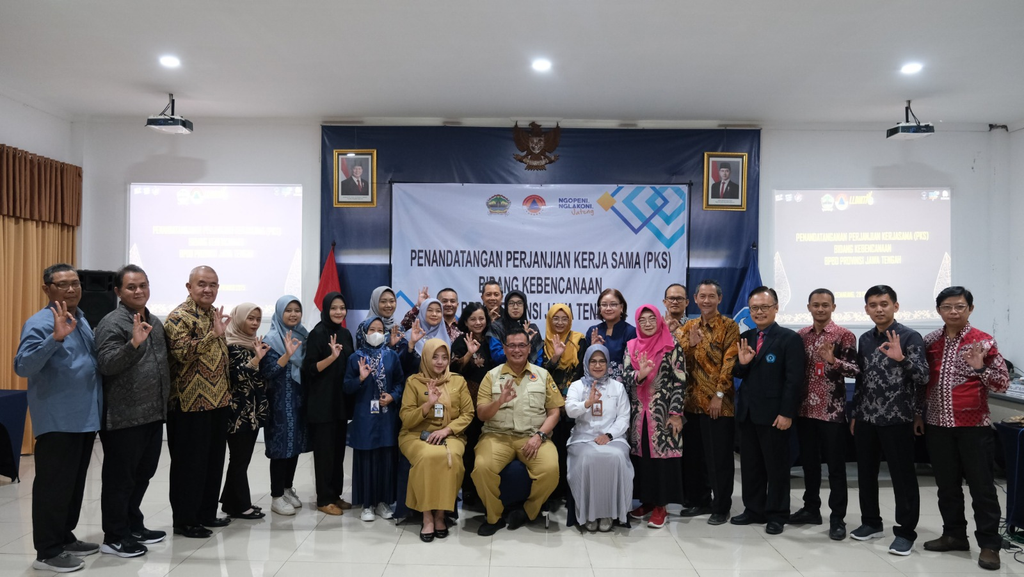
Formal Cooperation with the Government of Central Java
On 29 September 2025, UNISSULA and the Government of Central Java established a formal Cooperation Agreement concerning the implementation of higher-education tridharma activities in support of disaster management in Central Java.
The agreement provides a structured basis for collaboration between the university and BPBD Provinsi Jawa Tengah in disaster-management activities, research and development, community service, education, humanitarian activities, and other mutually agreed programmes.
This formal relationship enables UNISSULA to contribute academic and technical capacity to government disaster-risk management while also providing a mechanism for sharing information, research findings, and community-based knowledge.
Supporting Disaster-Risk Information
Effective early warning and disaster monitoring depend on the availability and communication of reliable information.
Through its cooperation framework with BPBD, UNISSULA participates in activities involving disaster-related data, information, academic expertise, research, and programme implementation.
Government partners may provide relevant disaster information, operational knowledge, and access to supporting facilities, while UNISSULA contributes researchers, academics, students, analytical capacity, community-service programmes, and scientific expertise.
This two-way exchange strengthens the ability of government and university partners to understand disaster risks and support preparedness and monitoring activities.
Climate-Related Disaster Risks
Climate-related risks are an important component of UNISSULA’s environmental and community-engagement activities.
Central Java faces a range of hazards associated with changing environmental conditions, including:
- River and urban flooding;
- Tidal flooding in coastal communities;
- Extreme rainfall;
- Coastal vulnerability;
- Water-management challenges;
- Infrastructure disruption; and
- Environmental risks affecting communities and public services.
UNISSULA addresses these issues through research, environmental monitoring, community engagement, disaster-management collaboration, and education.
Its Strategic Plan 2025–2029 identifies environmental performance areas including energy, emissions, water, waste, transport, open space, sustainability education, and sustainability research, establishing an institutional basis for measurable environmental action.
Disaster Risk Monitoring
UNISSULA supports disaster-risk monitoring through research and academic activities related to environmental conditions, flooding, water management, coastal areas, infrastructure, and community vulnerability.
Research and development are explicitly included in the formal cooperation with BPBD Central Java.
This allows academic findings and technical analysis to contribute to a wider government disaster-management framework.
Monitoring-related support may include the assessment of environmental risks, identification of vulnerable areas, analysis of community impacts, evaluation of infrastructure conditions, and examination of potential measures for reducing disaster impacts.
Early-Warning Awareness and Preparedness
UNISSULA’s role in early warning is closely connected with risk information, preparedness, education, and communication.
Early warning is not limited to the operation of warning devices. An effective disaster-risk approach also requires communities and institutions to:
- Understand existing hazards;
- Recognise changing environmental conditions;
- Receive and interpret risk information;
- Understand appropriate responses;
- Prepare for potential disaster impacts; and
- Coordinate with responsible government agencies.
Through university–government cooperation, research, education, and community service, UNISSULA contributes to these preparedness functions.
The university supports the development and dissemination of knowledge that can assist government institutions and communities in understanding and responding to disaster risks.
Research Support for Government
Research and development form an important component of UNISSULA’s cooperation with government.
University researchers can contribute expertise in areas such as:
- Flood-risk assessment;
- Tidal-flood and coastal vulnerability;
- Water-resource management;
- Resilient infrastructure;
- Environmental engineering;
- Community adaptation;
- Disaster-risk communication; and
- Evaluation of mitigation and preparedness measures.
This research capacity enables UNISSULA to support evidence-based government decision-making and provides a scientific basis for understanding changing disaster risks.
The university’s Strategic Plan also emphasises research and community service that generate measurable impact for society rather than being limited to academic outputs alone.
Community-Based Risk Information
Local communities play an important role in climate-related disaster monitoring and preparedness.
UNISSULA’s institutional collaboration model identifies society as a partner in co-creation and a beneficiary of university programmes, while government provides policy direction and institutional support.
This approach enables information from research, government agencies, and community experience to be connected.
Community engagement may help identify local conditions, vulnerable locations, recurring flood patterns, infrastructure problems, and preparedness needs that can support wider disaster-risk assessment.
Flood and Coastal Risk Support
UNISSULA has particular academic and community-engagement experience related to flood and coastal risks.
These areas are highly relevant to climate-related disaster monitoring because coastal and low-lying communities in Central Java may experience tidal flooding, heavy rainfall, drainage problems, and other water-related hazards.
University expertise in engineering, water management, environmental planning, infrastructure, and community resilience can therefore support government efforts to understand and reduce these risks.
Information Exchange with Government
The cooperation framework with BPBD establishes a formal channel for communication between university and government.
Such information exchange enables research findings, community observations, technical expertise, and academic analysis to be linked with government disaster-management information and operational priorities.
This relationship is important because effective monitoring and early warning require collaboration between institutions that generate knowledge and institutions responsible for public disaster management.
Integration with Community Service
Community service is explicitly included in the cooperation between UNISSULA and BPBD Central Java.
Through community-service activities, university knowledge can be translated into:
- Disaster-risk education;
- Preparedness awareness;
- Community capacity building;
- Environmental education;
- Flood-risk awareness;
- Resilience activities; and
- Support for vulnerable communities.
These activities help ensure that disaster-risk information is not limited to institutional reports but can be communicated to people who may directly experience climate-related hazards.
Humanitarian and Disaster Response Support
The formal cooperation agreement also includes humanitarian projects.
Humanitarian activities can support communities before, during, and after disasters through education, preparedness, assistance, assessment, and recovery-related activities.
Experience from humanitarian and community programmes can also provide information that contributes to future risk reduction and preparedness planning.
Institutional Monitoring and Evaluation
UNISSULA’s Strategic Plan establishes a broader performance-management framework based on monitoring, evaluation, evidence, risk management, and continuous improvement.
The university conducts operational review, periodic performance review, annual evaluation, and corrective action as part of its institutional governance cycle.
This monitoring culture supports the university’s capacity to manage disaster-related collaboration systematically rather than treating activities as isolated projects.
Pentahelix Approach to Disaster Risk Management
UNISSULA uses a pentahelix collaboration model involving government, communities, industry, media, and academia.
Within this model:
- Government provides policy direction and institutional support;
- Universities contribute research and scientific expertise;
- Communities provide local knowledge and participate in resilience activities;
- Industry may contribute technology and operational resources; and
- Media can support public information and awareness.
The Strategic Plan explicitly positions government and society as important partners in institutional collaboration.
This multi-stakeholder approach is particularly valuable for early warning and disaster-risk monitoring because climate-related risks often require information and action from multiple institutions.
Evidence of Implementation
- Formal Cooperation Agreement between the Government of Central Java through BPBD and UNISSULA, dated 29 September 2025, supporting disaster-management activities through university education, research, and community service.
- Research and development collaboration included within the formal cooperation framework, enabling academic expertise to support disaster-risk assessment and government decision-making.
- Exchange of data, information, resources, expertise, and institutional support between university and government within disaster-management programmes.
- Community-service and humanitarian activities included in the cooperation framework, supporting disaster preparedness, risk awareness, and community resilience.
- UNISSULA Strategic Plan 2025–2029, which establishes measurable environmental action in areas including emissions, water, energy, transport, environmental education, and sustainability research.
- Institutional pentahelix collaboration framework, connecting government, communities, academia, industry, and media in addressing societal challenges.
- Continuous monitoring and evaluation framework, enabling programmes and risks to be reviewed and improved through evidence-based institutional governance.