

















13.3.1 Local Climate Change Education and Community Awareness Programmes
Universitas Islam Sultan Agung (UNISSULA) provides educational programmes, seminars, outreach activities, and community-oriented initiatives that address climate change risks, impacts, mitigation, adaptation, impact reduction, and resilience. These activities are delivered through academic faculties, research centres, community-service programmes, and collaboration with government agencies, international universities, NGOs, and local communities.
In 2025, UNISSULA implemented several programmes that directly addressed climate-related challenges affecting Indonesia, particularly coastal and delta areas in Central Java. These programmes combined public education, knowledge exchange, climate adaptation, infrastructure resilience, flood-risk reduction, and stakeholder collaboration.


International Hybrid Seminar on Climate Change Adaptation and Resilience
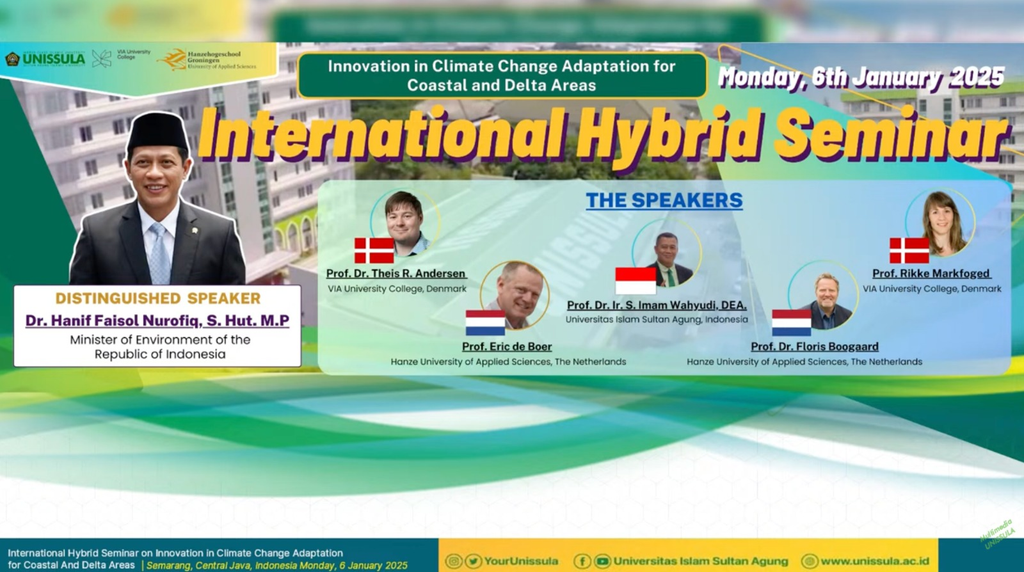
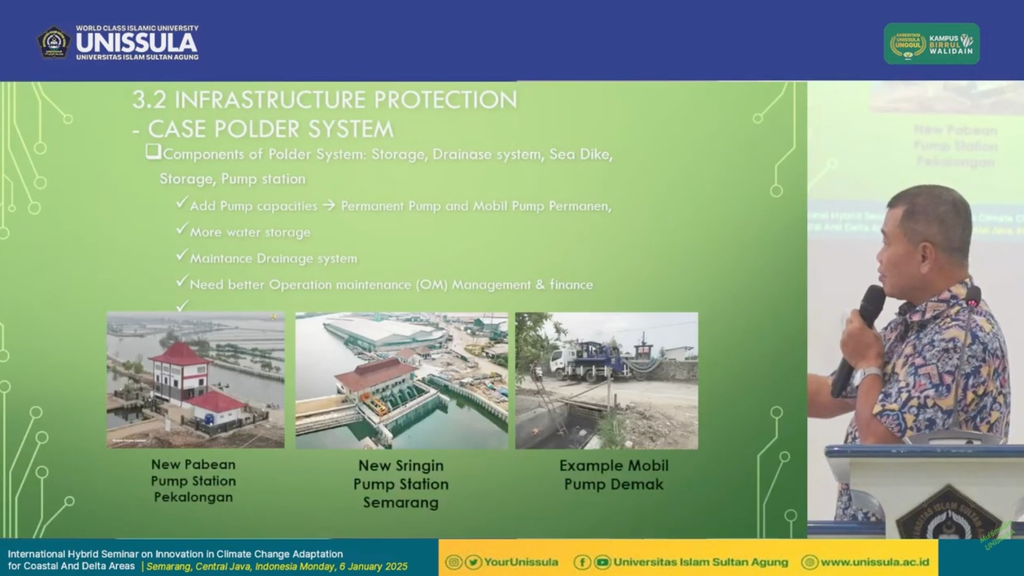
On 6 January 2025, the Faculty of Engineering of UNISSULA organised an international hybrid seminar focused on climate change adaptation and resilience.
The seminar was designed to develop a practical framework for addressing climate change in Indonesia, including actionable strategies and policy recommendations. Its expected outcomes included strengthening collaboration among stakeholders in coastal and delta regions, supporting climate adaptation and resilience-building, and identifying opportunities for technological innovation and funding for climate adaptation initiatives. (Fakultas Teknik UNISSULA)
The programme involved a broad range of local and regional stakeholders, including:
- Central Java Provincial Environmental Service;
- Environmental agencies from regencies and cities in Central Java;
- Public works, water resources, and spatial planning institutions;
- BBWS Pemali Juana;
- Regional settlement infrastructure agencies;
- Academics and students from universities in Central Java; and
- Non-governmental organisations.
The seminar was delivered through keynote presentations, panel discussions, and interactive sessions, enabling participants to exchange knowledge and discuss practical responses to climate-related challenges. (Fakultas Teknik UNISSULA)
This activity strengthened public and stakeholder understanding of climate risks, adaptation strategies, resilience planning, water management, renewable energy, sustainable infrastructure, and hydrological challenges.
ICCDA 6: Advancing Climate Adaptation and Resilience
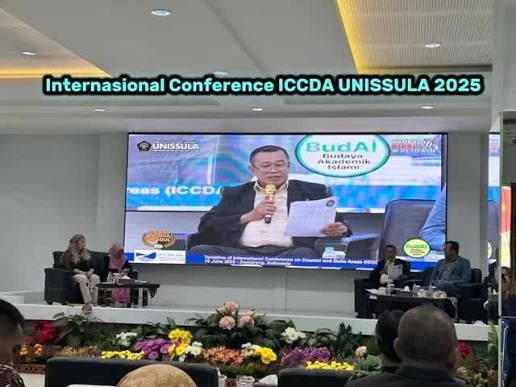
UNISSULA also organised the 6th International Conference on Coastal and Delta Areas (ICCDA 6) on 2 July 2025.
The conference theme was:
“Build A Strong Nation: Advancing Climate Adaptation and Resilience through Sustainable Development in Coastal and Delta Areas.”
The programme focused on climate change challenges affecting coastal and delta regions, which are particularly vulnerable to flooding, sea-level rise, environmental degradation, and other climate-related hazards. UNISSULA used the conference as a platform for international knowledge exchange, research dissemination, and discussion of innovative approaches to climate adaptation and resilience. (UNISSULA)
The conference brought together experts from Indonesia and several other countries and addressed issues related to climate change, sustainable infrastructure, water management, environmental technology, and resilience in vulnerable coastal environments. (UNISSULA)
Through this programme, climate-change education was extended beyond academic research to broader discussions on how communities, governments, and institutions can respond to current and future climate risks.
Climate Change Risks and Impacts in Coastal Areas
A significant focus of UNISSULA’s climate education activities is the vulnerability of coastal communities in northern Java.
Flooding, tidal flooding, sea-level rise, coastal erosion, and infrastructure disruption are among the climate-related risks frequently addressed in UNISSULA’s education, research, and community-service activities.
Research published through UNISSULA in 2025, for example, examined the adaptive capacity of communities affected by tidal flooding in Sriwulan Village, Sayung, Demak. The study assessed community responses to flood impacts and highlighted adaptive practices such as raising houses, raising roads, using technology, strengthening social institutions, and using local knowledge to anticipate tidal flooding. (UNISSULA Journals)
These issues are closely connected with the educational themes presented in seminars, conferences, and community programmes.
Climate Adaptation through International Collaboration
UNISSULA’s climate education activities are also strengthened through international collaboration.
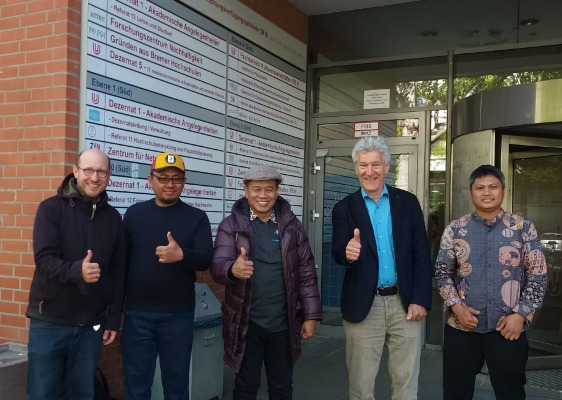
In May 2025, academics from the Faculty of Engineering collaborated with VIA University College Denmark. One of the key academic topics presented during the collaboration was climate change adaptation along the northern coast of Java. The programme also included discussions and field visits related to environmental and infrastructure research relevant to Indonesian climate challenges. (UNISSULA)
These international exchanges provide additional knowledge and examples of adaptation practices that can be transferred into education, research, and community engagement in Indonesia.
Community Education on Flood and Tidal-Flood Risk
UNISSULA also conducts community-service activities that address flood and tidal-flood mitigation.
The university’s community-service portfolio includes activities such as:
- Operational assistance for flood and tidal-flood mitigation in Sayung, Demak;
- Education to increase awareness among residents in flood-prone areas;
- Operational guidance and public outreach for flood and tidal-flood management in the Sringin Polder area, Semarang; and
- Environmental planning for local communities. (PDTS Unissula)
One programme specifically focuses on education and awareness for residents in flood-prone areas at SD Kaligawe, Semarang, with the objective of increasing public participation in maintaining flood-control infrastructure. (PDTS Unissula)
These initiatives demonstrate that climate-related education at UNISSULA is not limited to university classrooms. It also reaches local communities affected by flooding and other environmental risks.
Flood Mitigation and Impact Reduction
UNISSULA has also applied research findings to practical flood-risk reduction.
Through community engagement in Cilacap, UNISSULA supported the development and implementation of flood-control solutions for communities affected by tidal flooding. Measures discussed and implemented included polder systems, movable water-control structures, pipe gates, and multifunction pumps.
The programme also included a Focus Group Discussion involving government agencies, local authorities, village officials, and community members. (LPPM Unissula)
UNISSULA’s Delta Centre on Climate Change has also been involved in research, innovation, and assistance to areas in Central Java affected by flooding associated with sea-level rise and climate change. (LPPM Unissula)
These activities support climate-change education by connecting scientific knowledge with practical approaches to reducing climate-related impacts.
Mitigation, Adaptation, and Resilience
UNISSULA’s programmes address several complementary dimensions of climate action.
Climate risks and impacts are discussed through education on flooding, tidal flooding, sea-level rise, coastal vulnerability, and infrastructure disruption.
Mitigation is addressed through discussions of renewable energy, sustainable infrastructure, efficient resource use, and lower-carbon development.
Adaptation is addressed through coastal resilience, flood-control infrastructure, community preparedness, water management, and climate-responsive planning.
Impact reduction is supported through practical measures such as flood-control systems, drainage and polder management, infrastructure maintenance, and community participation.
Resilience is strengthened through collaboration among universities, government agencies, technical institutions, NGOs, students, and affected communities.
Climate Preparedness and Early-Warning Awareness
Climate preparedness is an important part of reducing risks from extreme weather, flooding, and coastal hazards.
UNISSULA’s educational and community-oriented programmes encourage communities and stakeholders to understand environmental conditions, recognise risks, improve preparedness, and strengthen their ability to respond to flood and climate-related events.
Community-based research conducted at UNISSULA has also documented the use of local knowledge and environmental observation to anticipate tidal flooding, showing how community knowledge can contribute to preparedness and adaptive capacity. (UNISSULA Journals)
While early-warning technology is not the sole focus of these programmes, awareness, risk recognition, preparedness, and community response are incorporated into broader climate-resilience and flood-risk education.
Collaboration with Local Stakeholders
UNISSULA’s climate education activities use a multi-stakeholder approach.
Participants and partners include environmental agencies, public works institutions, water-resource authorities, universities, NGOs, local governments, village administrations, schools, and community members.
This approach helps ensure that climate knowledge is not restricted to academic audiences but can be shared with institutions and communities that directly manage or experience climate-related risks.
Evidence of Implementation
- International Hybrid Seminar, 6 January 2025, addressing practical climate-change responses, adaptation, resilience, sustainable infrastructure, water management, and collaboration with government agencies, academics, students, and NGOs. (Fakultas Teknik UNISSULA)
- ICCDA 6, 2 July 2025, focused on advancing climate adaptation and resilience in coastal and delta areas. (UNISSULA)
- International collaboration with VIA University College Denmark, including education on climate-change adaptation along the northern coast of Java. (UNISSULA)
- Community-service programmes on flood and tidal-flood mitigation, including resident education, operational assistance, and flood-control awareness in Central Java. (PDTS Unissula)
- Applied flood-mitigation and community-engagement activities, including FGD and practical solutions for tidal-flood-affected communities. (LPPM Unissula)
- Research and education on community adaptation to tidal flooding, strengthening understanding of risk, adaptation, preparedness, and local resilience.