

















13.3.3 Co-operative Planning for Climate Change Disasters with Government
Universitas Islam Sultan Agung (UNISSULA) participates in co-operative planning and implementation for climate-related disaster risk reduction through formal collaboration with government institutions, research activities, community engagement, and disaster-management programmes.
A key institutional mechanism is UNISSULA’s formal cooperation with the Government of Central Java through the Regional Disaster Management Agency (BPBD Provinsi Jawa Tengah). This cooperation provides a structured framework for joint planning, resource sharing, research, community service, education, humanitarian activities, and disaster-management implementation.
The collaboration strengthens UNISSULA’s contribution to climate resilience, particularly in a region exposed to flooding, tidal flooding, extreme rainfall, coastal hazards, and other environmental risks.
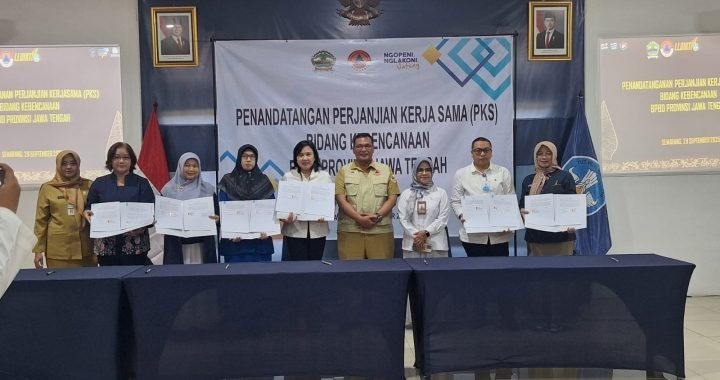
Formal Cooperation with the Government of Central Java
On 29 September 2025, the Government of Central Java and Universitas Islam Sultan Agung entered into a formal Cooperation Agreement concerning the implementation of higher-education tridharma activities in support of disaster management in Central Java.
The agreement was established between:
- Government of Central Java, represented through BPBD Provinsi Jawa Tengah; and
- Universitas Islam Sultan Agung, represented through its Research and Community Service Institute.
The agreement establishes a formal institutional basis for joint work in disaster management and related activities.
Purpose of the Cooperation
The cooperation is intended to strengthen the combined potential and resources of the participating institutions in supporting disaster-management implementation in Central Java.
The agreement states that collaboration is carried out through university tridharma activities, including education, research, and community service.
This approach enables academic expertise, research capacity, students, community-service programmes, government data, public-sector facilities, and disaster-management resources to be brought together within a coordinated framework.
Scope of Co-operative Disaster Planning
The cooperation covers a range of activities relevant to disaster planning, risk reduction, and resilience.
The scope includes:
- Support for priority disaster-management and environmental programmes of the Central Java Provincial Government;
- Activities in the field of disaster management;
- Research and development;
- Community service;
- Student internships and work-based learning;
- Teaching assistance in educational institutions;
- Humanitarian projects; and
- Other jointly agreed activities.
The agreement therefore goes beyond a general memorandum of understanding and provides an operational framework for coordinated activities involving government and university resources.
Climate-Related Disaster Context
Climate-related disasters are particularly relevant to Central Java because of recurring environmental risks affecting coastal, urban, and river-basin communities.
UNISSULA’s climate-related research, education, and community programmes have addressed issues such as:
- Flooding;
- Tidal flooding;
- Coastal vulnerability;
- Extreme rainfall;
- Water-management challenges;
- Sea-level-related risks;
- Infrastructure resilience; and
- Community preparedness.
These issues are consistent with the broader climate-action priorities incorporated into UNISSULA’s institutional planning, which identifies energy, emissions, water, waste, transport, environmental management, education, and sustainability research as areas requiring measurable action.
Integration of Disaster Planning with University Activities
UNISSULA contributes to co-operative disaster planning through the integration of disaster-related activities into teaching, research, innovation, and community service.
The university’s strategic framework emphasises research and community-service programmes that respond to real-world problems and generate measurable impact for society.
This allows disaster-management collaboration with government to include both technical and social dimensions.
Technical contributions may involve engineering, water management, infrastructure resilience, environmental monitoring, and risk assessment.
Social contributions may include public education, community preparedness, capacity building, humanitarian activities, and community-based adaptation.
Joint Use of Resources and Expertise
The cooperation agreement also establishes reciprocal responsibilities between the Government of Central Java and UNISSULA.
Government partners provide support such as data, information, facilities, programme materials, and disaster-management resources.
UNISSULA contributes academic personnel, researchers, students, expertise, educational activities, community-service capacity, and programme implementation.
This reciprocal arrangement allows disaster-related planning to benefit from both governmental operational experience and university research and educational expertise.
Research and Development for Disaster Resilience
Research and development are explicitly included within the scope of the cooperation.
This creates opportunities for UNISSULA researchers to support disaster planning through:
- Hazard and vulnerability studies;
- Flood and tidal-flood research;
- Water-management research;
- Resilient infrastructure development;
- Environmental monitoring;
- Community-resilience studies;
- Applied engineering solutions; and
- Evaluation of disaster-management strategies.
Research findings can therefore contribute to government decision-making and programme development while also strengthening academic understanding of climate-related disaster risks.
Community Service and Local Resilience
Community service is another major component of the cooperation.
UNISSULA’s community-engagement approach is designed to connect university knowledge with practical challenges faced by society.
The university’s Strategic Plan positions communities as partners in co-creation and beneficiaries of university activities, while government institutions provide policy direction, public resources, and implementation support.
This model is particularly relevant to disaster resilience because effective disaster planning requires cooperation among government institutions, universities, communities, and other stakeholders.
Humanitarian Projects
The cooperation agreement specifically includes humanitarian projects as part of its scope.
This enables UNISSULA students, academics, and institutional units to participate in activities supporting communities affected by disasters.
Humanitarian activities may complement preparedness, response, recovery, community education, and resilience-building programmes implemented together with government authorities.
Education and Disaster Preparedness
The cooperation also includes educational activities such as teaching assistance and disaster-related learning.
This creates a pathway for disaster preparedness and risk awareness to be incorporated into educational programmes involving schools, communities, students, and other stakeholders.
Educational activities can strengthen understanding of:
- Disaster risks;
- Environmental hazards;
- Preparedness measures;
- Community response;
- Climate adaptation;
- Resilience; and
- Risk-reduction strategies.
Coordination and Programme Evaluation
The agreement establishes coordination responsibilities between both parties.
UNISSULA is required to coordinate and report with the government partner in relation to programme implementation, evaluation, and follow-up.
This provides an institutional mechanism for ensuring that collaborative activities are not isolated events but part of a continuing process of implementation, assessment, and improvement.
Connection with UNISSULA’s Institutional Planning
The disaster-management cooperation is also consistent with UNISSULA’s wider institutional planning framework.
The Strategic Plan 2025–2029 uses a governance cycle involving target setting, programme implementation, monitoring, evaluation, risk management, corrective action, and continuous improvement.
This management approach supports the integration of climate resilience and disaster-risk reduction into institutional decision-making.
Pentahelix Collaboration
UNISSULA applies a pentahelix model of external collaboration involving:
- Government;
- Society;
- Industry;
- Media; and
- Academia.
Within this model, government provides policy direction and institutional support, while society participates as a partner and beneficiary.
The model is particularly useful for climate-related disaster planning because disaster resilience depends on cooperation across multiple sectors rather than action by a single institution.
Addressing Climate-Related Displacement Risks
Climate-related disasters can create conditions that disrupt livelihoods, damage homes and infrastructure, and in severe cases contribute to temporary or longer-term population displacement.
UNISSULA’s cooperation framework with government is designed primarily around disaster management, preparedness, resilience, research, community engagement, and humanitarian support.
Although population displacement is not identified as a separate stand-alone programme within the current cooperation agreement, the institutional framework provides a mechanism through which issues associated with disaster-affected communities, humanitarian needs, and recovery can be addressed in collaboration with government.
Evidence of Implementation
- Formal Cooperation Agreement between the Government of Central Java and UNISSULA dated 29 September 2025, concerning higher-education tridharma activities in support of disaster management in Central Java.
- Joint disaster-management framework, combining government resources with university education, research, and community-service capacity.
- Scope of cooperation covering disaster-management programmes, environmental priorities, research and development, community service, teaching assistance, and humanitarian projects.
- Government–university coordination mechanisms, including programme implementation, reporting, evaluation, and follow-up.
- UNISSULA Strategic Plan 2025–2029, which provides a broader environmental and climate-management framework covering energy, emissions, water, waste, transport, education, research, and measurable environmental performance.
- Pentahelix stakeholder model, in which government, communities, academia, industry, and media participate in collaborative problem-solving and social impact.