

















11.4.9 Building on Brownfield Sites
Prioritising Redevelopment of Previously Developed Campus Sites
Universitas Islam Sultan Agung (UNISSULA) prioritises the redevelopment, renovation, and reuse of previously developed campus sites where possible.
Rather than relying only on expansion into previously undeveloped land, UNISSULA makes use of existing built areas and existing structures within the campus for new academic, research, administrative, and service facilities.
This approach supports more efficient land use, reduces unnecessary expansion, and contributes to more sustainable campus development.


Brownfield Development Approach
THE Sustainability Impact Ratings defines brownfield sites as sites where there has been previous, recent building or development.
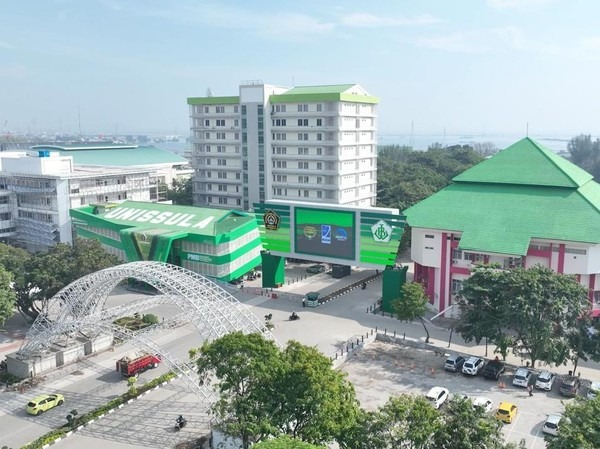
UNISSULA applies this principle through redevelopment projects located on sites that were already built and developed.
The university’s approach can be represented as:
Existing developed site → Redevelopment or renovation → New or improved university facility
This enables UNISSULA to make more efficient use of its existing campus footprint.
Redevelopment of Previously Built Structures
A significant example is the redevelopment of an existing building structure within the UNISSULA campus.
The structure had previously been built but remained underutilised and incomplete. Rather than abandoning the site and developing a new location, UNISSULA continued redevelopment on the existing built site.
During 2025, the structure was redeveloped to support new and improved facilities associated with:
- the Faculty of Medicine;
- the Integrated Biomedical Laboratory; and
- the Faculty of Dentistry.
This represents a clear example of reusing a previously developed location for renewed institutional purposes.
Reuse of an Underutilised Existing Building
The redevelopment project demonstrates the university’s preference for making productive use of existing built assets.
The site was not previously undeveloped land. It already contained a substantial building structure.
UNISSULA therefore chose to:
- reuse the existing building footprint;
- continue development on an already built site;
- upgrade the structure;
- expand its functional use; and
- convert the site into productive academic and research space.
This is consistent with the principle of brownfield redevelopment.
2025 Medical and Biomedical Redevelopment
In 2025, redevelopment works on the existing structure supported the creation and improvement of facilities for medicine, biomedical research, and dentistry.
The project enabled UNISSULA to expand academic and laboratory capacity through the reuse of an existing developed site.
The redevelopment supports:
- medical education;
- biomedical laboratory activities;
- dental education;
- research infrastructure; and
- shared academic facilities.
This demonstrates how previously developed land can be reused for higher-value academic purposes.
Integrated Biomedical Laboratory
The development of the Integrated Biomedical Laboratory on a previously developed site supports both land-use efficiency and research infrastructure improvement.
By integrating new research functions into an existing built area, UNISSULA strengthens laboratory capacity while avoiding the need to establish an entirely new site elsewhere.
This supports a more compact and efficient campus-development model.
Faculty of Medicine and Faculty of Dentistry
The redevelopment also supports facilities associated with the Faculty of Medicine and Faculty of Dentistry.
Using an existing developed site allows UNISSULA to strengthen health-science infrastructure while maintaining continuity within the established campus area.
The project therefore combines:
Site reuse + Academic development + Research capacity + Land-use efficiency
Rectorate Building Redevelopment
UNISSULA also applies redevelopment principles to its administrative infrastructure.
The Rectorate Building has undergone renovation and redevelopment within the existing campus site.
Rather than relocating the administrative centre to a new site, the university improved and renewed the existing built facility.
This demonstrates that UNISSULA’s brownfield approach is applied not only to academic buildings but also to institutional and administrative infrastructure.
Reuse Rather than Unnecessary Expansion
The redevelopment of the Rectorate Building illustrates the university’s preference for improving existing facilities before considering unnecessary outward expansion.
This approach can provide several sustainability benefits:
- better use of existing land;
- preservation of the existing campus structure;
- continued use of existing infrastructure;
- improved functionality of established facilities; and
- reduced need for additional site development.
Efficient Use of the Existing Campus Footprint
UNISSULA’s campus contains established academic, administrative, health, religious, residential, and service facilities.
Redeveloping existing sites allows the university to accommodate new needs within this established environment.
This supports a compact campus-development model in which existing land and infrastructure are used more efficiently.
Relationship with Sustainable Building Standards
Brownfield redevelopment also complements UNISSULA’s sustainable building requirements.
The university requires new buildings and renovations to apply relevant energy-efficiency standards, including:
- SNI 6197:2020 for energy conservation in lighting;
- SNI 6390:2020 for air-conditioning energy conservation;
- SNI 6389:2020 for building-envelope efficiency; and
- applicable Green Building requirements.
This means redevelopment can combine site reuse with improved building performance. Surat Edaran Gedung Baru, mengi…
Renovation and Adaptive Reuse
UNISSULA’s approach includes both renovation and adaptive reuse.
Existing structures may be improved, expanded, or repurposed to meet changing academic and institutional needs.
Adaptive reuse can reduce the environmental burden associated with:
- unnecessary land conversion;
- demolition and replacement;
- entirely new infrastructure development; and
- inefficient outward campus expansion.
Sustainable Land-Use Planning
The university’s redevelopment approach supports more sustainable land-use planning.
The underlying principle is:
Use existing developed land first, where feasible, before expanding onto new land.
This approach improves land-use efficiency and supports long-term campus planning.
Resource Efficiency
Redeveloping existing sites can also provide resource-efficiency benefits.
Existing sites may already have access to:
- roads;
- utilities;
- electricity;
- water systems;
- pedestrian networks;
- drainage;
- communications infrastructure; and
- nearby campus services.
Reusing these developed locations can reduce the need to create entirely new supporting infrastructure.
Supporting a Compact Campus
Brownfield redevelopment helps UNISSULA maintain a more compact campus structure.
A compact campus can provide benefits including:
- shorter travel distances;
- easier pedestrian access;
- more efficient infrastructure;
- better integration between faculties and services; and
- reduced dependence on motorised transport.
This connects brownfield development with the university’s wider sustainable mobility objectives.
Evidence Through Existing Development
UNISSULA has clear examples demonstrating reuse of previously developed sites.
These include:
- Redevelopment of an existing and previously underutilised building structure.
- Development of facilities supporting the Faculty of Medicine.
- Development of the Integrated Biomedical Laboratory.
- Development of facilities supporting the Faculty of Dentistry.
- Renovation and redevelopment of the existing Rectorate Building.
These projects demonstrate that UNISSULA makes active use of previously developed campus sites.
Contribution to SDG 11
UNISSULA’s approach contributes to SDG 11: Sustainable Cities and Communities by promoting efficient land use and sustainable redevelopment.
THE Sustainability Impact Ratings 2027 assesses whether universities build on brownfield sites, where possible.
The methodology defines brownfield sites as locations where there has been previous, recent building or development.
The indicator provides up to three points based on:
- existence of building on brownfield sites;
- evidence provided; and
- public availability of the evidence.
UNISSULA demonstrates this criterion through redevelopment and renovation of existing built sites within its established campus.
Evidence of Implementation
UNISSULA’s use of brownfield sites is demonstrated through:
- Redevelopment of a previously built and underutilised structure within the existing campus.
- Continued development of the site during 2025.
- Reuse of the existing building footprint.
- Development of facilities supporting the Faculty of Medicine.
- Development of the Integrated Biomedical Laboratory.
- Development of facilities supporting the Faculty of Dentistry.
- Renovation and redevelopment of the existing Rectorate Building.
- Continued use of existing campus infrastructure and utilities.
- Integration of redevelopment projects within the existing campus footprint.
- Application of redevelopment and adaptive-reuse principles where feasible.