

















11.2.1 Public Access to Buildings of Cultural Significance
Public Access to Masjid Abu Bakar Assegaf
Universitas Islam Sultan Agung (UNISSULA) provides public access to Masjid Abu Bakar Assegaf, one of the university’s historically and culturally significant buildings.
The mosque is located within the UNISSULA campus and has long served as a centre for worship, Islamic learning, religious gatherings, character development, and community engagement. Its role extends beyond the university community, as the mosque also serves members of the general public and surrounding community.
UNISSULA publicly describes Masjid Abu Bakar Assegaf as a religious centre that provides a spacious prayer area for students, lecturers, and the general public, while also hosting religious teaching, Islamic outreach, and other community religious activities.
Historical and Cultural Significance
Masjid Abu Bakar Assegaf forms an important part of the historical development and Islamic identity of Universitas Islam Sultan Agung.
The university documented the mosque’s quarter-century commemoration in 2016, demonstrating that it had already served the university community for approximately 25 years by that time.
Over the years, the mosque has developed into more than a place of daily worship. It has become an important institutional space for Islamic education, religious traditions, community gatherings, and the development of UNISSULA’s Islamic academic culture.
Its continued use for worship, Qur’anic education, religious lectures, and communal activities gives the building significant historical, cultural, and spiritual value within the university.
Centre of UNISSULA’s Islamic Academic Culture
Masjid Abu Bakar Assegaf plays a central role in UNISSULA’s Budaya Akademik Islami (Islamic Academic Culture).
The university’s Lembaga Kajian dan Penerapan Nilai-Nilai Islam (LKPI) identifies the mosque as a centre for:
- congregational prayer;
- Qur’anic learning;
- religious lectures and study;
- student character development;
- mosque-based activities; and
- Islamic community engagement.
The mosque therefore contributes to maintaining and transmitting the university’s Islamic cultural traditions.
Free Public Access
Masjid Abu Bakar Assegaf is accessible to members of the public as a place of worship and religious activity.
Access to the mosque does not require an admission fee for ordinary worship, religious gatherings, or public religious activities.
Members of the surrounding community may participate alongside students, lecturers, staff, and visitors.
This open-access approach supports the role of the mosque as both:
University religious heritage → Community religious space
The public character of the mosque is also reflected in UNISSULA’s own facilities information, which explicitly states that the prayer space is available to the general public.
Public Religious Gatherings
Public access is demonstrated through religious activities held at Masjid Abu Bakar Assegaf.
UNISSULA has documented public religious events at the mosque, including pengajian umum or public Islamic lectures.
For example, UNISSULA reported an Isra’ Mi’raj commemoration held at Masjid Abu Bakar Assegaf as a public religious lecture, demonstrating that the mosque is used for community-facing activities rather than being restricted solely to internal university functions.
These activities provide opportunities for the wider community to participate in religious and cultural life on the UNISSULA campus.
Worship and Community Participation
The mosque functions daily as a place of worship and community gathering.
It accommodates:
- daily congregational prayers;
- Friday prayers;
- Ramadan activities;
- Qur’anic recitation;
- religious lectures;
- Islamic commemorations;
- student religious education; and
- community religious activities.
This continuous use reinforces the mosque’s cultural significance and ensures that the building remains an active heritage space rather than merely a symbolic structure.
Qur’anic Education
Masjid Abu Bakar Assegaf also functions as a centre for Qur’anic education.
UNISSULA’s Islamic development programmes use the mosque for Qur’anic learning, including tahsin and other religious-development activities.
The university’s LKPI identifies Qur’anic learning as one of the mosque’s principal services.
This educational role contributes to the transmission of Islamic cultural and religious traditions to successive generations of students.
Religious Education as Living Cultural Heritage
The cultural significance of Masjid Abu Bakar Assegaf lies not only in its architecture or age but also in the traditions maintained within it.
Activities such as:
- collective prayer;
- Qur’anic recitation;
- Islamic lectures;
- religious commemorations;
- character education; and
- community engagement
represent forms of living cultural heritage that continue to be practised within the building.
The mosque therefore represents both a significant physical building and an active cultural space.
Large-Scale Religious and Educational Activities
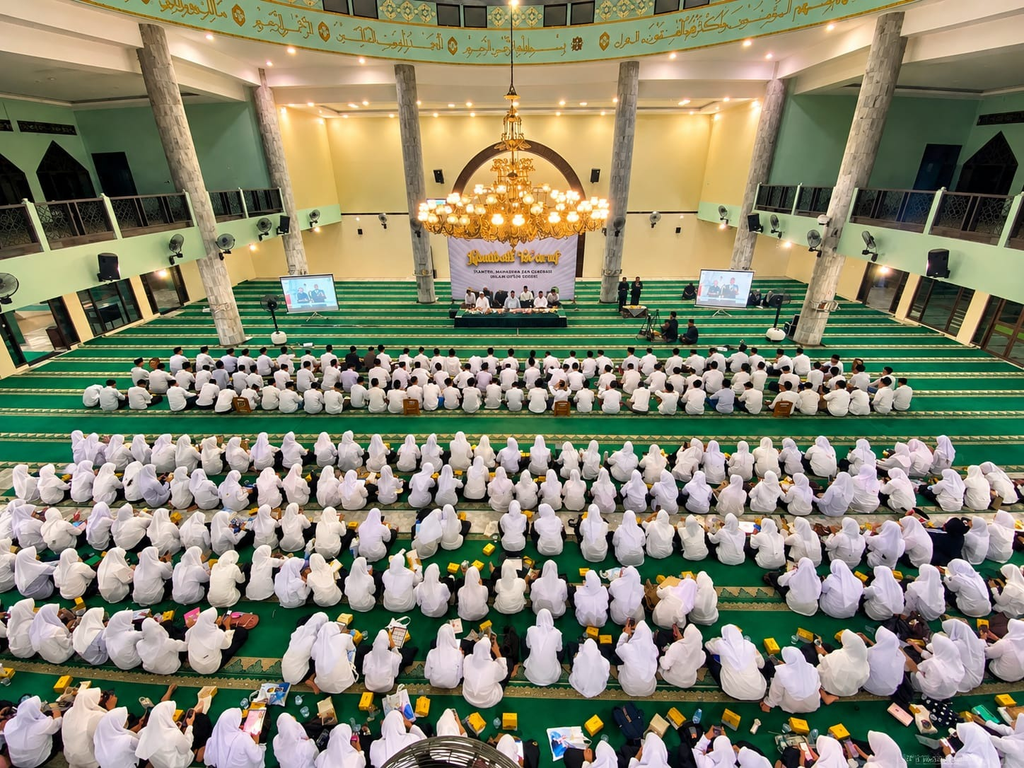
The mosque has sufficient capacity to accommodate large-scale activities involving members of the university community.
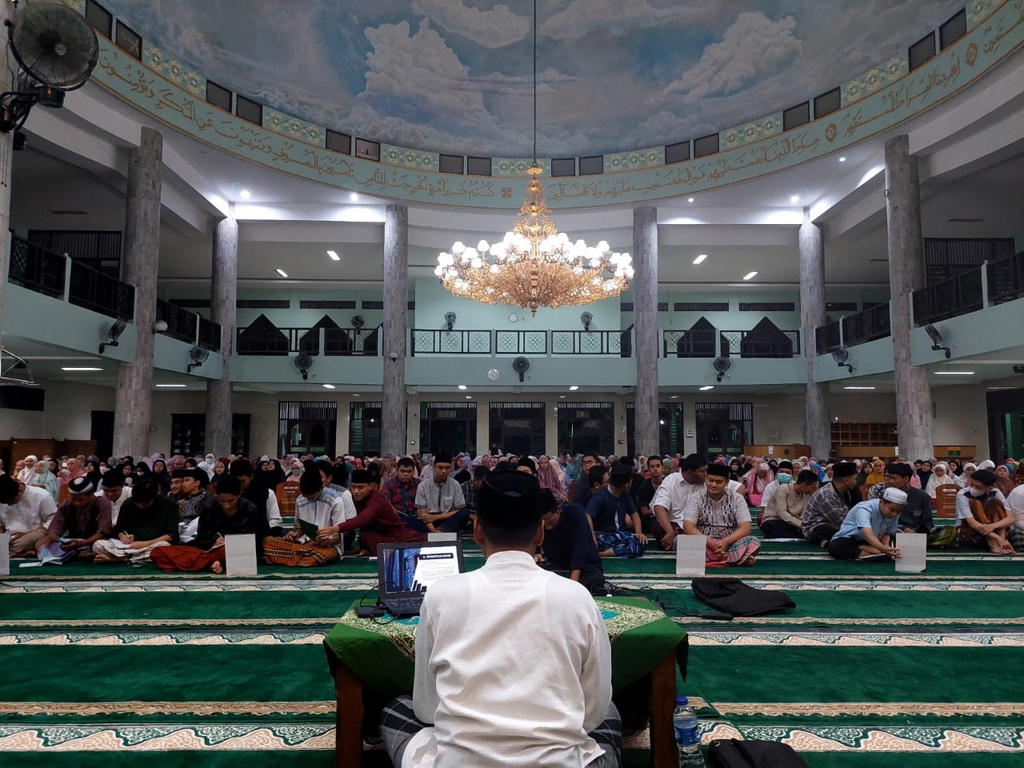
The photographic evidence shows large gatherings taking place inside Masjid Abu Bakar Assegaf, demonstrating its active role as a venue for collective religious and educational activities.
Public Religious and Cultural Engagement
Masjid Abu Bakar Assegaf connects university life with the surrounding community.
Public access enables community members to participate in religious activities alongside the university community.
This interaction supports:
- community engagement;
- preservation of religious traditions;
- public religious education;
- social interaction;
- transmission of Islamic values; and
- continuity of local religious culture.
The mosque therefore contributes to UNISSULA’s wider social and cultural role in Semarang.
Institutional Management and Mosque Services
Masjid Abu Bakar Assegaf is supported institutionally through UNISSULA’s Islamic development structure.
LKPI provides mosque-related services including:
- prayer schedules;
- religious-study information;
- Qur’anic learning;
- management of mosque activities; and
- Islamic character-development programmes.
This institutional management helps ensure that the culturally significant building remains active, maintained, and available for religious and educational use.
Continuing Religious Activities
The mosque continues to be actively used for university religious programmes.
UNISSULA documentation shows that Qur’anic teaching and student religious-development programmes continue to take place at Masjid Abu Bakar Assegaf.
This continuity demonstrates that the building remains an active part of the university’s contemporary cultural life while maintaining its historical role.
Cultural and Architectural Identity
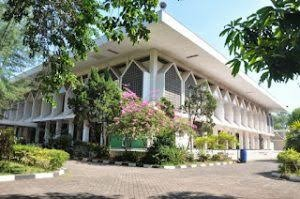
The mosque’s physical design also contributes to its significance within the university campus.
Its large prayer hall, Arabic calligraphic decoration, central chandelier, multi-level interior, and Islamic architectural elements contribute to the cultural and religious character of the building.
The mosque functions as a visible representation of UNISSULA’s identity as an Islamic university.
A Living Historical Building
Masjid Abu Bakar Assegaf is not preserved merely as a historical object.
It remains a living building, continuously used for worship, education, religious traditions, and community engagement.
This is particularly relevant to sustainable heritage because the cultural value of the building is maintained through continuous public use.
Public Access and Cultural Preservation
Providing free public access contributes directly to the preservation of the mosque’s cultural role.
Rather than restricting access, UNISSULA enables the wider community to experience and participate in the religious and cultural activities associated with the building.
The approach can be summarised as:
Historic and culturally significant building → Free public access → Worship and cultural activities → Community participation → Continuing cultural preservation
Relationship with SDG 11
UNISSULA’s public access to Masjid Abu Bakar Assegaf contributes to SDG 11: Sustainable Cities and Communities, particularly the protection and accessibility of cultural heritage.
Masjid Abu Bakar Assegaf provides a clear example of this contribution through its combination of historical significance, cultural function, continued use, and access for the wider community.
Evidence of Public Access and Cultural Significance
UNISSULA’s provision of public access to Masjid Abu Bakar Assegaf is demonstrated through the following evidence:
- Masjid Abu Bakar Assegaf is a historically significant university building, with UNISSULA documenting its quarter-century commemoration in 2016.
- The mosque forms an important part of UNISSULA’s Islamic institutional and cultural identity.
- UNISSULA publicly states that the mosque provides prayer space for students, lecturers, and the general public.
- Public access is free of charge for ordinary worship and public religious activities.
- The mosque functions as a centre for congregational prayer, Qur’anic learning, religious lectures, and Islamic character development.
- UNISSULA has held public religious lectures and religious commemorations at the mosque.
- The mosque continues to host Qur’anic education and religious-development programmes.
- Large religious and educational gatherings demonstrate continuing active use of the building.
- Its architecture and religious functions make the mosque a significant cultural and spiritual landmark within the university.
- Publicly available university webpages provide evidence of the mosque’s history, functions, activities, and public accessibility.