

















15.2.5 Sustainable Management of Land for Agriculture (Educational Outreach)
Universitas Islam Sultan Agung (UNISSULA) provides educational outreach for local agricultural communities on the sustainable management of agricultural land and production resources through training, technology transfer, practical mentoring, and community-based implementation.
In 2025, UNISSULA implemented a community-service programme in Kedungcino Village, Jepara Regency, focusing on the transformation of sustainable agriculture through smart hydroponic farming and green energy.
The programme worked directly with Oemahku Hydrofarm, a local hydroponic agricultural producer, and provided practical education on efficient agricultural land use, water and nutrient management, environmental monitoring, smart farming technology, automation, and renewable energy.
The educational and mentoring activities were provided free of charge to participating local agricultural partners.


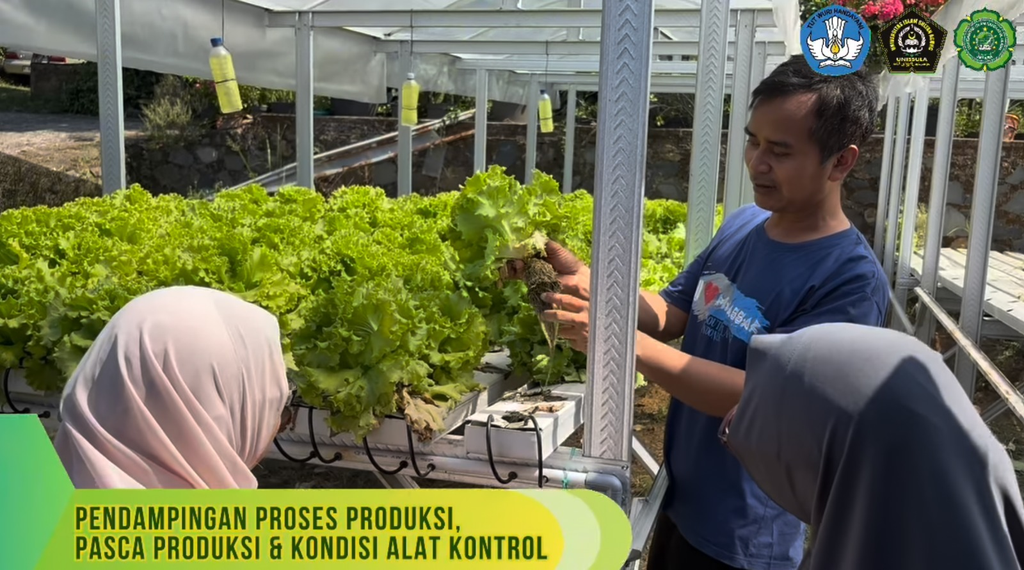


Sustainable Agricultural Management in Kedungcino
The 2025 programme was entitled “Transformasi Pertanian Berkelanjutan melalui Smart Hydroponic Farming dan Green Energy di Desa Kedungcino Kabupaten Jepara.”
The programme addressed challenges faced by local agricultural producers, including limited land availability, changing environmental conditions, manual monitoring of cultivation parameters, unstable nutrient management, water use, and dependence on conventional electricity.
Smart farming was introduced as an approach combining digital technology, Internet of Things (IoT), automation, and renewable energy to improve agricultural productivity and the efficiency of land management. 5099-Article Text-27852-1-10-20…
The programme therefore connected sustainable agricultural management with the practical management of land, water, nutrients, energy, and environmental conditions.
Public evidence:
https://ejournal.uniks.ac.id/index.php/bhakti_nagori/article/view/5099/3552
Educational Outreach to Local Agricultural Producers
The Kedungcino programme was implemented as a community-service activity involving direct interaction between university experts and a local agricultural producer.
The programme was carried out through technology transfer, intensive mentoring, implementation of smart-farming technology, training, and evaluation of programme sustainability.
The approach began with field observation and assessment of the existing greenhouse and nutrient-management system.
UNISSULA then developed and implemented technological solutions that were accompanied by practical education so that participants could understand, operate, and maintain the agricultural system themselves.
This represented educational outreach in a real agricultural production environment rather than education limited to classroom instruction.
Practical Training and Mentoring
Training was an integral part of the programme.
The participating agricultural partner received direct demonstrations on:
- Reading the smart-farming dashboard
- Monitoring temperature and humidity
- Setting environmental thresholds
- Monitoring nutrient conditions
- Using automatic nutrient controls
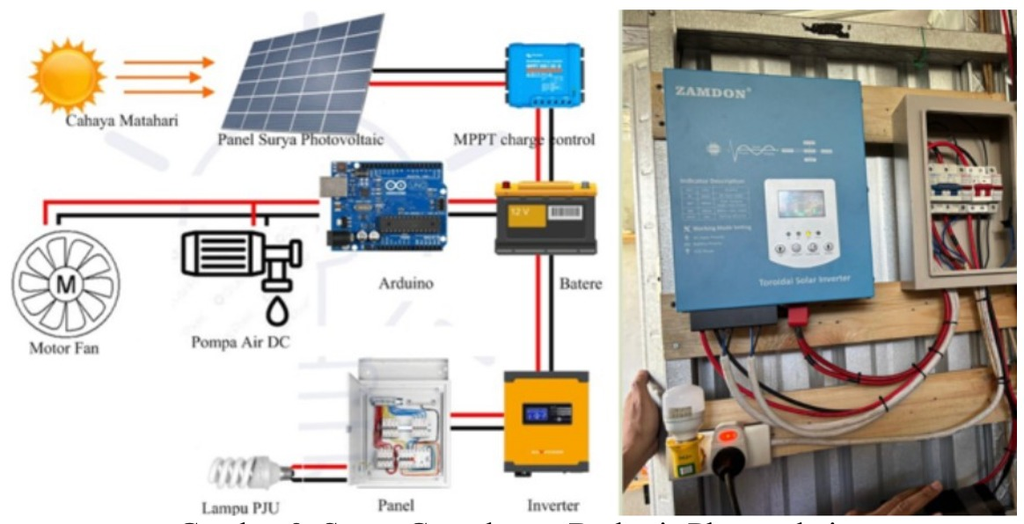
- Operating the photovoltaic system
- Maintaining agricultural technology
The owner and employees of Oemahku Hydrofarm were actively involved in the training so that technology transfer could be implemented effectively and the system could ultimately be operated independently.
The programme can therefore be described as:
University knowledge → practical demonstration → training → mentoring → agricultural application → independent local management
Supporting public documentation:
Efficient Management of Agricultural Land and Production Areas
The programme promoted more efficient use of agricultural production areas through smart hydroponic farming.
Oemahku Hydrofarm has more than 4,500 planting points, creating a need for effective management of cultivation space and production resources.
Smart hydroponic farming allows agricultural production to be managed systematically within available space while integrating monitoring and control of water, nutrients, temperature, humidity, and energy.
The programme therefore supported sustainable agricultural land management through:
Efficient agricultural space → controlled growing conditions → resource efficiency → stable production → sustainable farming
This approach is particularly relevant where agricultural land is limited and productivity must be balanced with responsible resource use.
Sustainable Water Management
Water efficiency was one of the direct outcomes of the programme.
The smart-farming system used more precise irrigation and environmental control to reduce unnecessary water consumption.
Implementation of the system resulted in a reported reduction in water use of up to 38% through precision irrigation.
This provides a practical example of how technology and farmer education can contribute to more sustainable management of agricultural resources.
The programme helped participants understand that agricultural productivity can be improved while reducing unnecessary pressure on water resources.
Sustainable Nutrient Management
Nutrient management was another important component of the educational programme.
Before the intervention, nutrient concentrations were monitored manually through pH and TDS measurements, making agricultural management highly dependent on regular manual checking.
UNISSULA introduced automatic monitoring and control technologies using pH and TDS sensors.
The system allows nutrient conditions to be monitored more consistently and enables automatic adjustment when necessary.
This provides local agricultural producers with practical knowledge about managing agricultural inputs more efficiently.
Environmental Monitoring through Smart Farming
The programme introduced an IoT-based environmental monitoring system to improve agricultural management.
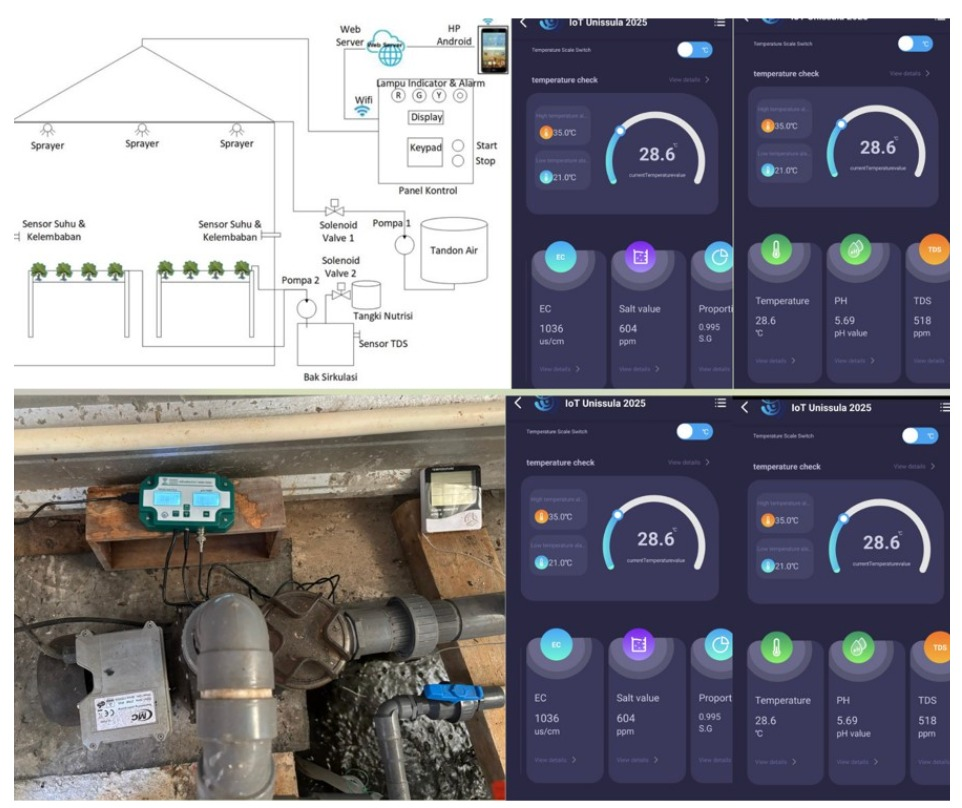
The system monitors:
- Temperature
- Humidity
- pH
- Total Dissolved Solids (TDS)
These parameters can be monitored in real time through a smartphone-based dashboard.
Farmers can observe greenhouse conditions remotely and respond when environmental parameters move beyond the desired range.
This allows agricultural management decisions to be based on actual cultivation conditions rather than relying solely on manual observation.
The educational programme therefore strengthened local knowledge of data-informed and technology-supported agriculture.
Renewable Energy for Agricultural Production
The sustainable-agriculture programme also introduced renewable energy.
A 500 Wp photovoltaic system was installed to provide an alternative source of electricity for the agricultural control system, nutrient pumps, and IoT monitoring equipment.
The photovoltaic system helps maintain agricultural operations during interruptions to conventional electricity.
The programme reported a reduction of approximately 65% in dependence on electricity from the conventional grid through integration of photovoltaic technology.
This demonstrates how sustainable agricultural management can integrate renewable energy with food-production systems.
Connecting Water, Nutrients, Energy, and Agricultural Land
The Kedungcino programme treats sustainable agriculture as an integrated management process.
The approach connects:
Agricultural land and production space → water efficiency → nutrient management → environmental monitoring → renewable energy → farmer knowledge
These elements are managed together rather than separately.
The result is an agricultural system designed to use available resources more efficiently while maintaining productive growing conditions.
The programme therefore provides a practical example of sustainable agricultural management that local producers can directly observe, learn, and apply.
Building Local Capacity
The educational outreach was designed to ensure that participants could continue using the technology after the period of direct university assistance.
Following training and mentoring, participants were able to operate the IoT system, adjust environmental parameters, and carry out basic maintenance of photovoltaic panels and batteries.
This capacity-building approach is important because sustainable agricultural technology requires local knowledge for long-term operation and maintenance.
UNISSULA therefore did not simply provide technological equipment.
The programme transferred knowledge and practical skills so that the local agricultural partner could manage the system independently.
Measurable Outcomes of the Programme
The 2025 community programme produced measurable agricultural and environmental outcomes.
Implementation of smart farming resulted in:
- Up to 38% reduction in water use through precision irrigation
- Approximately 22% improvement in plant growth associated with more stable nutrient conditions
- Approximately 65% reduction in dependence on conventional grid electricity through photovoltaic integration
- Improved farmer decision-making through real-time IoT monitoring
These outcomes demonstrate that the programme combined education with practical improvements in sustainable agricultural management.
Free Educational Access for the Local Community
The educational outreach, training, demonstrations, technology transfer, and mentoring were provided free of charge to participating local agricultural partners.
No participation or training fee was required from the beneficiaries.
The activity formed part of a community partnership programme supported through the 2025 Community Partnership Service Incentive Programme.
The published programme records that the community-service activities were funded by the Directorate General of Higher Education, Research, and Technology for the 2025 budget year.
Free participation enabled the local agricultural community to access university knowledge, mentoring, and agricultural technology without a financial barrier.
Supporting the Continuity of Sustainable Agricultural Practices
The programme also emphasised the long-term continuation of sustainable agricultural practices.
Participants and farmer groups were encouraged to continue capacity development through further training on the operation and maintenance of smart-farming technologies.
Regular monitoring of sensors and renewable-energy systems was also recommended to maintain the performance of the agricultural system.
This creates the potential for the knowledge and technologies introduced through the programme to continue benefiting agricultural communities beyond the initial outreach period.
Public Evidence
The implementation and outcomes of the 2025 sustainable-agriculture outreach programme are publicly documented in a peer-reviewed community-service publication:
https://ejournal.uniks.ac.id/index.php/bhakti_nagori/article/view/5099/3552
DOI:
https://doi.org/10.36378/bhakti_nagori.v5i2.5099
Supporting video documentation of the programme and technology implementation is publicly available at:
Evidence of Implementation
- UNISSULA implemented a sustainable-agriculture community-service programme in Kedungcino Village, Jepara Regency, in 2025.
- The programme directly involved a local agricultural producer, Oemahku Hydrofarm.
- The programme specifically addressed sustainable agricultural management through smart hydroponic farming, efficient use of agricultural production areas, water management, nutrient management, environmental monitoring, automation, and renewable energy.
- Educational outreach was delivered through direct demonstrations, practical training, technology transfer, and intensive mentoring.
- Local participants were trained to monitor and manage temperature, humidity, pH, TDS, nutrient conditions, IoT systems, and photovoltaic technology.
- The programme reduced water use by up to 38% through precision irrigation.
- Photovoltaic integration reduced dependence on conventional grid electricity by approximately 65%.
- Participants developed the capacity to operate and maintain key smart-farming technologies independently.
- Educational outreach and participation were provided free of charge to the local agricultural participants.
- The programme and its implementation are publicly documented through a peer-reviewed 2025 community-service publication and supporting video documentation.