

















15.2.3 Direct Action to Maintain and Extend Coastal Ecosystems and Biodiversity
Universitas Islam Sultan Agung (UNISSULA) undertakes direct environmental action to maintain and extend existing ecosystems and their biodiversity through coastal restoration, mangrove planting, student engagement, and community collaboration.
In 2025, UNISSULA participated in direct mangrove conservation activities in Tambakrejo and Mangkang, Semarang. These activities focused on strengthening existing coastal ecosystems through the planting of mangrove vegetation and supporting the ecological functions of habitats that sustain both plant and animal biodiversity.
The activities were carried out in coastal areas facing environmental pressures such as abrasion, climate-related impacts, and degradation of coastal vegetation.
Direct Coastal Restoration in Tambakrejo
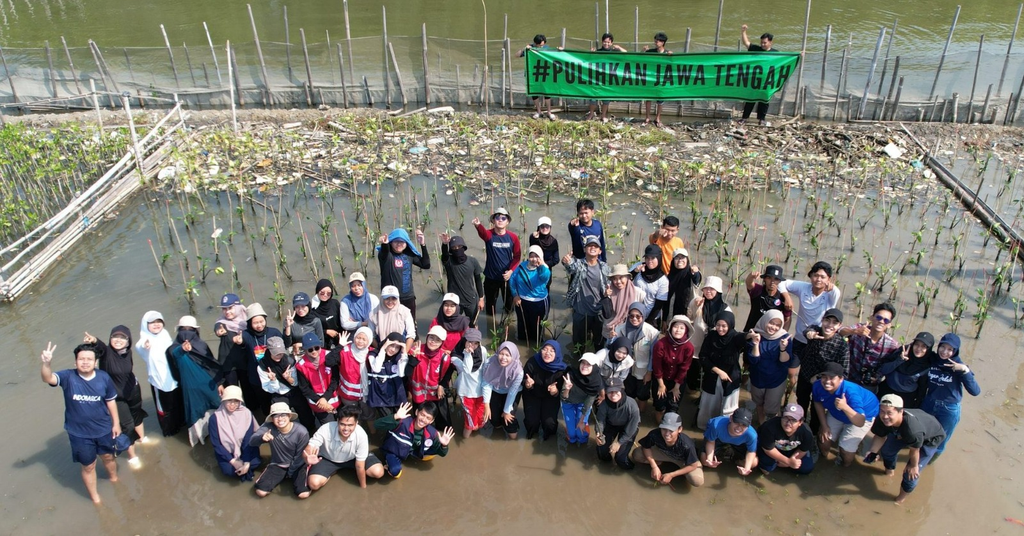
On 27 July 2025, a coastal restoration activity was conducted at Kampung Nelayan Tambakrejo, Semarang, as part of World Mangrove Day.
The programme was organised by WALHI Central Java together with Kelompok Mangrove Nusantara and Ikatan Remaja Tambakrejo and involved multiple community and student organisations, including Fikomedia UNISSULA.
The activity represented direct field-based ecosystem restoration rather than only environmental education or discussion.
A total of 1,200 Rhizophora mangrove seedlings were planted in the existing coastal ecosystem. The planting involved approximately 60 participants consisting of local residents, young people, university students, and volunteers.
Public evidence:
Maintaining an Existing Mangrove Ecosystem
The Tambakrejo activity was conducted within an established coastal mangrove environment.
The objective was not to create an artificial ecosystem disconnected from the surrounding landscape, but to contribute additional mangrove vegetation to an existing coastal ecosystem.
This approach supports both maintenance and extension of the ecosystem.
Maintenance occurs through the protection and restoration of existing coastal habitat, while extension is supported by planting additional mangrove seedlings within the affected area.
The intervention can therefore be described as:
Existing mangrove ecosystem → restoration activity → additional mangrove vegetation → strengthened habitat → continued biodiversity support
Responding to an Ecosystem Under Environmental Pressure
Tambakrejo is particularly relevant because the restoration activity explicitly responds to environmental threats affecting the coastal ecosystem.
The 2025 programme described mangrove restoration as an effort to strengthen coastal ecosystem resilience against abrasion and the climate crisis.
This makes the activity particularly important for environmentally vulnerable land and coastal habitats.
Mangrove vegetation helps maintain the physical structure of the coastline while supporting wider ecological functions within the terrestrial–aquatic transition zone.
Extending Plant Biodiversity and Vegetation
Plant biodiversity is directly supported through mangrove restoration.
The Tambakrejo programme planted Rhizophora mangroves, adding new vegetation to the existing ecosystem.
Increasing mangrove vegetation helps maintain habitat structure and strengthens the continuity of the coastal ecosystem.
UNISSULA’s participation in such restoration therefore represents direct action affecting the plant component of biodiversity rather than only research or awareness raising.
Supporting Animal Biodiversity Through Habitat Protection
Mangrove ecosystems support more than plant communities.
Their root systems, vegetation structure, mudflats, and surrounding waters provide habitat, shelter, feeding areas, and nursery environments for various coastal organisms.
For this reason, restoring mangrove vegetation also contributes to maintaining the habitat conditions required by animal biodiversity.
UNISSULA does not treat the planting activity as evidence that animal populations automatically increased. Rather, the restoration helps maintain and extend habitat capable of supporting animal biodiversity within the existing coastal ecosystem.
This distinction is important because biodiversity conservation requires protecting the ecological conditions on which both plants and animals depend.
Collaboration with Local Communities
The Tambakrejo restoration involved local residents and youth organisations as active participants.
The programme was linked with the establishment of Kelompok Mangrove Nusantara, a local initiative focused on coastal environmental protection and restoration. A mangrove planting map was also launched to support documentation and future planting activities.
The involvement of residents, students, volunteers, environmental organisations, and local groups strengthens the sustainability of ecosystem restoration because long-term conservation depends on continued local stewardship.
Additional Direct Mangrove Planting in Mangkang
UNISSULA’s direct action in 2025 was not limited to Tambakrejo.
Students from the Faculty of Industrial Technology (FTI) UNISSULA also conducted mangrove planting in Mangkang, Semarang, as part of the Student Management Skills Training programme for the 2025 cohort.
Approximately 70 students participated in the programme, which was organised by the FTI Student Executive Board. During the community-service component, students travelled to the Mangkang coastal area and directly planted mangrove trees along the shoreline.
The activity was accompanied by the Vice Dean I of FTI UNISSULA, demonstrating institutional support for the conservation activity.
Public evidence:
https://fti.unissula.ac.id/kegiatan-lkmm-bagi-mahasiswa-angkatan-2025
Strengthening Coastal Vegetation in Mangkang
The Mangkang activity provided another direct intervention in an existing coastal ecosystem.
Rather than only promoting conservation awareness, students physically participated in planting mangrove trees.
This activity contributes to maintaining vegetation cover and extending mangrove habitat within the coastal environment.
The Mangkang activity therefore complements the Tambakrejo restoration by demonstrating direct conservation action in more than one coastal location.
Multiple Forms of Direct Ecosystem Action
The two 2025 activities demonstrate complementary approaches.
In Tambakrejo, UNISSULA participated alongside local communities and environmental organisations in a coordinated coastal restoration programme involving 1,200 mangrove seedlings.
In Mangkang, FTI UNISSULA students directly participated in mangrove planting as part of a community-oriented university programme.
Together, the activities demonstrate:
Direct planting → maintenance of existing vegetation → extension of mangrove habitat → protection of ecological functions → biodiversity support
This is different from activities consisting only of seminars, publications, or environmental campaigns because the work physically affects the ecosystem itself.
Supporting Research on Mangrove Management
Direct restoration activities are complemented by UNISSULA’s academic work on mangrove ecosystem management.
A 2025 UNISSULA study examined Mangrove Edupark Tambakrejo and community participation in its management.
The study highlights the role of the mangrove environment in protecting northern Semarang from abrasion and tidal waves and emphasises the importance of community participation in maintaining and developing mangrove diversity. Unissula Repository
Public evidence:
https://repository.unissula.ac.id/46641
This research provides supporting ecological and management context for the university’s direct conservation activities.
However, the research is treated as supporting evidence; the principal evidence of implementation remains the direct field restoration and mangrove planting carried out in 2025.
Linking Research, Community Engagement, and Direct Conservation
UNISSULA’s approach combines three complementary functions.
Research contributes knowledge about mangrove ecosystems and community participation.
Community engagement connects university activities with residents and local organisations.
Direct conservation action physically maintains and extends vegetation and habitat.
These elements can be represented as:
Knowledge → collaboration → direct restoration → habitat maintenance → biodiversity conservation
The combination strengthens the university’s contribution to the conservation of ecosystems outside its own campus boundaries.
Protecting Existing Ecosystems Rather Than Replacing Them
An important principle of UNISSULA’s conservation activities is that restoration takes place within existing natural or semi-natural ecosystems.
Mangrove planting in Tambakrejo and Mangkang supports ecological continuity rather than converting the areas to unrelated land uses.
The activities therefore contribute to maintaining ecosystem functions while extending vegetation within environmentally sensitive coastal landscapes.
Maintaining Biodiversity of Plants and Animals
The ecological value of mangrove restoration extends across different components of biodiversity.
For plants, direct planting increases and maintains mangrove vegetation.
For animals, maintaining mangrove structure helps preserve habitat conditions used by coastal and aquatic fauna.
For the ecosystem as a whole, mangrove restoration supports the interactions among vegetation, soil, water, coastal organisms, and surrounding communities.
UNISSULA’s direct conservation approach therefore addresses biodiversity at both the habitat and ecosystem levels.
Evidence of Implementation
- UNISSULA participated directly in the Tambakrejo Coastal Restoration programme on 27 July 2025 through Fikomedia UNISSULA.
- The Tambakrejo restoration resulted in the planting of 1,200 Rhizophora mangrove seedlings within an existing coastal ecosystem.
- The activity involved 60 local residents, young people, students, and volunteers, demonstrating direct collaborative ecosystem restoration.
- The restoration specifically addressed a coastal ecosystem threatened by abrasion and climate-related pressures.
- Mangrove planting directly maintains and extends plant vegetation while protecting habitat conditions that support animal biodiversity.
- FTI UNISSULA students also conducted direct mangrove planting in Mangkang during the 2025 student programme, providing a second example of direct ecosystem conservation activity.
- Approximately 70 students participated in the FTI programme, with the mangrove activity conducted as a community-service component.
- The Mangkang activity was institutionally supported and accompanied by the Vice Dean I of FTI UNISSULA.
- UNISSULA’s 2025 research on Mangrove Edupark Tambakrejo provides additional evidence supporting community-based mangrove management and the maintenance of mangrove diversity.