

















2.2.1 Campus Food Waste Tracking
University-Wide Food Waste Measurement and Monitoring
Universitas Islam Sultan Agung (UNISSULA) systematically measures and monitors food waste generated across the university as part of its environmental sustainability and waste-management practices.
Throughout the 2025 reporting period, food waste was recorded monthly through the UNISSULA Waste Monitor, a digital monitoring system that separates food waste from other campus waste streams, including garden waste and other waste.
Based on monthly monitoring from January to December 2025, UNISSULA recorded a total of 63,050 kg of food waste, equivalent to 63.05 metric tonnes.
The availability of monthly quantitative data enables UNISSULA to monitor changes in food-waste generation, identify trends, evaluate waste-management performance, and support the development of future food-waste reduction initiatives.
Digital Food Waste Monitoring System
UNISSULA operates a digital Waste Monitor to record campus waste generation according to waste type and reporting period.
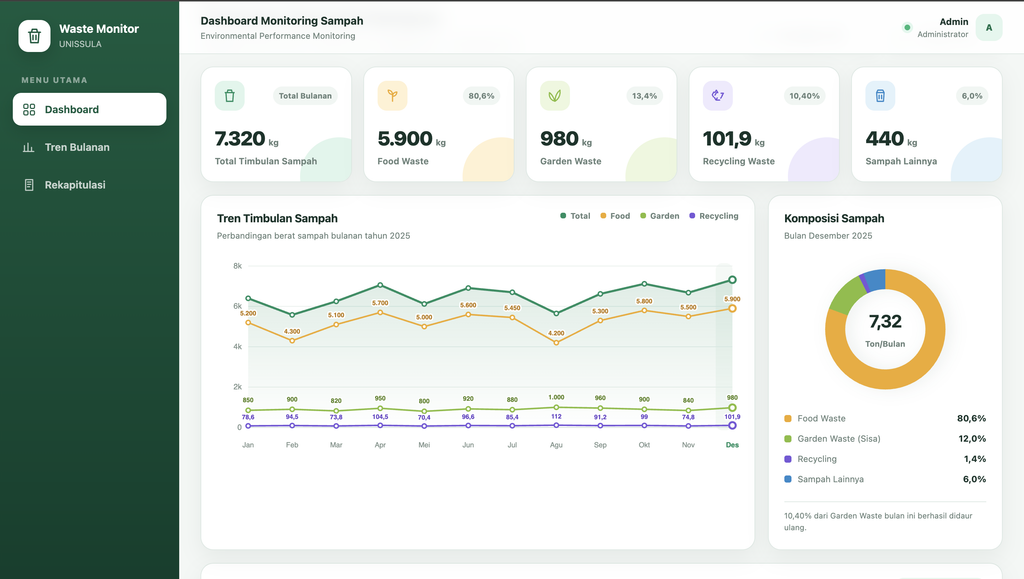
The monitoring system distinguishes between:
- Food Waste;
- Garden Waste;
- Other Waste; and
- Total Waste Generated.
Food waste is recorded separately in kilograms, allowing it to be measured independently from garden waste and other waste categories.
The system also provides monthly trend information covering the full reporting period from January to December 2025.
This separation enables UNISSULA to monitor food waste as a distinct waste stream rather than combining it with general organic waste, thereby improving the accuracy and transparency of institutional waste reporting.
Monthly Food Waste Measurement in 2025
UNISSULA recorded food waste every month throughout the 2025 reporting year.
| Month | Food Waste |
|---|---|
| January | 5,200 kg |
| February | 4,300 kg |
| March | 5,100 kg |
| April | 5,700 kg |
| May | 5,000 kg |
| June | 5,600 kg |
| July | 5,450 kg |
| August | 4,200 kg |
| September | 5,300 kg |
| October | 5,800 kg |
| November | 5,500 kg |
| December | 5,900 kg |
| Total 2025 | 63,050 kg |
| Total in Metric Tonnes | 63.05 metric tonnes |
The monthly records demonstrate continuous food-waste measurement throughout the reporting year rather than measurement at only a single point in time.
2025 Food Waste Measurement Summary
| Indicator | 2025 Result |
|---|---|
| Measurement coverage | University-wide |
| Monitoring period | January–December 2025 |
| Measurement frequency | Monthly |
| Number of monthly records | 12 months |
| Total food waste | 63,050 kg |
| Total food waste in metric tonnes | 63.05 metric tonnes |
| Monitoring system | UNISSULA Waste Monitor |
The annual total is calculated from the monthly food-waste records maintained through the university’s digital monitoring system.
Food Waste as a Distinct Waste Stream
UNISSULA differentiates food waste from other waste generated across the campus.
Food waste monitored through the system includes discarded food arising from food-service and food-consumption activities, such as:
- uneaten food;
- meal leftovers;
- food-preparation residues;
- spoiled or unusable food ingredients; and
- other discarded food materials.
Garden waste is recorded separately and is therefore not included in the food-waste total.
This distinction improves the reliability of food-waste measurement and enables UNISSULA to monitor food-related waste independently from leaves, landscaping materials, and other garden waste.
Example of Monthly Waste Composition
The December 2025 monitoring record illustrates how the system separates different campus waste streams.
| Waste Category | December 2025 | Share |
|---|---|---|
| Food Waste | 5,900 kg | 80.6% |
| Garden Waste | 980 kg | 13.4% |
| Other Waste | 440 kg | 6.0% |
| Total Waste Generated | 7,320 kg | 100% |
The December record demonstrates that food waste is quantitatively recorded as a separate category within UNISSULA’s waste-monitoring system.
Similar monthly monitoring is maintained throughout the reporting year.
Food Waste Monitoring Process
UNISSULA integrates food-waste measurement into its broader campus waste-management system.
The monitoring process includes:
- identifying sources of food waste;
- separating food waste from other waste streams;
- collecting food waste from designated areas;
- measuring the amount generated;
- recording measurements in kilograms;
- consolidating monthly food-waste data;
- monitoring trends throughout the year; and
- using the information for sustainability evaluation and improvement.
This process provides a quantitative basis for campus food-waste management and supports evidence-based sustainability planning.
Waste Segregation Infrastructure
Food-waste tracking is supported by waste-segregation infrastructure across UNISSULA.
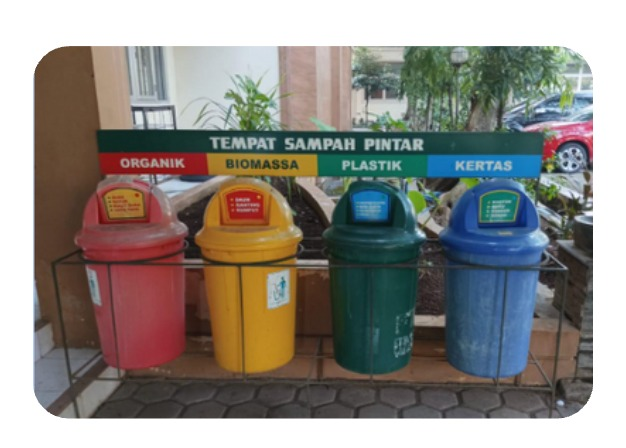
Designated waste containers are provided for different waste categories, including:
- organic waste;
- biomass;
- plastic; and
- paper.
Segregation at source helps prevent different waste streams from being mixed and supports more accurate collection, classification, and measurement.
Combined with the digital monitoring system, this infrastructure enables UNISSULA to maintain more reliable and structured waste data.
Monitoring Monthly Trends
Continuous monthly monitoring enables UNISSULA to observe variations in food-waste generation over time.
During 2025, monthly food waste ranged from:
- 4,200 kg in August, the lowest monthly value; to
- 5,900 kg in December, the highest monthly value.
These variations can be evaluated alongside university activities, food-service operations, academic schedules, and other factors that may influence campus food consumption.
Maintaining monthly records also enables UNISSULA to compare food-waste performance across future reporting periods.
Use of Food Waste Data
UNISSULA uses quantitative food-waste data to support environmental management and sustainability evaluation.
The data provide a basis for:
- monitoring food-waste generation;
- comparing monthly performance;
- identifying changes and trends;
- evaluating food-service waste patterns;
- improving waste-segregation practices;
- identifying opportunities for reducing food waste;
- evaluating future interventions; and
- supporting institutional sustainability reporting.
The 63.05 metric tonnes of food waste recorded in 2025 therefore serves as an institutional baseline against which future food-waste performance can be compared.
Data-Based Waste Management
UNISSULA’s food-waste management approach is based on measurable data rather than qualitative observation alone.
The digital monitoring system provides three key elements:
Separate food-waste classification → Monthly quantitative measurement → Annual data consolidation
This approach enables the university to establish a clear and measurable record of the quantity of food waste generated during the reporting period.
The system also enables UNISSULA to distinguish food waste from other forms of waste, particularly garden waste, thereby improving the accuracy and transparency of institutional food-waste reporting.
Continuous Improvement
UNISSULA continues to strengthen its food-waste monitoring and management practices.
Future development includes:
- maintaining consistent monthly measurement;
- strengthening digital data management;
- improving source-based tracking;
- evaluating food waste by food-service location;
- comparing annual food-waste performance;
- identifying areas with higher food-waste generation; and
- developing measurable food-waste reduction initiatives.
Long-term monitoring will enable the university to evaluate whether future interventions result in measurable reductions in food-waste generation.
Institutional Commitment to Food Waste Tracking
UNISSULA recognises that effective food-waste management requires consistent, reliable, and measurable data.
By maintaining monthly food-waste records, separating food waste from other waste streams, consolidating annual data, and using a digital monitoring system, the university establishes an evidence-based framework for food-waste management.
This approach enables UNISSULA to move beyond one-time measurement and maintain a continuous monitoring system that can support future reduction targets, waste-management improvements, and sustainability reporting.
Evidence of Implementation
UNISSULA’s food-waste tracking system is demonstrated through the following institutional evidence:
- A dedicated UNISSULA Waste Monitor for digital campus waste measurement.
- Monthly food-waste measurements from January to December 2025.
- A total of 63,050 kg (63.05 metric tonnes) of food waste recorded in 2025.
- Separate quantitative recording of Food Waste, Garden Waste, and Other Waste.
- Food-waste measurements recorded in kilograms.
- Monthly trend monitoring across the entire 2025 reporting period.
- Waste-composition monitoring by category.
- Campus waste-segregation infrastructure supporting source separation and waste classification.
- Consolidation and use of quantitative food-waste data for sustainability monitoring, evaluation, and future reduction planning.