


















1.3.1 Admission Target for Students from the Bottom 20% of Household Income Groups
Universitas Islam Sultan Agung (UNISSULA) is committed to widening participation in higher education by ensuring that students from economically disadvantaged households have meaningful access to university education. This commitment forms part of the university’s broader approach to inclusive and equitable higher education, particularly for prospective students whose financial circumstances may otherwise limit their ability to enter and continue university study.
UNISSULA implements a targeted admission and financial-support approach for prospective students from low-income households, including applicants who fall within, or are equivalent to, the lowest socioeconomic groups identified through nationally recognised social-protection and higher-education assistance mechanisms.
The purpose of this approach is to ensure that qualified students from the most economically vulnerable groups are represented within the university’s incoming student population and are provided with sufficient support to overcome financial barriers to higher education.
Targeted Admission for Economically Disadvantaged Students
A principal mechanism used by UNISSULA to implement this commitment is the Kartu Indonesia Pintar Kuliah (KIP Kuliah) admission and financial-support pathway.
KIP Kuliah is intended for students who demonstrate academic potential but face financial limitations. UNISSULA’s official Rector Decrees explicitly recognise the programme as part of the university’s efforts to improve fairness and access to higher education for students with limited economic capacity.
Through this mechanism, UNISSULA identifies prospective students from economically vulnerable households using recognised socioeconomic criteria and supporting documentation. These criteria enable the university to distinguish applicants who require targeted financial support from those applying through the general admission process.
In line with UNISSULA’s widening-participation objective, this targeted admission mechanism is directed toward prospective students from the lowest-income households, including students from the bottom 20% of household income groups, where identified through nationally recognised socioeconomic and social-protection criteria, as well as more tightly defined poverty-based categories..
The use of a dedicated mechanism ensures that access to higher education is not based solely on academic eligibility, but also takes socioeconomic disadvantage into account where appropriate.
Use of Nationally Recognised Low-Income Criteria
UNISSULA uses nationally recognised social-protection and economic-vulnerability mechanisms to identify students requiring targeted support.
Eligibility for KIP Kuliah is associated with conditions demonstrating limited economic capacity and documented financial need. Through this approach, the university is able to identify and support students from households facing significant socioeconomic disadvantage.
In the context of SDG 1.3.1, these nationally recognised low-income categories provide a practical institutional mechanism for identifying students who represent, or are equivalent to, the lowest household-income groups.
UNISSULA therefore uses these criteria as part of its widening-participation strategy to increase access for students from lower socioeconomic backgrounds, including students corresponding to the bottom 20% of household income groups or equivalent nationally recognised low-income categories.
Formal Institutional Implementation
UNISSULA formalises the implementation of its targeted admission and financial-support mechanism through official Rector Decrees.
Rector Decree No. 7500/F/SA/VIII/2025 formally establishes recipients of the KIP Kuliah programme among new students admitted to UNISSULA in 2025. The decree confirms that the listed students are officially designated as KIP Kuliah beneficiaries within the university’s new-student admission framework.
In addition, Rector Decree No. 10263/F/SA/X/2025 establishes additional KIP Kuliah recipients under the Usulan Masyarakat (USMAS) scheme for new students admitted in 2025.
These Rector Decrees provide formal institutional evidence that UNISSULA has an organised mechanism for identifying, admitting, and supporting students from economically disadvantaged backgrounds.
The existence of these formal decisions demonstrates that support for low-income students is not implemented on an ad hoc basis, but through a structured, documented, and institutionally recognised process.
Financial Support Linked to Admission
The targeted admission mechanism is directly connected to substantial financial assistance for eligible students.
Under the KIP Kuliah programme, recipients receive education-cost assistance according to the programme of study. The official Rector Decrees specify tuition support at different levels, including funding of up to IDR 15,000,000 per student per semester for certain programmes.
In addition to tuition assistance, KIP Kuliah recipients are also eligible to receive living-cost assistance in accordance with applicable national programme regulations.
This combination of admission access, tuition assistance, and living-cost support helps reduce the financial barriers that may otherwise prevent students from lower-income households from entering, participating in, and completing higher education.
Institutional Commitment to Widening Participation
UNISSULA’s approach goes beyond the provision of general scholarships. The university maintains a dedicated mechanism that connects admission, socioeconomic eligibility, official beneficiary designation, and financial assistance.
This structure supports the university’s institutional objective of widening access for economically vulnerable students and increasing their participation in higher education.
By using recognised indicators of economic disadvantage, UNISSULA seeks to ensure that prospective students from the lowest-income groups receive specific consideration and appropriate support within the admission and financial-aid process.
This approach is consistent with the university’s broader commitment to inclusive education, equal opportunity, and reducing socioeconomic inequality in access to higher education.
Monitoring and Continuity
UNISSULA regularly implements and documents its support for economically disadvantaged students through its admission and financial-aid processes.
The university records KIP Kuliah recipients through official Rector Decrees, maintains formal lists of beneficiaries, and integrates the programme into its new-student admission and student-support systems.
This recurring process enables UNISSULA to monitor the participation of students from low-income households and to evaluate the implementation of its targeted admission and financial-support mechanisms over time.
UNISSULA continues to strengthen this approach by ensuring that low-income and economically vulnerable applicants can be identified, admitted, and supported through clearly defined institutional procedures.
Evidence of Implementation
UNISSULA’s targeted admission and financial-support approach for economically disadvantaged students is supported by formal institutional evidence, including:
- Rector Decree No. 7500/F/SA/VIII/2025 concerning the designation of KIP Kuliah recipients among new students admitted to UNISSULA in 2025.
- Rector Decree No. 10263/F/SA/X/2025 concerning the designation of KIP Kuliah recipients under the Usulan Masyarakat (USMAS) scheme for new students admitted to UNISSULA in 2025.
KIP Kuliah Scholarship
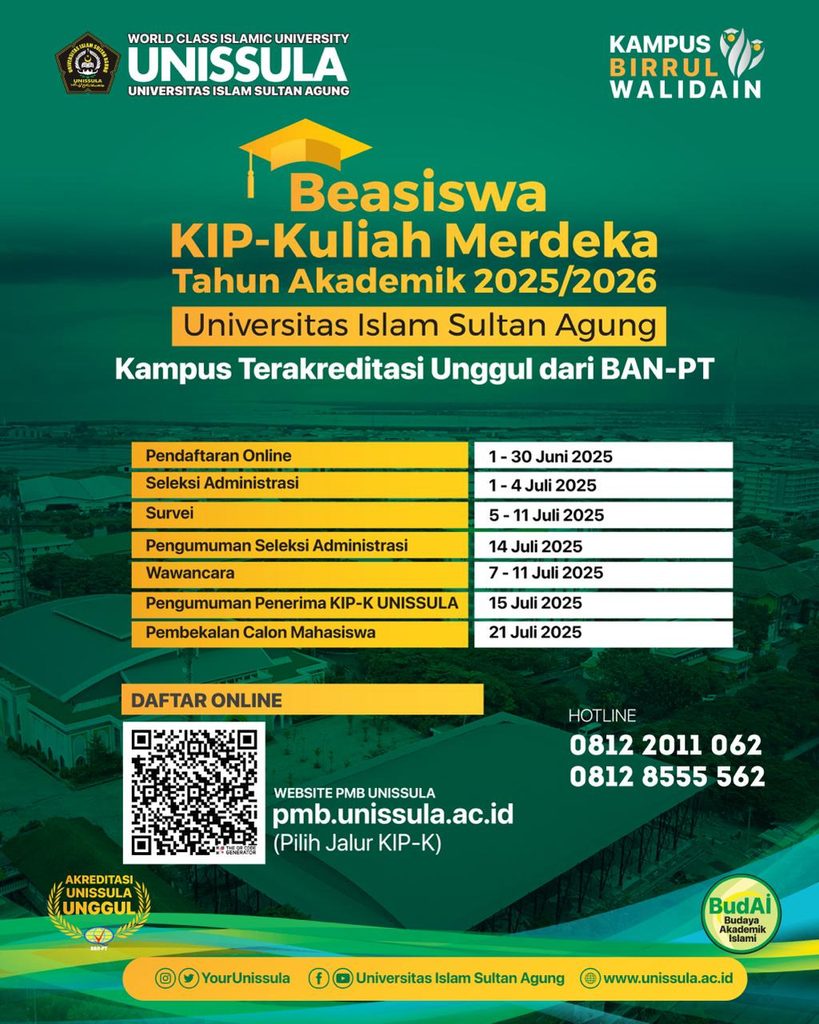
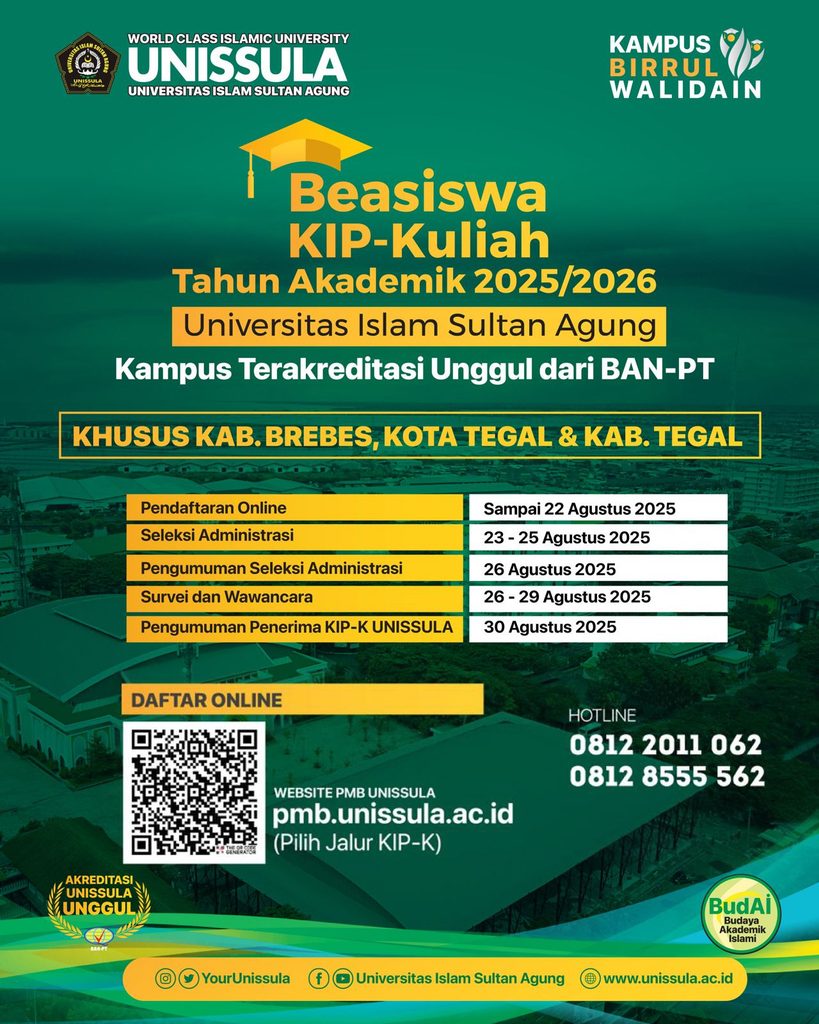
Universitas Islam Sultan Agung (UNISSULA) also implements the Kartu Indonesia Pintar (KIP) Kuliah Scholarship, a government-funded financial assistance programme intended to support students from low-income and economically disadvantaged families. The programme is implemented through a dedicated admission and selection process for eligible prospective students and continues to serve as one of UNISSULA’s main mechanisms for expanding equitable access to higher education.
Through the KIP Kuliah programme, verified recipients receive financial assistance in the form of tuition support and living-cost allowances in accordance with applicable government regulations. This support helps reduce the financial burden faced by students from economically vulnerable households and enables them to continue their studies without being hindered by tuition and basic living expenses.
By consistently participating in and implementing the KIP Kuliah programme, UNISSULA reinforces its commitment to ensuring that students from low-income households, including those within the bottom financial quintile, have greater opportunities to access, participate in, and successfully complete higher education.
Source :
Regular Admission Pathway with 50% DPI Discount
Universitas Islam Sultan Agung (UNISSULA) provides a Regular Admission Pathway with a 50% discount on the Institutional Development Fee (Dana Pengembangan Institusi/DPI) as part of its effort to improve affordability and widen access to higher education. This financial incentive is available to eligible prospective students who register through the regular admission scheme in accordance with the university’s admission policies and applicable terms and conditions.
The 50% DPI discount is designed to reduce the initial financial burden associated with university enrolment, particularly for families who may face constraints in meeting upfront education costs. By lowering a significant component of the admission fee, UNISSULA enables a broader range of prospective students to consider and access higher education opportunities.
This initiative complements UNISSULA’s broader financial support framework, including scholarships and other tuition assistance schemes. Through the provision of admission fee reductions under the regular pathway, UNISSULA demonstrates its commitment to creating a more inclusive and accessible admissions system while supporting students from diverse socioeconomic backgrounds.
Source :
Independent Achievement Admission Pathway with 50% DPI Discount
Universitas Islam Sultan Agung (UNISSULA) provides an Independent Achievement Admission Pathway for prospective students who demonstrate outstanding academic or non-academic achievements. This pathway is designed to recognise student potential while providing greater opportunities for high-achieving applicants to access higher education at UNISSULA.
As part of this admission scheme, eligible applicants receive a 50% discount on the Institutional Development Fee (Dana Pengembangan Institusi/DPI). The reduction in DPI helps lower the initial financial burden of university enrolment and makes higher education more accessible for talented students from diverse socioeconomic backgrounds.
The Independent Achievement Admission Pathway reflects UNISSULA’s commitment to combining merit-based admission with financial support. By recognising student achievement and providing a substantial reduction in admission-related costs, UNISSULA encourages talented prospective students to continue their education without being disproportionately constrained by financial considerations.
This initiative complements UNISSULA’s wider range of scholarship, tuition assistance, and admission support programmes, strengthening the university’s commitment to inclusive, equitable, and merit-based access to higher education.
Source :
Hafiz and Hafidzah Scholarship
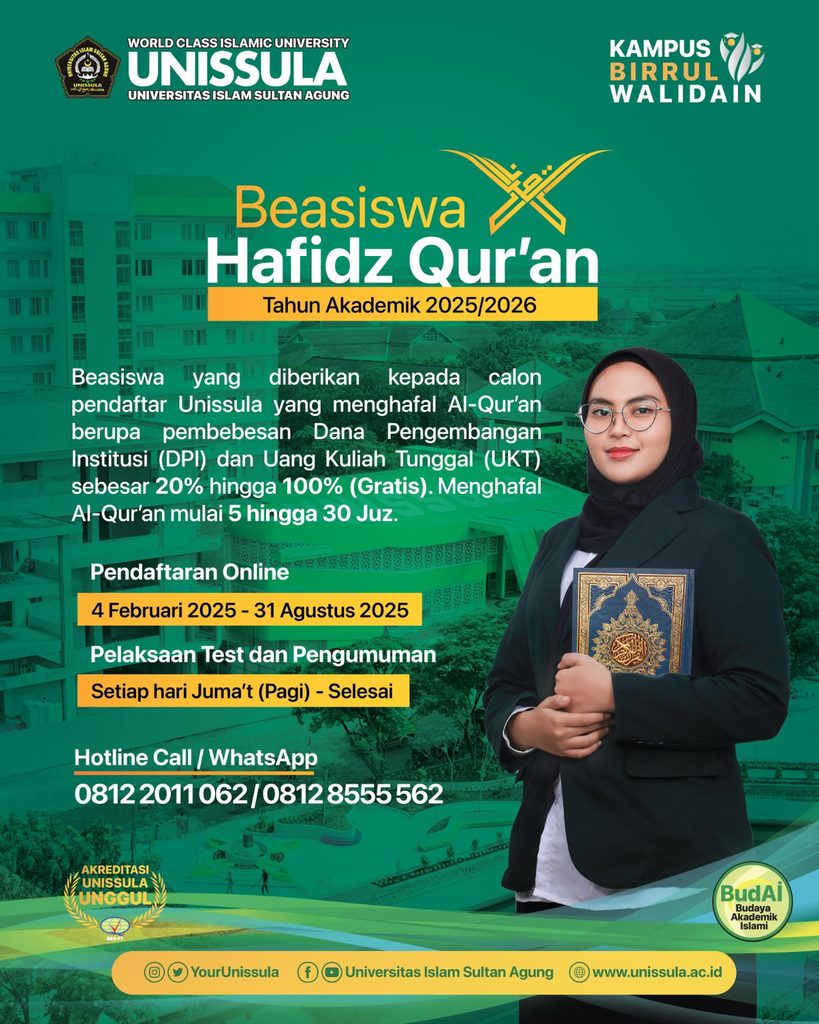
Universitas Islam Sultan Agung (UNISSULA) provides the Hafiz and Hafidzah Al-Qur’an Scholarship as part of its commitment to widening access to higher education while recognising prospective students who have demonstrated outstanding achievement in memorising the Qur’an. The programme provides a dedicated scholarship pathway for male and female Qur’an memorisers who meet the university’s admission and tahfidz selection requirements.
Through this scholarship programme, eligible prospective students receive significant financial support to reduce the cost of entering and continuing higher education. UNISSULA provides a 100% exemption from the Institutional Development Fee (Dana Pengembangan Institusi/DPI) for students admitted through the Hafidz Al-Qur’an Scholarship programme.
The scholarship is available to prospective students with demonstrated Qur’an memorisation ability. Applicants are required to provide evidence of their memorisation and participate in a tahfidz selection process. Scholarship support may also be differentiated according to the number of juz memorised, thereby recognising different levels of achievement while providing opportunities for Qur’an memorisers to pursue university education. UNISSULA information indicates that prospective students with memorisation starting from five juz may apply, subject to the applicable selection requirements.
The programme is implemented as a structured component of UNISSULA’s new student admission process. Selection results for the 2026/2027 academic year, for example, were formally determined through a university admission selection meeting involving university leaders, faculty representatives, and the New Student Admission Committee and were publicly announced through the official UNISSULA admission website.
Through the Hafiz and Hafidzah Scholarship, UNISSULA combines merit-based recognition with financial assistance, helping reduce financial barriers for talented prospective students and broadening opportunities to access higher education. The initiative also reflects UNISSULA’s institutional identity as an Islamic university by supporting the development of academically capable graduates who maintain strong Qur’anic values and contribute positively to society.
Source :