17.4.4 UNISSULA Measures Students’ Sustainability Literacy Through a Knowledge-Based Assessment
Institutional Sustainability Literacy Assessment
Universitas Islam Sultan Agung (UNISSULA) has developed the UNISSULA Sustainability Literacy Assessment (USLA), a knowledge-based assessment instrument designed to evaluate students’ understanding of sustainable development and the Sustainable Development Goals (SDGs).
The assessment uses 20 multiple-choice questions with objectively correct answers. Its conceptual structure draws on three interconnected sustainability knowledge frameworks inspired by Sulitest TASK:
- Earth Systems;
- Human Welfare; and
- Levers of Opportunity.
USLA is an independently developed institutional assessment and is not an official Sulitest TASK examination.
Assessment Instrument:
Sustainability Knowledge Assessment Framework
The assessment consists of 20 questions organised into three knowledge frameworks.
| Knowledge Framework | Questions | Assessment Scope |
|---|---|---|
| Earth Systems | 7 | Climate change, planetary boundaries, renewable energy, biodiversity, water pollution, circular economy, and ocean acidification |
| Human Welfare | 7 | Poverty, inclusive education, clean water and sanitation, decent work, equality of opportunity, food security, and climate-related social inequality |
| Levers of Opportunity | 6 | Multi-stakeholder partnerships, food waste management, evidence-based policies, flood resilience, sustainable procurement, and student-led sustainability solutions |
| Total | 20 |
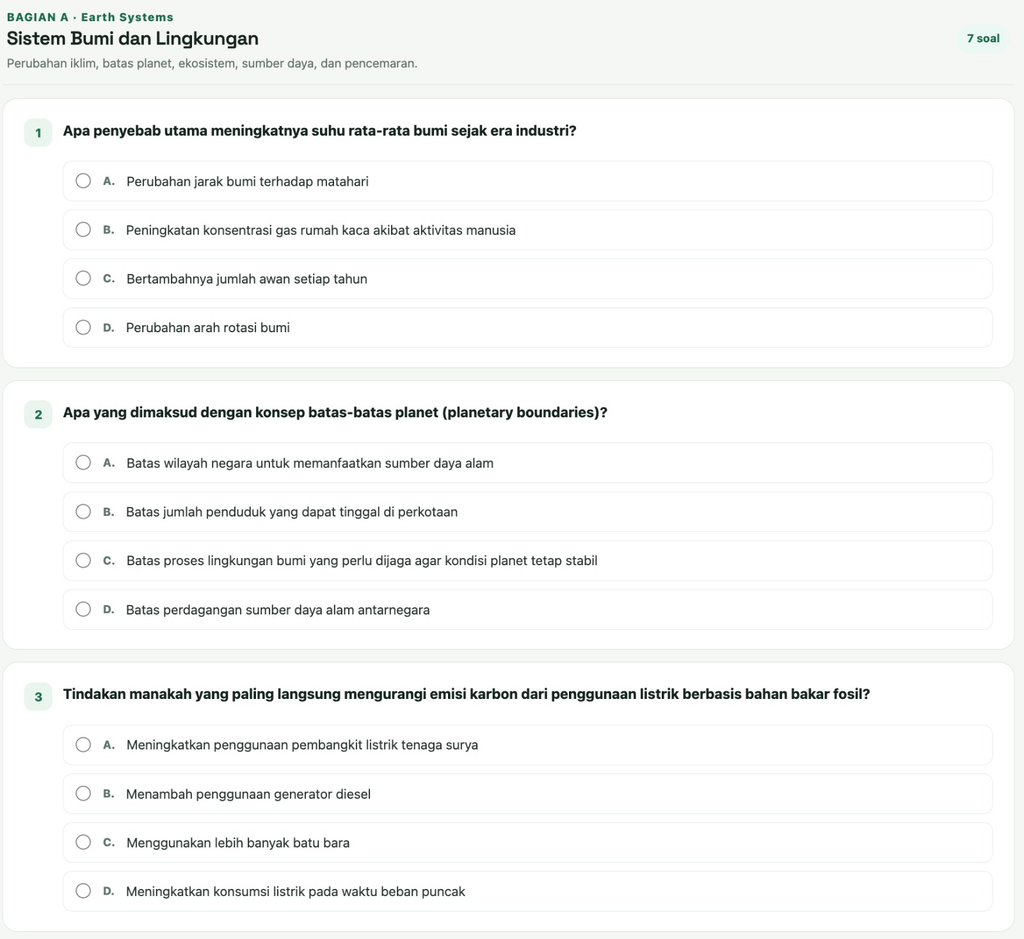
1. Earth Systems – Environmental Sustainability
This framework assesses students’ understanding of the natural systems that support life and the environmental challenges associated with sustainable development.
The seven questions evaluate students’ knowledge of:
- human-induced climate change;
- planetary boundaries;
- renewable energy;
- biodiversity and ecosystem services;
- water pollution;
- circular economy practices; and
- ocean acidification.
Through this framework, students are expected to recognise environmental challenges and identify scientifically informed approaches to protecting natural resources and ecosystems.
Related SDGs: SDG 6, SDG 7, SDG 12, SDG 13, SDG 14, and SDG 15.
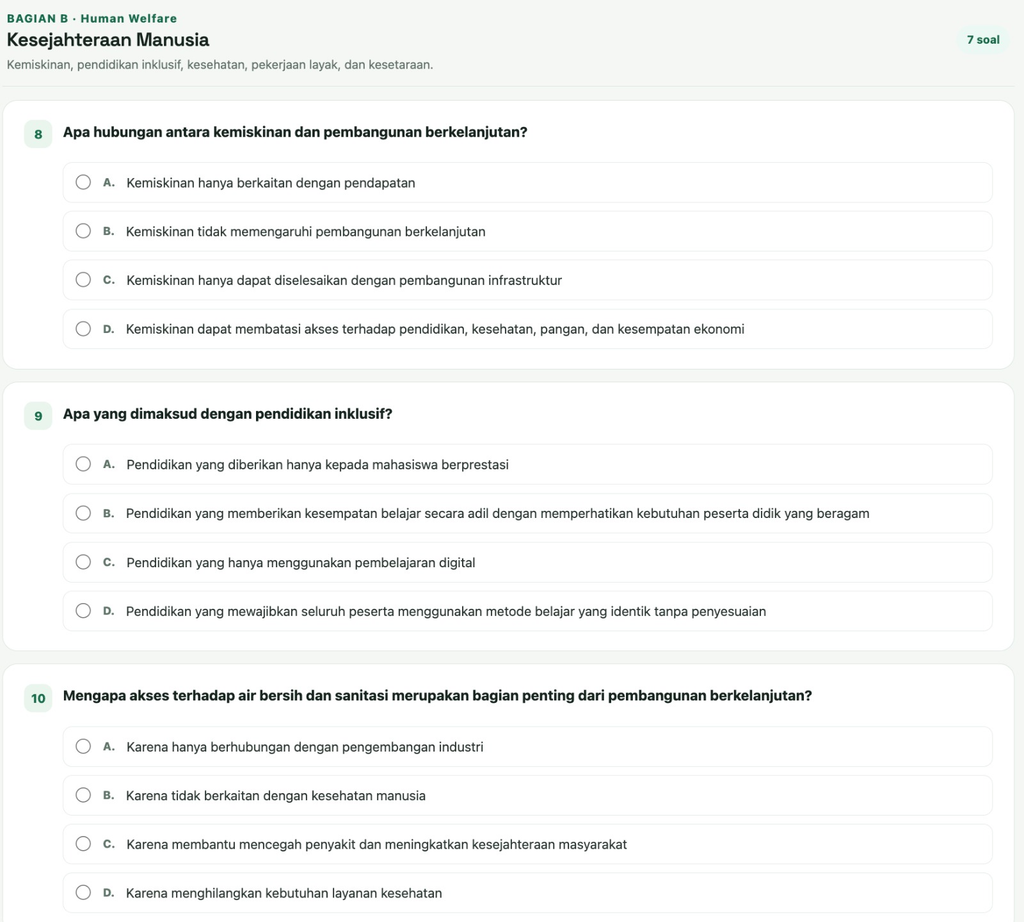
2. Human Welfare – Social Sustainability
This framework assesses students’ understanding of the relationship between sustainable development and human well-being.
The seven questions address:
- the multidimensional impacts of poverty;
- inclusive and equitable education;
- access to clean water and sanitation;
- decent work;
- equal opportunities;
- sustainable food security; and
- the disproportionate impacts of climate change on vulnerable communities.
This framework helps evaluate whether students understand the social and economic conditions required for inclusive and sustainable societies.
Related SDGs: SDG 1, SDG 2, SDG 3, SDG 4, SDG 5, SDG 6, SDG 8, SDG 10, and SDG 13.
3. Levers of Opportunity – Governance and Sustainability Solutions
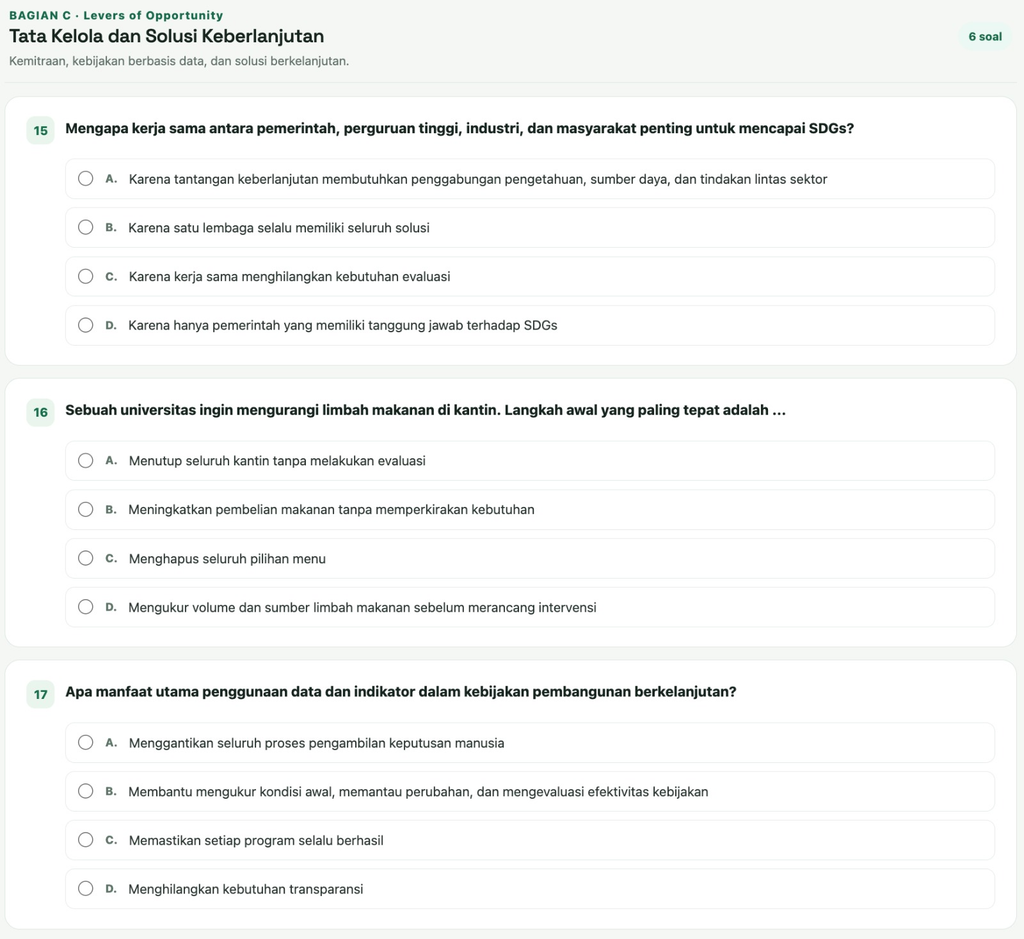
This framework assesses students’ knowledge of practical strategies, institutional mechanisms, and collaborative approaches for advancing sustainable development.
The six questions cover:
- partnerships among universities, governments, industry and communities;
- food waste assessment and reduction;
- data-driven public policy;
- integrated flood risk management;
- sustainable procurement; and
- students’ contributions to responsible sustainability solutions.
The framework evaluates students’ ability to identify appropriate actions and evidence-based responses to real-world sustainability challenges.
Assessment Methodology and Scoring
USLA employs a standardised institutional questionnaire containing 20 multiple-choice questions, with four answer options and one correct answer per question.
The assessment covers all three knowledge frameworks and uses an equally weighted scoring system.
| Assessment Component | Description |
|---|---|
| Assessment type | Objective knowledge-based assessment |
| Target participants | UNISSULA students |
| Total questions | 20 |
| Answer options | Four options per question |
| Correct answer | One per question |
| Score per correct answer | 5 points |
| Maximum score | 100 points |
| Assessment frameworks | Three |
Knowledge Score = (Number of Correct Answers ÷ 20) × 100
The assessment is designed to generate overall sustainability knowledge scores and framework-specific results for institutional monitoring.
Student Participation and Assessment Monitoring
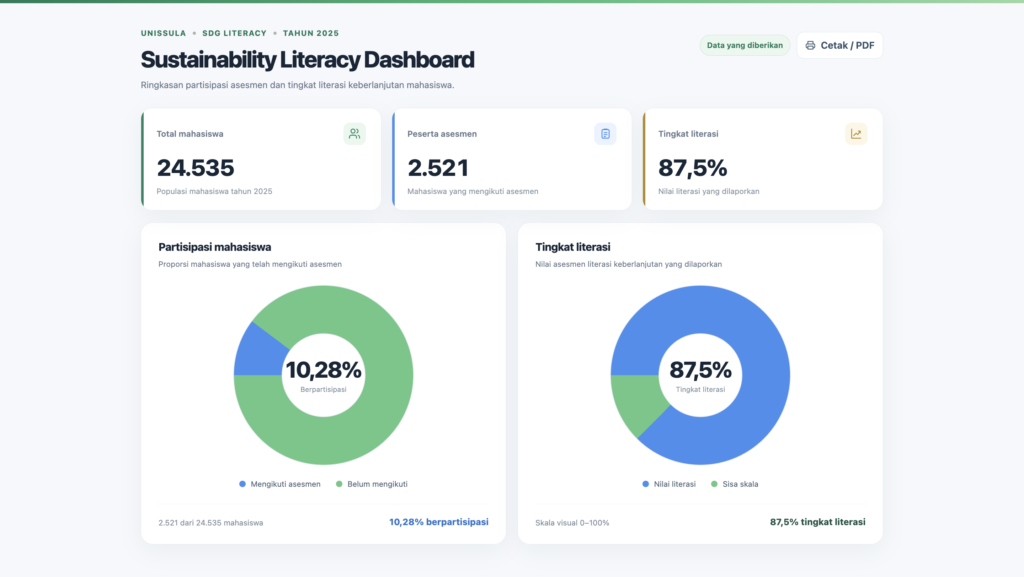
UNISSULA’s existing sustainability literacy survey records for 2025 report participation from 2,521 unique active students, representing 10.28% of the university’s 24,535 students.
| Institutional Indicator | Reported Data |
|---|---|
| Total student population, 2025 | 24,535 |
| Participants in the existing 2025 sustainability literacy survey | 2,521 |
| Participation rate | 10.28% |
| Questions in the USLA objective knowledge assessment | 20 |
| Sustainability knowledge frameworks | 3 |
The historical survey participation figures and the new objective knowledge assessment are recorded as separate measurement activities.
Verified results from the objective assessment will be published once implementation data and scoring records are available.
Institutional Monitoring and Continuous Improvement
UNISSULA’s sustainability literacy assessment framework supports institutional monitoring of students’ knowledge of environmental sustainability, human welfare, and sustainable development solutions.
The results can support:
- curriculum evaluation;
- the development of sustainability-related learning activities; and
- the identification of knowledge areas requiring further educational attention.
Through USLA, UNISSULA strengthens its institutional approach to measuring sustainability knowledge and supporting education for sustainable development.