

















14.3.1 Conservation and Sustainable Utilisation of Oceans, Seas, Lakes and Rivers
Universitas Islam Sultan Agung (UNISSULA) supports and organises academic and professional events that promote the conservation, resilience, and sustainable utilisation of aquatic and coastal ecosystems.
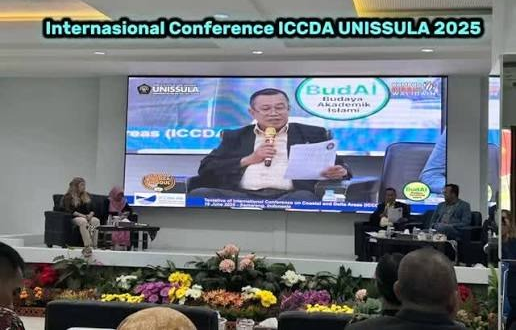
In 2025, UNISSULA organised the 6th International Conference on Coastal and Delta Areas (ICCDA #6), an international forum specifically focused on the challenges facing coastal and delta regions. The conference brought together academics, professionals, international experts, and other stakeholders to exchange knowledge and develop approaches to climate adaptation, environmental protection, sustainable infrastructure, and resilience in vulnerable coastal and delta areas.
The event directly supports UNISSULA’s wider commitment to maintaining aquatic ecosystems through knowledge exchange, collaborative research, technological innovation, and sustainable management approaches.
International Conference on Coastal and Delta Areas 2025
The 6th International Conference on Coastal and Delta Areas (ICCDA #6) was organised by UNISSULA’s Faculty of Engineering and Faculty of Industrial Technology on 2 July 2025.
The conference adopted the theme:
“Build A Strong Nation: Advancing Climate Adaptation and Resilience through Sustainable Development in Coastal and Delta Areas.”
The theme placed the conservation and sustainable development of coastal and delta environments at the centre of the event. These environments are closely connected with seas, rivers, estuaries, wetlands, and other aquatic ecosystems and are particularly vulnerable to climate-related pressures.
UNISSULA emphasised the importance of international collaboration, research innovation, and cross-country cooperation in responding to climate change, particularly in coastal and delta areas that face significant environmental and disaster risks.
Promoting Conservation of Coastal and Delta Ecosystems
Coastal and delta regions are dynamic environments where terrestrial and aquatic systems interact.
Protecting these areas requires integrated approaches involving water management, infrastructure planning, ecosystem protection, climate adaptation, environmental monitoring, and sustainable resource utilisation.
ICCDA #6 provided a platform for discussing these interconnected challenges. The conference covered major topics including:
- climate change;
- sustainable infrastructure;
- environmental technology;
- coastal and delta resilience;
- water and environmental management; and
- sustainable development.
Through these discussions, the conference promoted greater understanding of how scientific knowledge, technology, and planning can contribute to the long-term protection and sustainable utilisation of coastal and aquatic environments.
International Knowledge Exchange for Coastal Sustainability
ICCDA #6 brought together speakers from several countries, demonstrating the international character of the event and enabling participants to learn from different approaches to coastal and water-related challenges.
Speakers included experts from VIA University College in Denmark, Hanze University of Applied Sciences in the Netherlands, Gdansk University of Technology in Poland, Water Footprint Implementation and Wetskills Foundation in the Netherlands, Université de La Manouba in Tunisia, and UNISSULA.
The participation of experts with backgrounds in environmental technology, water management, infrastructure, and climate resilience strengthened the conference as a forum for exchanging approaches that can be applied to the conservation and sustainable management of aquatic and coastal environments.
Coastal Flooding and Environmental Monitoring
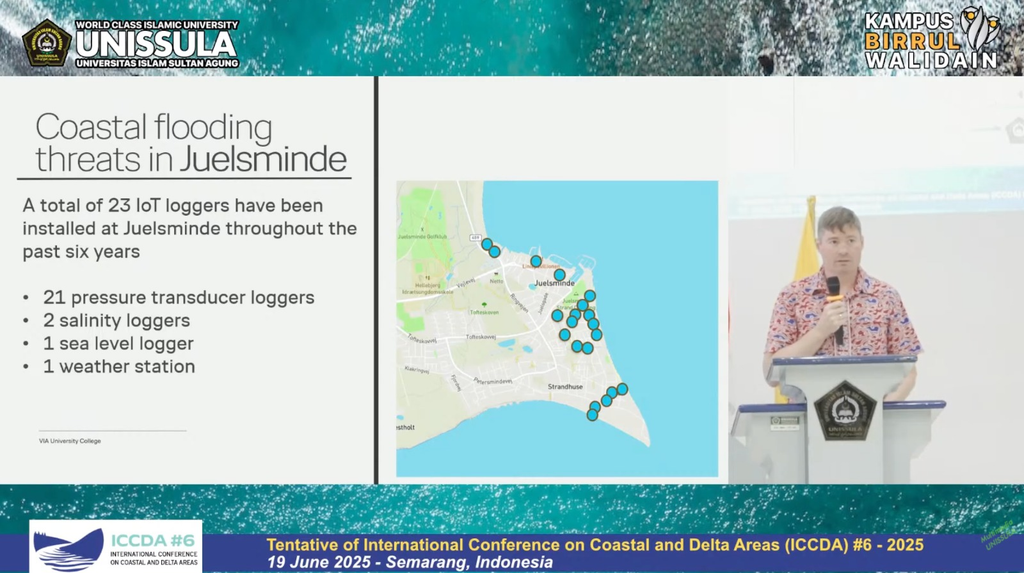
One of the presentations during ICCDA #6 highlighted coastal flooding threats in Juelsminde and demonstrated the use of environmental monitoring technology.
The presentation illustrated a monitoring system using multiple Internet of Things (IoT) loggers, including pressure transducers, salinity loggers, a sea-level logger, and a weather station.
This example demonstrated how environmental monitoring can support understanding of coastal flooding, salinity conditions, sea-level change, and other processes affecting coastal areas.
Such monitoring is important for evidence-based management because it allows coastal risks to be observed and analysed systematically. It also supports the development of adaptation strategies that can protect communities, infrastructure, and coastal ecosystems.
The presentation therefore connected technological innovation with the sustainable management and resilience of coastal environments.
Supporting Sustainable Management Through Science and Technology
ICCDA #6 emphasised that the challenges affecting coastal and delta areas cannot be addressed through a single discipline.
Effective management requires collaboration across areas such as:
- hydrology;
- environmental engineering;
- urban and regional planning;
- water management;
- sustainable infrastructure;
- environmental technology; and
- climate science.
By bringing these fields together, UNISSULA provided a forum where researchers and practitioners could exchange scientific evidence and practical approaches to the management of coastal and aquatic environments.
The conference also created opportunities for researchers to present solutions that can contribute to more resilient and sustainable development in coastal and delta regions.
Research Dissemination and Collaborative Solutions
ICCDA #6 received 78 scientific papers, of which 67 were accepted and presented following review. The conference therefore served not only as a seminar but also as a significant platform for disseminating research relevant to environmental sustainability and coastal development.
This research exchange is important because aquatic and coastal conservation depends on continuous improvement in knowledge, monitoring techniques, engineering approaches, community resilience strategies, and environmental management.
UNISSULA used the conference to encourage interdisciplinary collaboration and the development of practical solutions for the environmental challenges experienced by coastal and delta regions.
From Knowledge Exchange to Practical Action
The aim of ICCDA #6 extended beyond academic discussion.
UNISSULA described the conference as an opportunity to encourage collaborative action across disciplines and to inspire practical solutions for creating more resilient and sustainable coastal and delta areas.
This orientation is particularly important for the sustainable utilisation of aquatic resources. Conservation requires not only protecting ecosystems from degradation but also ensuring that human development, infrastructure, water management, and resource utilisation are planned in ways that do not compromise the long-term functioning of aquatic environments.
By connecting research with professional practice, ICCDA #6 supported this broader sustainability approach.
Additional International Seminar on Coastal and Delta Resilience
UNISSULA also strengthened its 2025 activities through an International Hybrid Seminar held on 6 January 2025 at the Faculty of Engineering.
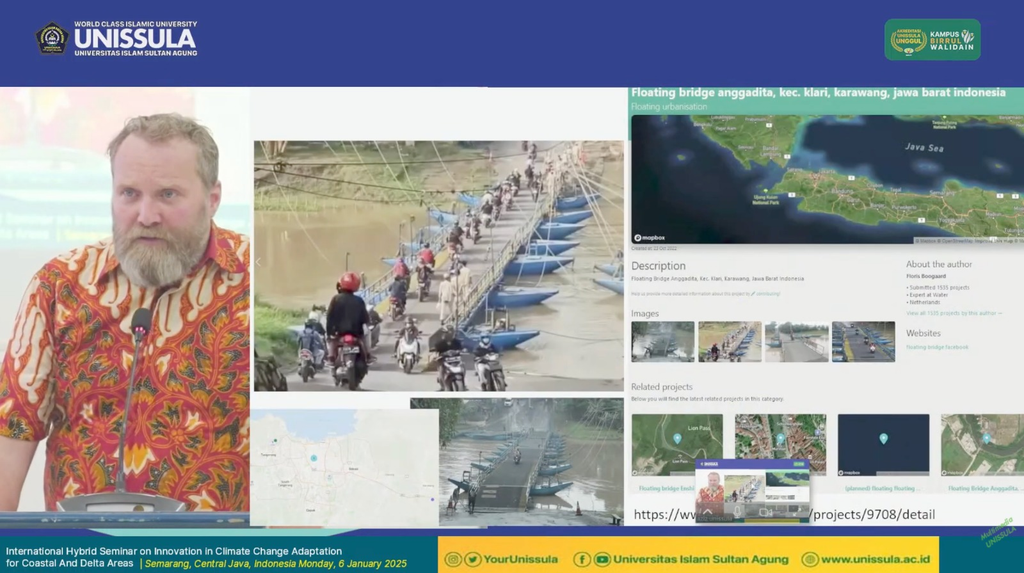
The seminar focused on climate change, adaptation, and resilience, particularly in coastal and delta regions. Its expected outcomes included practical strategies and policy recommendations for addressing climate change, documentation of international best practices, stronger collaboration among stakeholders in coastal and delta regions, and identification of technological innovations to support adaptation.
The event involved experts in water management systems, urban planning, renewable energy, sustainable infrastructure, and hydrology. Participants included environmental agencies, public works and water-resource institutions, BBWS Pemali Juana, academics, students, and NGOs.
This seminar complemented ICCDA #6 by broadening engagement with government agencies and practitioners responsible for water resources, environmental management, and infrastructure.
Engagement with Government and Environmental Stakeholders
An important feature of UNISSULA’s 2025 activities was the involvement of organisations responsible for environmental and water-resource management.
Participants in the January international seminar included:
- Central Java Provincial Environmental Service;
- environmental agencies from regencies and cities in Central Java;
- the Department of Public Works, Water Resources and Spatial Planning;
- BBWS Pemali Juana;
- the Central Java Regional Settlement Infrastructure Center;
- academics and students; and
- NGOs.
The involvement of these stakeholders strengthened the practical relevance of the event because many of them have direct responsibilities related to rivers, water resources, environmental protection, infrastructure, and climate resilience.
Building Capacity for Sustainable Aquatic Ecosystem Management
Through ICCDA #6 and its related international seminar activities, UNISSULA contributed to building knowledge and professional capacity for sustainable management of aquatic and coastal environments.
These activities promoted:
scientific understanding → environmental monitoring → stakeholder collaboration → sustainable planning → coastal and aquatic resilience.
This approach recognises that the conservation of oceans, seas, rivers, and related aquatic resources requires collaboration between universities, governments, professionals, communities, and international partners.
Evidence of Implementation
- ICCDA #6 was organised by UNISSULA on 2 July 2025, led collaboratively by the Faculty of Engineering and Faculty of Industrial Technology.
- The conference theme explicitly focused on climate adaptation, resilience, and sustainable development in coastal and delta areas, directly connecting the event with the sustainable management of coastal and aquatic environments.
- International experts from Denmark, the Netherlands, Poland, Tunisia, and Indonesia participated in the conference, supporting international knowledge exchange on environmental and coastal challenges.
- The conference addressed topics including climate change, sustainable infrastructure, environmental technology, and other sustainability challenges relevant to coastal and delta areas.
- A conference presentation on coastal flooding threats demonstrated environmental monitoring using pressure, salinity, sea-level, and weather data, illustrating practical approaches to understanding and managing coastal environmental risks.
- Seventy-eight scientific papers were submitted and 67 were presented, demonstrating substantial research engagement and dissemination through the conference.
- UNISSULA also organised an International Hybrid Seminar on 6 January 2025 addressing climate adaptation and resilience in coastal and delta regions, with participants from environmental agencies, water-resource institutions, academia, and NGOs.
- The seminar aimed to develop practical strategies, share international best practices, strengthen stakeholder collaboration, and identify technological solutions for climate adaptation in coastal and delta areas.