

















16.2.5 University Principles and Commitments Against Organised Crime, Corruption and Bribery at Universitas Islam Sultan Agung (UNISSULA)
Institutional Commitment to Integrity and Good Governance
Universitas Islam Sultan Agung (UNISSULA) is committed to promoting integrity, transparency, accountability, ethical conduct, and responsible governance throughout its academic and administrative activities.
Guided by its Islamic Academic Culture (Budaya Akademik Islami – BudAI), UNISSULA upholds honesty, justice, professional responsibility, and compliance with applicable laws as fundamental principles of institutional governance.
The university rejects corruption, bribery, organised criminal activities, fraudulent conduct, abuse of authority, and other unlawful practices that undermine institutional integrity and public trust.
These principles are supported by formal university regulations, an institutional anti-corruption task force, lecturer ethical standards, public awareness initiatives, and reporting mechanisms.
UNISSULA’s commitment is reflected in several institutional instruments, including:
- Rector Decree Number 1999/E/SA/III/2022 concerning the Anti-Corruption Prevention and Handling Task Force.
- Rector Decree Number 2663/A.1/SA/III/2023 concerning the Code of Ethics for Lecturers.
- The university’s public commitment to rejecting bribery, corruption, and organised crime.
- Lapor Sultan, the university’s official complaint and reporting platform.
Together, these institutional measures demonstrate UNISSULA’s commitment to strengthening ethical governance and preventing misconduct.
Institutional Anti-Corruption Commitment and Task Force
UNISSULA formally established its Anti-Corruption Prevention and Handling Task Force (Satuan Tugas Pencegahan dan Penanganan Anti Korupsi) through Rector Decree Number 1999/E/SA/III/2022, dated 14 March 2022.
The decree provides a formal university-level mechanism for supporting corruption prevention and the handling of corruption-related matters.
The task force operates within the university’s governance structure and is accountable to the Rector.
The Rector Decree assigns the task force responsibility for preparing and carrying out its duties and submitting written reports to university leadership.
Its organisational structure includes several functional divisions:
- Prevention Division: Supporting institutional efforts to prevent corruption.
- Handling Division: Supporting the handling of corruption-related matters.
- Assistance Division: Providing assistance within the task force’s institutional activities.
- Public Communication Division: Supporting information dissemination and awareness.
- Administrative and Logistics Division: Supporting operational activities.
The establishment of the task force demonstrates UNISSULA’s formal commitment to addressing corruption through designated institutional responsibilities.
It also provides an organisational basis for internal coordination and accountability in the university’s anti-corruption efforts.
Official Institutional Evidence:
Rector Decree Number 1999/E/SA/III/2022 concerning the Anti-Corruption Prevention and Handling Task Force, dated 14 March 2022.
Public Commitment Against Bribery, Corruption and Organised Crime
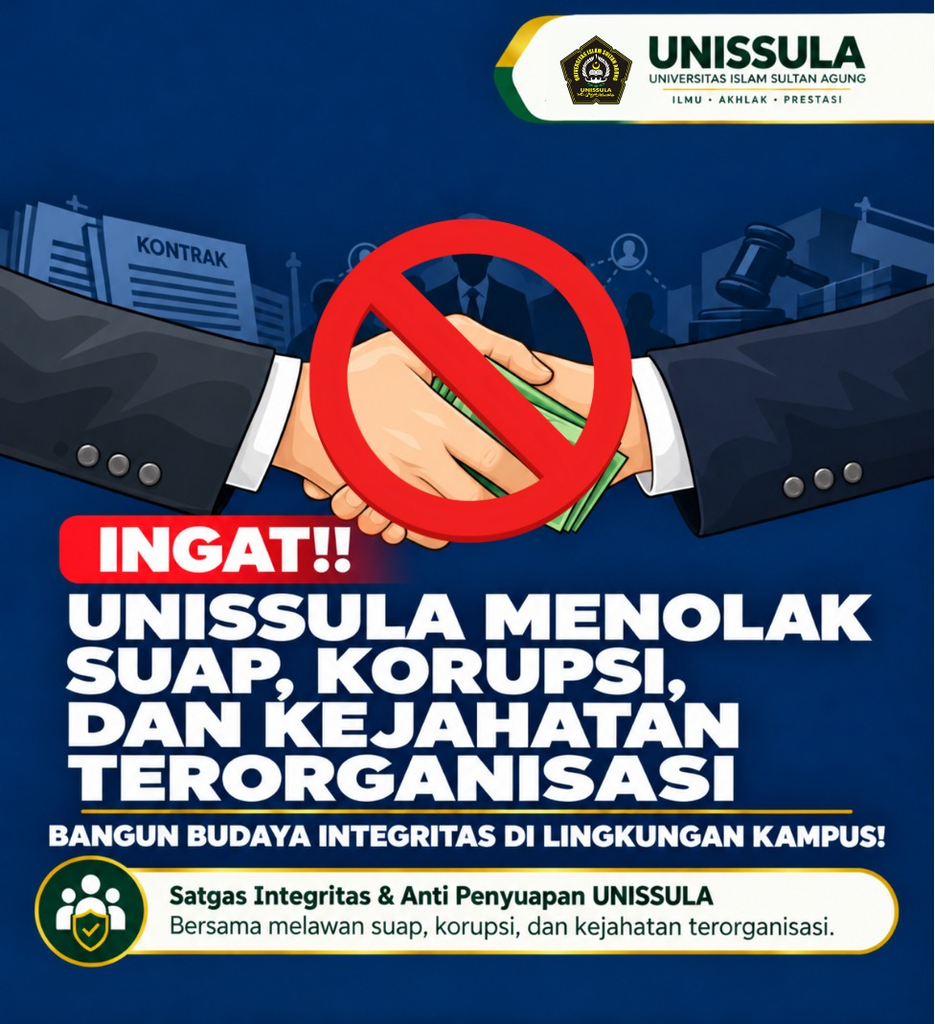
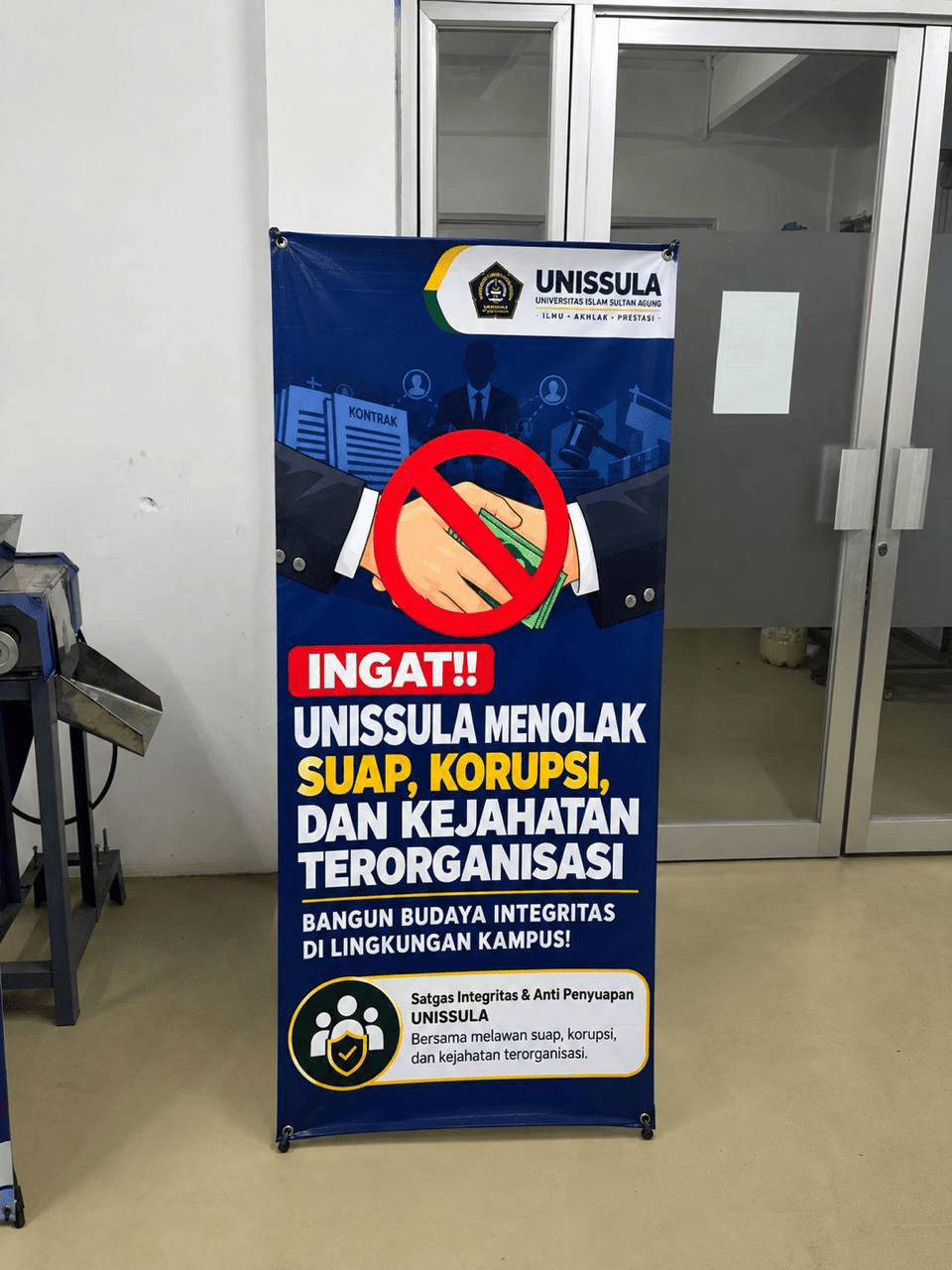
UNISSULA communicates its institutional commitment to integrity through public awareness materials that explicitly reject bribery, corruption, and organised crime.
The university’s integrity campaign carries the statement:
“UNISSULA MENOLAK SUAP, KORUPSI, DAN KEJAHATAN TERORGANISASI.”
“UNISSULA Rejects Bribery, Corruption and Organised Crime.”
The statement communicates the university’s position that such activities are incompatible with institutional ethics, responsible governance, and the values of its academic community.
The commitment encompasses three important principles.
Prevention of Bribery
UNISSULA rejects the use of improper payments, illicit benefits, or inducements intended to influence academic, administrative, financial, or institutional decisions.
Prevention of Corruption
UNISSULA supports the prevention of dishonest practices, fraudulent financial conduct, misuse of authority, and improper utilisation of institutional resources.
Rejection of Organised Crime
UNISSULA rejects organised criminal activities, including unlawful collective conduct and other criminal practices that threaten institutional integrity, safety, and public trust.
The university’s public integrity campaign promotes awareness of these principles and encourages responsible conduct among members of the academic community.
This communication complements the university’s formal anti-corruption task force and ethical regulations.
Supporting Evidence:
UNISSULA Institutional Integrity Campaign – “UNISSULA Menolak Suap, Korupsi, dan Kejahatan Terorganisasi.”
Rector Regulation on the Code of Ethics for Lecturers
UNISSULA maintains formal ethical standards governing lecturer conduct through Rector Decree Number 2663/A.1/SA/III/2023 concerning the Code of Ethics for Lecturers, enacted on 2 March 2023.
The regulation establishes principles of academic integrity, professional ethics, responsible behaviour, and compliance with applicable laws.
The Code of Ethics provides a university-level regulatory framework for lecturers and establishes specific prohibitions against misconduct.
Article 2 – Ethical and Professional Responsibilities
Lecturers are required to uphold the law, academic values, institutional objectives, and standards of ethical conduct.
Article 22 – Prohibited Conduct
The regulation prohibits various forms of misconduct, including:
- Improper use of university facilities and resources.
- Fraudulent or misleading financial reporting.
- Violations of university financial regulations.
- Intimidation, threats, and violent conduct.
- Misuse of institutional authority and academic positions.
- Activities prohibited under Indonesian criminal law.
- Conduct that undermines university safety, professional ethics, and institutional integrity.
These provisions provide a formal ethical foundation for preventing improper conduct and addressing unlawful practices within the university environment.
The prohibition of criminal acts also supports the university’s wider commitment to rejecting conduct associated with organised criminal activity.
Official Institutional Evidence:
Rector Decree Number 2663/A.1/SA/III/2023 concerning the Code of Ethics for Lecturers, dated 2 March 2023, particularly Articles 2 and 22.
Financial Integrity and Prevention of Corruption
UNISSULA promotes responsible financial conduct through institutional ethical regulations and anti-corruption measures.
The Code of Ethics for Lecturers contains provisions prohibiting financial misconduct and misuse of university resources.
Article 22 includes prohibitions concerning manipulation of financial reports and activities that violate university financial regulations.
These provisions establish ethical responsibilities relevant to financial integrity and the proper management of university resources.
The university’s Anti-Corruption Prevention and Handling Task Force provides an additional institutional mechanism supporting efforts to prevent and address corruption.
Together, the Rector Decrees of 2022 and 2023 reinforce UNISSULA’s commitment to:
- Preventing corruption and financial misconduct.
- Upholding integrity in institutional activities.
- Preventing misuse of university resources.
- Encouraging compliance with applicable laws and ethical standards.
- Supporting accountability through formal institutional responsibilities.
These measures contribute to ethical financial governance and the protection of institutional resources.
Official Institutional Evidence:
Rector Decree Number 1999/E/SA/III/2022 – Anti-Corruption Prevention and Handling Task Force.
Rector Decree Number 2663/A.1/SA/III/2023 – Code of Ethics for Lecturers, Article 22.
Examination Procedures, Sanctions and Institutional Enforcement
UNISSULA’s Code of Ethics establishes procedures for examining and addressing alleged ethical violations.
The regulation provides an institutional framework for investigating misconduct, determining accountability, and implementing appropriate disciplinary measures.
Article 23 – Examination Procedures
The regulation establishes procedures for examining alleged violations, documenting relevant information, and preparing formal examination records.
Article 25 – Disciplinary Sanctions
The Code of Ethics provides disciplinary measures that may be applied according to the nature and severity of violations.
Article 26 – University Ethics Council
UNISSULA establishes a University Ethics Council (Dewan Etik Universitas) responsible for supervising the implementation of the Code of Ethics and processing allegations of ethical misconduct.
The Council provides a formal mechanism supporting ethical accountability for lecturers.
These procedures demonstrate that UNISSULA’s ethical principles are supported by institutional examination and disciplinary mechanisms.
The framework reinforces the importance of compliance with university regulations and responsible professional conduct.
Official Institutional Evidence:
Rector Decree Number 2663/A.1/SA/III/2023, Articles 23–26.
Public Reporting and Institutional Accountability through Lapor Sultan
UNISSULA provides an official complaint and reporting platform known as Lapor Sultan.
The platform allows university stakeholders and members of the public to submit complaints and institutional concerns through an accessible reporting channel.
Lapor Sultan includes a structured reporting mechanism through which users can submit reports and monitor their handling.
Its features include:
- Online complaint and report submission.
- Direction of reports to relevant university units.
- Unique ticket identification for submitted reports.
- Complaint status tracking.
- Confidentiality provisions for complainant information.
The platform supports transparency, accountability, and responsiveness by providing a channel for communication between the university and its stakeholders.
Lapor Sultan complements UNISSULA’s institutional ethical governance framework and supports responsible reporting of concerns.
Official University Reporting Platform:
Anti-Corruption Awareness, Education and Institutional Culture
UNISSULA promotes ethical awareness and the prevention of corruption through its institutional culture and academic activities.
The university’s public integrity campaign communicates its rejection of bribery, corruption, and organised crime, reinforcing ethical expectations within the academic environment.
UNISSULA also contributes to academic discussion of anti-corruption issues through its Faculty of Law.
The Faculty of Law has established the Centre for Anti-Corruption Studies (Pusat Studi Kajian Anti Korupsi – PUSKAP) as part of its legal research activities.
The existence of this academic centre demonstrates institutional engagement with corruption-related legal studies and the development of relevant knowledge.
Together with the university’s ethical regulations and awareness activities, such academic initiatives contribute to a broader institutional culture supporting integrity and responsible conduct.
Official University Reference:
https://unissula.ac.id/fh-unissula-miliki-tujuh-pusat-studi-hukum
Contribution to SDG 16 – Peace, Justice and Strong Institutions
UNISSULA’s institutional principles and anti-corruption measures contribute to SDG 16 by promoting ethical governance, institutional accountability, and lawful conduct.
The university’s documented commitments include:
- Formal establishment of an Anti-Corruption Prevention and Handling Task Force in 2022.
- Adoption of updated lecturer ethical regulations in 2023.
- Public communication rejecting bribery, corruption, and organised crime.
- Formal procedures for examining ethical violations and imposing disciplinary measures.
- An official institutional complaint and reporting platform.
- Academic engagement with anti-corruption studies and legal research.
These measures demonstrate institutional efforts to prevent misconduct, uphold accountability, and strengthen ethical governance.
By integrating formal regulations, institutional responsibilities, public awareness, and reporting channels, UNISSULA supports the development of a university environment based on integrity, professional responsibility, and the rule of law.