


















10.6.7 Accessible Facilities for People with Disabilities
University-Wide Accessible Campus Facilities
Universitas Islam Sultan Agung (UNISSULA) provides accessible facilities across the campus to support students, lecturers, staff, visitors, and other members of the university community with disabilities and special mobility needs.
UNISSULA’s campus accessibility framework is designed to improve mobility, safety, comfort, and independent access to academic, administrative, religious, and public facilities.
The university provides a range of physical and supporting facilities, including ramps, accessible pathways, elevators, handrails, accessible entrances, accessible toilets, priority parking areas, pedestrian routes, seating areas, wheelchairs, and service assistance.
Accessible Building Access
Several campus buildings and public areas are equipped with infrastructure intended to facilitate access for people with mobility limitations.
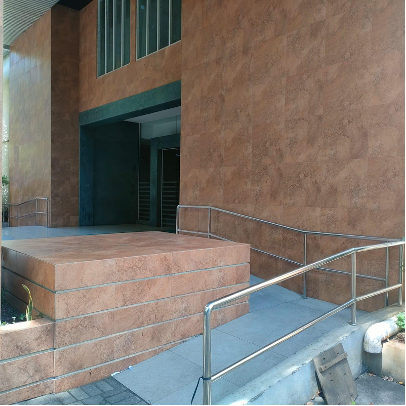
Accessible building features include:
- ramps;
- accessible pathways;
- wide corridors;
- handrails;
- accessible entrances; and
- elevators in multi-storey buildings.
These facilities help people with disabilities move more safely and comfortably between university spaces.
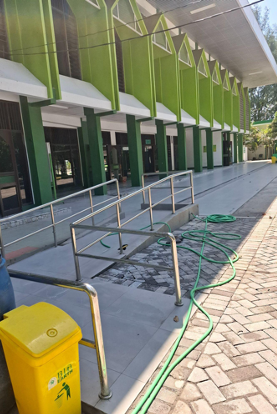
The visual evidence provided in the campus accessibility documentation also shows ramps and dedicated access routes at university buildings.
Ramps and Accessible Pathways
UNISSULA provides ramps and specially designed pathways to reduce physical barriers at building entrances and along campus routes.
These facilities are important for users who:
- use wheelchairs;
- have limited mobility;
- use walking aids; or
- require step-free access.
The accessibility evidence includes examples of ramps with handrails leading to building entrances and dedicated routes designed to improve mobility across campus.
Accessible Elevators
Multi-storey buildings at UNISSULA include elevators that support access between floors.
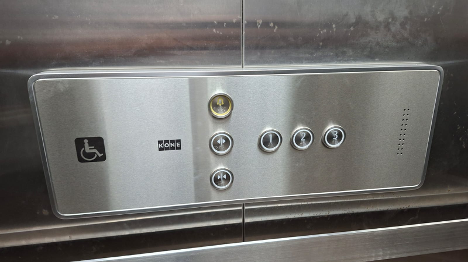
The accessibility documentation includes visual evidence of elevators and control panels with accessibility features.
Elevator access allows users with mobility limitations to move between building levels without relying on stairs.
This supports more equitable access to classrooms, offices, laboratories, and other facilities located on upper floors.
Accessible Toilets
UNISSULA provides accessible toilets for people with disabilities and users with special mobility needs.
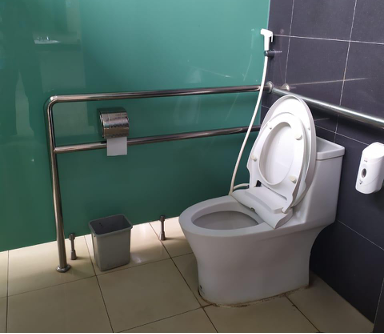
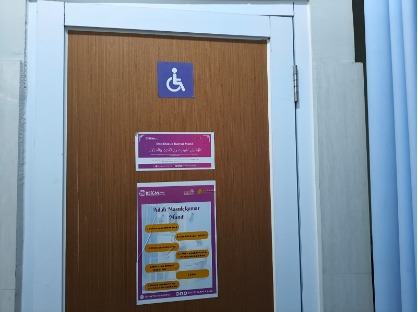
The documented facilities include:
- designated accessible toilet rooms;
- handrails beside toilet facilities;
- sufficient space to support safer use; and
- disability signage identifying accessible facilities.
The evidence document explicitly identifies accessible toilets as part of the university’s disability-support infrastructure.
Priority Parking for People with Disabilities
UNISSULA provides priority parking areas for people with disabilities.
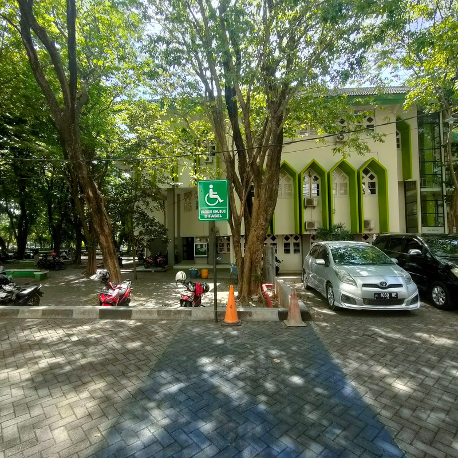
These areas are marked with disability-access signage and are positioned to support convenient access to university buildings.
The accessibility evidence includes photographs of designated disability parking spaces.
Priority parking helps reduce the distance that users with mobility limitations need to travel between vehicles and campus facilities.
Wheelchair Availability
Wheelchairs are also available as part of UNISSULA’s accessibility support.
The visual evidence includes wheelchairs located within university facilities for use by individuals requiring mobility assistance.
Wheelchair availability provides practical support for:
- students with temporary or permanent mobility limitations;
- staff and lecturers;
- visitors; and
- other individuals who may require mobility assistance while on campus.
Accessible Pedestrian Routes
The campus provides pedestrian routes designed to improve movement between buildings and public areas.
These routes support access to facilities such as:
- lecture rooms;
- laboratories;
- administrative offices;
- libraries;
- mosques;
- public spaces; and
- student-service areas.
The accessibility documentation explicitly identifies pedestrian paths as part of UNISSULA’s inclusive campus infrastructure.
Campus Accessibility Map
UNISSULA has documented a campus accessibility map showing disability routes and accessible toilet locations.

The map identifies:
- designated disability routes; and
- accessible toilet points within the campus.
This provides a practical reference for users with mobility limitations and demonstrates that accessibility is considered at the campus-planning level, not only at individual buildings.
The map is included in the institutional evidence on campus facilities for disabled and special-needs users.
Accessible Academic and Administrative Services
Accessibility at UNISSULA also includes service assistance in academic and administrative offices.
This helps ensure that students and visitors with disabilities can access university services in addition to physical infrastructure.
The university’s accessibility framework therefore includes both:
Physical access → Service access
The institutional evidence states that service assistance is provided in academic and administrative offices as part of disability-support arrangements.
Access to Academic Facilities
Accessible facilities help students and visitors reach key academic spaces more easily.
These include:
- classrooms;
- laboratories;
- offices;
- libraries; and
- other academic facilities.
The combination of ramps, elevators, accessible entrances, pedestrian routes, and service assistance supports participation in teaching, learning, and administrative activities.
Access to Religious Facilities
As an Islamic university, UNISSULA also considers accessibility in relation to religious activities.
The accessibility documentation includes support for people with disabilities in accessing religious facilities.
UNISSULA also provides supporting innovation such as the Gelang Getar Shalat (GGS), designed to assist people with disabilities in worship-related activities.
The evidence document identifies the GGS article on the official UNISSULA website as additional supporting evidence.
Safety and Comfort
Accessible facilities are designed not only to provide entry but also to support safety and comfort.
Features such as:
- handrails;
- ramps;
- accessible toilets;
- wide corridors;
- seating areas;
- priority parking; and
- wheelchairs
help reduce physical barriers and improve the campus experience for users with different mobility and accessibility needs.
Inclusion of Students, Staff and Visitors
UNISSULA’s accessible facilities are intended to support a wide range of campus users.
The institutional evidence states that the university provides facilities for:
- students;
- lecturers;
- staff;
- visitors;
- people with disabilities;
- individuals with special needs; and
- users requiring additional physical or health-related support.
This demonstrates that accessibility is treated as a university-wide responsibility.
Integration with Inclusive Admissions
Accessible facilities complement UNISSULA’s inclusive admissions framework.
The university maintains dedicated mechanisms for prospective students with disabilities, including the Special Selection Programme for Persons with Disabilities (SPKPD).
Providing accessible infrastructure ensures that students admitted through inclusive admission pathways can participate more effectively in university life after enrolment.
The relationship can be represented as:
Inclusive admission → Accessible campus → Participation in university life
Integration with Anti-Discrimination Policy
UNISSULA’s accessibility measures also support the university’s anti-discrimination framework.
The university prohibits discrimination based on disability as part of its wider anti-discrimination policy.
Providing accessible facilities helps translate this policy into practical campus conditions by reducing physical barriers that could otherwise limit participation.
Integration with Equality and Inclusion Functions
Campus accessibility also supports UNISSULA’s broader commitment to equality, inclusion, and human rights.
The university’s institutional inclusion functions address barriers that can affect participation among students and staff with different needs.
Accessible facilities therefore contribute to a wider institutional framework of:
Equality → Inclusion → Accessibility → Participation
Accessible and Inclusive Campus Environment
UNISSULA’s approach to accessibility extends beyond individual facilities.
The campus environment includes:
- accessible building access;
- ramps;
- elevators;
- accessible toilets;
- priority parking;
- disability pathways;
- wheelchairs;
- handrails;
- service assistance;
- rest areas; and
- health-support facilities.
This combination helps create a more inclusive environment for people with different physical and mobility needs.
Continuous Improvement
UNISSULA continues to strengthen accessible infrastructure across the campus.
Future development may include:
- increasing the number of accessible routes;
- improving signage;
- expanding accessible toilet coverage;
- strengthening accessible building entrances;
- improving accessibility information;
- maintaining elevators, ramps, and handrails;
- expanding mobility assistance; and
- improving coordination between infrastructure and student-support services.
Continuous improvement helps ensure that accessibility remains responsive to the needs of the university community.
Evidence of Implementation
UNISSULA’s accessible facilities for people with disabilities are demonstrated through the following institutional evidence:
- Designated disability parking areas.
- Ramps and special pathways for wheelchair and mobility access.
- Accessible entrances to university buildings.
- Elevators in multi-storey buildings.
- Accessible elevator controls.
- Handrails supporting safer movement.
- Accessible toilets with support rails and disability signage.
- Wheelchairs available for mobility assistance.
- Accessible pedestrian routes across campus.
- Service assistance in academic and administrative offices.
- A documented campus map identifying disability routes and accessible toilet locations.
- Accessibility support for lecture rooms, laboratories, offices, libraries, mosques, and other public facilities.
- Additional disability-support innovation, including the Gelang Getar Shalat (GGS).
- Institutional documentation demonstrating that accessibility facilities support students, lecturers, staff, visitors, and people with special needs.