

















10.6.3 Planned Actions to Recruit Students from Underrepresented Groups
University-Wide Planned Recruitment Actions
Universitas Islam Sultan Agung (UNISSULA) undertakes planned actions to expand access to higher education and recruit prospective students from underrepresented and potentially underrepresented groups.
In 2025, UNISSULA formalised this commitment through Circular Letter No. 8405/J/SA/IX/2025, issued on 9 September 2025. The Circular Letter establishes planned institutional actions to widen access and recruit prospective students from groups that are underrepresented or potentially underrepresented in higher education.
The university implements these actions through special or affirmative admission pathways, scholarships and educational assistance, targeted admissions outreach, and other forms of support designed to improve access for identified groups.

Planned Recruitment Mechanisms
UNISSULA’s approach combines institutional policy with practical recruitment programmes.
Planned recruitment actions include:
- Special or affirmative admission pathways
- Scholarships and financial assistance
- Targeted admissions promotion and outreach
- Selection arrangements adapted to particular target groups
- Institutional support intended to widen access to higher education
Two established programmes specifically identified in the university’s 2025 policy are:
- Kartu Indonesia Pintar Kuliah (KIP Kuliah) for prospective students from economically disadvantaged families
- Seleksi Program Khusus Penyandang Disabilitas (SPKPD) for prospective students with disabilities
These programmes are explicitly identified in Circular Letter No. 8405/J/SA/IX/2025 as institutional actions supporting the recruitment of underrepresented students.
Recruiting Economically Disadvantaged Students through KIP Kuliah
UNISSULA implements KIP Kuliah as a dedicated admission and financial-support pathway for prospective students from economically disadvantaged backgrounds.
The programme provides an identifiable route through which low-income applicants can apply to UNISSULA while also being considered for financial support.
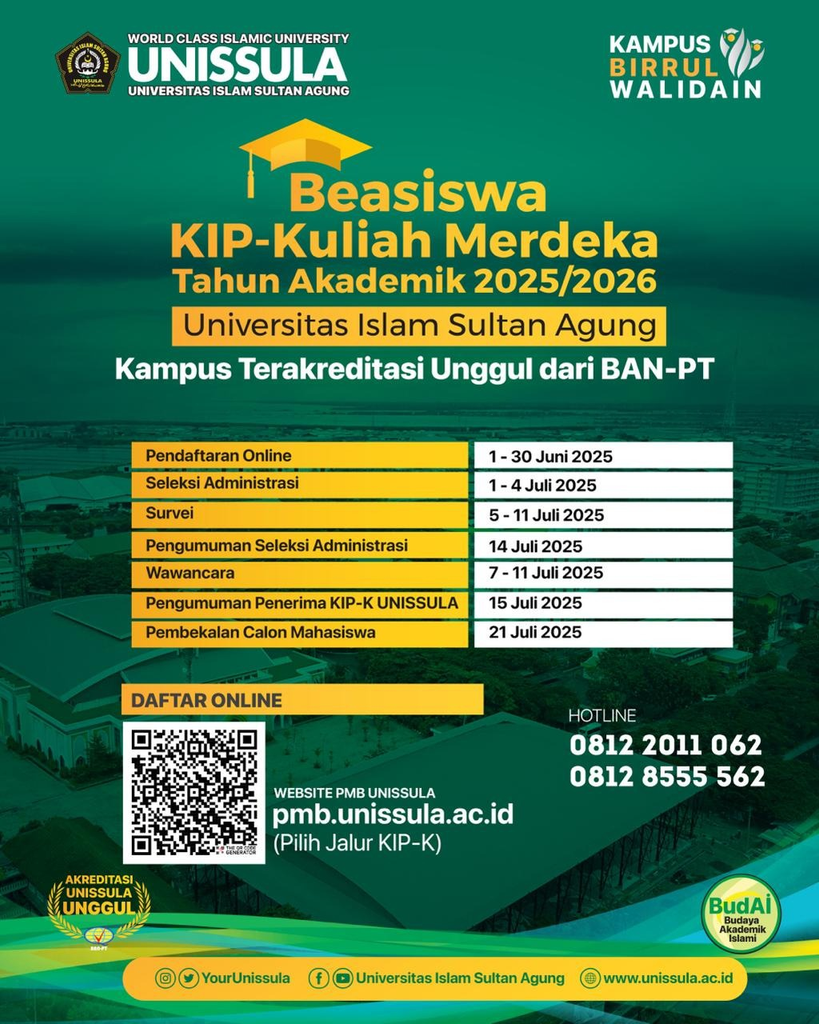
For the 2025/2026 academic year, UNISSULA publicly promoted KIP Kuliah through official admissions materials.
The recruitment process included:
Online Registration → Administrative Selection → Survey → Interview → Recipient Announcement → Student Preparation
This demonstrates that the programme is not limited to passive financial assistance after enrolment. It forms part of a planned recruitment and selection process through which economically disadvantaged prospective students are actively encouraged to enter higher education at UNISSULA.
Targeted KIP Kuliah Recruitment
UNISSULA also conducted geographically targeted KIP Kuliah recruitment for prospective students from:
- Brebes Regency
- Tegal City
- Tegal Regency
The 2025 recruitment materials established a specific schedule covering online registration, administrative selection, survey and interview, and the announcement of successful KIP Kuliah recipients.
This targeted activity demonstrates a planned effort to reach prospective students through a clearly defined recruitment campaign rather than relying only on general university admissions.
Structured KIP Kuliah Selection Process
The KIP Kuliah recruitment process enables UNISSULA to identify prospective students who require financial support before and during the admissions process.
The 2025 recruitment activities included several stages of assessment, including administrative verification, surveys, and interviews.
This structure supports the identification of students whose economic circumstances may otherwise create barriers to university participation.
The recruitment pathway can therefore be represented as:
Targeted outreach → Application → Eligibility verification → Selection → Admission → Financial support
This process provides a practical institutional mechanism for widening access for economically disadvantaged students.
Recruitment of Students with Disabilities
UNISSULA also maintains a dedicated recruitment mechanism for prospective students with disabilities through the Seleksi Program Khusus Penyandang Disabilitas (SPKPD).
The programme is specifically designed as a student admissions route for persons with disabilities.
The UNISSULA disability admissions guide states that SPKPD is a special selection process for prospective students with disabilities and that applicants are assessed according to their capabilities and suitability for their selected academic programmes.
This dedicated pathway represents a planned institutional action because prospective students with disabilities are provided with a specifically designed admission mechanism rather than being addressed only through the general admissions process.
Identifying Support Needs during Recruitment
The recruitment and admission process for students with disabilities also includes structured assessment of disability and functional needs.
The university’s documentation provides for the identification of disabilities including:
- Physical disabilities
- Visual disabilities
- Hearing disabilities
- Speech disabilities
- Intellectual or learning difficulties
- Developmental and mental conditions
- Other disabilities
The process can also identify required forms of assistance, including wheelchairs, walking aids, hearing aids, sign-language assistance, and other recommended support.
This enables UNISSULA to connect recruitment and admissions with the support that students may require to participate successfully in higher education.
Scholarships as a Recruitment and Access Mechanism
Financial assistance forms an important part of UNISSULA’s planned recruitment actions.
Through KIP Kuliah, economically disadvantaged applicants are provided with a dedicated pathway that combines admission with financial assistance.
Through the SPKPD mechanism, prospective students with disabilities can also be connected with scholarship opportunities subject to applicable scholarship requirements. The disability admissions guide explicitly states that persons with disabilities have opportunities to obtain scholarships according to the relevant conditions.
These mechanisms help reduce financial and accessibility barriers that could otherwise prevent prospective students from entering university.
Relationship with the Non-Discriminatory Admissions Policy
UNISSULA’s planned recruitment actions operate alongside its university-wide non-discriminatory admissions policy.
Through Circular Letter No. 83102/J/SA/IX/2025, UNISSULA establishes equal opportunity in student admissions and states that admissions should not discriminate on the basis of gender, economic condition, disability, regional origin, nationality, or other social backgrounds.
The same policy recognises the need for inclusive admission mechanisms for prospective students requiring particular support, including students with disabilities and other underrepresented groups.
The relationship between the policies can therefore be represented as:
Non-discriminatory admissions → Identification of access barriers → Planned recruitment actions → Targeted admission pathways → Support and admission
Relationship with Underrepresented-Group Monitoring
UNISSULA also measures and monitors applications and admissions of underrepresented and potentially underrepresented groups through Circular Letter No. 83103/J/SA/IX/2025.
The monitoring policy covers categories including gender, economic condition, disability, nationality, and international student status.
It also requires monitoring of the number of applicants, admitted students, and changes in these data over time.
This means that planned recruitment and monitoring operate as complementary institutional processes:
Tracking representation → Identifying access needs → Planned recruitment → Monitoring applications and admissions → Evaluation
Public Recruitment Activities
UNISSULA makes its targeted recruitment activities visible to prospective students through publicly distributed admissions information.
The KIP Kuliah 2025/2026 recruitment materials provide prospective students with:
- The application period
- Selection stages
- Survey and interview schedules
- Recipient announcement dates
- Online registration information
- Access to the official UNISSULA student admissions website
Public communication is important because planned recruitment actions must be capable of reaching the groups for whom the programmes are intended.
The availability of a dedicated KIP Kuliah option through the UNISSULA admissions process makes the programme identifiable to prospective low-income students during application.
Evidence-Based Recruitment Approach
UNISSULA’s approach does not rely on a single mechanism.
The university combines:
Institutional policy + Targeted admission pathways + Financial support + Public recruitment + Selection mechanisms
For economically disadvantaged prospective students, this is demonstrated through KIP Kuliah.
For prospective students with disabilities, this is demonstrated through SPKPD and the university’s dedicated disability admissions procedures.
These programmes provide concrete examples of planned actions intended to widen access to higher education.
Continuous Development of Inclusive Recruitment
UNISSULA continues to strengthen recruitment practices designed to expand participation among groups that may experience barriers to higher education.
Institutional development can include:
- Continuing targeted KIP Kuliah recruitment
- Maintaining dedicated disability admission mechanisms
- Expanding outreach to economically disadvantaged communities
- Strengthening targeted admissions communication
- Connecting admissions with scholarship and student-support programmes
- Monitoring application and admission outcomes
- Using monitoring results to improve future recruitment strategies
This approach allows recruitment programmes to be evaluated and developed according to institutional data and identified access needs.
Evidence of Implementation
UNISSULA’s planned actions to recruit students from underrepresented and potentially underrepresented groups are demonstrated through the following institutional evidence:
- Circular Letter No. 8405/J/SA/IX/2025, issued on 9 September 2025, establishing planned actions to widen access and recruit prospective students from underrepresented or potentially underrepresented groups.
- Institutional use of special or affirmative admission pathways.
- Use of scholarships and educational assistance as part of access and recruitment measures.
- Targeted admissions outreach and support for identified groups.
- A dedicated KIP Kuliah 2025/2026 admission pathway for economically disadvantaged prospective students.
- A structured KIP Kuliah process covering application, administrative selection, survey/interview, and recipient announcement.
- Targeted KIP Kuliah recruitment for prospective students from Brebes Regency, Tegal City, and Tegal Regency.
- A dedicated Special Selection Programme for Persons with Disabilities (SPKPD).
- Structured assessment of disability and functional support needs during the admissions process.
- Scholarship opportunities for prospective students with disabilities subject to applicable requirements.
- Integration with UNISSULA’s non-discriminatory and inclusive admissions policy.
- Integration with the university’s system for measuring and monitoring applications and admissions of underrepresented groups.
- Public communication of targeted recruitment opportunities through official UNISSULA admissions materials and channels.