


















10.6.2 Tracking Applications and Admissions of Underrepresented Groups
University-Wide Tracking of Applications and Admissions
Universitas Islam Sultan Agung (UNISSULA) measures and tracks applications and admissions of underrepresented and potentially underrepresented groups as part of its commitment to equitable and inclusive access to higher education.
In 2025, UNISSULA formalised this practice through Circular Letter No. 83103/J/SA/IX/2025, issued on 7 September 2025, which establishes the university-wide measurement and monitoring of applications and admissions of underrepresented and potentially underrepresented groups.
The Circular Letter states that UNISSULA measures and monitors application and admission data for underrepresented or potentially underrepresented groups based on information available within the university’s student admissions system.

Categories Included in the Monitoring Framework
Under Circular Letter No. 83103/J/SA/IX/2025, the monitoring framework includes data based on:
- Gender
- Economic condition
- Disability
- Nationality
- International student status
- Other relevant categories available within the admissions system
These categories enable UNISSULA to identify participation patterns among groups that may be underrepresented or potentially underrepresented in higher education.
Tracking Applications and Admissions
UNISSULA’s monitoring framework covers both the application and admission stages.
The university tracks:
- The number of applicants
- The number of applicants admitted
- Changes in these data over time
Circular Letter No. 83103/J/SA/IX/2025 explicitly requires monitoring of applicant numbers, admitted student numbers, and the development of these data over time to support evaluation of access and equity in student admissions.
This enables UNISSULA to evaluate representation throughout the admissions process rather than relying only on the characteristics of currently enrolled students.
Student Admissions Information System
The UNISSULA student admissions system collects demographic and personal information that can be used to identify and monitor potentially underrepresented groups.
Among the information recorded during the admissions process are gender and disability status/type.
The admissions system also records nationality, providing a basis for identifying international applicants and monitoring participation by country of origin.
These structured data fields allow UNISSULA to distinguish applicant groups during the admissions process and support institutional monitoring of representation.
Tracking Women in the Admissions Process
Gender information is collected as part of the UNISSULA student application process.
The availability of gender data enables UNISSULA to identify female applicants and monitor their participation through the admissions process.
This can support analysis of:
- Female applicant participation
- Female admission outcomes
- Changes in representation over time
- Participation across faculties and academic programmes
The collection of gender information therefore provides an institutional basis for monitoring women as a potentially underrepresented group.
Tracking Students with Disabilities
UNISSULA also records disability information during the admissions process.
The student application system includes a field for the applicant’s type of disability, allowing applicants with disabilities to be identified within admissions data.
This tracking is supported by UNISSULA’s dedicated Special Selection Programme for Persons with Disabilities (Seleksi Program Khusus Penyandang Disabilitas/SPKPD).
The SPKPD provides a specific admissions mechanism for prospective students with disabilities and assesses applicants according to their capabilities and suitability for their selected academic programme.
Through this mechanism, UNISSULA is able to identify prospective students with disabilities at the application stage and follow their admission outcomes.
Disability and Functional Needs Information
The admissions process for prospective students with disabilities also includes structured information regarding disability and functional capability.
The university’s admissions documentation provides categories covering physical, visual, hearing, speech, intellectual, learning, developmental, mental, and other disabilities.
The documentation can also identify assistive support needs, including:
- Wheelchairs
- Walking aids
- Hearing aids
- Sign-language assistance
- Other recommended support
This information supports both the identification of applicants with disabilities and the university’s ability to respond to their needs after admission.
Tracking Low-Income Applicants through KIP Kuliah
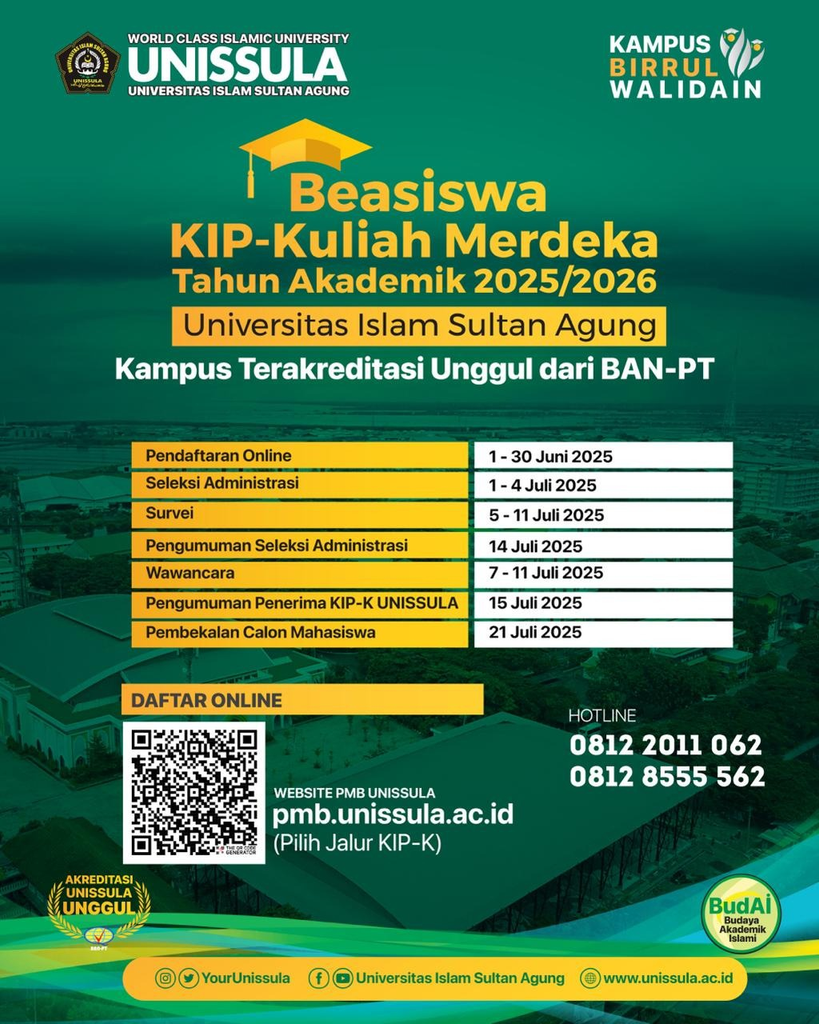
UNISSULA identifies and tracks prospective students from economically disadvantaged backgrounds through its Kartu Indonesia Pintar Kuliah (KIP Kuliah) admission and financial-support pathway.
KIP Kuliah is intended for students who demonstrate academic potential but face financial limitations. Through this mechanism, UNISSULA identifies prospective students from economically vulnerable households using recognised socioeconomic criteria and supporting documentation.
The pathway supports the identification of applicants from the lowest-income households, including students corresponding to the bottom 20% of household income groups or equivalent nationally recognised low-income categories.
This mechanism enables UNISSULA to distinguish low-income applicants from those applying through the general admissions route.
Public information on this pathway is available through the UNISSULA Sustainability website under SDG 1, Indicator 1.3.1.
Formal Identification of Low-Income Students
UNISSULA formally records and confirms KIP Kuliah beneficiaries through Rector Decrees.
For the 2025 admissions cycle:
- Rector Decree No. 7500/F/SA/VIII/2025 establishes KIP Kuliah recipients among new students admitted to UNISSULA; and
- Rector Decree No. 10263/F/SA/X/2025 establishes additional KIP Kuliah recipients through the Usulan Masyarakat (USMAS) scheme.
These decisions provide formal institutional evidence that low-income applicants are identified, admitted, and recorded through a structured process.
Monitoring Low-Income Student Participation
The KIP Kuliah pathway connects:
Socioeconomic identification → Application → Admission → Financial support → Institutional monitoring
UNISSULA records KIP Kuliah recipients through official institutional decisions and maintains beneficiary data as part of its student admissions and support processes.
This provides a practical mechanism for identifying and monitoring one of the key underrepresented groups included in the university’s 2025 monitoring policy.
Tracking Nationality and International Students
UNISSULA’s admissions process records applicants’ nationality.
This information enables the university to identify international applicants and monitor their participation in admissions according to nationality.
Circular Letter No.83103/J/SA/IX/2025 explicitly includes nationality and international student status among the categories used for monitoring applications and admissions.
This provides an institutional basis for evaluating participation among international students and identifying nationalities that may be less represented within the student population.
Use of Monitoring Data
The purpose of collecting and tracking these data is not limited to reporting.
Circular Letter No. 83103/J/SA/IX/2025 establishes that the results of measurement and monitoring are used as a basis for:
- Evaluation
- Planning
- Development of more inclusive, fair, and responsive student admissions policies
The university can therefore use application and admission data to identify representation patterns, evaluate accessibility, and determine where additional institutional measures may be required.
Monitoring Changes Over Time
UNISSULA’s monitoring policy also requires consideration of changes in admissions data over time.
This enables the university to assess whether participation among potentially underrepresented groups is:
- Increasing
- Remaining stable
- Declining
Longitudinal monitoring strengthens the university’s ability to evaluate the effectiveness of inclusive admissions practices and targeted support mechanisms.
Relationship with the Non-Discriminatory Admissions Policy
The tracking framework complements UNISSULA’s broader non-discriminatory and inclusive admissions policy.
Through Circular Letter No. 83102/J/SA/IX/2025, UNISSULA states that its admissions process provides equal opportunities and does not discriminate against prospective students on the basis of gender, economic condition, disability, regional origin, nationality, or other social backgrounds, provided applicants meet applicable academic and administrative requirements.
The same policy also provides for inclusive admission mechanisms for applicants who require particular support, including prospective students with disabilities and other underrepresented groups.
The two policies therefore work together:
Non-discriminatory admissions policy → Identification of relevant applicant groups → Application tracking → Admission tracking → Evaluation → Inclusive admissions improvement
Evidence-Based Admissions Monitoring
UNISSULA’s approach combines several institutional data sources and mechanisms.
The admissions system provides demographic information such as gender, disability, and nationality.
Dedicated admission and support mechanisms provide additional identification of particular groups, including:
- SPKPD for prospective students with disabilities
- KIP Kuliah for students from economically disadvantaged households
This enables the university to identify potentially underrepresented groups through both general admissions data and dedicated admission pathways.
Institutional Monitoring Framework
UNISSULA’s monitoring framework can therefore be represented as:
Applicant data → Identification of underrepresented groups → Application monitoring → Admission monitoring → Institutional evaluation → Policy development
This structured approach enables admissions data to support evidence-based decisions concerning access and participation.
Continuous Improvement
UNISSULA continues to strengthen its measurement and monitoring of applications and admissions.
Future development includes:
- Maintaining consistent data collection across admissions cycles
- Strengthening integration between admissions and student information systems
- Comparing application and admission patterns across academic years
- Evaluating representation by gender, economic condition, disability, nationality, and other available categories
- Strengthening documentation of targeted admission pathways
- Using monitoring results to improve inclusive admissions strategies
These measures support continuous institutional improvement in equitable access to higher education.
Evidence of Implementation
UNISSULA’s measurement and tracking of applications and admissions of underrepresented and potentially underrepresented groups is demonstrated through the following institutional evidence:
- Circular Letter No. 83103/J/SA/IX/2025, issued on 7 September 2025, establishing university-wide measurement and monitoring of applications and admissions of underrepresented or potentially underrepresented groups.
- Monitoring of both applicant numbers and admitted student numbers.
- Monitoring of changes in admissions data over time.
- Admissions monitoring based on gender, economic condition, disability, nationality, and international student status.
- A student admissions system that records gender.
- A student admissions system that records disability status/type.
- A student admissions system that records nationality.
- A dedicated Special Selection Programme for Persons with Disabilities (SPKPD).
- Structured disability and functional-needs documentation for prospective students.
- A dedicated KIP Kuliah admission and financial-support pathway for economically disadvantaged students.
- Formal identification of KIP Kuliah recipients through Rector Decrees for the 2025 admissions cycle.
- Institutional monitoring of low-income student participation through admissions and financial-support records.
- Use of monitoring results for evaluation, planning, and development of more inclusive admissions policies.
- Integration of tracking activities with UNISSULA’s broader non-discriminatory and inclusive admissions policy.